

The foundation of a business isn't found in its first sale, but in the quiet intentionality of its legal structure. Most entrepreneurs view the process of how to register a business in New York as a mere administrative hurdle. In reality, this moment defines the financial trajectory of the enterprise for years to come. It's the difference between a structure that weathers the seasons of the tax code and one that feels precarious under the weight of avoidable liabilities.
You likely feel the weight of these choices already. The complexity of the New York publication requirement or the subtle tension between an LLC and an S-Corp often creates a sense of hesitation. We understand that you seek more than just compliance. You want a structure that serves your vision with precision. This guide provides a sophisticated, step-by-step framework for establishing your entity with a focus on long-term tax strategy and absolute financial clarity.
We'll move through the specific filing rules for Buffalo and Erie County, demystify the publication process, and chart a clear path from your initial idea to a fully operational business bank account.
Key Takeaways
- View business registration as a deliberate architectural choice that formalizes your professional intent and protects your personal assets.
- Evaluate the Limited Liability Company as a versatile structure that offers a protective envelope for your venture's growth and tax flexibility.
- Master the technical nuances of how to register a business in New York through a curated, step-by-step guide to state and local filings.
- Secure your financial infrastructure by establishing a dedicated bank account and obtaining the necessary Certificate of Authority for sales tax compliance.
- Integrate long-term tax strategy from day one by positioning your business formation as a strategic, project-based consulting engagement.
The Architecture of a New Venture: Why Registration is Strategic
Registration is the deliberate formalization of your professional intent. It's the act of bringing a visionary idea into the physical and legal realm. Most entrepreneurs view the question of how to register a business in New York as a simple administrative hurdle to clear. Instead, consider it the architectural phase of your enterprise. The structure you select today acts as a protective envelope. It separates your personal assets from the inevitable risks of the marketplace, ensuring your home and savings remain untouched by the complexities of commerce.
Financial intentionality requires you to look beyond the immediate filing fee. Every choice made during registration creates a lasting relationship between your entity and your future tax liability. A C-Corp interacts with the New York Department of Taxation and Finance differently than an LLC. One offers simplicity; the other offers a canvas for complex tax strategy. By choosing with purpose, you ensure your business remains a source of calm rather than a source of friction. You're not just registering; you're designing a financial destiny.
Establishing Your Presence in Western New York
Buffalo and Rochester have become centers for a new generation of creators. These cities offer a unique intersection of tradition and modern sensibility. The local culture values businesses that contribute to the built environment and the community fabric. When you establish a presence here, you aren't just entering a market; you're joining a legacy of industry. For those looking to build specifically in the 716, our guide on Starting a Business in Buffalo, NY: A Checklist for Financial Intentionality provides the specific local context needed for a successful launch. The geography of your business matters as much as its legal form.
The Quiet Authority of a Legal Entity
A registered entity possesses a quiet authority that an individual lacks. It signals to the world that your venture is a permanent intervention, not a fleeting project. This formality builds immediate trust with financial institutions, vendors, and high-value clients. It allows you to move with confidence, knowing the boundaries of your liability are clearly defined. When you present a formal entity, you speak with the voice of an expert.
This transition is also internal. The shift from "freelancer" to "business owner" is profound. It requires a disciplined commitment to excellence and a rigorous approach to record-keeping. Your Articles of Organization function as the foundational design document for your future. They dictate how you will grow, how you will be taxed, and how you will eventually exit. By formalizing your structure, you create the spatial openness necessary for your vision to expand without limit.
Choosing Your Business Structure: A Framework for Clarity
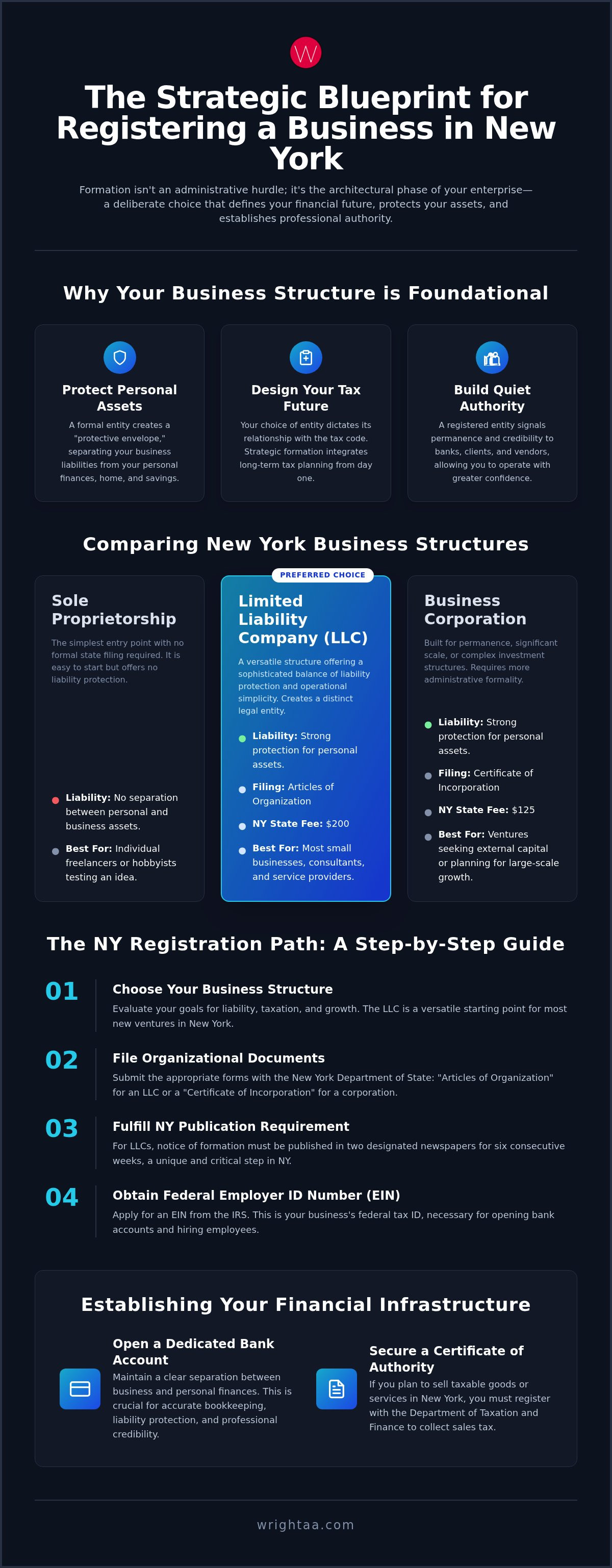
The structure of your business serves as its skeleton. It dictates how the entity breathes, grows, and interacts with the law. A Sole Proprietorship is the simplest entry point. It requires no formal state filing; however, it leaves your personal life exposed to every business risk. There is no wall between your home and your professional liabilities. For many, this lack of separation is a design flaw that outweighs the ease of the start. It's a structure that lacks the necessary envelope of protection.
The Limited Liability Company (LLC) has become the preferred choice for those learning how to register a business in New York. It offers a sophisticated balance of protection and simplicity. By filing Articles of Organization and paying the $200 state fee, you create a distinct legal person. This entity holds its own debts and obligations. For a deeper look at the technical requirements, the New York Business Express portal offers the necessary forms and regulatory context to begin your journey.
Business Corporations serve those with a vision for significant scale or complex investment. While the $125 filing fee for a Certificate of Incorporation is lower than the LLC's cost, the ongoing administrative weight is greater. Corporations require boards, minutes, and rigid formalities. They are built for permanence and external capital. They represent a more disciplined approach to governance that fits a specific type of growth-oriented venture.
LLC vs. S-Corp: The Strategic Divide
Choosing between an LLC and an S-Corp election is a matter of tactical tax planning. While an LLC is a legal entity, an S-Corp is a tax designation that can reduce your self-employment tax burden. We view this as the "Architecture of Finance"—ensuring the structure supports the weight of your profit without unnecessary leakage. In New York, the transition to an S-Corp election generally becomes tax-efficient once your business generates approximately $60,000 to $75,000 in net annual profit. This threshold marks the point where the savings on self-employment taxes outweigh the additional administrative costs of payroll and corporate filings.
The Professional Service Corporation (PC) for Licensed Experts
Licensed professionals in Buffalo and Rochester, such as attorneys and physicians, often require specialized structures like the Professional Service Corporation (PC) or a PLLC. These entities acknowledge the unique ethical and legal responsibilities of your craft. Navigating these filings requires a deep understanding of both state law and professional licensing boards. Our team specializes in Specialized Accounting for Law Firms in Buffalo, NY, helping practitioners align their legal structure with their long-term financial goals. If you're unsure which path fits your specific vision, a business formation consultation can provide the clarity you need.
The Registration Path: A Step-by-Step Guide to NY Filing
The path of how to register a business in New York is a sequence of deliberate steps. It's an unhurried progression from concept to legal reality. This journey begins with curating your identity. Your business name must be distinct; it must meet the rigorous standards of the New York Department of State while reflecting your brand's essence. Once you verify availability, the physical act of creation begins with your formal filing. For an LLC, this involves submitting Articles of Organization and a one-time $200 fee. Corporations file a Certificate of Incorporation for $125. These documents function as the foundational blueprints for your professional future.
After your filing is accepted, you must secure a Federal Employer Identification Number (EIN). This is the entity's social security number. It's a critical component for opening a business bank account and establishing a clear boundary between personal and professional funds. Without an EIN, the financial separation required for liability protection remains incomplete. It is the final signature on your federal identity.
Navigating the Publication Requirement in Erie and Monroe Counties
New York maintains a unique local nuance known as the publication requirement. Within 120 days of formation, all LLCs must publish a notice in two newspapers for six consecutive weeks. In Erie and Monroe Counties, the county clerk designates these specific publications. Once the six weeks conclude, you'll receive an Affidavit of Publication from each newspaper. You must then file these with a Certificate of Publication and a $50 fee. Ignoring this step can jeopardize your "Good Standing," potentially leading to the suspension of your authority to do business in the state.
The Operating Agreement as a Strategic Asset
While the state doesn't require you to file your Operating Agreement, New York law mandates that you have one. View this document as the interior design of your business logic. A curated agreement defines roles, responsibilities, and profit-sharing with absolute precision. Generic online templates often fail to capture the specific nuances of your vision or partnership. A thoughtful, custom-drafted agreement prevents future internal friction by setting clear expectations. It transforms a legal requirement into a strategic asset that protects the harmony of your enterprise.
Establishing Your Financial Infrastructure Post-Registration
Once the legal entity is formed, you must build the financial walls that protect it. The process of how to register a business in New York concludes at the state level but begins at the bank. Your business bank account is the first wall of separation. It ensures that the corporate veil remains intact. Using a personal account for business expenses creates a structural weakness that can lead to personal liability. It's a risk that undermines the very purpose of your registration.
For those selling taxable goods or services, obtaining a Certificate of Authority is the next essential step. You must register for New York sales tax at least 20 days before you begin conducting business. This certificate allows you to collect tax on behalf of the state, a responsibility that requires rigorous record-keeping. Similarly, if you plan to hire in Buffalo or the surrounding counties, you must register for payroll taxes and workers' compensation insurance. These are the technical details that transform a legal shell into an operational reality.
The Discipline of Clean Bookkeeping
Commingling funds is the greatest threat to a new enterprise. It blurs the lines between the site and the structure, making it impossible to gauge true profitability. We recommend choosing modern technology to automate financial data capture from the start. Tools like cloud-based accounting software allow for a serene, curated view of your cash flow. Our guide on Small Business Accounting in Buffalo, NY: Designing Financial Clarity explores how to build these systems with purpose and precision.
Proactive Tax Planning from Day One
Intentionality requires a shift from reactive filing to proactive planning. Establishing a cadence for quarterly estimated tax payments prevents the sudden weight of a large year-end bill. New York startups often overlook significant deductions, such as Section 195 startup costs, home office expenses for curated workspaces, and self-employed health insurance premiums. Identifying these early ensures your capital remains focused on growth rather than liabilities. A CFO-level advisor acts as a visionary partner who translates complex tax codes into a clear roadmap for sustainable growth.
If you are ready to build a resilient financial foundation for your venture, our team can assist with New Business Formation and strategic planning.
Partnering with Wright CPAs, LLC for Your New York Business Formation
A business is a permanent intervention in the marketplace. It requires a foundation that's both rigid in its compliance and flexible in its potential for growth. At Wright CPAs, LLC, we move beyond the administrative mechanics of how to register a business in New York. Our approach is deeply intentional; we translate broad philosophical goals into specific, material financial details. We view the formation process as a project-based consulting engagement that sets the tone for your entire professional life.
Our commitment is rooted in deep listening and contextual awareness. We understand that a law firm in Buffalo has different structural needs than a creative agency in Rochester. By prioritizing substance over spectacle, we ensure your entity choice aligns with a proactive tax strategy. This isn't a one-time transaction. It's the beginning of a thoughtful, permanent financial strategy designed to improve your daily life and the health of your enterprise.
Our Process: Beyond the Paperwork
We begin with discovery. This is a period of unhurried conversation where we explore your vision and the specific geographic context of your work. We don't just file forms; we provide entity selection consulting that considers your long-term tax liability. Once the structure's defined, we move into the implementation phase. We establish robust bookkeeping and payroll solutions that function with technical precision. Our fixed-fee monthly advisory model ensures you have CFO-level guidance from day one. This continuous oversight allows you to focus on your craft while we maintain the integrity of your financial infrastructure.
The Path to Financial Clarity in Buffalo
Local expertise matters because the environment matters. Navigating the specific filing rules of Erie County or the publication requirements in Syracuse requires a firm that's grounded in Western New York. Since 2012, we've helped entrepreneurs achieve a sense of calm and purpose through disciplined financial management. We remove the friction of the unknown, replaced by a steady rhythm of clarity and insight. Your business deserves a structure that's as well-designed as the services you provide. You can design your business foundation with Wright CPAs, LLC and begin your journey with absolute confidence.
Designing for Permanence and Growth
Establishing a new enterprise requires more than administrative accuracy; it demands a vision for the future. Learning how to register a business in New York is the first step in creating a structure that protects your personal assets and optimizes your tax position. By selecting the right entity and fulfilling local nuances like the publication requirement, you build a resilient foundation. This level of intentionality ensures your venture's prepared for the complexities of the New York tax landscape from its very first day.
At Wright CPAs, LLC, we provide the CFO-level financial guidance necessary to navigate this transition with calm and precision. Our approach integrates modern technology with fixed-fee transparency. We ensure you have absolute clarity as you move from registration to operational success. We invite you to begin your journey with a business formation consultation to align your legal structure with your long-term vision. Your professional future deserves a foundation that's as thoughtful and enduring as the work you do.
Frequently Asked Questions
How much does it cost to register an LLC in New York in 2026?
Filing the Articles of Organization requires a $200 fee paid to the Department of State. This initial cost is the baseline for how to register a business in New York as an LLC. You must also account for the $50 Certificate of Publication fee and the varying costs of newspaper notices. In Western New York counties like Erie, these publication costs typically range from $200 to $800, depending on the specific newspapers designated by the county clerk.
What is the New York LLC publication requirement, and is it mandatory?
The publication requirement is a mandatory legal obligation unique to New York. All newly formed LLCs must publish a notice in two newspapers for six consecutive weeks within 120 days of their formation. Failure to comply can result in the suspension of your authority to conduct business. It's a rigorous process that ensures transparency and formalizes your presence within the local geographic and cultural context of your chosen county.
Do I need a lawyer or a CPA to register my business in NY?
While New York law doesn't mandate professional assistance for registration, the choice is a matter of structural integrity. A CPA provides the CFO-level guidance necessary to align your entity selection with a proactive tax strategy from day one. This partnership moves beyond the simple act of filing paperwork. It ensures your business architecture is designed for long-term financial clarity and resilience, preventing the need for costly structural corrections later.
How long does the business registration process take in New York?
Online filings are typically processed immediately during standard business hours. If you choose to file by mail, the process can take two to three weeks, excluding transit time. For those requiring a swifter intervention, the state offers expedited services ranging from $25 for 24-hour processing to $150 for a two-hour turnaround. This unhurried timeline allows you to move deliberately from a philosophical concept to an operational legal reality.
What is the difference between a Certificate of Incorporation and Articles of Organization?
These documents serve as the foundational blueprints for different business structures. A Certificate of Incorporation is filed to establish a corporation, whereas Articles of Organization are used to form a Limited Liability Company. Each document dictates the internal governance and the relationship between the structure and its owners. Choosing the correct form is essential for defining your professional intent and establishing the appropriate protective envelope for your personal assets.
Do I need a local business license in Buffalo or Rochester in addition to state registration?
New York doesn't require a general, state-wide business license. However, specific industries and localities often mandate their own permits. In Buffalo and Rochester, you must verify requirements based on your professional craft and physical location. This local context is critical for maintaining compliance. We recommend utilizing the Business Wizard tool to identify the precise licenses necessary for your specific intervention within the Western New York marketplace.
Can I register a business in New York if I live in another state?
You can register a business in New York regardless of your personal residence. The state requires that your entity maintains a physical presence through a registered agent who can receive legal documents. This person or service must have a physical address within New York's borders. It allows out-of-state entrepreneurs to participate in the vibrant economic landscape of cities like Syracuse or Buffalo while adhering to state-specific legal formalities.
What is a Registered Agent and why do I need one for my NY business?
A registered agent is the official point of contact for the service of process and legal notices. By default, the New York Secretary of State acts as the agent for domestic entities. However, many businesses appoint a specific individual or professional service to ensure timely communication. This role provides a reliable bridge between your structure and the legal environment, ensuring that no official intervention or requirement goes unnoticed in your daily operations.


