

Personal and business taxes are connected through decisions that shape income, cash flow, and reporting. Yes, a strategic tax advisor in Buffalo can support both personal and business tax returns. Coordinated planning can make those obligations easier to understand.
For business owners, tax questions often overlap with payroll, bookkeeping, and everyday financial decisions. Personal returns can reflect the same business realities, so it helps to consider both together.
This article explains how a Buffalo tax advisor can support personal and business tax preparation, tax incentives, income reporting, and corporate compliance. It also covers what contributes to effective tax guidance and when ongoing planning may help you understand how the pieces fit before choosing a next step.
Key Takeaways
- See how coordinated planning can bring personal and business tax returns into one clearer financial picture.
- Learn what factors shape eligibility for tax credits and incentives, and why timing and records matter.
- Understand how organized bookkeeping supports consistent income reporting and clearer tax preparation.
- Explore how forward-looking tax planning can help businesses approach corporate compliance with greater structure.
Can you handle both personal and business tax returns?
Yes. A tax advisor can coordinate personal and business tax preparation, taking into account how income, expenses, and business decisions connect. A strategic tax advisor in Buffalo can also help plan ahead, rather than treating each return as a separate annual task. For example, a change in business income may affect an owner’s personal tax picture.
Tax planning starts with understanding the facts behind each return. An advisor reviews income sources, business records, major changes, and the timing of decisions. That context can help shape an approach to estimated obligations, deductions, and filing preparation that fits the taxpayer’s circumstances. The aim is clear reporting for both the individual and the business.
For a tax strategy consultation, useful documents often include prior tax returns, income records, bookkeeping reports, payroll summaries, and records of major purchases or sales. New business owners can also provide formation documents and ownership details. These materials help the advisor identify questions, understand how income moves between the business and owner, and organize next steps.
Personal planning can also take family priorities and estate goals into account. For example, a planned ownership change or future asset transfer may affect the timing of financial decisions. An advisor can consider those goals alongside tax planning, while an estate attorney handles legal documents. The right approach depends on each person’s circumstances and priorities.
Business planning works best when tax considerations are part of the discussion before a decision is final. A company considering new equipment, a payroll change, or a shift in ownership can review the financial and tax implications first. An advisor can assess the effects on records, cash flow, and the owner’s personal return, then adjust the plan as the business changes.
Be cautious of strategies that promise unusually large savings without explaining their assumptions. A proposal that doesn’t fit the business’s records or actual transactions can lead to inaccurate reporting and unexpected costs. Ask for a clear explanation of the steps, required records, and how the strategy relates to your financial circumstances.
Tax credits and incentives
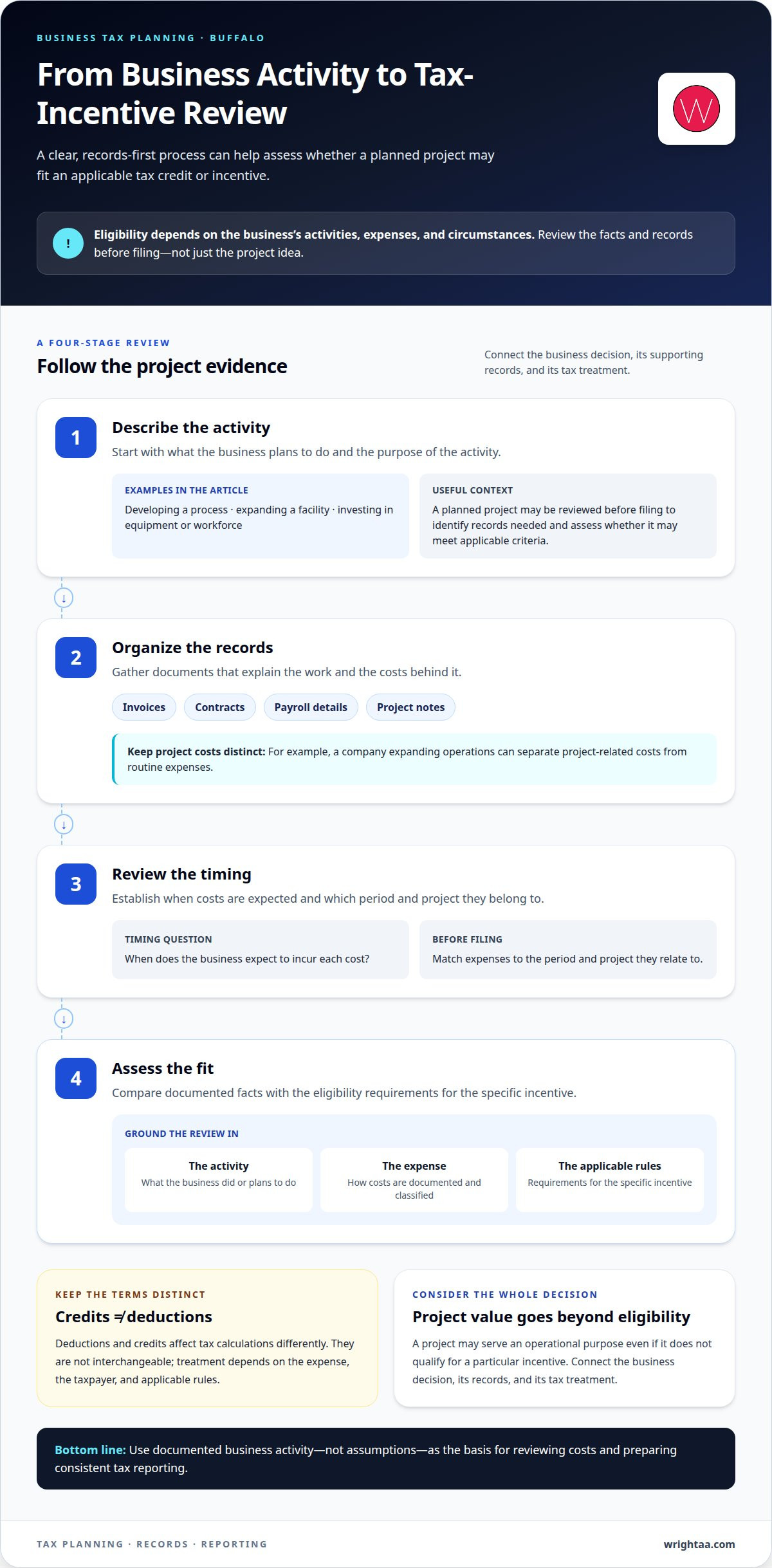
A tax credit or incentive may affect a business’s tax position, but eligibility depends on its activities, expenses, and circumstances. A Buffalo business considering a new process, equipment purchase, or workforce investment can review the plans before filing. Early review helps identify the records needed and whether the activity may meet applicable criteria.
The assessment starts with the facts behind the expense or project. An advisor can examine what the business plans to do, when it expects to incur costs, and how those costs appear in its books. For example, a company expanding operations can separate project-related costs from routine expenses. Clear records support a careful eligibility review and consistent tax reporting.
Deductions and credits affect tax calculations differently, so they shouldn’t be treated as interchangeable. The appropriate treatment depends on the expense, the taxpayer, and the applicable rules. During preparation, an advisor can classify relevant costs, review supporting documents, and consider how a deduction or credit fits the broader tax picture. This keeps the filing grounded in documented business activity rather than assumptions.
- Describe the activity: Record what the business is doing, such as developing a process or expanding a facility.
- Organize the records: Gather invoices, contracts, payroll details, and project notes that explain the costs.
- Review timing: Match expenses to the period and project they relate to before filing.
- Assess fit: Compare documented facts with the eligibility requirements that apply to the specific incentive.
A useful review also considers trade-offs. A project may serve an operational purpose even if it doesn’t qualify for a particular incentive. Planning should connect the business decision, its records, and its tax treatment. For help aligning potential incentives with documented activity, explore tax strategy planning as part of a considered filing approach.
Tax accounting and income tax reporting
Accurate reporting starts with records that show how income moved through the business. A Buffalo company can organize sales, operating expenses, payroll, and owner transactions into distinct categories. This gives a tax preparer a clearer basis for preparing returns and explaining reported figures. It can also reveal gaps before filing, rather than after questions arise.
A practical accounting review traces transactions from source documents to financial summaries. An advisor can compare bank activity with bookkeeping entries, investigate unusual deposits, and classify expenses consistently. For example, a customer payment recorded in the wrong period can distort income summaries. Resolving the discrepancy creates a more reliable basis for tax reporting and business decisions.
Personal and business income can overlap, especially when an owner receives compensation or distributions. Separating those flows in the books helps explain how reported amounts were determined. U.S. citizens who move abroad are still required to file a tax return with the U.S. federal government. Their income reporting also requires organized records of relevant sources and transactions.
- Reconcile records: Compare bookkeeping entries with bank and payment records.
- Classify activity: Separate sales, expenses, payroll, and owner transactions.
- Track changes: Note unusual receipts, asset sales, or changes in business activity.
- Prepare summaries: Keep financial reports aligned with the supporting transaction records.
Consistent records can reveal patterns in income and expenses. A seasonal business, for instance, may receive most of its income during particular operating periods. Recognizing that pattern can inform cash-flow decisions and saving, while giving the tax preparer useful context. Reporting is more coherent when the numbers reflect actual activity, not just a year-end estimate.
For a law firm, accounting may involve tracking client-related receipts separately from operating income. Careful categorization helps maintain clear financial records for reporting and internal review. Across industries, the same principle applies: document each transaction, classify it consistently, and retain its connection to the source. This gives income tax reporting a dependable foundation.
Corporate tax strategy and compliance
Buffalo businesses may have federal and New York State tax responsibilities. The applicable rules depend on factors such as entity structure, income, business activities, and where transactions occur. A corporation and a sole proprietorship, for example, can have different reporting needs. Tax planning begins by identifying the business’s structure and reviewing its activity before preparing filings.
Which federal and New York State tax rules affect Buffalo businesses? Requirements depend on the entity, its income, and its activities. A compliance review identifies the relevant filings, reporting responsibilities, and records for the business’s circumstances, rather than assuming every company follows the same process.
Corporate strategy connects tax requirements to decisions made throughout the year. Before changing ownership, hiring, expanding operations, or purchasing equipment, a business can assess the likely financial effects and the records each decision creates. For example, an expansion may change payroll, cash flow, and expense tracking. Reviewing these factors together can help identify opportunities while keeping reporting aligned with actual activity.
- Map the business: Document entity structure, owners, locations, and core activities.
- Review transactions: Identify changes in income, payroll, assets, and ownership.
- Set record practices: Assign clear categories and retain support for significant transactions.
- Revisit decisions: Update the tax plan when business operations or financial conditions change.
Which Buffalo tax advisors specialize in business tax strategy and planning? Look for professionals who provide business tax planning, preparation, and accounting, and connect tax considerations with operational decisions. This integrated perspective helps owners understand how a choice affects compliance and the company’s financial picture.
For a closely held business, the owner’s decisions and company finances may be closely connected. A structured review can clarify how compensation, cash flow, and business changes should be reflected in records and tax planning. Discuss corporate tax planning to connect compliance needs with the decisions shaping your business.
The relevant federal and New York State requirements include filings, reporting duties, and recordkeeping obligations triggered by a business’s structure, income, activities, and transaction locations. Corporations and sole proprietorships may therefore have different reporting responsibilities.
Wright CPAs
Wright CPAs, LLC helps bring tax decisions, financial records, and business planning into a coordinated view. Its support can be useful when personal and business returns overlap, business activity changes, or compliance becomes harder to manage alongside daily operations.
Tax planning and preparation can draw on bookkeeping and payroll records, while CFO services give business owners financial guidance for decisions affecting cash flow and operations. This connected approach keeps tax work grounded in the company’s actual activity and the owner’s broader financial picture.
If you’re considering a tax strategy or want a clearer process for business reporting, contact Wright CPAs, LLC to discuss your needs.
Shape the decisions ahead with a clear tax plan
Tax planning is most useful when it moves with the business, not just the filing calendar. A new contract, ownership change, or shift in operations can change which questions need attention. A forward-looking conversation connects those decisions to financial reporting and the company’s longer-term direction.
Working with a strategic tax advisor in Buffalo can help business owners approach those choices thoughtfully. The goal isn’t to force every decision into a tax calculation. It’s to understand the financial consequences, keep the underlying records aligned, and make deliberate choices with a clear view of the business’s priorities.
As your plans take shape, bring the next significant business decision into the discussion. A focused conversation can clarify what information matters and where tax planning fits. Start a conversation with Wright CPAs, LLC about the questions shaping your next move, and take the next step with greater clarity.
Frequently Asked Questions
What tax planning services should a Buffalo business owner look for?
Look for tax planning and preparation that considers the business’s records, payroll, cash flow, and upcoming decisions together. For example, an owner preparing to hire can discuss the effects on payroll records and financial projections before making a decision. A strategic tax advisor in Buffalo can also connect bookkeeping with tax reporting, so planning reflects the business’s actual activity.
What local Buffalo and Erie County tax incentives or credits are available?
Available incentives depend on business activity, project location, expenses, and eligibility requirements, so no single program fits every Buffalo or Erie County business. A planned renovation, equipment purchase, or hiring initiative may warrant a review of applicable federal, New York State, and local programs. Keep project descriptions, contracts, invoices, and related records organized to assess eligibility against the relevant program rules.
How do I compare strategic tax advisors in Buffalo by credentials and services?
When comparing advisors, consider whether they are state-licensed CPAs who maintain their licenses through continuing education, and whether their services include business tax planning, preparation, incentive review, income reporting, and corporate compliance.
How can I verify a Buffalo tax advisor’s credentials and client reviews?
To assess credentials, confirm whether the advisor is a state-licensed CPA and ask about continuing education. CPAs can lose their licenses for fraud, negligence, or ethics violations.


