

Accounting for HVAC companies in Syracuse has no standard cost. Fees depend on the work required, transaction volume, payroll needs, and the level of tax planning and financial reporting. The right accounting support should also reflect seasonal cash flow, not just year-end tax preparation.
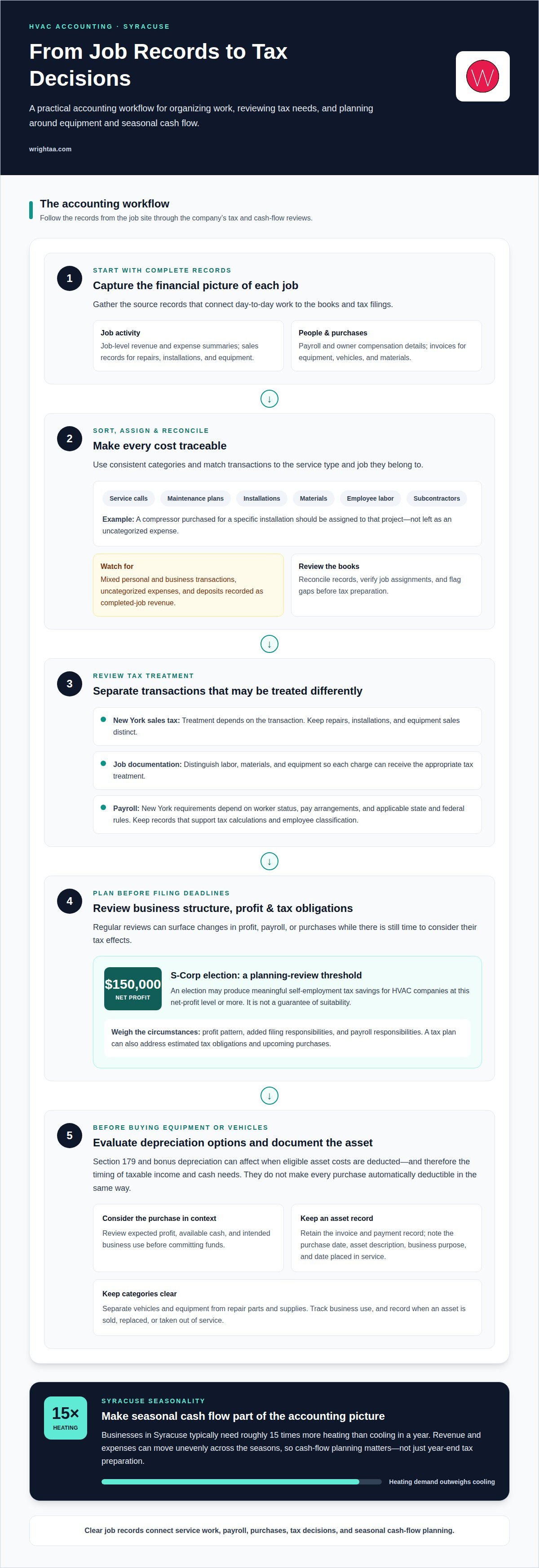
That seasonal pattern matters in Syracuse, where businesses typically need roughly 15 times more heating than cooling in a year. Revenue and expenses can move unevenly across the seasons, making cash flow planning an important part of understanding what accounting support needs to cover.
This guide explains what affects accounting costs, which services HVAC companies may need, and how tax planning, equipment purchases, and seasonal cash flow fit together. Understanding the work involved can help you define the support your business needs.
Key Takeaways
- Understand how tax-return complexity and planning needs shape the accounting work an HVAC business may require.
- Learn which business and industry considerations matter when choosing an accountant for your company.
- Explore why Section 179 and bonus depreciation are worth evaluating before buying equipment or vehicles.
- See how aligning cash flow planning with Syracuse’s heating and cooling seasons can help prepare for uneven revenue.
Business tax returns and tax planning
An HVAC tax return should reflect more than annual sales. Job revenue, parts, equipment purchases, payroll, and operating expenses all shape the financial picture. Start by organizing records by category and reconciling them with the books before preparing the return. Separating replacement parts from equipment purchases, for example, makes it easier to review job costs alongside tax records.
Business structure also matters. An S-Corp election may produce meaningful self-employment tax savings for HVAC companies with $150,000 USD in net profit or more. That threshold is a prompt for a tax-planning review, not a guarantee that an election will suit every company. The decision depends on the business’s circumstances, including its profit pattern and the added filing and payroll responsibilities associated with the structure.
New York sales tax treatment depends on the transaction, so record repairs, installations, and equipment sales separately. Job documentation should distinguish labor, materials, and equipment so each charge can receive the appropriate tax treatment. A repair invoice and a separately itemized equipment sale, for instance, should not be combined under a vague description.
Tax planning is most useful before a return is due. Regular reviews can reveal changes in profit, payroll, or purchases while there is still time to consider their tax effects. For accounting for HVAC companies in Syracuse, useful records include:
- Job-level revenue and expense summaries
- Payroll records and owner compensation details
- Invoices for equipment, vehicles, and materials
- Sales records that distinguish repairs, installations, and equipment
These records connect tax filings with day-to-day decisions. A tax plan can then address business structure, estimated tax obligations, and upcoming purchases based on the company’s actual financial activity.
Choosing an HVAC accountant
Choose accounting support that connects payroll, service revenue, and job-level costs. For a Syracuse contractor, the accounting system should show how each type of work affects the company’s finances.
Accounting for HVAC Services
Service calls, maintenance plans, and equipment installations create different revenue and expense patterns. Organize transactions so recurring plan income stays distinct from one-time repair or installation work. The software should make it practical to match invoices, payments, and expenses to each service category. This structure helps reports show which work generates revenue and where costs are accumulating.
Tracking Job Costs
Job costing brings together materials, employee labor, and subcontractor expenses for each project. Use consistent categories and processes to record costs, then review whether each entry is assigned to the right job. A compressor bought for a specific installation, for example, should be traceable to that project rather than recorded only as an uncategorized expense. Project-based reports help management assess margins and find incomplete records.
Common Accounting Mistakes and Tax Risks
Common risks include mixing business and personal transactions, leaving expenses uncategorized, and recording deposits as completed-job revenue. Inconsistent treatment of service calls and installations can also make reports difficult to interpret. Reconcile records, review transaction categories, and flag gaps before tax preparation. For payroll, New York requirements depend on worker status, pay arrangements, and applicable state and federal rules. Keep payroll records that support accurate tax calculations and consistent employee classification.
Accounting software should support clear categories for service calls, maintenance plans, installations, materials, labor, and subcontractors. A professional can assess whether the current system captures those details and produces useful reports, rather than selecting software by name alone. Payroll accounting also needs to reflect applicable taxes and labor requirements, with classification and pay records organized for review. A focused accounting review for HVAC businesses can bring these records into a more coherent financial picture.
Equipment and vehicle depreciation
Furnaces, recovery machines, service vans, and diagnostic tools support HVAC work over time. Their cost affects both the balance sheet and tax records, so each asset needs clear documentation. Depreciation generally allocates an asset’s cost across its useful life rather than treating the full purchase as an ordinary operating expense. The accounting treatment should reflect the asset and its business use.
Before buying equipment or vehicles, evaluate Section 179 and bonus depreciation. These tax provisions can affect when eligible asset costs are deducted, changing the timing of taxable income and cash needs. They don’t make every purchase automatically deductible in the same way. A planned purchase of a service van, for example, should be reviewed alongside the business’s expected profit, available cash, and intended use.
An accountant can compare available tax treatments for a planned purchase and record the selected approach consistently. Start with the invoice, purchase date, asset description, and business purpose. For a replacement furnace or diagnostic unit, distinguish the asset from supplies consumed during routine jobs. Clear categories connect tax records to the company’s operating costs.
- Keep purchase invoices and payment records with the asset file.
- Identify vehicles and equipment separately from repair parts and supplies.
- Record business use and the date each asset enters service.
- Revisit planned purchases before committing funds.
Vehicles need careful records because personal and business use can differ. Keep records supporting the business use of a service van for calls, installations, and supply pickups. Equipment changes over time too: a tool may be sold, replaced, or taken out of service. Record each change so asset schedules reflect what the company actually owns.
For HVAC companies in Syracuse, depreciation planning should fit the broader tax picture, not stand alone as a bookkeeping entry. Reviewing a planned purchase in advance gives the accountant time to consider tax treatment alongside cash-flow priorities and equipment needs. That supports a more deliberate decision about timing, documentation, and how the asset appears in the company’s records.
Seasonal cash flow planning
Syracuse HVAC cash flow follows the region’s heating and cooling cycle. The business typically needs roughly 15 times more heating than cooling in a year, while air-conditioning demand rises in June, peaks in July and August, then fades by September. A forecast should reflect that uneven rhythm rather than assume steady monthly receipts.
Build the forecast around expected customer payments, payroll, supplier invoices, vehicle costs, and equipment purchases. Strong summer installation revenue, for example, may arrive before supplier bills or payroll are due. A monthly cash forecast can map these timing differences and show when incoming payments may not cover scheduled outflows. Update it as work is booked to see upcoming cash needs more clearly.
Review the profit-and-loss statement, balance sheet, and cash-flow forecast with an accountant. Track useful measures such as cash available, customer balances awaiting payment, bills due, and the difference between projected receipts and expenses. Compare actual results with the forecast to spot changes in collections, job costs, or seasonal demand.
- Separate heating, cooling, service, and installation revenue.
- Track customer invoices and supplier payments by expected timing.
- Include payroll and planned equipment purchases in cash projections.
- Compare actual cash movement with the forecast and revise assumptions.
These steps distinguish a profitable month from one with enough available cash. A completed installation can generate revenue even while payment is outstanding, while labor and materials may already have been paid for. Tracking invoice timing alongside scheduled expenses helps reveal the gap. In Syracuse, planning for the quieter cooling season and busier heating cycle can also help owners prepare for changes in workload and receipts.
Use a seasonal forecast to connect operating decisions with cash needs. Plan HVAC cash flow around seasonal demand with professional financial guidance.
Wright CPAs: Law Firm Accounting
Wright CPAs provides Law Firm Accounting for law firms. For HVAC contractors, Wright CPAs offers support that connects bookkeeping, payroll, and tax preparation with seasonal finances.
Turn to Wright CPAs when financial records need consistent organization, payroll needs professional attention, or tax planning should account for business activity and upcoming decisions. Tax Planning and Preparation, Bookkeeping, and Payroll Services can bring these responsibilities into a clearer structure.
For an HVAC business balancing service work, installations, and seasonal receipts, organized books and considered tax planning can support more informed decisions. Contact Wright CPAs to discuss your accounting needs.
Set a Clearer Financial Course
Start by defining the accounting support your business needs. A useful conversation focuses on the decisions ahead: organizing financial records, planning for taxes, and keeping business activity visible throughout the year. For accounting for HVAC companies in Syracuse, the right scope reflects the company’s operations and the questions its owners need answered.
Wright CPAs offers Tax Planning and Preparation, Bookkeeping, and Payroll Services. These services can bring financial records and routine responsibilities into a more coherent process, giving owners a clearer foundation for planning. The goal is not simply to close the books, but to make the information useful as the business moves into its next season.
Begin with the financial pressures or decisions you want to address. Contact Wright CPAs to discuss your accounting needs and take a considered next step.
Frequently Asked Questions
What Does Accounting for an HVAC Business Cost?
Costs depend on the work involved, transaction volume, payroll needs, reporting requirements, and tax-planning scope. A company that needs only tax-return preparation has different requirements from one seeking ongoing bookkeeping and financial reporting. Defining the services and records involved helps establish an appropriate scope.
What accounting services do HVAC companies in Syracuse, NY need?
Accounting for HVAC companies in Syracuse can include bookkeeping, payroll processing, tax preparation, and planning. Contractors may also need financial reports that separate business lines, such as equipment installations and recurring maintenance work. A useful scope connects these records, so owners can understand how customer payments, operating expenses, and payroll appear in the company’s financial picture.
What do accounting and bookkeeping services cost for HVAC contractors in Syracuse?
Bookkeeping and accounting fees depend on service frequency, transaction volume, payroll complexity, and whether tax strategy or reporting is included. Wright CPAs offers ongoing monthly accounting and advisory retainers, as well as project-based tax preparation and consulting. Monthly retainers cover bookkeeping, financial reporting, and proactive tax strategy. Project fees apply to discrete work, such as annual returns or specific financial analysis.
Which Syracuse accounting firms specialize in HVAC or construction businesses?
Wright CPAs serves businesses in Syracuse and provides tax, bookkeeping, payroll, and financial guidance. Its specialized accounting includes law firms and closely held businesses. For an HVAC or construction company, the right fit depends on whether the accounting scope addresses its needs, such as payroll, tax planning, and clear financial reporting for business decisions.
What tax deductions and credits are available to HVAC businesses in New York?
Potential tax treatment depends on the purchase, expense, business use, and applicable eligibility rules. For equipment and vehicle purchases, HVAC owners can evaluate Section 179 and bonus depreciation with a tax professional before buying. Specific credits depend on the activity or purchase involved, so identify the underlying expense and have its eligibility assessed rather than assuming a credit applies.


