

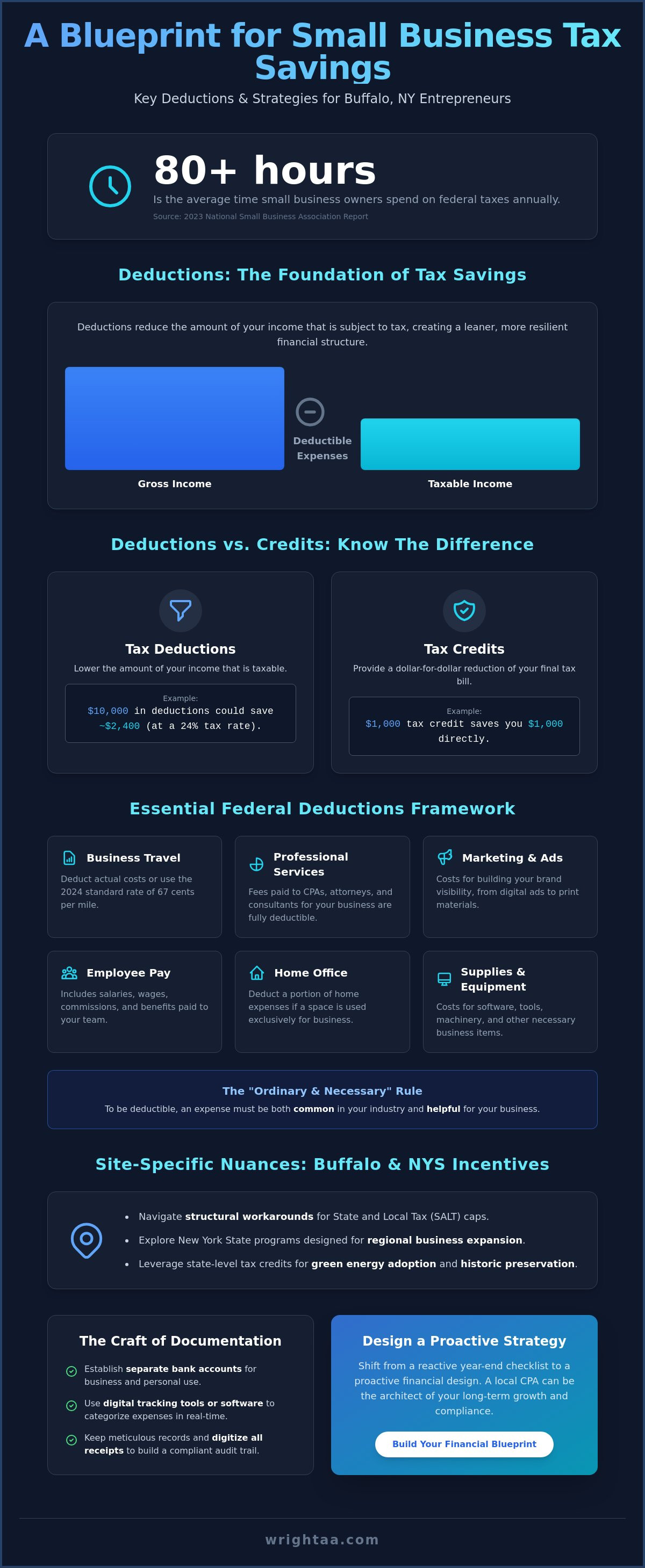
What if your annual filing was more than a technical obligation; what if it functioned as a deliberate blueprint for your company’s structural integrity? According to a 2023 National Small Business Association report, the average owner spends over 80 hours a year on federal taxes. In Western New York, this burden often feels heavier due to the intricate layers of state regulations. It’s natural to feel a sense of hesitation when faced with the complex 2024 tax landscape. You deserve a financial foundation that feels as intentional as the craft you pursue.
This guide offers a serene approach to small business tax deductions Buffalo NY entrepreneurs can utilize to lower their liability and strengthen their local impact. We’ve distilled the clutter into a precise framework for categorizing your expenses and reclaiming your time. By the end of this checklist, you’ll possess a clear path to maximized savings and the quiet confidence that comes with total compliance. Let's examine the specific levers that allow your business to breathe and grow within the Queen City.
Key Takeaways
- Learn to view deductions as structural assets that define the negative space of your taxable income, ensuring your financial foundation is both lean and resilient.
- Identify the essential federal framework for small business tax deductions Buffalo NY entrepreneurs can leverage, from the tectonics of travel to the boundaries of the home office.
- Navigate site-specific incentives unique to the Buffalo-Niagara region, including structural workarounds for SALT caps and programs designed for regional expansion.
- Master the craft of documentation by establishing a clear separation between personal and professional materiality through digital tracking and segregated accounts.
- Shift from reactive year-end checklists to a proactive design strategy that positions a local CPA as the architect of your long-term growth.
The Foundation: Understanding Tax Deductions as Structural Assets
A business is a living structure. Like a well-designed building, its strength depends on the integrity of its foundation. In the context of fiscal management, Understanding Tax Deductions is akin to identifying the negative space in an architectural plan. These are the voids that define the final form. By subtracting legitimate expenses from your gross income, you reduce the taxable mass of your enterprise. For those pursuing small business tax deductions Buffalo NY offers a unique landscape where local costs and state-level nuances meet.
The IRS evaluates these subtractions through the lens of the "Ordinary and Necessary" rule. An expense is ordinary if it's common in your specific industry. It's necessary if it's helpful and appropriate for your trade. This isn't a rigid cage; it's a flexible framework. In Western New York, this might range from specialized snow removal for a retail storefront to high-efficiency HVAC maintenance in a historic Larkinville office. Effective tax planning serves as the blueprint for long-term financial clarity. It ensures that every dollar spent contributes to the structural growth of the firm rather than disappearing into a void of inefficiency.
For specialized service providers like I Wuff You Dog Training, these ordinary and necessary expenses form the tectonic plates of their professional practice; learn more about their approach to canine behavior and business standards.
The Materiality of a Deduction
Materiality in tax law mirrors materiality in design. It's about how an element fits the purpose of the space. An expense must be appropriate for your specific craft. The human experience of your business dictates these costs. A software developer's need for high-end server capacity is as fundamental as a carpenter's need for kiln-dried timber. In Buffalo's diverse economy, an ordinary and necessary expense is any cost that aligns with the specific functional requirements and cultural context of a local trade.
Deductions vs. Credits: Designing Your Strategy
Distinguishing between these two tools is vital for strategic integration. A deduction lowers your taxable income tier by reducing the base upon which you're taxed. A credit is a more direct intervention. It provides a dollar-for-dollar reduction in your final tax bill. New York State offers specific credits for historic preservation and green energy that act as immediate offsets. Successful entrepreneurs in Buffalo don't choose one over the other. They design a balanced strategy that utilizes small business tax deductions Buffalo NY to lower the ceiling of their taxable income while applying credits to settle the final balance. This dual approach ensures the business remains grounded and resilient.
- Deductions: Lower the volume of income subject to tax.
- Credits: Directly reduce the amount of tax owed.
- Strategy: Integrating both creates a more sustainable financial site-plan.
The Framework: Essential Federal Deductions for WNY Businesses
Building a business in Western New York requires a structural understanding of your financial footprint. Just as a building's integrity relies on its foundation, your strategy for small business tax deductions Buffalo NY rests on identifying ordinary and necessary costs. Following the IRS guidelines on business expenses ensures your deductions are both compliant and optimized for growth. This framework isn't just about reduction; it's about the intentional allocation of resources.
Navigating the physical landscape of Buffalo involves a specific rhythm of travel and logistics. The tectonics of business transportation allow you to deduct costs for visiting job sites in the Elmwood Village or meeting clients in East Aurora. Whether you track actual expenses or use the 67 cents per mile standard rate for 2024, these movements are vital to your professional dialogue. Beyond physical travel, the intellectual framework of your business depends on professional services. Fees paid to CPAs and law firms are foundational investments that provide the structural stability your enterprise needs to thrive.
Establishing a presence in the local market through marketing and advertising is another essential layer. These costs build the visibility of your brand and are fully deductible. Similarly, employee compensation reflects the value of craft and talent in our region. These expenses represent the human element of your business architecture, ensuring that the cost of labor supports both your operational goals and the local economy.
The Home Office: A Site-Specific Analysis
For many entrepreneurs, the home serves as the primary site of production. To claim a deduction, the IRS requires exclusive and regular use of a specific area. This means your workspace cannot double as a guest room or dining area. You may choose the simplified method, which offers a deduction of $5 per square foot up to a maximum of 300 square feet, or the actual expense method. The latter requires a detailed calculation of your floor plan to determine the percentage of utilities, mortgage interest, and insurance that apply to your office. Your choice often depends on your entity structure; you can explore how this applies to your setup in our analysis of S-Corp vs. LLC in New York.
Material Costs and Professional Craft
The materiality of your work is expressed through the tools you use. Whether it's specialized software, physical equipment, or the rhythm of recurring subscription costs, these items are essential small business tax deductions Buffalo NY owners should track with precision. Software used specifically for your trade, from design suites to accounting platforms, constitutes a deductible professional expense. Investing in strategic business tax planning is itself a fully deductible cost that helps you integrate your financial goals with your creative vision. If you're ready to refine your financial structure, consulting with a specialist can provide the clarity your business deserves.
Site-Specific Nuances: New York State and Buffalo Local Incentives
Architecture and finance both require a deep understanding of site. In Western New York, the fiscal landscape is as distinct as the lakefront wind. Accessing small business tax deductions Buffalo NY depends on recognizing how state and local incentives interact with your specific physical location. The dialogue between a structure and its surroundings mirrors the relationship between a business and its tax environment. Both require precision and a long-term view of growth.
The PTET: A Visionary Strategy for LLCs
The New York State Pass-Through Entity Tax (PTET) serves as a deliberate structural response to federal limitations. It allows Buffalo business partners to bypass the $10,000 federal SALT limit by shifting the tax burden from the individual to the entity level. This shift creates a federal deduction for state taxes paid, effectively lowering the overall taxable income of the partners. PTET is an optional but highly effective structural tax tool.
Timing is essential for this election. Owners must make their selection by the March 15 deadline each year to benefit from the current tax cycle. It's a strategy that rewards the disciplined. By choosing this path, LLCs and S-Corporations in the Queen City transform a personal tax liability into a powerful business expense. This approach reflects a commitment to the craft of financial management, ensuring that more capital remains within the local economy.
Buffalo-Specific Growth Credits
The physical restoration of Buffalo is supported by robust fiscal incentives. For businesses operating within the city's historic core, the New York State Historic Commercial Properties Tax Credit offers a 20% credit for the rehabilitation of certified historic structures. This credit encourages the preservation of the tectonic beauty found in downtown Buffalo. It turns the act of restoration into a viable path for sustainable expansion.
Other vital incentives include:
- The Excelsior Jobs Program: Provides fully refundable tax credits for up to 10 years for businesses in the Buffalo-Niagara region that meet specific job creation and investment thresholds.
- Investment Tax Credits (ITC): Available to Western New York manufacturers and those engaged in architectural craft, offering credits ranging from 4% to 9% for new production equipment.
- Brownfield Cleanup Program: Offers significant deductions for businesses that restore and repurpose contaminated sites, contributing to the renewal of the local landscape.
- The Buffalo Green Code: Integrates with local property tax abatements like the 485-a program, which supports the conversion of non-residential buildings into mixed-use spaces.
These local incentives don't exist in isolation. They should integrate seamlessly with your business tax preparation to ensure every site-specific advantage is captured. When you align your physical footprint with these regional credits, you create a foundation for small business tax deductions Buffalo NY that supports both your firm and the community. This holistic view ensures that your business growth is as grounded and intentional as the buildings we design.
The Craft of Documentation: A Checklist for Financial Materiality
Documentation is the tectonic foundation of a healthy enterprise. To maximize small business tax deductions Buffalo NY, one must approach the ledger with the same precision a builder applies to a site plan. This process begins with the absolute segregation of accounts. When personal and professional finances intermingle, the clarity of the business identity dissolves. Establishing separate banking and credit entities for all transactions isn't just a legal requirement; it's a commitment to the craft of business management. It creates a clean boundary, allowing the business to stand as its own distinct structure.
Modern materiality requires digital agility. Real-time expense tracking ensures that no detail is lost to the passage of time. Digital tools allow for the immediate capture of data, transforming a fleeting transaction into a permanent record. Every deduction requires a dialogue. A receipt for a dinner or a piece of equipment is merely a fragment of evidence. It needs a narrative that explains its business purpose, linking the expense to the growth of the firm. Without this narrative, the deduction lacks the structural integrity to withstand a formal review by the IRS, which typically requires records to be held for three years under Publication 583.
Designing Your Bookkeeping System
Effective small business accounting transforms raw numbers into actionable insight. This system acts as the framework for deduction accuracy, ensuring that every dollar spent is categorized with intent. Digital tools like QuickBooks Online or Xero provide the spatial organization needed to maintain a clean general ledger. Maintaining this ledger is a disciplined craft. It requires a daily habit of reconciliation, ensuring that the financial site remains orderly and transparent. By treating the ledger as a living document, you prepare the business for the scrutiny of an audit long before the need ever arises. This proactive stance ensures that your financial materiality is always visible and verified.
Compliance as a Poetic Practice
The rhythm of the fiscal year is defined by quarterly estimated taxes. These deadlines rely on the integrity of monthly tracking. When you maintain a consistent dialogue with your receipts, you create an audit-proof trail. An intentional receipt includes the date, the amount, the vendor, and a brief note on the business objective. This practice ensures your small business tax deductions Buffalo NY are defensible, separating the personal poetics of daily life from the business tectonics of the firm. It ensures that when tax season arrives, the documentation is already complete, reflecting a year of thoughtful intervention. Quarterly internal audits act as a site inspection, verifying that your financial growth remains aligned with your long-term vision.
Designing Your Strategy: Integrating Deductions into a Proactive Plan
A year-end checklist is a reactive response to a story that has already been told. It's a look in the rearview mirror when the path ahead requires your full attention. For the small business owner, tax season often feels like a technical hurdle rather than a moment of design. To achieve strategic growth, you must shift your perspective. View your financial structure as a site-specific build, where every decision contributes to the integrity of the whole.
A Buffalo CPA serves as the architect of this financial future. They don't merely record historical data; they help you place the stones for what comes next. When you integrate small business tax deductions Buffalo NY into a proactive plan, you move away from the stress of the deadline. You move toward a sense of purpose. This clarity elevates the human experience of business ownership, transforming a list of expenses into a blueprint for expansion.
The Value of Intentional Tax Strategy
Tax preparation is a mechanical task. Tax strategy is an intentional craft. Preparation looks at what happened, while strategy dictates what will happen. This distinction is vital for long-term ROI. To see how these elements combine into a cohesive plan, visit Timothy Roberts & Associates, LLC. Since the 2017 Tax Cuts and Jobs Act, the complexity of the tax code has increased, yet so have the opportunities for those who plan. Businesses that engage in quarterly reviews often identify 15% more savings opportunities than those who wait until January.
The process begins with alignment. Choosing a tax preparer in Buffalo requires finding a partner who understands your specific vision. It's about more than compliance. It's about creating a tectonic shift in how your capital is deployed. A well-designed framework ensures that your small business tax deductions Buffalo NY serve the broader goals of your enterprise, whether that involves hiring new talent or investing in specialized equipment.
Building Your Financial Future with Wright CPAs
At Wright CPAs, we provide CFO-level guidance tailored to the unique landscape of Buffalo's small business community. Our approach is grounded in the belief that financial oversight should be a continuous dialogue, not a seasonal event. We focus on the materiality of your business, ensuring every deduction is a deliberate choice that strengthens your foundation.
Our fixed-fee model reflects this commitment. It removes the friction of hourly billing, allowing for open communication and constant oversight. We help you navigate specific thresholds, such as the Section 179 deduction limit, which reached $1.22 million for the 2024 tax year. This level of detail ensures your growth is both sustainable and sophisticated. Contact Wright CPAs to design your strategic tax plan today and begin the transition from simple awareness to intentional implementation.
Structuring Your Path Toward Sustainable Growth
Tax planning isn't a seasonal obligation; it's the architectural framework that supports your company's long-term stability. By mastering the small business tax deductions Buffalo NY provides, you turn abstract financial goals into a grounded reality. We've examined how New York’s Pass-Through Entity Tax, implemented in 2021, functions as a vital structural asset for local owners. Proper documentation serves as the essential materiality of your strategy, ensuring your financial foundation is both transparent and resilient.
Since 2012, Wright CPAs has cultivated a deep understanding of the Western New York business landscape. Our specialized expertise in the PTET and site-specific local credits allows us to build tax strategies with surgical precision. We utilize fixed-fee advisory models to ensure your financial clarity is never obscured by unpredictable costs. This disciplined approach honors the craft of accounting while elevating the human experience of business ownership.
Design your tax-efficient future with Wright CPAs.
Your business is a permanent intervention in the Buffalo community; let's ensure its foundation is built to endure.
Frequently Asked Questions
What are the most common tax deductions for small businesses in Buffalo, NY?
Common small business tax deductions Buffalo NY include rent for local storefronts, employee wages, and professional services like accounting. These costs form the foundation of your business structure. When you align your expenses with the local vernacular of the Buffalo economy, you create a sustainable model for growth. Every dollar spent on marketing or utilities serves as a building block for your firm's long-term presence in Western New York.
Can I deduct my Buffalo home office if I also work from a shared coworking space?
You can deduct home office expenses if the space is used exclusively and regularly as your principal place of business. If you balance your time between a Buffalo home office and a coworking site like Seneca One, the home space must remain the primary site for administrative tasks. The IRS requires this area to be a clearly defined environment. It's a spatial commitment to your craft that requires careful documentation of square footage and utility integration.
How does the New York State PTET benefit my Buffalo-based LLC?
The New York State Pass-Through Entity Tax (PTET) provides a federal tax benefit by allowing your LLC to pay state income tax at the entity level. This 2021 legislation enables partners to bypass the $10,000 SALT deduction limit on their personal returns. It creates a more favorable dialogue between your business earnings and federal obligations. By electing into PTET annually by March 15, you refine the financial materiality of your firm's tax strategy.
Is the cost of my commute from Amherst to downtown Buffalo tax-deductible?
The cost of your daily commute from Amherst to downtown Buffalo is not a deductible expense. The IRS views the journey between your home and a permanent place of work as a personal living expense. However, travel between two different job sites is deductible at the 2024 rate of 67 cents per mile. Understanding this distinction ensures your travel logs reflect the true movement of your professional life across the Western New York landscape.
What documents do I need to keep to support my business deductions?
You must maintain receipts, canceled checks, and invoices for at least three years to support your business deductions. For assets like property or equipment, keep records for the entire period of ownership plus three years after disposal. This documentation serves as the tectonic evidence of your business transactions. A disciplined approach to record-keeping mirrors the precision of a well-drafted blueprint, ensuring every deduction is grounded in verifiable fact.
Can I deduct the cost of a new vehicle for my Western New York business?
You can deduct the cost of a new vehicle through Section 179 expensing, provided the vehicle is used more than 50% for business. For 2024, the Section 179 deduction limit is $1,220,000, allowing for immediate recovery of equipment costs. This integration of modern transit into your business model supports the physical reach of your services. It's an intentional investment that moves your craft forward while reducing your immediate tax burden.
Are meals and entertainment still deductible for Buffalo business owners in 2026?
Business meals remain 50% deductible in 2026, while entertainment expenses are generally no longer deductible under the Tax Cuts and Jobs Act of 2017. This shift requires a clear separation between the act of dining with a client and the cost of a sporting event or theater ticket. Focus your spending on the dialogue shared over a meal rather than the spectacle of entertainment. Accurate categorization ensures your financial records maintain their integrity and purpose.
How do I calculate the depreciation of business equipment in New York?
You calculate depreciation using the Modified Accelerated Cost Recovery System (MACRS) to spread the cost of an asset over its useful life. Most office equipment follows a 5-year or 7-year recovery period under IRS guidelines. This process acknowledges the natural wear of materials and the evolution of your firm's physical tools. By applying these rhythmic calculations, you align your tax strategy with the lifecycle of the assets that define your professional environment.


