

What if the financial structure of your practice was as intentional as its most successful legal strategy? Within the specific context of the Buffalo market, many firms operate within a dense fog of opaque overhead and inconsistent cash flow. You likely find that high case volumes don't always translate into a sustainable bottom line. A thorough law firm profitability analysis Buffalo requires more than a simple audit; it's an act of design. It's about looking at the materiality of your firm's data to find the hidden structural gaps that drain your resources.
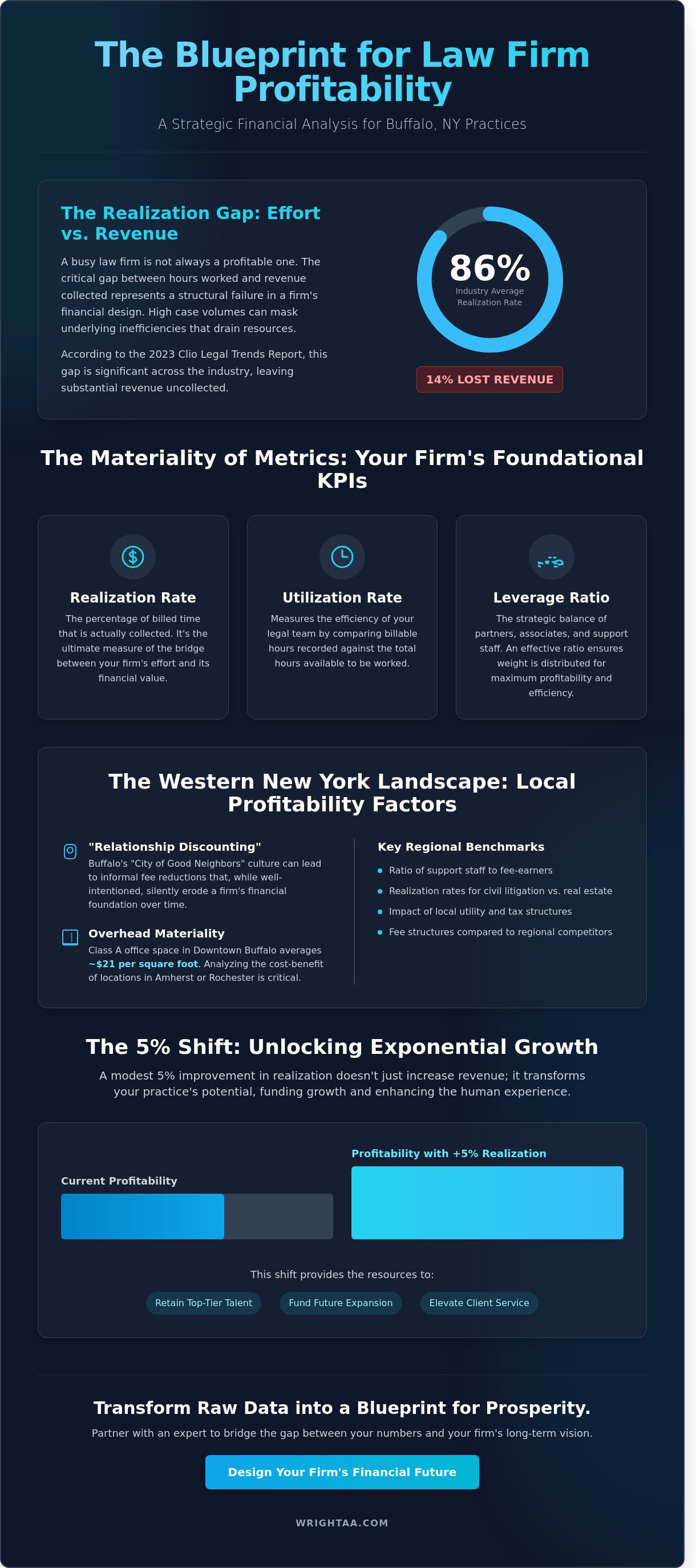
You understand that a busy office is not always a profitable one. This friction between attorney effort and firm ROI often stems from a lack of clarity regarding realization rates, which averaged 86% across the industry in 2023 according to the Clio Legal Trends Report. We'll show you how to transform these fragmented numbers into a blueprint for sustainable growth and elevated profitability. This article provides a clear framework for matter-level analysis, ensuring your firm's financial foundation supports both immediate success and long-term succession planning.
Key Takeaways
- View your practice through a tectonic lens to transform simple bookkeeping into a strategic foundation for enduring stability.
- Identify the elemental metrics that dictate your financial flow, uncovering how realization rates define the true materiality of your firm’s success.
- Implement a disciplined framework for a law firm profitability analysis Buffalo leaders can rely on to ensure data integrity and NY IOLTA compliance.
- Explore how intentional financial design allows a modest 5% shift in realization to elevate the human experience and fund future expansion.
- Discover the value of a curated partnership that bridges the gap between raw data and a sophisticated blueprint for long-term prosperity.
The Architecture of Profit: Why Buffalo Law Firms Need Strategic Analysis
Profitability is the tectonic foundation of any enduring legal practice. It's the silent framework that supports every client interaction and every legal argument. While many firms rely on basic bookkeeping to track cash flow, a sophisticated law firm profitability analysis Buffalo partners need requires a deeper look at the firm's materiality. It's the difference between looking at a list of building materials and understanding how those components integrate to form a load-bearing wall. Without this structural insight, a firm remains vulnerable to the shifting winds of the regional economy.
True analysis moves beyond the surface level of bank balances. It involves understanding profit margins as a diagnostic tool that reveals if the practice is truly sustainable. When profit is treated with intentionality, it elevates the human experience within the office. It provides the necessary resources to retain top-tier talent and offer the quiet, focused service that Buffalo clients expect. A firm that is financially secure has the spatial breathing room to practice law with craft and purpose rather than rushing through a high volume of low-value tasks.
The Shift from Billables to Net Realization
The billable hour is a deceptive metric. It captures time spent but ignores the spatial gap between effort and actual collection. Data from the 2023 Clio Legal Trends Report indicates that the average realization rate for law firms is approximately 86 percent. This 14 percent loss represents a structural failure in the firm's financial design. Intentional practices focus on net realization; they recognize that high-margin work is superior to high-volume work. By choosing practice areas that offer a higher return on effort, firms create a more balanced and resilient business model.
Local Context: The Western New York Legal Landscape
Buffalo is known as the "City of Good Neighbors," a cultural vernacular that often impacts how local firms approach fee structures and client relationships. This reputation can sometimes lead to "relationship discounting" that erodes the firm's financial health. A site-specific approach to law firm profitability analysis Buffalo accounts for these local nuances. The materiality of overhead is also a critical factor. For instance, according to 2023 market data, Class A office space in Downtown Buffalo averaged roughly $21 per square foot, while satellite offices in Amherst or Rochester present different cost-benefit ratios.
To remain competitive within the Western New York landscape, firms must benchmark their performance against regional standards. This includes evaluating:
- The ratio of support staff to fee-earners in mid-sized WNY practices.
- Regional realization rates specifically for civil litigation and real estate.
- The impact of local utility and tax structures on suburban versus urban office locations.
By analyzing these site-specific variables, a firm can ensure its financial structure is as robust as the historic architecture of the city it serves. This disciplined approach allows for a practice that is both artistically fulfilling and economically sound.
The Materiality of Metrics: Key KPIs for WNY Legal Practices
Profitability is the foundation upon which a practice rests. It's not a vague concept but a structural reality defined by the elemental numbers that dictate your firm's financial flow. To perform a rigorous law firm profitability analysis Buffalo practitioners must look at the materiality of their data. This process begins with three core metrics that measure the spatial efficiency and structural integrity of your team.
- Realization Rate: This is the percentage of worked time that actually becomes revenue, representing the bridge between effort and value.
- Utilization Rate: This measures the spatial efficiency of your legal team by comparing billable hours to the total hours available in a workday.
- Leverage Ratio: This is the intentional balance between partners, associates, and support staff, ensuring the firm's weight is distributed effectively.
When these numbers are out of alignment, the entire structure of the firm feels the strain. Firms that Leverage Legal Analytics can identify where the friction exists, allowing for a more deliberate approach to growth. It's about finding the rhythm in the work and the data.
Realization vs. Collection: The Dialogue of Data
The gap between the work performed and the payment received is often where profitability erodes. Hours are frequently written down before they ever reach a Buffalo client because of perceived value gaps or administrative friction. Maintaining financial integrity requires a three-way reconciliation process to ensure every dollar is accounted for. A collection process that respects the client relationship while protecting margins is a craft in itself. It requires clear communication and a steady, unhurried follow-up that mirrors the firm's professional standards.
Overhead Allocation and Matter-Level Profitability
True profitability is found by assigning tectonic costs to specific cases to identify your most sustainable practice areas. Some matters appear lucrative on the surface but carry a heavy administrative drag that diminishes their actual value. This includes the hidden cost of IOLTA compliance and the time spent on non-billable management. Understanding these nuances is essential for a complete law firm profitability analysis Buffalo.
Net Overhead Per Attorney is the total of all non-billable operating expenses divided by the number of fee-earners, representing the baseline cost each lawyer must surpass to generate a profit for the firm. By isolating this number, you gain a clearer view of the firm's internal landscape. If your current financial structure feels cluttered or unclear, you might seek a more refined perspective on your accounting practices. A disciplined approach to these metrics creates the spatial breathing room necessary for visionary legal work.
Conducting Your Profitability Analysis: A Step-by-Step Framework
A law firm profitability analysis Buffalo requires a rhythmic, steady approach. It isn't a frantic search for lost revenue; it's a deliberate study of the firm's financial materiality. To understand the true health of your practice, you must move beyond surface-level numbers and examine the underlying structure of your operations. This framework provides the discipline needed to transform raw data into a clear vision for growth.
- Step 1: Aggregate your data. Gather information from both your practice management and accounting software. This creates the site-plan for your analysis, ensuring every billable hour and expense is accounted for in a single, unified view.
- Step 2: Cleanse and validate. Ensure your records maintain strict IOLTA compliance in NY. Precision here isn't optional; it's the foundation of your firm's integrity.
- Step 3: Segment the landscape. Break down your analysis by practice area, partner, and individual matter. This reveals the spatial efficiency of your team and highlights which structures are most resilient.
- Step 4: Identify leakage. Look for the tectonic shifts where time or expenses are lost. Common points include unbilled administrative tasks or unrecovered filing fees that quietly erode your margins.
- Step 5: Professional review. Review these findings with a CPA for law firms in Buffalo. Their expertise helps interpret the data, turning technical figures into a poetic strategy for the future.
Data Aggregation and the Craft of Reporting
Standard P&L statements often offer a flat, two-dimensional view of a firm's health. Crafting custom dashboards allows for a more spatial understanding of financial trends. It's vital to separate site-specific data, such as reimbursable client expenses, from the firm’s internal operational costs. When you use technology to automate this unhurried flow of information, you create room for more thoughtful decision-making. This integration ensures that your financial reporting is as precise as a well-drafted blueprint.
Segmenting for Clarity: Practice Area Deep Dives
Personal injury and corporate law in Buffalo exist in different atmospheres; they require unique lenses to judge their success. Identifying the vernacular of your most profitable client types helps you understand where your firm’s strengths truly lie. High-quality law firm bookkeeping is the quiet engine that maintains this granular data. It allows you to see the dialogue between different practice groups, ensuring that every resource is placed with intention and purpose.
Beyond the Billable Hour: Optimizing the Human Experience and ROI
Many partners suggest they don't have time for the deep law firm profitability analysis Buffalo practices require to thrive. This is understandable. The tectonic pressure of daily litigation and client demands creates a sense of perpetual urgency. However, intentionality is a form of craft. When a firm increases its realization rate by just 5%, it creates a specific, measurable financial surplus. For a firm billing $2 million annually, that 5% represents $100,000 in found capital. This isn't just money. It's the ability to fund firm expansion or invest in the restorative space needed for attorney wellness.
A law firm profitability analysis Buffalo ensures the structure can support the people within it. High production shouldn't come at the cost of the human experience. By analyzing data, firms can identify where time is wasted on low-value tasks. This allows attorneys to focus on the work that requires their highest intellectual craft. It creates a dialogue between the firm’s financial needs and the individual’s need for professional fulfillment.
Incentivizing the Right Behaviors
Compensation should reflect the materiality of the work, not just the volume. Moving beyond simple origination credits to include profitability metrics changes the dialogue between partners and associates. It fosters a culture where financial craft is respected. When associates understand how their efficiency impacts the firm’s foundation, they become stakeholders in the firm’s spatial growth. This alignment of values ensures the firm’s long-term stability.
Strategic Tax Planning as a Profit Center
Profit is the light that illuminates a firm’s potential. Integrating business tax planning in Buffalo acts as a structural reinforcement for your net income. CFO-level guidance reduces the tax amperage that often dims your earnings. This methodical approach ensures that every dollar earned is protected through thoughtful fiscal architecture. By treating tax planning as a daily operation rather than a year-end chore, you stabilize the firm’s future and increase your effective ROI.
Build a more resilient practice by partnering with a dedicated fractional CFO today.
Elevating Your Practice: Partnering with Wright CPAs, LLC for Financial Clarity
Profitability is not a happy accident. It is the result of deliberate design. At Wright CPAs, LLC, we view ourselves as thoughtful makers of financial strategy. We don't just file forms; we build the tectonic foundations that allow a Buffalo practice to stand firm. Our "Architecture of Finance" approach shifts the focus from simple tax compliance to structural integrity. While research from the 2023 Clio Legal Trends Report suggests that many firms struggle with collection rates, our fixed-fee monthly advisory provides the steady rhythm necessary for growth. This model ensures that our dialogue is never constrained by the clock. It allows for a deeper integration of your firm’s goals with its daily operations.
Standard tax preparation is often a retrospective exercise. It looks backward at what has already passed. In contrast, our approach is prospective and site-specific. We examine the materiality of your firm’s financial data to identify where leaks occur and where strength can be added. By conducting a law firm profitability analysis Buffalo, we help partners understand the relationship between their billable hours and their actual take-home equity. We treat your ledger as a blueprint for a more intentional future.
Our CFO-Level Guidance for Law Firms
Growing a practice in Western New York requires a roadmap tailored to the local legal landscape. Whether you are preparing for a 2025 merger or designing a long-term succession plan, you need visionary oversight. Integrating personal legacy protections with firms like Flex Legal, PLLC ensures that your estate planning and probate needs are handled with the same precision as your firm's finances. We provide the CFO-level clarity that standard accounting lacks. Our onboarding process is unhurried and deliberate. We don't rush into conclusions. Instead, we spend the first 30 to 60 days listening to the history of your firm and analyzing its current performance metrics. This patience ensures that the financial structures we build are both permanent and purposeful.
Our guidance extends to the most complex transitions a firm can face. We assist with:
- Evaluating the financial viability of potential partner buy-ins.
- Designing compensation structures that reward both originations and technical craft.
- Developing site-specific tax strategies that respect the unique regulations of New York State.
A Call to Financial Intentionality
The journey from data chaos to architectural clarity begins with a single, intentional step. You can move beyond reactive bookkeeping toward a future defined by precision and peace of mind. We invite you to a proactive consultation at our Buffalo office. Together, we can examine the specific vernacular of your practice and identify the levers that will drive your firm toward its next phase of evolution. It's time to elevate the human experience of running your firm. Schedule your Law Firm Profitability Analysis with Wright CPAs, LLC to begin the process of building a more resilient and profitable practice.
Constructing a Foundation for Financial Intentionality
Profitability isn't an accident; it's a deliberate craft. By shifting focus from simple billing to the materiality of specific KPIs, firms build a more resilient structure. The 2023 Thomson Reuters Peer Monitor report noted that law firm expenses rose by 8.1% on average, making a precise law firm profitability analysis Buffalo essential for local practices seeking stability. This process transforms abstract numbers into a site-specific strategy for growth. It integrates the human experience with financial ROI, ensuring that every hour spent serves both the client and the firm’s long-term health.
Wright CPAs brings a tectonic precision to this financial architecture. We provide specialized expertise in New York IOLTA compliance and offer fixed-fee advisory retainers for a predictable financial craft. Our CFO-level guidance helps Buffalo’s leading law practices navigate complexity with a sense of calm and purpose. We believe that financial clarity is the light that reveals a firm's true potential.
Design a more profitable future for your firm with Wright CPAs. Your firm’s legacy is a space waiting to be fully realized.
Frequently Asked Questions
What is the average realization rate for law firms in Buffalo, NY?
Law firms in Buffalo typically see an average realization rate of 84 percent based on 2023 regional benchmarks. This metric measures the delicate relationship between the work you perform and the fees you actually collect. It's a reflection of your firm's operational craft. Improving this rate requires a site-specific approach to how you value your time and communicate that value to your clients.
How often should a law firm conduct a full profitability analysis?
You should conduct a law firm profitability analysis Buffalo every 90 days to maintain a clear view of your financial health. This quarterly rhythm allows for steady, intentional adjustments rather than reactive changes. It creates a meaningful dialogue between your long-term vision and your daily practice. Regular reviews ensure your firm remains grounded in its fiscal reality while seeking new heights of efficiency.
Can I analyze profitability if my firm uses flat fees instead of billable hours?
Profitability analysis is essential for flat fee structures to ensure your work remains sustainable and purposeful. You calculate this by dividing the total fee by the actual hours invested, revealing your effective hourly rate. This data exposes the true materiality of your time. It helps you understand if your fixed-price projects are elevating your practice or quietly draining its resources.
What is the biggest "hidden" cost reducing law firm profit in Western New York?
The most significant hidden cost for Western New York firms is administrative leakage, which accounts for 2.5 hours of lost productivity per attorney each day according to 2023 industry data. These lost moments are the tectonic shifts that undermine a firm's foundation. Reducing this friction requires a disciplined approach to time capture. It's about respecting the value of every intentional action within your office space.
How does IOLTA reconciliation impact my firm’s profitability reporting?
Monthly IOLTA reconciliation ensures your profitability reports reflect earned revenue rather than just cash held in trust. New York State Rule 1.15 requires this rigorous discipline to protect client funds and maintain professional integrity. Without it, your financial perspective becomes blurred and unreliable. Accurate reconciliation creates a transparent dialogue between your trust account and your operating budget, providing a stable floor for growth.
Is it worth hiring an outsourced CFO for a small Buffalo law firm?
Hiring an outsourced CFO is a strategic investment for Buffalo firms exceeding 500,000 dollars in annual revenue. This professional brings a refined intellectual perspective to your financial structure. They help you move beyond simple bookkeeping into a more sophisticated understanding of your profit margins. It's an integration of financial expertise that allows partners to focus on their legal craft and the human experience of their clients.
What software is best for tracking matter-level profitability?
Software like Clio or LeanLaw provides the most precise tools for tracking matter-level profitability through integrated timekeeping and expense management. These platforms offer a site-specific view of every case's financial performance. They act as a digital blueprint for your firm's evolution. Choosing the right tool is about finding a system that feels both intuitive and rigorous, allowing for spatial clarity in your data.
How can I increase profit without raising my hourly rates?
You can increase profitability by improving your collection rate from the 2023 national average of 89 percent to a more disciplined 95 percent. This doesn't require a change in pricing, but rather a more intentional approach to the billing cycle. Focus on the quality of your client intake and the clarity of your communication. Elevating the human experience in your billing process often leads to more timely and consistent payments.


