

What if the seasonal anxiety of a year-end tax bill could be dismantled and redesigned into a source of quiet confidence? For many Western New York entrepreneurs, the uncertainty of a looming liability creates a persistent noise that disrupts the creative process. It's common to feel a sense of friction when reconciling the nuances of New York State requirements with federal mandates. Managing quarterly estimated taxes Buffalo NY often feels like a technical burden rather than a deliberate act of business craft. In late 2023, the IRS interest rate for underpayments rose to 8%, making precision a vital structural element of your financial health.
We believe that financial structure should serve the human experience; it provides the spatial breathing room necessary for your work to flourish. By mastering the intentional practice of quarterly payments, you can eliminate the fear of penalties and find a steady dialogue between your revenue and your responsibilities. This guide provides a clear 2026 calendar of deadlines and a site-specific method for estimating your liability. We will move through the essential steps of proactive planning to ensure your business remains both grounded and visionary. You deserve the peace of mind that comes from a well-structured foundation.
Key Takeaways
- Embrace the pay-as-you-go philosophy to transform tax compliance into a rhythmic, intentional practice of financial stewardship for your business.
- Identify if your specific structure and income thresholds require you to submit quarterly estimated taxes Buffalo NY to remain in alignment with federal and state mandates.
- Map the unique cadence of the 2026 fiscal year to ensure your payments follow the specific, non-standard deadlines required to maintain financial clarity.
- Apply the precision of the "Safe Harbor" rule to calculate your obligations with the same materiality and care you bring to your business’s core craft.
- Discover how integrating a fixed-fee advisory model can elevate your tax position from basic bookkeeping to a sophisticated, intentional financial strategy.
The Rhythm of Financial Stewardship: Understanding Estimated Taxes
Estimated taxes represent more than a fiscal obligation. They are the intentional, incremental payments of income and self-employment tax throughout the year. This practice reflects the "pay-as-you-go" philosophy mandated by the IRS and the New York State Department of Taxation and Finance. Within the U.S. income tax system, individuals who earn income not subject to traditional withholding must maintain this steady cadence. For the Buffalo entrepreneur, this is not an afterthought. It's a core business discipline. It serves as the tectonic foundation upon which a stable enterprise is built. Proactive payments foster a sense of financial serenity, ensuring that the dialogue between your business and the state remains harmonious and clear.
The Intersection of Business and Place
The Western New York economic climate rewards businesses that prioritize consistent cash flow oversight. In Buffalo, where seasonal shifts influence consumer behavior, place-based accounting becomes essential. You must navigate challenges specific to our region, from fluctuating utility costs during lake-effect winters to the summer tourism surge. Materiality in your tax records starts with quarterly precision. By aligning your finances with the specific rhythm of our city, you integrate your business into the local vernacular. Consistent oversight ensures your quarterly estimated taxes Buffalo NY filings are not just accurate; they are reflective of your business's true spatial health and site-specific needs.
Why Buffalo Entrepreneurs Prioritize Proactivity
Proactivity prevents the "April Surprise." This sudden tax liability can destabilize a growing WNY small business, particularly those among the 85,000 small firms operating in the region. Paying in real-time offers a profound psychological benefit. It removes the weight of tax debt before it has the chance to accumulate. These payments act as a vital pulse check. They reveal the strength of your business health every three months. In 2024, maintaining this discipline is the difference between a business that merely survives and one that elevates the human experience of its owners and employees. Managing your quarterly estimated taxes Buffalo NY ensures your growth remains sustainable, grounded, and deeply intentional.
- Real-time awareness: Quarterly payments force a review of profit and loss statements every 90 days.
- Penalty avoidance: The IRS generally requires taxpayers to pay at least 90% of their current year tax to avoid underpayment penalties.
- Cash flow preservation: Smaller, frequent payments prevent the depletion of capital reserves in the spring.
Defining the Scope: Who in Buffalo Must Submit Estimated Payments?
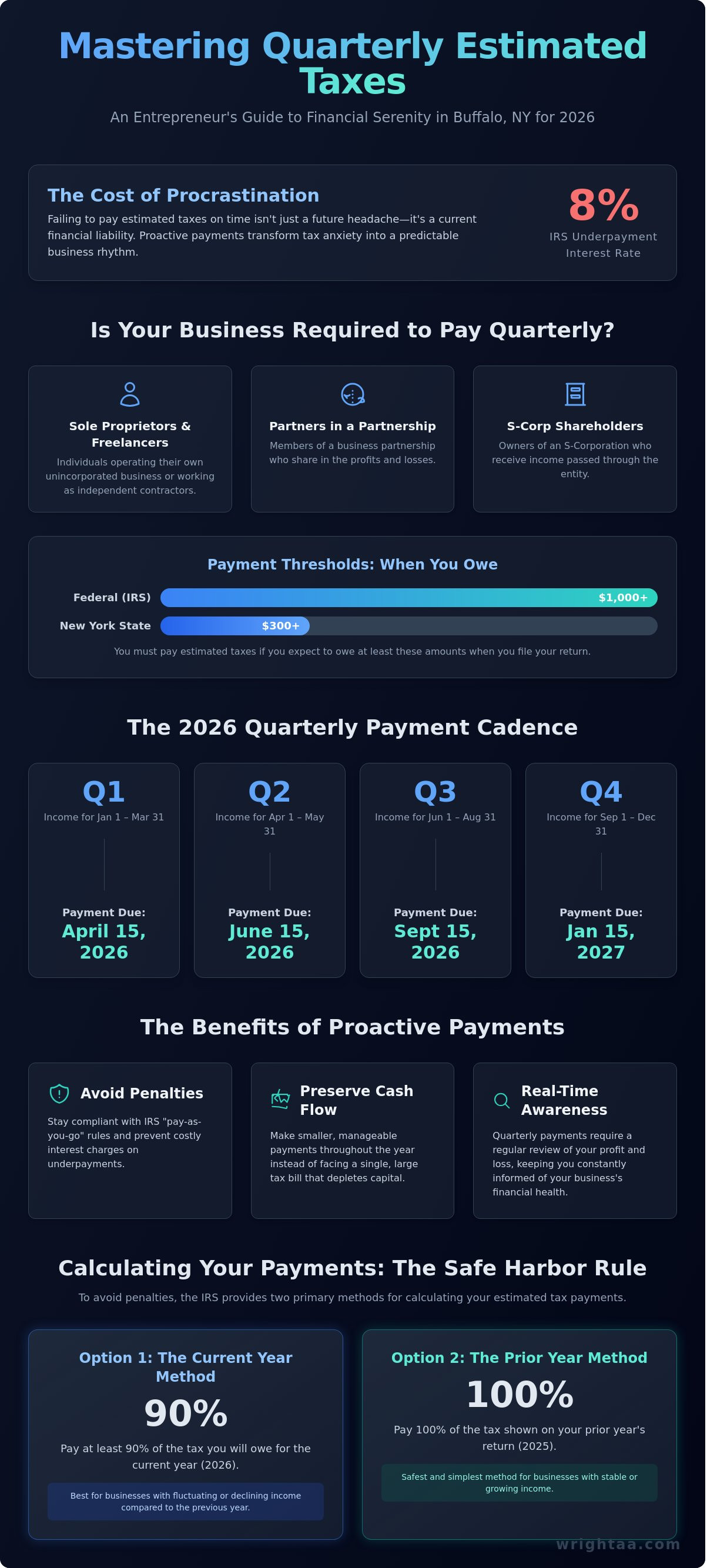
Tax compliance is a deliberate act of structural integrity. For professionals in Western New York, the obligation to file quarterly estimated taxes Buffalo NY depends on the specific form of their business entity. Sole proprietors, partners, and S-corp shareholders form the primary groups required to manage these payments. If you expect to owe $1,000 or more when your federal return is filed, the IRS guidelines on estimated taxes mandate these periodic contributions. New York State maintains a lower threshold of $300 for individuals, reflecting a more stringent local requirement. These figures represent the tectonic plates of your financial structure; ignoring them causes friction in the long-term viability of your practice.
Closely held businesses, which are the backbone of the Western New York economy, face unique architectural challenges. These entities often have a limited number of shareholders who are also active participants in daily operations. In these cases, the line between corporate profit and personal income is thin. You must ensure that your personal estimated payments reflect the pass-through income generated by the business. This requires a rhythmic review of profit and loss statements to avoid underpayment penalties that can erode your capital.
The Freelance and Independent Contractor Landscape
The creative energy in Elmwood Village or the tech corridor downtown often begins as a modest side hustle. A tax obligation matures when net earnings from self-employment reach $400 in a calendar year. At this point, calculating the 15.3% self-employment tax becomes essential for Medicare and Social Security contributions. For a Buffalo-based remote worker, a taxable nexus is established through the physical performance of service within the city limits, creating a spatial link between labor and local obligation. This integration of local presence and digital output requires a disciplined approach to cash reserves.
Specialized Considerations for WNY Law Firms
The transition from a W-2 associate to a K-1 partner is a fundamental shift in professional materiality. Law firm partners in Buffalo must manage their own tax architecture, as income is no longer subject to employer withholding. Diligence prevents IOLTA complications, ensuring that personal tax liabilities never intersect with client trust accounts. Integrating tax planning into monthly cash flow management creates a serene environment for legal practice. Professional tax advice offers a clearer perspective on these complex structures, allowing you to focus on the craft of law rather than the mechanics of the ledger.
The Seasonal Cycle: 2026 Deadlines and Compliance
Compliance is not a static event. It's a dialogue between the taxpayer and the landscape of the law. In Western New York, this dialogue follows a specific seasonal rhythm that mirrors the shifting light of the seasons. Managing quarterly estimated taxes Buffalo NY requires an understanding of this cadence, much like an architect understands the movement of shadows across a site. The year isn't divided into four equal, ninety-day segments. Instead, it's structured by specific dates that demand precision and foresight.
The structure of the tax year relies on the IRS Form 1040-ES, which serves as the blueprint for federal obligations. While we often speak of quarters, the gaps between deadlines are uneven. The leap from the April deadline to the June payment is only two months, while the stretch from September to January covers four. This asymmetry requires a disciplined approach to cash flow. For those operating within the New York State vernacular, the deadlines for state and federal payments fortunately align, creating a unified timeline for the 2026 cycle.
2026 Unified Tax Calendar
- Q1: April 15, 2026. This date serves as the foundation for the year. It's the moment to project your annual earnings and set the structural integrity of your payment plan.
- Q2: June 15, 2026. A mid-year assessment. This deadline arrives quickly, only sixty days after the first, requiring a swift evaluation of your spring revenue.
- Q3: September 15, 2026. Preparing for the final stretch. This payment accounts for the summer months and ensures your site-specific obligations remain on solid ground.
- Q4: January 15, 2027. The closing of the 2026 cycle. This final payment reconciles your year-end performance before the traditional filing season begins in the spring.
Navigating Late Penalties and Interest
Penalties are the friction in an otherwise smooth process. The IRS and New York State calculate underpayment interest based on the amount owed and the duration of the delay. As of the current fiscal period, federal underpayment rates have hovered near 8 percent. These rates are adjusted quarterly, making the materiality of unpaid balances a significant concern for the 2026 tax year. When handling quarterly estimated taxes Buffalo NY, the cost of "under-intentionality" is measured in daily interest accruals.
Missing a deadline isn't a cause for total retreat. It's a moment for swift adjustment. If a date passes without a payment, immediate intervention is better than waiting for the next quarter. Even a partial payment made fourteen days late reduces the interest accrued compared to waiting until the next cycle. This proactive stance preserves the financial health of your practice and ensures that your focus remains on your craft rather than on mounting state or federal debt.
The Materiality of Numbers: Calculating Your Quarterly Estimates
Calculating your tax liability is a craft. It requires the same precision as a structural drawing; every figure must support the weight of the whole. For business owners, determining quarterly estimated taxes Buffalo NY is not a generic exercise in arithmetic. It's a site-specific analysis of your business's unique structure and the economic environment it inhabits. You must track material changes in your income with the same diligence an architect uses to monitor a foundation's settling. If your revenue shifts by more than 15% in a single quarter, your estimates must adapt to maintain equilibrium.
The Safe Harbor Method: A Foundation of Certainty
The Safe Harbor rule provides a tectonic floor for your tax planning. It offers a sense of permanence in an unpredictable fiscal climate. If your adjusted gross income remains under $150,000, paying 100% of your prior year's tax liability protects you from underpayment penalties. For high-income earners whose income exceeds that $150,000 threshold, the requirement rises to 110%. Your prior year's tax return serves as a blueprint for the current year. This method is particularly effective for businesses with steady, predictable growth. It allows you to focus on your work while ensuring your obligations are met with quiet authority.
Accounting for New York State Credits and Deductions
New York's fiscal landscape is complex, requiring a sophisticated approach to integration. Buffalo-based S-Corps and Partnerships often find value in the Pass-Through Entity Tax (PTET). This allows the entity to pay tax at the state level, potentially creating a federal deduction that would otherwise be capped. You must also consider local Western New York economic development credits. These incentives, often tied to specific geographic zones or industry sectors, can significantly alter your liability. As we look toward the updated 2026 tax brackets, refining your estimate becomes a matter of foresight.
- Utilize the Annualized Income Installment Method if your business follows the Buffalo seasonal cycle.
- A snow removal firm may generate 75% of its revenue between December and March, while a landscaping company peaks in the summer.
- This method ensures you only pay taxes on income as it's actually earned, preserving your cash flow during leaner months.
- Document every credit, from the Excelsior Jobs Program to historic preservation incentives, to ensure your quarterly estimated taxes Buffalo NY are lean and accurate.
Precision in these calculations prevents the friction of year-end surprises. It creates a serene financial environment where your business can thrive. When you treat your tax strategy as a deliberate design process, the numbers become a source of strength rather than a burden. If you're ready to bring this level of intentionality to your business's fiscal health, it's time to refine your financial structure with expert guidance.
Integrating Strategy: How Wright CPAs Refines Your Tax Position
Wright CPAs functions as a thoughtful maker in the financial landscape. We move beyond the transactional nature of bookkeeping to offer CFO-level advisory that feels personal and grounded. Every business has its own materiality. We treat your financial data as site-specific information that informs a larger, intentional strategy. Managing quarterly estimated taxes Buffalo NY requires more than just calculation; it demands an understanding of the relationship between your current cash flow and your future goals. This dialogue between our firm and your business ensures that every decision serves a specific purpose.
The Value of a Fixed-Fee Partnership
Financial breathing room requires a stable foundation. Our fixed-fee monthly retainers provide this stability by removing the friction of hourly billing. This model allows for year-round oversight, ensuring the precision of quarterly estimated taxes Buffalo NY remains steady. We aim to prevent the tectonic shifts of unexpected liabilities that often occur during traditional tax seasons. By maintaining a constant pulse on your finances, we can begin optimizing your 2026 tax structure well before the Tax Cuts and Jobs Act provisions expire on December 31, 2025. We monitor specific thresholds, such as the 110% safe harbor rule for those with adjusted gross incomes over $150,000, to maintain total clarity.
Moving Toward Long-Term Financial Success
The human experience is at the center of our work. We believe that financial clarity has the power to elevate your daily life by removing the quiet anxiety of tax compliance. Our process is unhurried and methodical. We listen to the unique vernacular of your business before we propose a single adjustment. This partnership values substance over volume, ensuring your growth is both sustainable and serene. Professional guidance provides permanent value that extends far beyond the four standard deadlines of April 15, June 15, September 15, and January 15. It creates a space where you can focus on your own craft while we refine the structural integrity of your wealth.
Mastering the Cadence of Fiscal Stewardship
Compliance is a rhythmic discipline rather than a static obligation. Understanding the seasonal cycle of quarterly estimated taxes Buffalo NY ensures your business maintains its structural integrity throughout the 2026 fiscal year. By calculating the materiality of your earnings with precision, you transform a technical requirement into a strategic dialogue between your current assets and future growth. This integration of data and strategy provides the spatial breathing room necessary for long-term stability.
Founded in 2012, Wright CPAs focuses on proactive strategy that elevates the human experience of business ownership. We provide CFO-level guidance designed for the specific vernacular of the Buffalo market, including specialized accounting expertise for Law Firms. Our team treats tax positioning as a craft, ensuring every financial intervention is both site-specific and intentional. This rigorous commitment to excellence helps you navigate the intersection of traditional compliance and modern growth.
Elevate your tax strategy with a consultation at Wright CPAs and find the clarity your vision deserves. It's time to build a financial foundation that feels as purposeful as the work you do every day.
Frequently Asked Questions
What happens if I underpay my quarterly taxes in New York State?
New York State imposes an underpayment penalty if your total payments don't reach 90% of the current year's tax or 100% of the prior year's liability. For taxpayers with an adjusted gross income over $150,000, the prior year threshold increases to 110%. The interest rate for these penalties is updated quarterly; for the first quarter of 2024, the rate was set at 12%.
Can I pay my federal and state estimated taxes online?
You can submit payments through the IRS Direct Pay portal and the New York State Department of Taxation and Finance website. These digital platforms offer a clear record of every transaction, ensuring your quarterly estimated taxes Buffalo NY are documented with precision. Most taxpayers utilize these portals to maintain a clean, verifiable trail of their financial commitments throughout the year.
How do I know if I qualify for the Safe Harbor rule in 2026?
You qualify for the Safe Harbor rule if your 2026 withholdings and credits equal at least 100% of the tax shown on your 2025 return. If your 2025 adjusted gross income exceeds $150,000, you must pay 110% of that amount to stay protected. This rule acts as a structural safeguard, preventing underpayment penalties even if your income rises unexpectedly during the year.
Do I need to pay quarterly taxes if this is my first year in business?
You must make estimated payments if you expect to owe $1,000 or more in federal tax or $300 in New York State tax. While the first year of a business is a period of discovery, the tax obligation begins as soon as you generate taxable income. Establishing this rhythm early creates a stable foundation for your firm's long term financial health.
Is there a penalty for paying my estimated taxes all at once in April?
The IRS and New York State require taxes to be paid as income is earned. If you wait until the April 15 deadline to pay the full year's balance, you'll likely face penalties for the three previous missed quarters. These charges accrue from the original due dates of June 15, September 15, and January 15, regardless of your final payment.
How does the New York State PTET affect my individual quarterly payments?
The Pass-Through Entity Tax allows partnerships and S-corporations to pay state taxes at the entity level. If your business makes this election by the March 15 deadline, you can often reduce the amount required for your individual quarterly estimated taxes Buffalo NY. This shift in materiality allows the business to handle the tax burden directly, simplifying your personal cash flow requirements.
What forms do I need to file for quarterly estimated taxes in Buffalo?
You'll use Federal Form 1040-ES to calculate and submit your national payments. For state requirements, New York utilizes Form IT-2105. These documents serve as the blueprints for your compliance strategy. They ensure that your contributions are correctly attributed to your account and that you're following the specific legislative vernacular of both the state and federal governments.
Can a Wright CPA help me calculate my estimates if my income is unpredictable?
Our team applies a rigorous, site-specific approach to financial planning for clients with fluctuating revenue. We analyze your income patterns to create a responsive framework that adapts to your changing needs. By treating your tax strategy as a living craft, we ensure your payments remain accurate and intentional, providing clarity even when your fiscal landscape feels complex or uncertain.


