

A tax credit is not merely a rebate. It is a structural design element that, when placed with intention, reinforces the foundation of your enterprise. In the context of New York’s intricate fiscal landscape, these incentives function like the hidden supports within a building, providing strength and stability where it is needed most. Identifying the right small business tax credits NY requires a steady eye and a commitment to precision. It's a process of finding the intersection between your company's growth and the state's economic priorities.
We understand that the complexity of New York State tax laws can feel overwhelming. The fear of missing out on available resources is often balanced by a valid anxiety regarding the risks of aggressive claims. You deserve a strategy that prioritizes substance over spectacle. This guide serves as a framework to help you move through the fiscal landscape of 2026 with clarity and purpose. We will outline the most relevant credits available, provide a method for documenting your eligibility, and demonstrate how intentional planning can lower your tax liability while protecting your business’s integrity.
Key Takeaways
- Distinguish between the temporary relief of deductions and the permanent structural value of credits to clarify your financial foundation.
- Discover how specific small business tax credits NY can be used as intentional design elements to support your 2026 growth objectives.
- Leverage industry-specific incentives and MWBE certifications to strengthen your firm’s position within the local economic landscape.
- Build a disciplined framework for documentation that protects your enterprise from the friction of state audits.
- Move beyond seasonal compliance toward a proactive tax strategy that monitors incentives throughout the entire calendar year.
Understanding the Landscape of Small Business Tax Credits in NY
The topography of small business tax credits NY is shaped by deliberate legislative intent. It's a landscape where your business's physical site dictates the incentives available to your enterprise. In cities like Buffalo, Rochester, and Syracuse, the state has mapped out specific zones where the tax environment is designed to be more hospitable to innovation and job creation. Understanding this landscape requires looking at tax policy as a form of economic architecture. Every credit is a material choice made by the state to encourage specific behaviors and industries. When your business aligns with these priorities, the tax code becomes a source of structural support rather than a point of friction.
The Structural Difference: Credits vs. Deductions
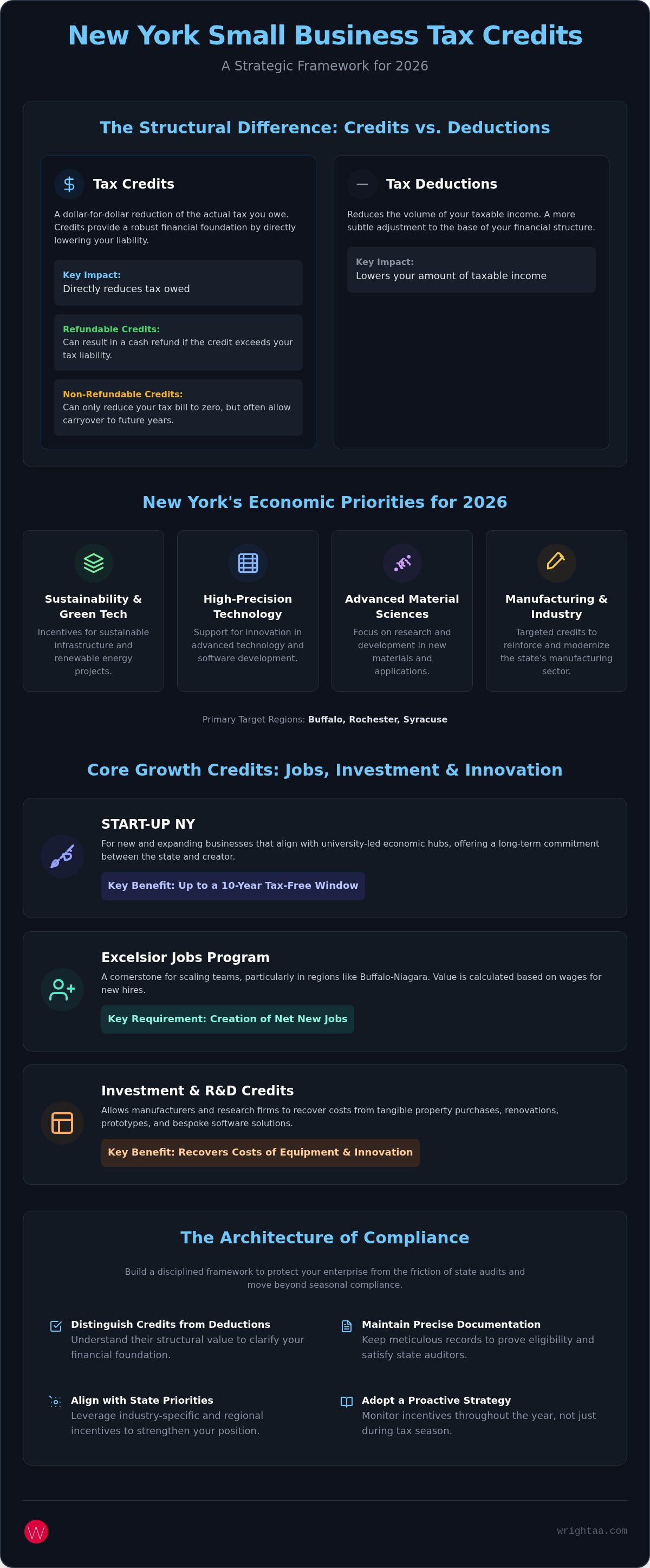
A tax deduction reduces the volume of your taxable income. It's a subtle adjustment to the base of your financial structure. A tax credit is a dollar-for-dollar reduction of the actual tax you owe. This provides a much more robust financial foundation than a standard deduction. While federal policies often focus on broad deductions, New York State uses credits to precisely target and reinforce specific sectors like manufacturing and green technology. This intentionality allows businesses to retain more capital for reinvestment. A refundable tax credit is a direct cash infusion for businesses with low liability. This ensures that even early-stage firms with minimal profits can benefit from the state's incentive programs. Non-refundable credits, by contrast, can only reduce your tax bill to zero, though they often allow for carryover into future years.
New York’s Economic Priorities for 2026
The 2026 fiscal landscape reflects a steady shift toward sustainability and high-precision technology. In Upstate New York, this transition is visible in the incentives offered for sustainable infrastructure and advanced material sciences. The state uses these policies to guide business development in Buffalo and Rochester, treating these regions as laboratories for a new industrial legacy. Identifying the intent behind current legislation allows you to anticipate future credit availability. When you understand the "why" behind a tax incentive, you can align your business's growth with the state's long-term vision. This foresight transforms tax planning into a strategic exercise. It ensures your business isn't just surviving the current tax year but is built to thrive within the state's evolving economic structure. Utilizing small business tax credits NY becomes a way to harmonize your company's goals with the broader community's progress.
Core Growth Credits: Jobs, Investment, and Innovation
Growth is a deliberate act of construction. Within the framework of small business tax credits NY, the state provides a set of tools designed to incentivize the addition of new layers to your enterprise. These credits aren't just rewards for past performance. They're catalysts for future expansion. Programs like START-UP NY offer a ten-year tax-free window for businesses that align with university-led economic hubs. It's a long-term commitment between the state and the visionary creator. It requires a patient, methodical approach to qualifying and maintaining compliance over a decade of development.
The Excelsior Jobs Program in Buffalo and Beyond
In the Buffalo-Niagara region, the Excelsior Jobs Program functions as a cornerstone for scaling teams. Eligibility depends on your industry and a rigorous commitment to creating net new jobs. The state calculates the value of the credit based on a percentage of the wages for these new hires. Documentation is paramount. To satisfy state auditors, you must maintain precise records that prove these positions are truly additive to the local economy. This isn't just paperwork. It's the evidence of your company's contribution to the regional fabric. Maintaining a clear audit trail ensures that the financial integrity of your growth remains unquestioned by the Department of Taxation and Finance.
Investment and R&D: Building for the Future
The Investment Tax Credit (ITC) allows manufacturers and research-heavy firms to recover costs associated with tangible property. If you're purchasing high-precision equipment or renovating a commercial space in Syracuse, the ITC provides a direct reduction in liability. It rewards the physical manifestation of your business goals. Similarly, the NYS Research and Development credit isn't reserved for those in white lab coats. Innovation often happens in the workshop or the software studio. It includes the testing of new prototypes or the implementation of bespoke software solutions designed to improve operational flow.
There's a powerful duality between federal Section 41 credits and New York's counterparts. When these layers are stacked correctly, the cumulative effect on your bottom line is significant. Identifying these overlaps is a core component of a proactive tax strategy. It ensures that no effort in innovation goes unrecognized by the fiscal system. By aligning state incentives with federal frameworks, you create a more resilient financial structure. This approach moves beyond simple filing toward a disciplined method of wealth preservation. It treats your tax return as a carefully curated project rather than a seasonal obligation.
Incentives for Specialized Industries and Social Equity
A business is defined by more than its output. It's defined by its identity and its relationship with the land it occupies. In New York, the state recognizes these distinctions through incentives tailored to specific demographics and environmental stewardship. These small business tax credits NY are not secondary additions. They are core components of a sophisticated financial strategy that respects the diverse nature of the modern marketplace. By aligning your business's social and environmental footprint with state goals, you create a more harmonious relationship with the public sector.
MWBE and Social Equity Incentives
The Minority and Women-Owned Business Enterprise (MWBE) certification acts as a prerequisite for a specialized suite of advantages. It's a formal recognition that opens doors to specific procurement opportunities and tax-related benefits. In cities like Buffalo, this status provides the clarity needed to compete for regional contracts that might otherwise remain inaccessible. The certification process is rigorous. It requires a disciplined approach to documentation. Once achieved, it serves as a powerful signal of your firm's structural integrity and commitment to equitable growth. This status doesn't just improve your chances of winning a bid; it refines your financial narrative within the state's economic framework.
Strategic Planning for Professional Service Firms
Law firms and accounting practices often overlook state credits, viewing them as the domain of manufacturing or retail. This is a missed opportunity for structural reinforcement. Professional offices generate significant data through payroll and employee training that can be converted into tax assets. For legal practices, maintaining IOLTA compliance NY is the baseline for ethical operation, but it's also a part of a broader, intentional accounting framework. By identifying credits related to staff development or technology upgrades, a firm can lower its liability while enhancing its service quality. It's about finding the hidden value in your daily operations.
Environmental responsibility also offers tangible fiscal rewards. The Brownfield Cleanup Program is a prime example of turning a site liability into a tax asset. By remediating contaminated land, a business can claim credits that offset the costs of redevelopment. Similarly, green energy credits for solar and fuel cell installations provide commercial property owners with a way to reduce utility costs and tax debt simultaneously. These programs reflect a belief that the built environment should contribute to the health of the natural world. They reward the business owner who chooses to build with a long-term, sustainable vision. This alignment of ethics and economics is what creates a truly resilient enterprise.
The Architecture of Compliance: Documentation and Risk Management
Documentation is the joinery of a business's financial structure. It holds the weight of your claims when the pressure of an audit is applied. Without a disciplined framework for record-keeping, even the most legitimate claim becomes fragile. Reactive accounting, where records are gathered only when a deadline looms, is a design flaw that leads to missed opportunities and increased risk. By contrast, a proactive approach treats compliance as a permanent, thoughtful intervention. It ensures that your eligibility for small business tax credits NY is documented as it occurs, rather than reconstructed through memory.
Designing Your Documentation Strategy
A robust documentation strategy requires a clear list of materials. Before claiming a state credit, every business owner should secure five essential documents: payroll summaries that distinguish new hires, detailed receipts for equipment or renovations, formal certification letters, project logs for innovation work, and the state's own allocation notices. This level of detail is a core component of small business accounting Buffalo NY. It moves your financial narrative from a collection of receipts to a curated archive. Digital records should be organized with the same precision as a physical blueprint. They must be accessible, timestamped, and reflective of the specific geographic context of your operations.
Mitigating Audit Risk through Intentionality
New York State’s Department of Taxation and Finance operates with a steady, unhurried thoroughness. Auditors look for inconsistencies that suggest a lack of structural integrity. Common red flags include round-number estimates or sudden, unexplained shifts in tax liability. A proactive tax strategy functions as an architectural blueprint for safety. It anticipates the questions an auditor might ask and answers them through meticulous, year-round oversight. This is where a fixed-fee advisory model proves its value. It allows for constant monitoring of small business tax credits NY, ensuring that your financial choices are always grounded in current state requirements.
Technology plays a vital role in automating this tracking. By integrating your bookkeeping with digital compliance tools, you remove the element of human error. This automation creates a steady rhythm of data collection that supports your long-term goals. It allows you to focus on the creative aspects of your business while the technical foundation remains secure. If you're looking to reinforce your business’s financial clarity, you might consider a tax strategy that prioritizes deep listening and contextual awareness. This disciplined approach ensures that your pursuit of state incentives never compromises your firm's reputation or its future stability.
Designing Your Financial Future with Wright CPAs
Financial clarity is not a seasonal event. It is a continuous state of awareness. For the modern enterprise, identifying small business tax credits NY is an act of intentionality that requires more than a year-end review. It requires a partner who views your financial statements as a living structure, one that needs constant calibration to remain resilient. At Wright CPAs, we move beyond the mechanics of filing. We focus on the architecture of your success. By treating tax strategy as a permanent, thoughtful intervention, we help you build a business that is both fiscally sound and aligned with your broader purpose.
The Wright Approach: Proactive vs. Reactive
Our process begins with deep listening. We seek to understand the unique site and structure of your business before we suggest a single intervention. Whether you are operating in Buffalo, Rochester, or Syracuse, your geographic context dictates your opportunities. We leverage modern technology to provide real-time insights, allowing us to pivot from simple bookkeeping to high-level strategic guidance. This transition is essential for those who value substance over spectacle. It ensures that every decision is grounded in a business tax planning Buffalo NY framework that anticipates the future rather than merely recording the past. We prioritize the relationship between your internal operations and the external regulatory environment, creating a sense of calm and purpose in your financial life.
Next Steps for Your WNY Business
Designing a tax strategy is a patient, methodical process. It starts with a comprehensive review of your current position and your long-term vision. During your initial financial clarity session, we look for the intersection of your growth goals and available small business tax credits NY. We prioritize quality over quantity, ensuring that your tax plan serves your daily life and the integrity of your firm. Our fixed-fee model removes the friction of hourly billing. This allows for the year-round monitoring necessary to capture complex credits as they arise, rather than searching for them in retrospect.
To begin this walkthrough of your financial landscape, you can schedule a consultation with our team. We will guide you through the technical details with the same care an architect brings to a blueprint. It's time to move toward a proactive tax strategy that reinforces your foundation. Our CFO-level guidance provides the visionary perspective needed to navigate New York’s complex tax landscape with confidence. Let's design a future that is as stable as it is visionary, ensuring your business remains a permanent and thoughtful intervention in your community.
Strengthening Your Financial Foundation
The architecture of your business is constantly evolving. It requires a steady hand and a commitment to clarity to ensure every incentive is utilized to its full potential. By moving from a reactive stance to a proactive tax strategy, you transform your tax return into a blueprint for future growth. We've explored how identifying the right small business tax credits NY can reinforce your company's structural integrity. This process isn't just about compliance; it's about aligning your enterprise with the economic fabric of Western New York.
At Wright CPAs, we provide the CFO-level guidance and fixed-fee predictability that closely held businesses need to thrive. Our approach is rooted in deep listening and a rigorous commitment to excellence. You deserve a financial partner who understands the relationship between your specific site and your long-term vision. We focus on the improvement of your daily life through steady, methodical planning that ensures year-round monitoring of your incentives.
Schedule your strategic tax planning session with Wright CPAs today.
Let's build a future that is as resilient as it is intentional.
Frequently Asked Questions
How do I know if my Buffalo-based business qualifies for the Excelsior Jobs Program?
Qualification depends on your industry and a commitment to job creation. In Buffalo, the program prioritizes sectors like manufacturing, tech, and life sciences. You must be a net new job creator, meaning the positions must be additive to your existing workforce. Documentation of payroll and strategic growth plans is essential to confirm eligibility before applying for these small business tax credits NY. It's a precise alignment between your growth and state goals.
Can I claim both federal and New York State R&D tax credits?
You can claim both federal Section 41 credits and their New York State counterparts. These incentives are designed to be stacked, providing a layered financial foundation for innovation. While the federal credit focuses on wages and supplies, the state credit often mirrors these expenses but with specific NYS limitations. Utilizing both requires meticulous cross-referencing of your research and development expenditures to ensure full compliance and structural integrity.
What is the most common tax credit missed by small businesses in New York?
The Investment Tax Credit (ITC) for equipment and property improvements is frequently overlooked. Many owners assume it only applies to heavy industrial manufacturing. In reality, it can support a variety of businesses that invest in tangible property used in production or research. Identifying these opportunities early in the fiscal year allows for better cash flow management. It transforms a simple purchase into a strategic asset for your financial structure.
Is the MWBE certification worth the effort for a small professional service firm?
The MWBE certification is a valuable asset for firms seeking state contracts. It provides a formal recognition that opens doors to procurement goals set by New York State. For a small professional service firm, this status offers a competitive edge in regional bidding. It requires a disciplined approach to the application, but the long-term procurement and credit advantages often outweigh the initial administrative effort. It's an investment in your firm's visibility.
How does the START-UP NY program work for businesses near Syracuse or Rochester?
START-UP NY operates through partnerships with universities in Syracuse and Rochester. Your business must be located in a designated tax-free area on or near a campus. If accepted, your enterprise and its employees can operate 100% tax-free for ten years. It's a significant commitment that aligns your business with academic research and regional innovation hubs. This creates a decade of fiscal stability while you build your legacy in Western New York.
What happens if I claim a tax credit but don’t have the proper documentation?
Claiming a credit without documentation creates a fragile financial structure. If the Department of Taxation and Finance audits your return, they'll likely disallow the credit and apply interest or penalties. This friction can be avoided by establishing a documentation strategy before the claim is made. Meticulous record-keeping ensures that your eligibility for small business tax credits NY remains defensible and secure. Your records are the joinery that holds your strategy together.
Are there specific tax credits for law firms in New York State?
Law firms don't have a singular industry credit, but they qualify for broader incentives. Credits related to employee training, technology implementation, or green energy improvements for office space are often applicable. Additionally, firms relocating to specific economic zones may access regional job creation incentives. The key is to view the firm's operations through a strategic lens. Identifying where your activities align with state priorities can significantly lower your firm's liability.
How often should I review my business’s eligibility for state tax credits?
You should review your eligibility continuously throughout the year. A proactive tax strategy moves beyond the annual filing deadline to monitor growth and expenditures in real-time. This steady rhythm ensures that no credit is missed due to a lack of documentation or timing. Regular sessions with your advisor allow for the intentional adjustments needed to maintain your firm's financial health. It ensures your long-term vision remains supported by a solid foundation.


