

The right accounting provider for a Syracuse law firm does more than keep the books current. A search for “law firm accounting Syracuse” support often reflects a broader need: connecting organized client-fund records with a clear view of cash flow, expenses, and firm performance.
It’s reasonable to ask whether general business bookkeeping can keep up with a law practice’s distinct financial workflows. Trust-account responsibilities add another layer, and New York-specific requirements deserve careful attention. Accounting support can organize financial records and inform decisions, but it doesn’t replace legal advice or determine whether a firm meets its professional obligations.
This guide explains what dependable law firm accounting can cover, how to evaluate support serving Syracuse practices, and what to ask before choosing a provider. It looks at how bookkeeping, financial reporting, tax planning, and cash-flow support can work together, and where an accounting professional’s role ends. The goal is a clearer view of both client-fund records and the practice’s finances.
Key Takeaways
- Learn what law firm accounting Syracuse support can include, from bookkeeping and payroll to tax planning and advisory work.
- Understand how client-fund records differ from operating finances, and where accounting processes end and legal guidance begins.
- Compare providers by their law-practice experience, deliverables, communication, technology, and fee structure.
- Use a consistent process for gathering records, setting responsibilities, and reviewing reports to strengthen financial visibility.
- See how Wright CPAs’ accounting, bookkeeping, payroll, tax, and advisory services may fit Syracuse firms, with service provided from its Buffalo base.
Law Firm Accounting in Syracuse: What Specialized Support Covers
Law firm accounting is financial recordkeeping and reporting shaped around how a legal practice operates. It organizes the movement of money through the firm, from client-related activity to operating expenses and revenue. The resulting records can help owners understand the practice, prepare for tax discussions, and make informed decisions.
The work can extend beyond routine bookkeeping, but each service has a distinct role. Bookkeeping records and categorizes transactions. Payroll supports employee compensation. Tax planning uses financial information to inform tax decisions, while cash-flow support helps the firm monitor money coming in and going out. Advisory or CFO services can provide a broader view of financial performance. Ask a provider to explain exactly which tasks are included and which remain with the firm.
How law firm accounting differs from general small-business bookkeeping
A law practice may need to understand financial activity in relation to matters, billing cycles, collections, and operating costs. The precise workflow varies by practice. Clear categorization and regular reconciliation make records easier to review, help identify inconsistencies, and support useful reporting. They also help distinguish operating finances from client-related funds. Accounting processes support accurate records, but they don’t determine whether a firm has met its legal or professional obligations.
Accounting support organizes and reports financial information; the lawyer remains responsible for legal compliance and should seek qualified legal guidance on professional obligations. Accountants have professional responsibilities of their own. This overview of accountant professional liability offers background, but isn’t a substitute for advice about a specific engagement.
Which Syracuse law firms may benefit from ongoing support?
Solo practitioners may want a steadier process for recording expenses and reviewing income. Small firms may need consistent reports across billing and payroll cycles. Growing practices may benefit from a clearer view of how costs and cash flow change as the firm expands. The right scope depends on the firm’s structure and needs, not simply its size.
Consider ongoing support if reconciliations are routinely delayed, cash flow is difficult to interpret, or reports arrive inconsistently. Before engaging a provider for law firm accounting Syracuse practices can use, ask what work is included, how records will be exchanged, and whether support is delivered remotely, in person, or through a combination. A Buffalo-based firm such as Wright CPAs serves Syracuse clients, but confirm current service scope and delivery details directly.
Client Funds and Firm Finances: Keep the Accounting Responsibilities Clear
A law practice may handle money that belongs to clients as well as revenue and funds used to run the firm. These categories serve different purposes and should remain clearly distinguished in the firm’s records. A client-related balance isn’t the same as earned revenue or operating cash, even when both appear in the practice’s broader financial picture.
Client funds belong to clients; firm operating funds belong to the practice and support its business expenses. Clear documentation helps lawyers and their authorized advisers understand transactions, review account activity, and prepare accurate financial reports. It also gives the firm a more reliable basis for oversight. Bookkeeping and reconciliations organize and compare records; they don’t, on their own, establish that legal or professional obligations have been met.
What Syracuse firms should understand about IOLA and trust-account records
New York’s Rules of Professional Conduct, including Rule 1.15, address lawyers’ handling of client funds. The New York State Bar Association’s IOLA Fund explains the program for qualifying client funds. Requirements can depend on the circumstances, so firms should consult current authoritative guidance and confirm how the rules apply to their practice. A general article or accounting engagement can’t make that legal determination for them.
When evaluating law firm accounting in Syracuse, ask how the provider handles bookkeeping and reporting related to client-fund records, and what information the firm must supply. Don’t assume that hiring an accountant transfers the lawyer’s professional responsibilities. For interpretation or questions about obligations, consult the firm’s attorney or the appropriate regulator.
Where accounting support can help, and where its scope ends
Depending on the agreed scope, accounting support may include bookkeeping, reconciliations, financial reporting, and tax planning. These processes can help the practice maintain organized records and understand how client-related activity and operating finances appear in its books. Ask a prospective provider to explain the work, records, and review process it will handle instead of relying on broad assurances about compliance.
Accounting services aren’t legal advice, and bookkeeping or reconciliation isn’t an audit or attestation engagement. Wright CPAs offers bookkeeping, tax planning, and law firm accounting among its services, but firms should confirm the current scope available to them. To assess accounting support for your practice, review Wright CPAs’ accounting services and discuss which financial tasks are within scope.
Compare Law Firm Accounting Providers Serving Syracuse
Start your comparison with the work your practice needs, not a broad label such as “full service.” Ask each provider to describe its law firm experience, included tasks, and process for communicating about open questions. For law firm accounting support in Syracuse, confirm that the provider currently serves local firms, how onboarding works, and who will handle your account.
| Compare | Questions to ask |
|---|---|
| Specialization | What law firm experience can you substantiate? Which practice types or financial workflows have you supported? |
| Deliverables | Will the engagement include bookkeeping, reconciliations, financial reporting, tax planning, or only selected services? What will we receive, and how often? |
| Communication | Who is our main contact? How do we raise questions, share records, and review work? |
| Technology | Which tools will be used to exchange and store records? Ask how access, protection, and review are handled, and verify the provider’s specific practices. |
| Fees and scope | Is the work project-based or recurring? How are responsibilities, included services, and any work outside the agreed scope documented? |
Questions to ask before engaging a law firm accountant
Ask how bookkeeping, reconciliations, reporting, and tax planning fit together, and which tasks remain your responsibility. Request a clear description of the service scope and the provider’s relevant experience. Discuss how client records are shared and reviewed. Don’t assume a general statement about technology answers questions about your data; ask for details about the provider’s actual process.
Compare service models and reporting expectations
A project-based tax preparation engagement may suit a defined, one-time need. Ongoing monthly accounting may be a better fit when the practice wants recurring bookkeeping and financial reporting throughout the year. The right model depends on your workflow and desired level of support. A monthly arrangement shouldn’t be assumed to include every accounting or advisory task.
Before work begins, put the scope in writing. Confirm deliverables, responsibilities, reporting cadence, expected timelines, communication process, and fee structure. Wright CPAs is based in Buffalo and serves Syracuse clients; confirm current availability, onboarding details, and who would handle your account. To learn what the firm’s accounting work may include, explore Wright CPAs’ accounting services.
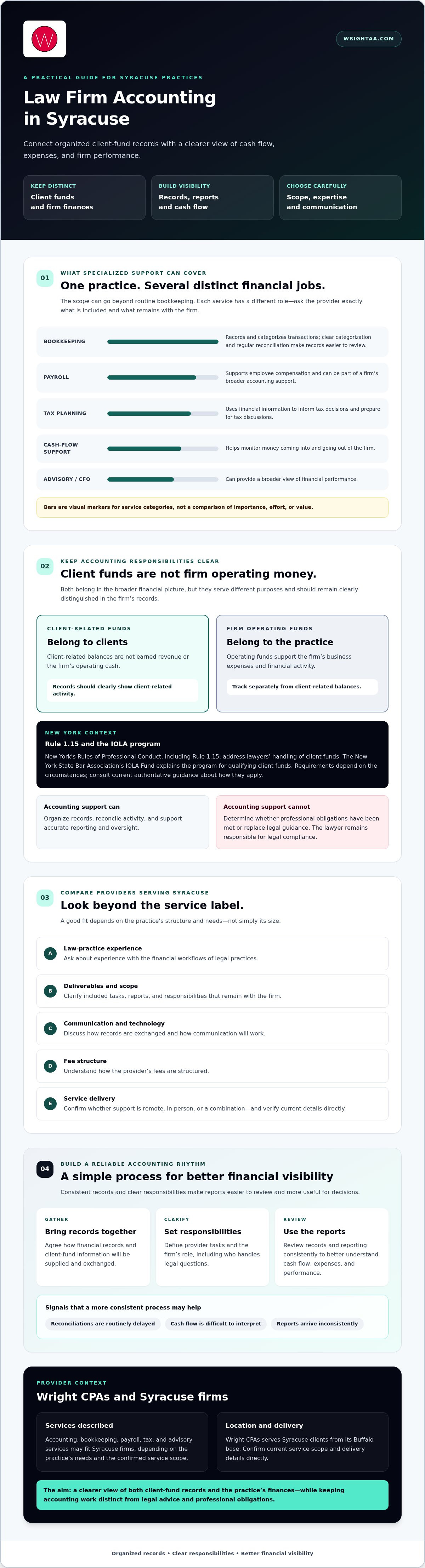
Build a More Reliable Accounting Rhythm for Your Syracuse Practice
Reliable accounting depends on a repeatable process. For a Syracuse practice, that process can begin with organized records, clear responsibilities, regular reporting, and a review rhythm suited to the firm’s workload. Details vary by practice, so agree on the scope with your accounting provider rather than assuming every firm needs the same checklist or schedule.
Set up records, roles, and a regular review process
Before onboarding, ask what information the provider needs. Depending on your practice and the agreed services, it may include bank and credit card statements, payroll records, expense documentation, billing and collection summaries, prior financial reports, and tax documents. Keep client-fund records distinct from operating records, and confirm with your attorney how relevant professional obligations apply.
Then establish who is responsible for each step. Decide who will:
- Provide records and explain unusual transactions.
- Review reports and raise questions about discrepancies.
- Follow up on missing information or unresolved items.
Agree on a recurring review cadence, whether monthly or on another schedule suited to the engagement. Consistency is the goal: records are gathered, reviewed, and discussed before details become difficult to trace. Firms seeking broader context on professional-practice finances can also read this guide to CPA support for law firms in Buffalo, NY.
Use financial reporting to guide practice decisions
Timely bookkeeping and reporting can help owners see the relationship between incoming receipts and outgoing costs. For example, a report may prompt questions about the timing of collections, payroll, or recurring expenses. It doesn’t predict future cash flow or guarantee a particular financial result, but it can give the firm a clearer basis for planning.
Complete, current records also make tax-planning conversations more grounded. A firm and its accounting professional can discuss the available information, upcoming decisions, and questions that may need further review. The accountant can explain the financial and tax-planning work within the engagement; legal interpretations and professional obligations should be confirmed with qualified legal counsel or the appropriate regulator.
For law firm accounting in Syracuse, define the reporting cadence and responsibilities with the provider based on your practice’s needs. To explore accounting and cash-flow support for your firm, review Wright CPAs’ accounting services.
Wright CPAs for Law Firm Accounting in Syracuse: Consider the Next Step
Choosing accounting support comes down to fit: which financial work needs attention, what insight the firm wants from its reports, and how much support makes sense over time. Wright CPAs, LLC is based in Buffalo and serves clients in Syracuse. It offers law firm accounting, bookkeeping, payroll, tax planning and preparation, and advisory support. Its Buffalo location doesn’t imply a Syracuse office, so confirm how services are delivered and which offerings are currently available for your practice.
What to prepare for an initial conversation
A short, clear overview can make the discussion more productive. Describe your practice, how bookkeeping is handled now, and which reports or financial questions remain unresolved. Note whether you want to discuss tax planning, payroll, cash flow, or broader advisory needs. You don’t need to resolve every accounting question before speaking; the goal is to identify priorities and determine whether the provider’s scope fits them.
Ask direct questions about the engagement before deciding:
- Which services are currently available to Syracuse law firms, and what work is included?
- Who will handle your account, and what information or review will be expected from your team?
- What timelines, reporting expectations, and communication process should you anticipate?
- How are fees structured, and how is work outside the agreed scope addressed?
Choose support that fits the practice, not a generic package
A solo practice’s priorities may differ from those of a firm with employees, multiple billing workflows, or plans to grow. Consider which tasks need consistent attention and which are limited to a defined project. Wright CPAs describes ongoing monthly accounting and advisory retainers, as well as project-based tax preparation and consulting. These are different engagement models, not a prescribed package for every firm.
Before proceeding, compare the proposed work with your practice’s needs. Confirm the deliverables and responsibilities in writing, including the reporting rhythm and how questions will be handled. To evaluate law firm accounting in Syracuse with a clearer sense of fit, first define the work you want addressed and confirm its availability with the provider.
If Wright CPAs’ service scope aligns with your priorities, discuss accounting support for your law firm.
Bring Clarity to Your Firm’s Financial Next Steps
Dependable law firm accounting support in Syracuse should fit the way your practice works. Clear records and reporting can help you understand firm finances, while client-fund responsibilities remain distinct and legal obligations stay with the lawyers responsible for them. Before choosing a provider, define the work you need, the reports you expect, and how the engagement will be managed.
Wright CPAs is a privately owned firm founded in 2012. Based in Buffalo and serving Syracuse, it offers law firm accounting, bookkeeping, payroll, tax planning, and CFO services. The right scope depends on your practice, so use an initial discussion to clarify service availability, responsibilities, reporting expectations, timelines, and fees.
With those questions in view, you can make a considered choice about the financial support your firm needs. Discuss accounting support for your law firm with Wright CPAs and take a measured next step toward a clearer financial picture.
Frequently Asked Questions
Is specialized accounting necessary for a small law firm?
Not every small firm needs the same level of accounting support. A solo practitioner with straightforward records may need a different scope from a growing practice handling payroll, recurring reports, or more complex cash flow. Start by identifying the specific gaps causing difficulty, such as late reconciliations or limited visibility into expenses. Then ask providers serving Syracuse, Buffalo, or Rochester which services address those needs.
Can an accountant help with IOLA or trust-account recordkeeping in New York?
An accountant may support bookkeeping and reconciliations related to client-fund records, depending on the engagement. Confirm the provider’s relevant experience and exact responsibilities before relying on that support. New York obligations can depend on current rules and a firm’s circumstances, so consult authoritative state sources and qualified legal counsel for interpretation. Accounting services aren’t legal advice, and engaging a provider doesn’t guarantee compliance.
How do I choose a law firm accountant in Syracuse?
Compare law firm experience, defined services, reporting practices, communication, technology, and fee structure. Ask whether the provider currently serves Syracuse practices, how onboarding works, and who will handle your account. Clarify who supplies records and reviews reports, then document responsibilities and deliverables in writing. A provider serving firms in Syracuse, Buffalo, and Rochester should explain how its process fits your practice rather than relying on a broad promise.
What accounting services might a law firm need?
A firm’s needs may include bookkeeping, payroll, financial reporting, cash-flow management, tax planning, or tax preparation. The appropriate combination depends on the practice’s size, internal capacity, and financial workflows. Ask providers to distinguish ongoing work from project-based services and to describe deliverables and exclusions plainly. Don’t assume legal advice, audits, or attestation are included in an accounting engagement; confirm the scope before work begins.
Can a Buffalo accounting firm serve a law firm in Syracuse?
Yes, a firm based in Buffalo may serve clients in Syracuse, but confirm current availability and how the relationship would work. Wright CPAs is based in Buffalo and serves clients in Buffalo, Rochester, and Syracuse. Ask how records are exchanged, how reports are shared, whether meetings are remote or in person, and what the engagement includes. Those details help determine whether the arrangement suits your practice.
Should a law firm choose monthly accounting or project-based support?
Monthly support may suit firms seeking recurring bookkeeping, financial reporting, and tax strategy over the year. Project-based work may fit a defined need, such as tax preparation or a specific consulting engagement. Consider your workload, internal capacity, and desired reporting rhythm. Wright CPAs describes both monthly accounting and advisory retainers and project-based services. Compare deliverables, responsibilities, timelines, and fees before choosing a model.
Does law firm accounting include legal compliance advice?
No, accounting support should not be assumed to include legal advice. An accountant can explain the agreed services, such as bookkeeping, reporting, or tax planning, while legal interpretation and professional obligations require appropriate qualified guidance. Ask your provider and attorney to clarify who is responsible for each task. For a Syracuse practice, verify New York requirements through current authoritative sources and consult counsel about how they apply.


