

Strong sales don’t always mean clear financial performance. For accounting for breweries Buffalo NY owners need, the real test is whether the numbers clarify what each batch, sales channel, and operating expense means for the business. Ingredient costs, production inventory, and taproom activity can make the picture harder to read.
It’s reasonable to expect a CPA to do more than prepare taxes. Brewery owners also need dependable books, a clear view of cash flow, and guidance that keeps pace as operations change. The right fit should understand your needs and be able to discuss relevant brewery experience, rather than asking you to assume it.
This guide explains the accounting needs to raise with a prospective CPA and the questions that can help you compare providers. It also considers how bookkeeping, payroll, tax planning, cash-flow management, and CFO support may fit together. You’ll come away with a practical framework for building more reliable financial visibility and making operating decisions with greater clarity.
Key Takeaways
- Match your accounting processes to how your brewery tracks production, inventory, sales channels, and payroll.
- Use accounting for breweries Buffalo NY as a framework for assessing whether records, tax support, and reporting fit your operating needs.
- Compare CPAs by asking how they’ll learn your workflows, what their engagement includes, and how often you’ll communicate.
- Choose support based on the decisions you need to make; periodic tax preparation and ongoing accounting or CFO guidance serve different purposes.
- Prepare for provider conversations by gathering available financial statements, tax filings, payroll information, and notes on inventory practices.
Why brewery accounting in Buffalo needs more than routine bookkeeping
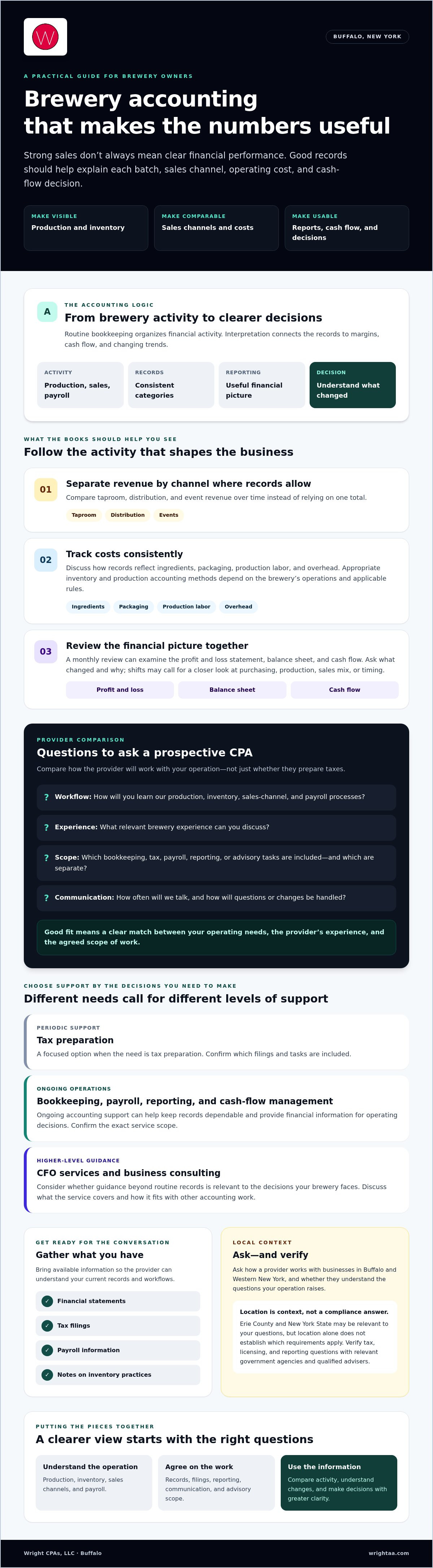
A brewery owner choosing accounting support needs more than correctly entered transactions. The records should help answer practical questions: Which sales channels contribute to revenue? How are ingredient and production costs moving? Is cash available for the next operating decision? Routine bookkeeping organizes financial activity; interpretation connects those records to margins, cash flow, and changing trends.
A brewery’s operations can span production, ingredients and finished inventory, taproom sales, wholesale distribution, events, and payroll. Each creates activity that may need to be recorded in a way that reflects how the business actually works. The broad range of Brewery business models provides useful context, but the right financial detail depends on each brewery’s structure and sales mix.
For owners evaluating accounting for breweries Buffalo NY, ask whether a prospective provider can help turn consistent records into useful comparisons and timely financial insight. Business structure and tax treatment vary, so have a qualified professional review your brewery’s circumstances rather than assuming one approach fits every operation.
Which brewery activities should the books make visible?
Where records allow, separate taproom, distribution, and event revenue so you can compare how different channels contribute over time. Track ingredient, packaging, labor, and production costs in a consistent way, without assuming a particular accounting method applies to every brewery. Stable categories make month-to-month or period-to-period comparisons more meaningful. If the numbers change, you can investigate the activity behind the shift rather than relying on a single total.
Why Buffalo-area context belongs in the conversation
Ask providers how they work with businesses in Buffalo and the wider Western New York region, and whether they understand the questions your specific operation raises. Erie County and New York State are relevant location context, not proof that a particular rule applies. Requirements can depend on the business and its activities. Verify tax, licensing, and reporting questions with the relevant government agencies and qualified advisers.
Wright CPAs, LLC, based in Buffalo, offers bookkeeping, payroll, tax planning and preparation, cash-flow management, CFO services, and business consulting. It may be a fit for a brewery seeking coordinated financial support, but owners should ask about relevant industry experience and confirm the scope of services before choosing a provider.
What brewery accounting should cover: records, taxes, payroll, and reporting
A useful accounting engagement should establish dependable records, deliver reports on a schedule you can use, clarify which tax and payroll tasks are covered, and help translate financial information into decisions. For accounting for breweries Buffalo NY, the right scope depends on the operation. Ask a prospective provider to explain how they’ll learn your production and inventory workflows before recommending a reporting approach.
Inventory, cost of goods sold, and financial reporting
Ingredient purchases, packaging, production labor, and overhead are useful categories to discuss with an accountant. The appropriate inventory and production accounting methods depend on your brewery’s operations and applicable accounting rules. Ask how the provider will understand your existing records and what changes, if any, they recommend.
Reports are most useful when they prompt good questions. In a monthly review, look at the profit and loss statement, balance sheet, and cash flow, then ask what changed and why. A shift in costs or margins may call for a closer look at purchasing, production, sales mix, or timing. The Brewers Association’s Brewery finance and accounting best practices can offer industry context as you assess what information would help your decisions.
Tax, payroll, and compliance questions to verify
Don’t assume that a general accounting engagement includes every filing or compliance task. Ask for a clear division of responsibilities:
- Which federal and New York tax filings are included, and which remain the owner’s responsibility?
- Does the engagement include payroll processing, payroll tax support, and payroll reconciliations, or are any of these separate?
- Who will monitor questions involving federal, state, or local requirements, and how will changes or uncertainties be handled?
Requirements can depend on a brewery’s activities and circumstances. Verify current federal information with the Alcohol and Tobacco Tax and Trade Bureau (TTB), and check New York State and local matters with the relevant agencies and qualified advisers. Treat a provider’s explanation as a starting point for confirming what applies to your business, not as a substitute for current guidance.
Before agreeing to ongoing bookkeeping, payroll, or tax support, make sure the scope and responsibilities are documented. Owners considering coordinated support can review Wright CPAs’ bookkeeping and tax services and ask how the firm would address their brewery’s specific needs, including relevant industry experience.
How to compare brewery accountants in Buffalo, NY
For accounting for breweries Buffalo NY, compare how a provider would work with your operation, not just the confidence of a sales pitch. Industry familiarity matters, but so do the engagement’s boundaries, the rhythm of reporting, communication, and clear accountability. Ask each firm to explain how it would learn your production and sales workflows before proposing a scope of support.
Questions that reveal relevant brewery experience
Ask whether the firm has worked with breweries or similar manufacturers, and request examples you can verify. Then move from general experience to your actual records: how would the team understand inventory tracking, production activity, taproom and wholesale sales, and the reports you need? Clarify who performs the work, who reviews it, and who answers questions during the year. A careful provider should be able to describe its process without implying that every brewery is alike.
How to assess service scope and communication
Review bookkeeping, tax planning, tax preparation, payroll, and advisory support as separate items. Confirm which are included, what the brewery must provide, and how records will be shared and accessed. Ask what reports you’ll receive, how often they’ll be reviewed, and how an urgent discrepancy or unresolved question is handled. Don’t assume a particular software platform; focus on whether the process is clear and workable for your team.
A simple comparison sheet can keep provider conversations grounded. Record the answer and any follow-up needed, rather than relying on memory or broad assurances.
| Criteria | Provider answer to record | Follow-up to consider |
|---|---|---|
| Industry experience | Relevant brewery or manufacturing work described | Can examples or references be verified? |
| Workflow understanding | How the firm will learn production and sales records | Does the proposed process fit your operations? |
| Scope and deliverables | Included services, reports, and owner responsibilities | Which tasks are separate or remain with you? |
| Communication and review | Reporting cadence, review roles, and contact process | Who responds to questions throughout the year? |
| Records and access | Document-sharing and record-access procedures | Can your team retrieve what it needs? |
Compare the answers side by side. A strong fit is one where the scope is understandable, responsibilities are explicit, and the provider can explain how its approach connects financial records to your decisions. If an answer is vague, ask for clarification before signing an engagement.
When a brewery needs ongoing accounting or CFO-level guidance
A brewery may not need every accounting service. It does need records that are timely and clear enough to support the decisions its owners actually face. Periodic tax preparation may suit a business with organized books and few questions between filing periods. Recurring bookkeeping and advisory support may be more useful when the owner needs to review financial activity throughout the year.
Signs the current accounting arrangement may not be enough
Look for patterns, not one difficult month. If reconciliations are regularly delayed, it may be hard to tell what cash is available after bills and payroll. If reports arrive late or aren’t easy to interpret, planning purchases or evaluating operating performance becomes less grounded. Incomplete records can also make tax preparation more difficult because information may need to be gathered and clarified under time pressure.
Separate process gaps from seasonal variation. A quiet period or uneven sales month may reflect the brewery’s operating cycle. But repeated uncertainty about cash on hand, unpaid obligations, or the meaning of financial reports may signal that the records or review process need attention. For a broader view of how ongoing support can be structured, see small business accounting in Buffalo, NY.
What ongoing advisory support can help owners examine
Recurring conversations can make financial information more useful between tax filings. Depending on the engagement, an owner and adviser might review cash-flow forecasts, compare actual results with a budget, or consider scenarios such as a planned equipment purchase or a change in operating costs. These discussions can help frame trade-offs, but they don’t guarantee a particular business outcome.
CFO-level guidance is one option to evaluate when the brewery needs more structured financial planning or help interpreting trends. It isn’t a universal requirement. Ask what decisions the service is designed to support, which reports or discussions are included, and what responsibilities remain with the owner. If strategic financial planning is part of the need, learn more about outsourced CFO services in Buffalo.
Wright CPAs offers bookkeeping, cash-flow management, CFO services, tax planning and preparation, and fixed-fee monthly accounting and advisory retainers. A brewery considering that support should confirm relevant industry experience and discuss which services fit its operations. To explore whether the scope matches your needs, discuss accounting and advisory support with Wright CPAs.
Choosing brewery accounting support in Buffalo and planning your first conversation
A focused first conversation makes it easier to compare providers and see whether their services fit your brewery. Start by mapping what you need, then gather the records that show how your business operates. Compare proposed scopes, verify relevant experience, and agree on who is responsible for each task before moving forward. This gives you a practical basis for choosing accounting for breweries Buffalo NY that supports your real operating decisions.
A practical checklist before contacting an accounting firm
Prepare a concise picture of your current systems and open questions. You don’t need perfect records to begin, but useful context helps a provider understand the work involved.
- List your bookkeeping tools, sales channels, payroll arrangements, and recurring reporting questions.
- Gather recent financial statements, business tax filings, payroll information, and any outstanding notices.
- Note how you track ingredients, production, and inventory, including any steps that are difficult to reconcile.
- Write down the outcomes you want, such as clearer cash-flow information or more consistent reporting.
- Identify services already handled by other advisers so responsibilities don’t overlap or fall through the gaps.
Share what’s available, and identify anything that’s missing or out of date. That distinction helps a prospective accountant assess both immediate needs and the effort required to establish a reliable process.
What to clarify in a first conversation with Wright CPAs
Wright CPAs offers bookkeeping, tax planning and preparation, payroll, cash-flow management, and CFO services. These may be relevant to a brewery seeking coordinated support, but confirm whether the firm’s services match your operation and ask directly about relevant brewery experience. Don’t assume industry familiarity from a service list alone.
Discuss who would handle each service, how communication and reporting would work, and what records your brewery would need to provide. Clarify what is included, what remains your responsibility, and how the scope would adapt if your production or sales activity changes. The aim is a clear working arrangement, not a promise of a particular financial result.
Once you’ve outlined your needs, you can discuss accounting support with Wright CPAs and determine whether there’s a suitable fit. A thoughtful choice begins with clear records, direct questions, and shared expectations.
Choose financial support that fits your brewery
The right accounting arrangement connects dependable records with the decisions you make throughout the year. Look for clear reporting, defined responsibilities, and tax and payroll support suited to your operation. You may need periodic tax preparation, recurring bookkeeping, or broader advisory guidance. The best fit depends on what your brewery needs to understand and manage.
As you compare options for accounting for breweries Buffalo NY, ask providers how they’ll learn your workflows and confirm relevant brewery experience. Wright CPAs is a Buffalo-based firm founded in 2012, with services that include bookkeeping, payroll, tax planning, and CFO services. Discuss your brewery’s specific needs and confirm that the firm’s experience and service scope are appropriate before proceeding.
Discuss your brewery’s accounting needs with Wright CPAs. A clear first conversation can help you map a practical path toward more reliable financial information and decisions made with greater confidence.
Frequently Asked Questions
What does an accountant do for a brewery?
An accountant helps a brewery organize its financial records and understand what they show. Depending on the engagement, support may include bookkeeping, financial reporting, tax planning and preparation, payroll, cash-flow management, or CFO guidance. For accounting for breweries Buffalo NY owners are considering, ask how the provider will account for your production, inventory, and sales workflows, and which responsibilities remain with you.
Does a brewery need an accountant with brewery-specific experience?
Brewery-specific experience can be valuable, but ask providers to explain their relevant work rather than relying on a general claim. Experience with similar manufacturers may also help. Discuss how the firm would learn your inventory records, production activity, and taproom or wholesale sales. Ask who would handle your work and whether you can verify examples or references. Confirm that the team understands your needs before choosing a provider.
What accounting records should a brewery keep?
A brewery should organize records that support its financial reporting and help explain its operations. These may include bank and credit card statements, sales records by channel, supplier invoices, ingredient and packaging purchases, production and inventory information, payroll records, tax filings, and notices. Keep records in a consistent, accessible format. The specific records and retention practices to follow can depend on the brewery’s activities, so confirm requirements with relevant agencies and qualified advisers.
What brewery taxes and filings apply in New York?
Applicable filings can involve federal and New York State taxes, and may depend on the brewery’s operations, sales, employees, and license type. Topics to verify include federal and state beer excise taxes, sales tax, payroll taxes, and any relevant operational reports or licensing requirements. Check current federal guidance with the Alcohol and Tobacco Tax and Trade Bureau, and confirm state or local matters with the appropriate New York agencies and qualified advisers.
How often should a brewery review its financial statements?
Many owners find a monthly review useful for spotting changes before they become difficult to explain, though the right cadence depends on the brewery’s needs and recordkeeping. Review the profit and loss statement, balance sheet, and cash flow together, and ask what changed in sales, costs, or obligations. If monthly information isn’t available, discuss a realistic reporting schedule with your accountant and identify what decisions the reports should support.
Should a brewery hire a bookkeeper or a CPA?
The choice depends on the work the brewery needs covered. A bookkeeper may handle recurring recordkeeping tasks, while a CPA may provide tax planning and preparation or broader financial guidance. These roles can overlap, so compare the actual scope rather than relying on titles alone. Clarify who reconciles accounts, prepares reports, manages payroll or tax work, and advises on financial questions throughout the year.
Can Wright CPAs provide accounting support for a Buffalo brewery?
Wright CPAs may be a potential fit for a Buffalo brewery seeking bookkeeping, payroll, tax planning and preparation, cash-flow management, or CFO services. The firm is based in Buffalo, was founded in 2012, and serves clients in Buffalo, Rochester, and Syracuse. Its brewery-specific experience isn’t confirmed, so ask about relevant industry work and verify that the proposed services fit your operation before proceeding.


