

What if your financial reports are accurate, yet still don’t show whether you can afford the next step? When the books are in order but cash flow remains hard to predict, it’s natural to ask: controller vs CFO what's the difference, and which does your business need?
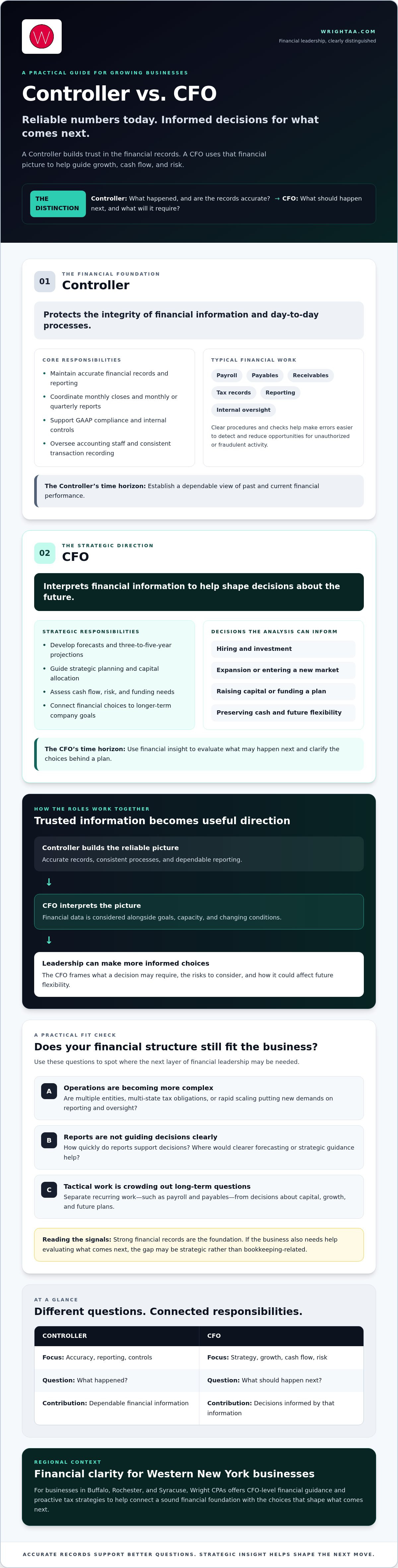
A Controller focuses on the integrity of financial records, reporting, and day-to-day financial processes. A CFO looks ahead, using those numbers to guide decisions about growth, cash flow, and risk. As a business expands, the distinction matters. Multi-state tax obligations and changing operational demands can make reliable reporting essential, while still leaving owners without a clear direction for what comes next.
This article explains the roles, offers a practical framework for deciding which level of financial leadership fits your next stage, and shows how to bridge the gap between bookkeeping and strategy. For businesses in Buffalo, Rochester, and Syracuse, CFO guidance can connect a sound financial foundation to the choices that shape what comes next.
Key Takeaways
- To understand controller vs CFO what's the difference, compare each role’s focus: financial accuracy and reporting versus forward-looking decisions and growth strategy.
- Use the complexity of your operations, such as multiple entities or rapid scaling, to assess whether your current financial structure still fits.
- Review how quickly your reports support decisions, then identify where clearer forecasting or strategic guidance could help.
- Separate tactical financial work, such as payroll and payables, from the longer-term questions that shape capital and growth.
- Wright CPAs offers CFO-level financial guidance and proactive tax strategies to help businesses in Buffalo, Rochester, and Syracuse build greater financial clarity.
Controller vs CFO: What's the Difference in Financial Leadership?
A stable financial department needs both a sound foundation and a plan for what to build next. The Controller protects the reliability of the information the business uses; the CFO interprets that information to help shape its direction. These are distinct responsibilities, not competing ones. Together, they connect disciplined financial operations with intentional decisions about growth.
So, controller vs CFO what's the difference in practice? It’s the difference between ensuring the numbers accurately describe the business and using those numbers to evaluate what the business should do next. For a growing company in Buffalo, Rochester, or Syracuse, both perspectives can matter as operations and decisions become more complex.
The Controller: Ensuring the Integrity of the Foundation
The Controller is responsible for the structure beneath financial reporting. That can include maintaining accurate records, coordinating monthly closes, supporting compliance with generally accepted accounting principles (GAAP), and overseeing internal controls. The role may also involve managing accounting staff and ensuring transactions such as payroll, payables, and receivables are recorded consistently.
This work is more than keeping books tidy. Clear procedures and appropriate checks can make errors easier to detect and reduce opportunities for unauthorized or fraudulent activity. A Financial comptroller is associated with accounting oversight and financial reporting, responsibilities that help establish a dependable view of the company’s past. That view gives owners a firmer basis for understanding performance and asking better questions.
The CFO: Designing the Path to Long-Term Success
The CFO works from that financial foundation to consider what lies ahead. Strategic planning, capital allocation, and risk management depend on understanding what the numbers reveal, as well as exercising judgment about the company’s goals, capacity, and changing conditions. The CFO translates financial data into business insight that can inform choices about hiring, investment, expansion, or preserving cash.
As a strategic partner to the CEO, the CFO helps connect those choices to the company’s longer-term direction. Rather than simply presenting a report, they can frame the decision it raises: what resources will it require, what risks should be considered, and how might it affect future flexibility?
The roles work best when information moves between them. The Controller helps establish trustworthy reporting; the CFO uses it to guide decisions and can bring new questions back to the finance function. This is why adding financial leadership isn’t simply about adding another title. It’s about connecting accurate records to timely, informed action, helping a growing Western New York business make decisions with greater intention.
Operational Precision vs. Strategic Direction: Core Differences in Execution
The distinction between a Controller and a CFO is clearest in how each uses financial information. A Controller helps establish what has happened and whether the records accurately reflect it. A CFO uses that reliable picture to consider what may happen next and which decisions could move the business toward its goals. Understanding controller vs CFO what's the difference means looking beyond task lists to the different time horizons and questions each role serves.
Controllers typically focus on recurring financial rhythms: recording transactions, coordinating payroll and accounts payable and receivable, and preparing monthly or quarterly reports. Their work supports internal oversight, accurate tax records, and reporting that can be shared with lenders or other stakeholders. The emphasis is on consistency and a dependable account of past performance.
CFOs work with a longer view. They may develop forecasts and three-to-five-year projections, evaluate how much capital a plan could require, and consider how a business might fund expansion. Their analysis can help leaders assess options such as raising capital, entering a new market, or adjusting operations. The CFO’s role is not simply to produce a larger report; it is to clarify the choices behind it.
Data Management vs. Data Interpretation
A Controller helps ensure the profit and loss statement (P&L) is complete and accurate, with income and expenses assigned to the right periods and categories. The CFO then interprets that P&L in context. If a product line’s costs are rising or a location is consistently underperforming, the CFO can help leadership examine the causes and consider whether to adjust pricing, staffing, or operations. The Controller strengthens the data; the CFO turns it into a decision-making tool.
Financial intentionality is the practice of using reliable financial information to make deliberate choices that connect day-to-day operations with long-term business aims.
Risk Mitigation vs. Opportunity Identification
Both roles help protect the business, but from different angles. The Controller supports accurate records, tax compliance, and organized documentation that can help a company respond to information requests. The CFO considers broader financial exposure, weighs trade-offs, and looks for ways to improve efficiency or pursue higher-margin opportunities. Potential acquisitions may also enter the discussion when they fit the company’s strategy and resources.
Protecting assets and pursuing opportunity are not opposing goals. Reliable reporting gives leaders a clearer view of risks; thoughtful analysis helps them decide which opportunities are worth exploring. For businesses in Buffalo, Rochester, and Syracuse weighing a next step, CFO-level financial guidance can help connect operational clarity with forward-looking decisions.
Evaluating the Threshold: When Does Your Business Outgrow a Controller?
There isn’t a single revenue figure that signals when a business needs CFO-level guidance. Complexity is often a more useful measure. A company may have accurate books and still lack the analysis to coordinate several entities, understand inventory costs, or plan for rapid expansion. The threshold arrives when financial reporting describes the business clearly but doesn’t help leadership decide what to do next.
For businesses in Buffalo, Rochester, and Syracuse, growth can bring new operating questions: Are employees working across state lines? Do separate locations or entities need clearer financial reporting? Are changing operations making existing accounting methods less useful for management? These questions merit careful review. Their implications depend on the business’s circumstances, so tax and accounting decisions should be considered with qualified guidance.
Complexity Triggers in Modern Business
Some changes place new demands on the accounting function. A remote workforce may prompt questions about where employees work and what tax obligations apply. Multiple entities can make it harder to see performance across the whole business. Inventory-heavy operations may need more detailed cost tracking, while a move from cash-basis to accrual-basis accounting can change how leaders understand revenue, expenses, and obligations over time.
These shifts don’t automatically mean a company needs a full-time CFO. They do signal a need to examine whether the current financial structure can support sound decisions. Tracking a focused set of financial KPIs for small business can help owners see whether reporting answers practical questions about cash flow, profitability, and operating performance.
The Cost of a CFO Gap
The “CFO gap” appears when the business has reliable records but no one has the capacity or mandate to connect them to forward-looking choices. Owners may miss opportunities to plan taxes proactively, commit cash without understanding the effect on upcoming needs, or consider a major acquisition without modeling its financial demands. These are risks to evaluate, not inevitable outcomes of growth.
Watch for signs that your team is stretched beyond transactional work:
- Reports arrive, but leaders still lack a clear view of future cash needs.
- Important operating decisions rely on instinct because financial scenarios aren’t available.
- Tax planning happens reactively rather than as part of broader business decisions.
- Potential expansions or acquisitions are discussed without a clear picture of their financial impact.
If you’re asking, controller vs CFO what's the difference, consider whether your need is stronger financial control or better decision support. A Controller helps keep the financial foundation sound. CFO-level guidance can help when accurate books alone no longer provide enough direction for the next stage of growth.
Designing Your Financial Department: A Framework for Growth
Choosing the right financial structure starts with the work your business needs done, not a title alone. Use this framework to locate the gap between reliable financial operations and the guidance required for your next decisions.
- Audit reporting and decision speed. Check whether reports arrive in time to guide choices and whether they answer the questions leaders actually face.
- Name the strategic gaps. Identify what’s missing, such as cash flow forecasts, scenario analysis, or financial input before expansion decisions.
- Consider the right level of leadership. Decide whether those needs call for a Controller, CFO guidance, or a combination of both.
- Connect tax strategy to the plan. Consider tax implications as part of broader financial decisions rather than treating tax planning as a separate, last-minute task.
- Set a review rhythm. Establish regular conversations to review results, update forecasts, and turn emerging questions into deliberate action.
The Fractional CFO: Strategic Guidance with a Flexible Structure
A fractional CFO can provide strategic financial guidance without adding a full-time CFO role. This can suit a business whose leadership needs have outgrown bookkeeping but don’t yet call for a full-time executive. A fractional partner may also bring perspective from work with different companies and industries. The fit depends on the business’s needs, the partner’s experience, and the scope of the engagement.
For Buffalo businesses considering this approach, outsourced CFO services in Buffalo offer a model to explore. Wright CPAs provides CFO-level financial guidance through fixed-fee monthly accounting and advisory retainers. Before engaging any fractional CFO, clarify what decisions and deliverables the arrangement is intended to support.
Bridge the Gap with Technology and Talent
Accounting software can help organize records and automate parts of routine financial workflows. That may give an accounting team more room for review and analysis, but technology doesn’t replace the judgment required to interpret results, weigh risk, or advise leadership. The tools are part of the structure; experienced people help determine how to use the information.
A proactive financial relationship makes space to discuss concerns before they become urgent. If your business is ready to connect reporting, tax strategy, and forward planning, explore CFO services for your business. The aim is a financial department designed around the decisions ahead, not simply the transactions already completed.
Elevating Your Business Strategy with Wright CPAs
Reliable financial records and forward-looking decisions belong in the same structure. Wright CPAs provides CFO-level financial guidance and proactive tax strategies for business owners in Buffalo, Rochester, and Syracuse who want to move beyond basic bookkeeping toward greater financial clarity. The aim is to connect accurate financial information with decisions that reflect the business’s long-term goals.
That connection gives the question controller vs CFO what's the difference a practical answer: a sound financial foundation matters, but it also needs interpretation and direction. CFO guidance can help owners consider how cash flow, tax strategy, and growth plans fit together. For Buffalo businesses, business tax planning in Buffalo is one part of that broader financial design, not simply a task reserved for filing season.
A Partnership Rooted in Clarity
A once-a-year tax preparation relationship may address filing needs, but business decisions arise throughout the year. Ongoing advisory creates space to review financial information and consider questions before they become urgent. The right cadence and scope depend on the business, its goals, and the advisory arrangement.
Local context matters, too. A business operating in Western New York makes decisions within its own industry, community, and operating environment. Financial guidance grounded in that context can help owners consider how a proposed change fits their circumstances rather than relying on a generic template. Wright CPAs works with closely held businesses and law firms, bringing specialized accounting experience to its financial guidance.
Next Steps: Toward a More Intentional Future
A first conversation can clarify what’s working, where financial visibility is limited, and which decisions need better support. Beforehand, gather recent financial reports and note the questions you want guidance to address. You don’t need to have every answer; identifying the uncertainty is a useful beginning.
The first 90 days of a new advisory relationship can be approached as a period for establishing priorities: understanding the current financial picture, agreeing on the questions to address, and setting a review rhythm. That is a practical framework, not a fixed timeline or promised process. The resulting roadmap should reflect your business’s goals, resources, and pace of growth.
For a measured next step, schedule a conversation to design your financial future. The purpose is to explore whether CFO-level guidance and proactive tax strategy fit your business’s needs, and how they might support a more intentional financial foundation.
Build a Financial Foundation for What Comes Next
The right financial leadership depends on what your business needs now and where it intends to go. The Controller helps maintain accurate, dependable financial records. CFO guidance builds on that foundation to connect financial information with thoughtful decisions about growth, cash flow, and risk. That’s the practical answer to controller vs CFO what's the difference: one safeguards the clarity of the financial picture, while the other helps use it to shape the road ahead.
For business owners in Buffalo, Rochester, and Syracuse, Wright CPAs brings CFO-level guidance and proactive tax strategies into a more intentional financial plan. Fixed-fee monthly accounting and advisory retainers provide a defined structure for ongoing support, with specialized expertise for law firms and closely held businesses.
If your reports are accurate but leave important decisions unanswered, consider what strategic financial guidance could make possible. Design your financial future with Wright CPAs' CFO services and take a considered step toward a clearer path for your business.
Frequently Asked Questions
What is the primary difference between a Controller and a CFO?
A Controller focuses on accurate financial records and reporting, while a CFO uses financial information to help guide future decisions. The Controller may oversee bookkeeping, monthly closes, and internal financial processes. A CFO may help evaluate cash flow, growth plans, and financial risks. In short, one role establishes a reliable picture of performance; the other interprets that picture to support the business’s direction.
Can one person perform both the Controller and CFO roles?
Yes. At a smaller company, one person may handle accounting oversight while also advising leadership on forecasts and business decisions. As the organization grows, the workload and complexity can make those responsibilities difficult to balance. Consider whether the person has enough time and relevant expertise for both accurate financial operations and forward planning. The right arrangement depends on the company’s needs, not simply its size.
At what revenue level should a Buffalo business hire a CFO?
There isn’t a universal revenue threshold for hiring a CFO. A Buffalo business may need CFO-level guidance when operational complexity or important decisions outgrow the support its current financial team can provide. Consider whether you need help forecasting cash, evaluating expansion, or understanding financial risks. Businesses in Buffalo, Rochester, and Syracuse can assess the complexity of their operations and decision-making needs rather than rely on a single revenue figure.
What are the specific qualifications for a Controller vs. a CFO?
There’s no single qualification checklist that applies to every Controller or CFO position. Employers commonly look for accounting and financial expertise for both roles, then weigh experience according to the work. A Controller needs strengths in accurate reporting, accounting processes, and financial controls. A CFO also needs the judgment to interpret financial results, communicate with leadership, assess trade-offs, and help shape strategy. Clarify the responsibilities before setting hiring criteria.
How much does a fractional CFO cost compared to a full-time hire?
Costs vary with the scope of work, experience, and engagement structure, so a reliable comparison requires proposals based on your needs. A full-time hire involves employing an executive; a fractional arrangement provides CFO guidance under an agreed scope without creating a full-time role. Wright CPAs offers fixed-fee monthly accounting and advisory retainers. Ask prospective providers what the retainer includes, how responsibilities are defined, and how fees may change if needs expand.
Does my law firm need a Controller or a CFO for IOLTA compliance?
The right support depends on whether your immediate need is accurate accounting processes or broader financial decision-making. A Controller-level function can help maintain organized records and financial reporting, while a CFO can advise on cash flow and planning. IOLTA requirements are specific, so confirm applicable obligations and procedures with qualified legal and accounting professionals. Wright CPAs provides specialized accounting for law firms, but financial leadership should complement, not replace, required compliance guidance.
What are the common mistakes when hiring a financial leader for the first time?
A common mistake is hiring for a title before defining the business problem. Another is expecting one person to manage daily accounting, improve reporting, and lead strategy without clarifying priorities or available capacity. Write down the decisions you need support with, the responsibilities that must remain covered, and the outcomes you expect. For a business in Western New York, also consider whether the candidate understands its industry and operating context.
How does a CFO assist with New York State business tax planning?
A CFO can help connect tax planning with broader business decisions by considering how growth, cash flow, and financial plans may affect tax strategy. They can work with tax professionals to identify questions that merit review and incorporate planning into the company’s decision-making rhythm. The details depend on the business’s structure and circumstances. For specific New York State tax obligations, consult a qualified tax professional familiar with your situation.


