

Severe lake-effect storms do not create cash flow crises across Western New York; uncalibrated financial structures do. For regional business owners, managing seasonal cash flow in WNY often feels like an exhausting collision between relentless overhead and climate-driven revenue drops. When winter deepens, receivables slow, and fixed operational payroll runs headlong into quarterly New York State tax estimates, the balance sheet strain is tangible. Relying on high-interest credit lines to survive regional shoulder seasons is a stressful reaction, not a sustainable design.
Seasonal volatility isn't an unavoidable crisis. It's an environmental condition you can build around with foresight and discipline. In this guide, discover how Western New York businesses build resilient, weather-tested cash flow architectures that endure winter troughs and capitalize on warm-weather surges. We'll outline how to establish a 13-week rolling cash flow framework, smooth payroll and vendor obligations across all twelve months, and safeguard critical working capital reserves through proactive tax strategy.
Key Takeaways
- Build a dynamic 13-week liquidity forecast that separates fixed overhead from elastic operational costs, fundamentally redefining your approach to managing seasonal cash flow in WNY.
- Understand how regional lake-effect weather cycles compress revenue horizons, and adapt working capital structures before receivables slow down.
- Deploy disciplined cash reserve strategies and renegotiated vendor terms to eliminate dependence on expensive short-term lines of credit during regional shoulder months.
- Harmonize quarterly New York State estimated tax payments and safe harbor provisions with actual seasonal revenue timing to safeguard lean-season liquidity.
- Transition from reactive year-end accounting to ongoing financial oversight that smooths payroll and vendor obligations across all twelve months.
The Anatomy of Western New York Seasonality: Understanding Regional Revenue Waves
Every commercial ecosystem responds to its natural environment. In Western New York, climate acts as a direct economic governor. For enterprises across Erie, Monroe, and Onondaga counties, operational velocity does not move in a straight, predictable line. Instead, it rises and contracts in deep, rhythmic waves shaped by geography. Successfully managing seasonal cash flow in WNY requires recognizing that these climate shifts are not random interruptions. They are structural conditions that demand deliberate financial architecture.
When organizations treat seasonal compression as an acute emergency rather than an environmental parameter, they turn to reactive borrowing. Expensive commercial credit lines then erode margins. Sustainable liquidity begins by viewing treasury planning not as an annual scramble, but as a permanent, calibrated framework built to withstand regional weather cycles.
Regional Climate and Economic Drivers in Buffalo, Rochester, and Syracuse
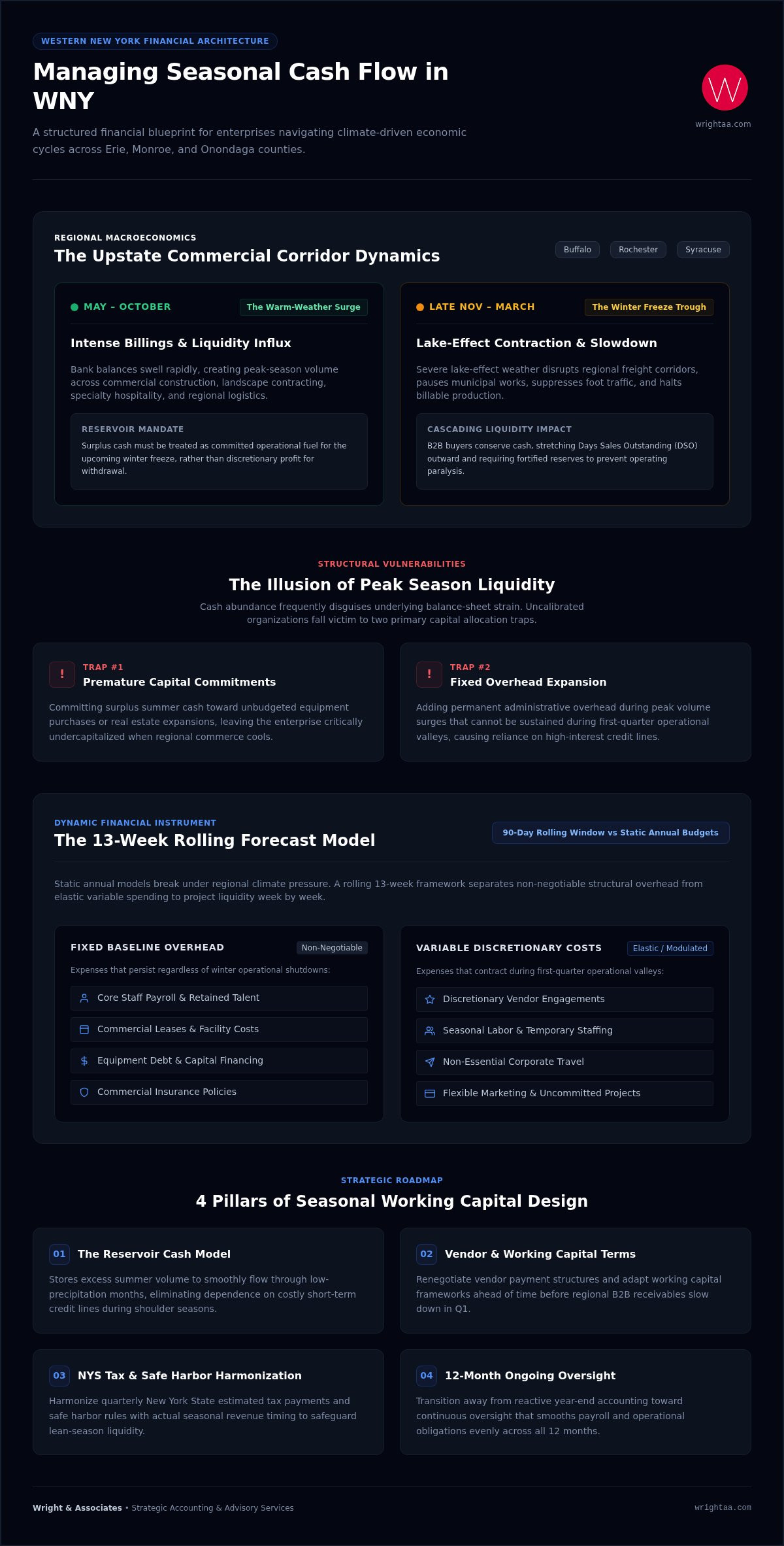
The operational window across the Upstate commercial corridor contracts sharply each winter. Lake-effect weather systems consistently disrupt regional freight corridors, pause municipal works, and suppress foot traffic. For industries like commercial construction, landscape contracting, specialty hospitality, and regional logistics, billable production often slows from late November through March.
This climate drag creates a cascading liquidity effect. As regional buyers conserve their own cash to endure the freeze, payment velocity drops across business-to-business supply chains. Days sales outstanding (DSO) stretch outward. Mastering regional working capital management requires planning for this synchronized regional hesitation, ensuring receivables delays do not paralyze your own operating capacity.
The Illusion of Peak Season Liquidity
Cash abundance can disguise structural vulnerability. Between May and October, Western New York businesses frequently experience an intense surge in billings and collections. Bank balances swell, creating a deceptive impression of permanent liquidity.
A resilient financial framework depends on avoiding two common balance-sheet traps:
- Premature capital commitments: Committing surplus summer cash toward unbudgeted equipment purchases or real estate expansions, leaving the business undercapitalized when regional commerce cools.
- Fixed overhead expansion: Adding permanent administrative overhead during peak volume that cannot be sustained during first-quarter operational valleys.
Liquidity functions much like a physical reservoir. It stores excess volume during regional surges so the enterprise flows uninterrupted through low-precipitation months. When mastering the art of managing seasonal cash flow in WNY, disciplined business leaders treat peak-season capital as committed operational fuel for the coming freeze, rather than discretionary profit ready for immediate withdrawal.
Designing a 13-Week Rolling Cash Flow Forecast for Climate-Impacted Markets
Static annual budgets break under climate pressure. An annual model assumes a linear trajectory that Western New York winters quickly dismantle. True operational stability requires a dynamic 13-week rolling forecast. This ninety-day window acts as a responsive instrument, projecting liquidity week by week as conditions shift. By continuously refreshing this rolling timeline, managing seasonal cash flow in WNY transforms from an anxious guessing game into a disciplined architectural practice.
Step 1: Mapping Fixed Baseline Overhead Against Variable Discretionary Costs
A resilient forecast begins by separating structural obligations from elastic spending. Non-negotiable costs, including core staff payroll, commercial leases, equipment debt, and insurance, persist regardless of seasonal interruptions. Categorize variable expenses that can contract during the first quarter, such as discretionary vendor engagements, seasonal labor, and non-essential travel. Monitoring these thresholds alongside proven financial KPIs for small business clarifies the exact working capital buffer needed to sustain sixty days of subdued receipts.
Step 2: Calibrating Receivables Aging to Regional Payment Behaviors
Receivables do not age uniformly throughout the year. Days sales outstanding often stretch when regional peers conserve their own liquidity during harsh weather. Factor this regional drag into your forecast by applying realistic probability adjustments to outstanding balances rather than assuming full, timely remittance. To defend operational velocity, replace traditional net-60 terms with structured progress billings and automated retainer schedules that ensure steady capital inflows.
Step 3: Establishing the Weekly Review Discipline
A liquidity forecast is a living blueprint, not an archived spreadsheet. Reserve thirty minutes every Monday morning to reconcile projected numbers with actual bank activity. This disciplined cadence reveals emerging cash shortfalls three to six weeks before they strain core operations. Maintaining this standard requires structured oversight, much like the systems outlined in our guide to small business accounting in Buffalo, NY. For leadership teams seeking rigorous financial control, partnering with Wright CPAs, LLC for ongoing cash flow management provides the visibility required to operate with quiet confidence through every seasonal transition.
Comparing Strategic Solutions for Managing Seasonal Working Capital Deficits
Tension between incoming receipts and recurring overhead tests the structural integrity of any business. When winter tightens liquidity, leadership teams instinctively seek relief. Yet the nature of that relief dictates whether an organization gains lasting independence or accumulates compounding financial drag. Successfully managing seasonal cash flow in WNY demands a deliberate balance across four primary levers: internal capital reserves, pre-negotiated credit facilities, vendor term realignments, and counter-seasonal revenue agreements.
Internal Capital Preservation vs. External Debt Financing
External borrowing often looks like the most accessible path across an off-season trough. In practice, revolving debt carries real carrying costs that quietly erode operational margins. Relying on high-interest credit lines to finance predictable winter slowdowns converts a regular climate cycle into an expensive recurring liability.
Disciplined capital preservation offers a far more stable foundation. Building a dedicated cash reserve, calibrated to cover two to three months of non-negotiable overhead, insulates core operations without compromising autonomy. When tapping this reserve during deep winter months, treat it as an internal line of credit. Establish explicit repayment schedules that replenish the reserve from early second-quarter inflows before approving discretionary distributions. If commercial credit lines remain part of your capital mix, secure them during peak summer liquidity. Financial institutions extend the most favorable terms when statements demonstrate peak operating strength, not mid-winter strain.
Strategic Vendor Alignments and Counter-Seasonal Revenue Models
Liquidity design extends beyond internal balance sheets into commercial relationships. Upstream suppliers and downstream clients can both act as stabilizing elements across cyclical contractions.
Two commercial adjustments effectively smooth operating volatility:
- Procurement term renegotiation: Leverage substantial summer purchasing volumes to negotiate extended payment terms for early-year deliveries. Major suppliers frequently grant 60-day or 90-day winter grace periods when anchored to high-volume warm-weather orders.
- Counter-seasonal agreement design: Convert cyclical project fees into twelve-month service agreements. Introducing winter inspection programs, preventative maintenance packages, or off-season advisory retainers transforms dormant winter capacity into predictable monthly baseline revenue.
By pairing internal reserves with restructured commercial agreements, managing seasonal cash flow in WNY ceases to be a scramble for liquidity. It becomes a quiet, repeatable operating rhythm.
Harmonizing New York State Tax Obligations with Seasonal Cash Realities
State tax compliance frequently clashes with seasonal liquidity. In New York, statutory estimated tax deadlines follow rigid calendar dates that ignore regional weather patterns. For an enterprise experiencing severe winter revenue compression, remitting a standard quarterly tax voucher in mid-January can trigger an immediate capital drought. Effectively managing seasonal cash flow in WNY requires integrating tax liabilities directly into your working capital architecture, ensuring that compliance never dismantles baseline operational stability.
Managing NYS Quarterly Estimated Taxes During Revenue Contractions
Default quarterly tax vouchers assume equal earnings across four calendar periods. For cyclical Western New York businesses, paying equal installments forces the business to remit taxes on income it has not yet collected. Navigating New York State Department of Taxation and Finance rules with precision requires utilizing the annualized income installment method. This mechanism calculates estimated payments based on actual cumulative earnings to date, protecting winter cash when revenues contract.
Pairing this method with statutory safe harbor benchmarks safeguards your reserves against underpayment penalties while preventing premature capital drain. Integrating these methods alongside established frameworks for business tax planning in Buffalo, NY ensures that tax liabilities scale in direct proportion to realized seasonal cash.
Timing Deductions, Capital Investments, and Pass-Through Entity Taxes
Tax timing must mirror actual cash availability. Executing capital investments or electing Section 179 and New York State depreciation deductions should occur during peak third-quarter liquidity, when excess operating income can fund improvements without straining working capital.
Similarly, the New York State Pass-Through Entity Tax (PTET) provides valuable entity-level deductions for owners, but its payment schedule demands deliberate orchestration:
- Liquidity-aligned estimated remittances: Schedule optional PTET payments during high-cash months rather than depleting thin winter reserves.
- Synchronized credit utilization: Align state tax credits with personal tax returns so distributions stay balanced throughout the year.
Coordinating regulatory compliance with environmental business cycles prevents cash panics. When managing seasonal cash flow in WNY, proactive strategy replaces administrative surprise. To insulate your balance sheet and structure your tax obligations around regional revenue cycles, schedule a strategic tax consultation with Wright CPAs.
Institutionalizing Stability: Building an Ongoing Financial Architecture
Perpetual stability is rarely an accident. It is designed. When leadership teams treat liquidity as an annual emergency solved each spring, they remain trapped in a reactive posture. Seasonal equilibrium requires transforming treasury oversight into an ongoing operational discipline. When managing seasonal cash flow in WNY, long-term resilience emerges from replacing crisis intervention with permanent structural governance.
The Role of Ongoing Monthly Advisory vs. Annual Compliance
Traditional accounting compliance looks backward at history. Filing tax returns months after a fiscal year closes does nothing to safeguard capital during a difficult January freeze. Fixed-fee monthly advisory models dismantle the friction of hourly billing, fostering continuous dialogue between business owners and seasoned accounting advisors.
Maintaining clean ledger hygiene week after week ensures rolling forecasts reflect verifiable bank realities, not wishful estimates. When executive teams establish consistent monthly review cadences, operational bottlenecks become visible well before they threaten core commitments like payroll or vendor accounts.
Designing Long-Term Enterprise Resilience in Western New York
True enterprise durability extends past a single twelve-month calendar. A well-designed balance sheet withstands multiple economic tides and localized weather events through multi-year capital pacing. By establishing structured lines of communication with regional lenders while cash reserves are robust, organizations secure favorable terms long before seasonal troughs appear.
Strategic leadership harmonizes payroll schedules, tax obligations, and operating capital into a cohesive growth engine, as detailed in our analysis of outsourced CFO services in Buffalo, NY. Businesses that master managing seasonal cash flow in WNY don't wait for winter storms to reveal structural balance sheet vulnerabilities; they build environmental safeguards into their operating model year-round. Engage Wright CPAs to design a resilient, weather-tested financial architecture tailored to your commercial vision.
Constructing Sustainable Liquidity for the Seasons Ahead
Regional weather cycles will always shape commerce across Upstate New York. Winter freezes and mid-year surges don't have to dictate your operational peace of mind. By replacing reactive credit lines with rolling thirteen-week forecasts, disciplined working capital buffers, and synchronized tax planning, managing seasonal cash flow in WNY transforms into an exercise in control rather than survival.
Sustainable stability isn't built in isolation. Founded in 2012 by professional Certified Public Accountants, Wright CPAs guides growing enterprises across Buffalo, Rochester, and Syracuse through disciplined treasury and tax strategy. Through specialized fixed-fee advisory retainers that ensure predictable year-round costs, our team provides the continuous financial oversight required to protect your balance sheet across every seasonal turn. When you establish the right structural foundation, your enterprise moves forward with calm confidence through any winter. Design your seasonal financial architecture with Wright CPAs.
Frequently Asked Questions
Why is seasonal cash flow management uniquely challenging for Western New York businesses?
Western New York commerce experiences an acute weather contraction caused by lake-effect winters that compress field operations, delay regional supply chains, and slow payment collections across Buffalo, Rochester, and Syracuse. Fixed overhead remains steady while top-line revenue temporarily contracts. Successfully managing seasonal cash flow in WNY requires anticipating these localized regional slowdowns rather than treating them as unexpected emergencies.
What is a 13-week rolling cash flow forecast, and how does it prevent seasonal insolvency?
A 13-week rolling cash flow forecast is a dynamic ninety-day treasury model that projects weekly cash inflows and disbursements based on current operating realities. Unlike static annual budgets, it updates continuously every week. This mechanism exposes upcoming liquidity deficits four to six weeks before they occur. It gives leadership the clear window needed to delay discretionary expenditures, accelerate billing collections, or draw on pre-arranged facilities without panic.
How should I handle New York State quarterly estimated tax payments if winter revenue plunges?
You should utilize the annualized income installment method rather than submitting default equal payments on standard statutory deadlines. When first-quarter earnings drop significantly below annual projections, calculating your required tax voucher on actual year-to-date income prevents remitting capital on earnings you haven't received. Pairing this with New York safe harbor provisions preserves winter liquidity while ensuring you avoid underpayment penalties from the Department of Taxation and Finance.
How much cash reserve should a seasonal business in Buffalo or Rochester maintain?
A seasonal business in Western New York should maintain an operating reserve equal to two to three months of fixed baseline overhead. Calculate this reserve strictly using non-negotiable obligations, such as core payroll, commercial rent, utilities, and essential debt service, rather than average gross revenue. Building this liquidity cushion during summer revenue peaks insulates the business from regional winter slowdowns without requiring expensive short-term financing.
When should a seasonal business apply for a commercial line of credit?
Apply for a commercial credit line during peak revenue months when balance sheets show maximum liquidity and trailing profitability. Lenders in Buffalo and Rochester extend the most favorable rates when debt service coverage ratios are strongest. Securing financing during warm-weather surpluses provides an unencumbered emergency backstop. Approaching banks mid-winter during a cash crunch leads to restrictive covenants, higher interest rates, or potential underwriting rejection.
Can changing my business pricing or billing model eliminate winter revenue troughs?
Yes, restructuring one-time project billings into annual retainers or flat monthly service agreements significantly smooths cyclical revenue valleys. Many businesses convert peak seasonal services into comprehensive twelve-month contracts, blending winter preventative maintenance or early-spring preparation into equal monthly installments. This approach establishes predictable baselines, stabilizing monthly collections and fundamentally easing the challenge of managing seasonal cash flow in WNY.
What is the difference between seasonal bookkeeping and fractional CFO cash management?
Seasonal bookkeeping is historical, focusing on categorizing past transactions, reconciling accounts, and preparing balance sheets for tax filing. Fractional CFO cash management is forward-looking and strategic. It designs dynamic liquidity forecasts, optimizes working capital cycles, models multi-year capital pacing, and structures tax planning around seasonal revenue fluctuations. Bookkeeping records what happened; fractional CFO leadership directs where the balance sheet must go next.


