

A growing roster of advisory clients can easily mask the quiet erosion of engagement margins. When generalist bookkeepers misclassify pass-through expenses and lump retainers into generic income, true project profitability becomes pure guesswork. You know the tension of managing unbilled scope creep and delayed milestone invoicing while wondering why robust billings don't reflect in your cash reserves. Securing tailored bookkeeping for consulting firms Buffalo practices depend on means moving past reactive data entry and building an intentional financial structure.
Discover how specialized bookkeeping clarifies engagement margins, streamlines cash flow, and drives sustainable advisory growth. With disciplined project accounting, you gain immediate visibility into individual realization rates, consultant utilization, and true overhead costs. This buyer's guide examines how to evaluate an accounting partner in Western New York who can unite daily transaction tracking with cash flow forecasting and proactive tax strategy.
Key Takeaways
- Discover why consulting practices require project-based accounting structures rather than standard cash-basis recordkeeping to protect engagement margins.
- Identify the critical evaluation criteria for choosing bookkeeping for consulting firms Buffalo practices need to monitor realization rates, unbilled work, and consultant utilization.
- Weigh the operational overhead and recruitment burden of an in-house hire against the predictable stability of an outsourced, fixed-fee monthly retainer.
- Master a phased transition methodology that audits legacy records and aligns daily transaction feeds without disrupting billable client work.
- Learn how connecting routine transaction tracking directly to cash flow management and tax strategy creates an enduring framework for firm growth.
Why Generic Bookkeeping Fails Modern Consulting Practices
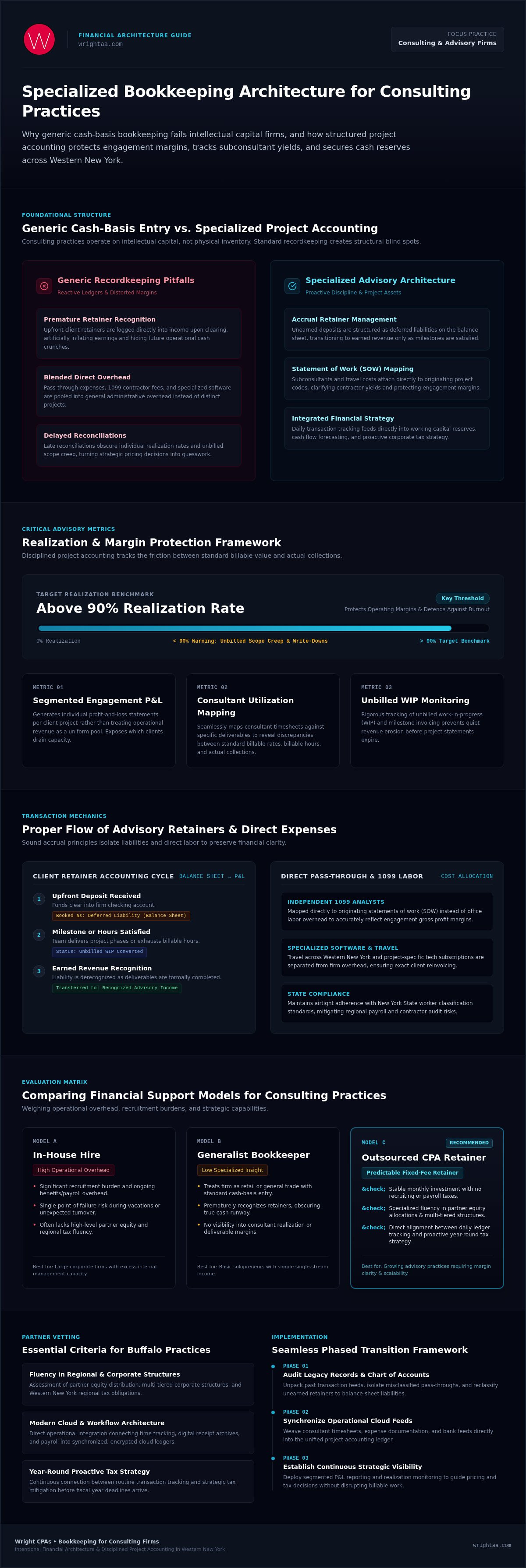
A consulting practice operates on intellectual capital, not physical inventory. While the historical fundamentals of bookkeeping center on balancing debits and credits, professional advisory firms require a deliberate financial architecture. Generic recordkeeping merely logs cash movements after they settle. It treats all revenue as a uniform stream and records operational spending as an undifferentiated pool.
In professional services, that lack of depth creates immediate structural blind spots. When direct engagement expenses blend into routine office overhead, leadership can't determine which client engagements generate healthy margins and which drain staff capacity. Delayed monthly reconciliations obscure individual consultant realization rates, turning strategic pricing decisions into guesswork. Foundational data must do far more than balance a ledger; it informs working capital reserves and shapes proactive corporate tax strategy before deadlines arrive. Implementing precise bookkeeping for consulting firms Buffalo practices depend on ensures every project is treated as a distinct, measurable financial asset.
The Friction of Billable Hours, Retainers, and Milestone Billing
Upfront retainers create immediate financial obligations, not immediate revenue. Generic bookkeepers often categorize client deposits directly to income the moment funds clear the bank account. This premature recognition artificially inflates current earnings and masks future operational cash crunches. Under sound accrual principles, unearned retainers belong on the balance sheet as deferred liabilities. They transition to recognized income only as your team satisfies project milestones or exhausts billable hours against deliverables. Without rigorous tracking of unbilled work-in-progress, leadership cannot see the friction between billed fees and actual cash collected.
Tracking Pass-Through Expenses and Subconsultant Costs
Advisory engagements routinely involve independent analysts, specialized software subscriptions, and billable travel across Western New York. Misclassifying 1099 contractor payments as general administrative overhead distorts engagement gross profit margins, making unprofitable contracts appear viable. Every pass-through cost and direct labor hour must attach strictly to its originating statement of work. Clean categorization ensures accurate client reinvoicing, clarifies contractor yields, and maintains airtight compliance with New York State worker classification and reporting standards.
Essential Criteria for Evaluating a Consulting Bookkeeper in Buffalo
Selecting an accounting partner for an advisory practice requires looking beyond routine ledger maintenance. The federal SBA guide to managing business finances underlines the value of disciplined financial systems, but consulting models present distinctive complexities. Evaluating providers of bookkeeping for consulting firms Buffalo leaders trust involves assessing their fluency in partner equity allocations, multi-tiered corporate structures, and regional tax obligations across Western New York. The goal is an intentional relationship built on structural precision, not reactive cleanups.
Project-Level Accounting and Utilization Reporting
A qualified partner must produce segmented profit-and-loss statements for individual client engagements. They should seamlessly map consultant timesheets to specific deliverables, exposing discrepancies between standard billable value and actual collections. Monitoring realization benchmarks above 90% helps leadership spot unbilled scope adjustments early. Exploring key metrics outlined in our review of Financial KPIs for Small Business reveals how project-level transparency prevents consultant burnout and defends operating margins.
Modern Cloud Architecture and Workflow Integration
Advisory practices can't afford manual data reentry. Your bookkeeping setup should weave directly into your operational fabric, connecting time tracking, digital receipt archiving, and payroll systems into a synchronized ledger. This integration provides instant visibility into cash positions while safeguarding confidential client files and firm compensation data through secure, encrypted cloud permissions.
Alignment with Year-Round Tax Strategy
Isolated recordkeeping creates an artificial barrier between current operational performance and upcoming tax liabilities. An intentional bookkeeper works in lockstep with tax strategists, ensuring accurate tracking of elections such as the New York Pass-Through Entity Tax (PTET) and timely estimated payments. As detailed in our guide to Strategic Business Tax Planning in Buffalo, NY, real-time ledgers transform tax compliance from a disruptive annual scramble into a disciplined cadence of wealth preservation. If you want to replace administrative friction with quiet, structural clarity, consider exploring how Wright CPAs aligns monthly financial stewardship with long-term firm stability.
Comparing Financial Support Models: In-House vs. Generalist vs. CPA Retainer
Every advisory practice reaches an inflection point where managing internal finances demands a dedicated framework. Choosing how to structure that support defines your operational overhead and operational peace of mind. While generic bookkeeping treats all businesses identically, selecting the right model for bookkeeping for consulting firms Buffalo practices require comes down to balancing structural durability against total cost of ownership. Principles explored in our overview of Small Business Accounting in Buffalo, NY illustrate how intentional systems protect leadership from administrative overload.
The In-House Bookkeeper: Hidden Overhead and Key-Person Risk
Direct employment creates significant unseen commitments. In the Buffalo metro area, average base compensation for an in-house bookkeeper ranges between $48,988 and $57,567 annually. Factoring in statutory payroll taxes, healthcare coverage, paid leave, and software licenses elevates the true employer burden to $60,000 to $75,000 or more. Beyond the balance sheet, an internal employee introduces key-person vulnerability. If that individual resigns midway through a quarterly billing cycle, your firm faces administrative friction and a total void in financial continuity, compounded by the absence of senior technical review.
The Generalist Freelancer: Low Cost vs. Strategic Blind Spots
Engaging a solo freelance bookkeeper often seems economical, but it carries operational compromises. Most generalists lack deep experience with professional advisory firms. They tend to record activity on a simple cash basis, failing to uphold rigorous IRS business recordkeeping standards for complex pass-through client expenses. This disconnect obscures multi-month deliverable costs and leaves leadership without accurate visibility into work-in-progress or future cash allocations.
The Specialized CPA Firm: Structured Clarity on a Fixed-Fee Retainer
Partnering with a dedicated CPA firm establishes a resilient financial foundation. Instead of unvetted transaction logging, this approach anchors day-to-day books inside a broader strategic continuum. Predictable monthly retainers eliminate the anxiety of variable hourly invoices and align routine reconciliations directly with tax planning. By pairing clean ledgers with higher-level advisory, firms can also integrate Outsourced CFO Services in Buffalo, NY, transforming historical financial data into a forward-looking roadmap for intentional growth.
Preparing Your Buffalo Firm for a Seamless Bookkeeping Transition
Transitioning financial oversight should feel like establishing a deliberate foundation, not enduring an operational crisis. For practices upgrading to specialized bookkeeping for consulting firms Buffalo leaders rely on, success begins with a methodical diagnostic audit. Moving away from fragmented spreadsheets or legacy software requires a clear cut-off date. This preserves current client billing cycles while cleaning historical data, ensuring that accounts receivable and unbilled work-in-progress transfer across systems without dropping a single billable hour.
A rigorous migration process follows four essential stages:
- Diagnostic Ledger Review: Uncovering misclassified accounts, unapplied retainers, and stale accounts receivable balances before syncing new ledgers.
- Vendor and Subcontractor Auditing: Collecting Form W-9s and establishing clear 1099-NEC profiles before distributing future contractor disbursements.
- Bank and Clearing Account Synchronization: Verifying that opening balance sheet entries reconcile to exact penny figures across all regional financial accounts.
- Workflow Cadence Alignment: Setting clear monthly close calendars, scheduled reporting dates, and structured invoicing intervals.
Restructuring the Chart of Accounts for Professional Services
Generic account structures lump all payroll and consulting costs together. A modern chart of accounts separates direct project labor from non-billable administrative time, giving firm owners immediate visibility into actual delivery margins. Reimbursable client travel across Western New York must align strictly with active client accounts rather than general operational expenses. Isolating owner compensation and partner draws from core payroll guarantees that your profit metrics reflect true enterprise earnings rather than disguised executive equity transfers.
Standardizing Invoicing and Accounts Receivable Workflows
Cash flow stability requires consistent billing rhythms. Transitioning to structured milestone billing and automated retainer collections reduces days sales outstanding, ensuring your practice operates on client-funded capital rather than relying on credit facilities. Clear dispute resolution terms built into your statements of work prevent invoicing discrepancies from delaying timely vendor payments. To begin architecting a stable financial foundation for your advisory practice, partner with Wright CPAs to establish an intentional, seamless transition strategy.
Designing Financial Clarity: Wright CPAs’ Bookkeeping for Consulting Firms
Financial equilibrium in an advisory practice is never accidental; it is designed. Founded in Buffalo in 2012 by professional certified public accountants, Wright CPAs approaches accounting not as retrospective data logging, but as an intentional financial architecture. For growing practices, sustainable expansion requires uncompromised visibility into engagement margins and working capital. We replace the friction of variable hourly billing with transparent, fixed-fee monthly retainers. This predictable model eliminates invoicing surprises and fosters continuous, honest collaboration throughout the fiscal year.
Our work unites daily ledger precision directly with proactive tax planning, cash flow management, and CFO-level insight. When transactional details connect to broader fiscal strategy, leadership moves from reactive crisis management to deliberate execution. Delivering specialized bookkeeping for consulting firms Buffalo practices rely on means crafting an enduring framework that protects partner earnings and preserves capital across every business cycle.
A Methodical Approach Grounded in Western New York
For more than a decade, Wright CPAs has partnered with professional service firms across Buffalo, Rochester, and Syracuse. We understand the specific rhythm of consulting environments, where human capital is the primary asset and client deadlines govern operational tempo. Our clients engage directly with experienced professionals who prioritize deep listening over hurried solutions. This dedicated relationship delivers calm, transparent reporting that empowers firm owners to make strategic decisions with quiet authority.
The Next Step Toward Strategic Financial Alignment
Establishing structural clarity begins with a focused discovery conversation. We start by conducting a comprehensive diagnostic review of your firm's current accounting infrastructure, balance sheet integrity, and unearned retainer schedules. This methodical assessment uncovers hidden friction points, isolates unbilled scope creep, and reveals opportunities to optimize cash reserves. We invite firm leadership to experience the lasting clarity and confidence that purposeful financial stewardship brings to modern advisory practices.
Architecting a Resilient Financial Foundation for Your Advisory Practice
A thriving consulting practice requires financial systems built with the same precision and intention you bring to client engagements. Moving beyond retrospective data entry unlocks genuine clarity around engagement margins, protects cash reserves from unearned retainer distortions, and eliminates administrative friction. Implementing specialized bookkeeping for consulting firms Buffalo leaders trust transforms the routine general ledger into an active instrument of operational control.
Founded in 2012 by professional Certified Public Accountants in Buffalo, NY, Wright CPAs delivers predictable, fixed-fee monthly accounting retainers without hourly surprises. We unite daily transaction management with proactive tax strategy and fractional CFO guidance, giving your firm the structural equilibrium it needs to scale sustainably. Take the next step toward intentional clarity and Begin a Conversation with Wright CPAs today.
Frequently Asked Questions
How does bookkeeping for consulting firms differ from standard small business bookkeeping?
Consulting bookkeeping centers on project-level financial architecture rather than basic transaction logging. Standard businesses track inventory turns and general operating costs. Advisory firms rely on human capital, requiring exact allocations of billable hours, contractor sub-costs, and unbilled work-in-progress. Implementing tailored bookkeeping for consulting firms Buffalo practices require ensures direct engagement costs don't blend into overhead, revealing true margins for every client statement of work.
Why is cash-basis bookkeeping inadequate for multi-phase consulting engagements?
Cash-basis accounting registers income only when funds deposit and expenses only when cash leaves. In multi-phase advisory contracts spanning months, this timing distortion hides reality. A firm might show artificial windfalls during upfront retainer disbursements, followed by phantom losses while staff deliver the work. Accrual principles match project revenues directly against the labor expenses incurred to produce them, presenting a dependable picture of operational health.
How should retainer payments and milestone deposits be recorded on the balance sheet?
Retainers and milestone deposits must enter your ledger as deferred revenue liabilities on the balance sheet. They are not earned income upon receipt. Funds transition to the income statement only as your consultants satisfy contractual deliverables or log billable hours against the engagement. Treating customer deposits as immediate top-line revenue artificially inflates profitability and exposes the firm to severe cash flow deficits later.
Can our consulting firm transition bookkeepers mid-fiscal year without operational disruption?
Yes, mid-year transitions succeed when guided by a disciplined onboarding protocol and clear cut-off dates. Rather than disrupting daily operations, modern transitions conduct a silent diagnostic review of prior reconciliations and Chart of Accounts structures. Daily client invoicing and vendor payments continue uninterrupted. Once the historical foundation aligns, bank feeds and reporting calendars migrate cleanly without losing a single hour of billable client tracking.
What financial reports should a consulting firm review on a monthly basis?
Advisory practices should examine segmented profit-and-loss statements by engagement alongside standard balance sheet reports. Key monthly metrics include consultant realization rates, employee utilization benchmarks, accounts receivable aging, and unbilled work-in-progress. Reviewing these project-level statements gives firm leadership a granular view of true gross margins, ensuring partner distributions and operational hiring decisions stem from verifiable performance rather than intuitive assumptions.
How does specialized bookkeeping support proactive year-end tax planning?
Specialized bookkeeping keeps general ledgers perpetually reconciled, converting tax planning from an annual scramble into a disciplined quarterly routine. Real-time project data allows CPAs to forecast year-end entity earnings accurately. For Buffalo practices, this structural precision simplifies strategic elections like the New York Pass-Through Entity Tax (PTET), ensuring estimated payments align smoothly with partner income while preserving federal tax deductions throughout the fiscal year.
Why do consulting firms benefit from fixed-fee monthly retainers over hourly billing?
Fixed-fee monthly retainers replace billing uncertainty with calm, predictable financial administration. When evaluating bookkeeping for consulting firms Buffalo leaders value fee clarity that matches their own client engagement structures. Fixed retainers encourage open communication throughout the month, eliminating hesitation over unexpected hourly charges while unifying transactional recordkeeping, cash flow forecasting, and proactive advisory guidance under one cohesive agreement.


