

A single desk in a home office can quietly redraw an organization's legal perimeter. For executive leadership, evaluating the tax implications of remote employees NY operations introduce is no longer an administrative footnote; it is an immediate question of structural exposure. What begins as a flexible telecommuting arrangement can quickly transform into permanent corporate nexus, pulling out-of-state entities directly into the state's exacting tax jurisdiction before leadership identifies the shift.
You already know the administrative friction that accompanies this territory. Sorting through multi-state payroll filings, rising unemployment wage bases, and New York's notoriously aggressive Convenience of the Employer rule often feels like building on shifting ground. This guide gives you the clarity needed to establish a fully compliant payroll framework, eliminate unexpected corporate franchise tax exposure, and safeguard your balance sheet against costly audit assessments. Ahead, we examine the statutory rules, verified 2026 withholding thresholds, and proactive practices required to anchor your workforce securely.
Key Takeaways
- Recognize how a single home workstation can instantly establish physical corporate nexus and extend filing requirements into New York jurisdiction.
- Unpack the state's Convenience of the Employer doctrine to address the operational tax implications of remote employees NY frameworks create for nonresident compensation.
- Structure revenue sourcing properly under Article 9-A rules to prevent remote team distribution from distorting corporate franchise tax liabilities.
- Implement rigorous payroll withholding and unemployment insurance systems to protect your business against misclassification penalties and state inquiries.
- Replace reactionary filings with an intentional, proactive multi-state tax strategy designed to provide structural clarity as your enterprise expands.
Understanding New York Tax Nexus: When Remote Work Crosses State Lines
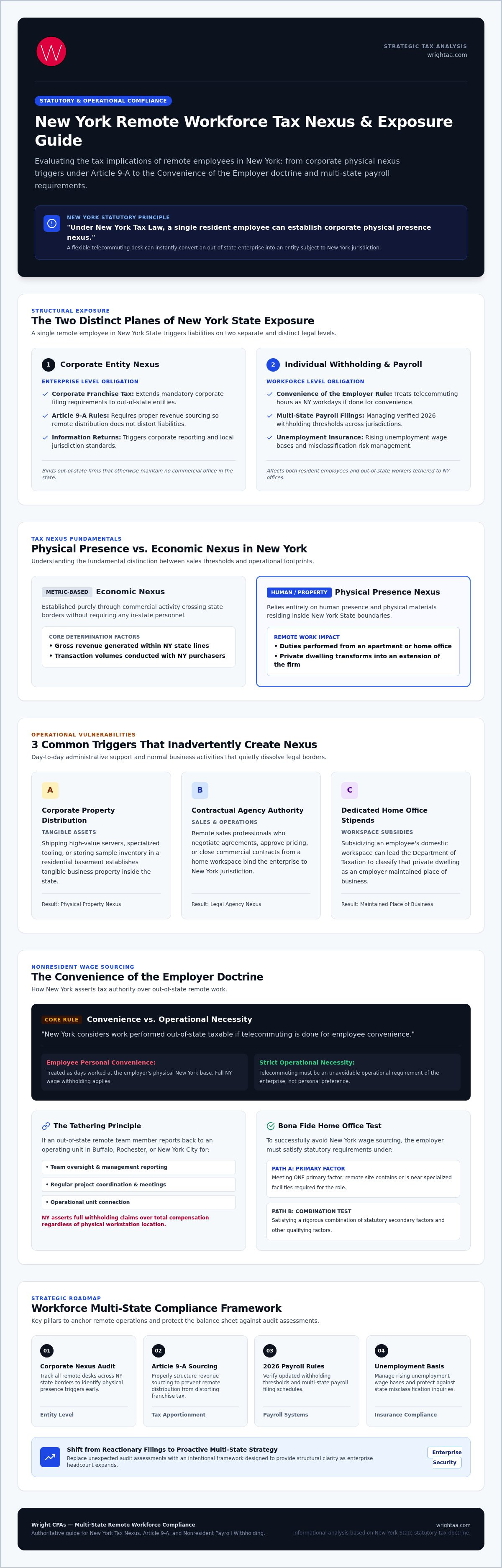
Tax nexus represents the foundational connection between a business and a sovereign taxing authority. It is the precise threshold where operational presence triggers a legal requirement to file returns and remit tax. While temporary travel or incidental client meetings rarely cross this boundary, permanent remote telecommuting fundamentally alters the site. The tax implications of remote employees NY brings forward exist on two distinct planes: individual withholding obligations and corporate entity exposure. "Under New York Tax Law, a single resident employee can establish corporate physical presence nexus." An out-of-state company might believe its footprint remains contained within its home jurisdiction, yet the daily presence of a remote desk within New York State borders quietly dissolves that border.
Physical Presence vs. Economic Nexus in New York State
Economic nexus relies on transaction volumes or gross revenue generated within state lines. Physical nexus, by contrast, relies entirely on human presence and physical materials. When an employee performs regular duties from an apartment in Brooklyn or a home office in Buffalo, that domestic environment becomes an extension of the firm. General state income tax rules for nonresidents govern basic wage withholding, but corporate nexus reaches further, subjecting out-of-state entities to corporate franchise tax filings, information returns, and local jurisdiction standards merely because an employee resides and works here.
Common Triggers That Inadvertently Create Business Nexus
Day-to-day operations contain quiet triggers that cement corporate presence. When evaluating the tax implications of remote employees NY operations demand, consider how ordinary support activities establish an official presence:
- Corporate Property Distribution: Shipping high-value servers, specialized tooling, or maintaining sample inventory in a residential basement establishes tangible business property inside the state.
- Contractual Agency: Remote sales professionals who negotiate agreements, approve pricing, or close contracts from a home workspace bind the enterprise to New York jurisdiction.
- Dedicated Home Office Stipends: Subsidizing an employee's domestic workspace can lead the Department of Taxation to classify that private dwelling as an employer-maintained place of business.
Preventing these uncoordinated activities from eroding your balance sheet requires clear structural sightlines. Grounding your multi-state operations within a thoughtful small business accounting framework brings necessary discipline to workforce expansion, ensuring that hiring talent across borders remains a strategic asset rather than an unintended tax footprint.
The Convenience of the Employer Rule: How NY Taxes Remote Earnings
New York maintains an exceptionally long jurisdictional reach over nonresident wages through its convenience doctrine. At its foundation, "New York considers work performed out-of-state taxable if telecommuting is done for employee convenience." If a team member works remotely by personal preference rather than out of strict operational necessity, the Department of Taxation treats those hours as days worked at the employer's physical base. For firms headquartered in Buffalo, Rochester, or New York City, this creates immediate friction. The tax implications of remote employees NY enterprises manage are not resolved simply by assigning an out-of-state home address to an employee who reports back to an Empire State operating unit.
The state draws a sharp boundary between an assigned home duty station and fully independent remote work. If an individual remains tethered to a New York office for team oversight, meetings, or project coordination, the state asserts full withholding claims over their compensation, regardless of where they physically sit.
The Bona Fide Home Office Test Requirements
To avoid New York wage sourcing, an employer must prove that an out-of-state domestic workspace meets the state's bona fide employer office test. This statutory framework requires meeting either one primary factor or a rigorous combination of secondary and other factors:
- Primary Factor: The remote site contains or is near specialized facilities that cannot physically be replicated at the employer's central facilities, such as specialized scientific laboratories or heavy industrial fabrication equipment.
- Secondary Factors: The employer maintains a separate telephone listing for the home office, pays an explicit fair-market rental fee for the domestic square footage, reimburses home utility expenses directly, and regularly features the remote location as an official corporate branch on marketing collateral.
- Other Factors: The employee carries out core duties exclusively from this space and does not retain a dedicated desk or workstation at the main headquarters.
Standard home offices set up with monitors, desks, and broadband connections routinely fail audit scrutiny because they serve personal flexibility rather than absolute business necessity.
Mitigating Double Taxation Risks for Out-of-State Workers
When New York taxes an out-of-state telecommuter's entire wage base, the employee faces real double taxation risks. Most resident jurisdictions provide credits for taxes paid to other states, but those mechanisms often fail when applied to convenience earnings. Several states refuse to issue resident credits for taxes paid to New York if the physical work occurred locally within their borders. Addressing the complex tax implications of remote employees NY businesses employ requires deliberate contract structuring, explicit duty assignments, and proactive tax planning that protects staff from conflicting interstate demands.
Corporate Franchise Tax and Apportionment Impacts for Remote Teams
Hiring out-of-state talent alters an entity's corporate tax architecture just as profoundly as physical expansion. Many executives mistakenly assume that adding remote staff increases their payroll apportionment factor. New York, however, discarded the traditional three-factor formula years ago. The state relies exclusively on a single sales factor model driven by customer market-based sourcing. While a remote worker in Albany or Syracuse does not dilute or expand your New York payroll ratio for corporate tax calculations, their physical presence pulls the entire organization into New York Article 9-A corporate franchise tax jurisdiction. Understanding the tax implications of remote employees NY brings into play requires looking beyond gross wages directly into entity-level apportionment rules.
Article 9-A Filing Obligations Triggered by Remote Staff
Once an out-of-state corporation crosses the physical presence threshold through a telecommuting worker, an Article 9-A corporate return becomes mandatory. The business must file Form CT-3 and calculate its liability under New York's primary corporate franchise tax rate of 6.5 percent, or 7.25 percent for entities with business income exceeding $5 million. Even organizations generating minimal or zero New York sales face annual fixed dollar minimum tax liabilities based on their gross balance-sheet assets or receipts. Aligning corporate entities before onboarding remote personnel is essential; anchoring these moves through strategic business tax planning in Buffalo helps leadership isolate risk, select clean organizational structures, and prevent unexpected capital base assessments.
Pass-Through Entity Tax (PTET) Considerations for Partnerships and S-Corps
Remote arrangements introduce distinct layers of nuance for closely held partnerships and S-corporations utilizing New York's Pass-Through Entity Tax (PTET). The elective PTET serves as an intentional workaround to federal state and local tax caps, yet remote personnel reshape how firms compute taxable income pools:
- Apportionment Baselines: Entity-level PTET liabilities for nonresident partners depend entirely on New York-sourced receipts determined under market-based delivery rules, not employee headcounts.
- Resident Partner Calculations: New York resident partners are taxed on 100 percent of their distributive share within the PTET pool, regardless of where individual employees work.
- Interstate Credit Parity: Partners operating from outside New York must verify whether their home states grant reciprocal credits for New York PTET payments, preserving capital across interstate lines.
Addressing the full tax implications of remote employees NY establishes ensures corporate profits, flow-through credits, and operational realities remain in balance.
Payroll Withholding, Unemployment, and Multistate Compliance Frameworks
Automated payroll software often creates a false sense of security. Algorithms process tax tables efficiently, but they cannot interpret statutory intent or geographical nuance. When managing the tax implications of remote employees NY enterprises face, misidentifying a worker's physical jurisdiction exposes an employer to compounding wage reporting penalties. New York State enforces income tax withholding rates between 4.0 percent and 10.9 percent. For employees living in the five boroughs, employers must account for separate New York City personal income tax rates ranging from 3.078 percent to 3.876 percent. Firms operating within the downstate metropolitan commuter transportation district face additional MCTMT liabilities, an expense Upstate businesses based in Buffalo or Syracuse avoid if their personnel remain strictly outside that region.
Department of Labor Four-Tier Localization Cascade
Unemployment insurance contributions do not follow subjective preferences; they adhere to a rigid, federally established four-tier cascade enforced by the New York State Department of Labor:
- Localization: If services occur predominantly within New York, with out-of-state tasks remaining incidental or temporary, the wages localize fully to New York.
- Base of Operations: If work routinely divides between states, contributions flow to the jurisdiction where the employee stores equipment, starts travel, or maintains an operational anchor.
- Place of Direction and Control: When no fixed operational base exists, the state where executive direction and operational instructions originate claims the wage allocation.
- Residence: If the preceding structural tests remain inconclusive, the employee's residential state governs reporting.
For 2026, New York's unemployment insurance taxable wage base is $17,600 per employee, up 37.5 percent from $12,800 in 2025. Coupled with mandatory Paid Family Leave contributions capped at $411.91 annually (calculated at 0.432 percent of gross pay) and statutory disability coverage, proper localization directly governs your annual labor costs.
Worker Misclassification and Independent Contractor Scrutiny
Classifying out-of-state talent as independent 1099 contractors to bypass New York payroll complexity carries profound risk. State auditors apply stringent common-law right-of-control guidelines. If your enterprise dictates schedules, supplies hardware, or integrates workers directly into core workflows, the state reclassifies those roles into statutory employees. This reclassification retroactively assesses unpaid unemployment insurance, back withholding, and interest. If your growing team crosses state borders, partner with Wright CPAs for comprehensive payroll services to structure defensible multi-state payroll systems that withstand regulatory scrutiny.
Designing a Proactive Multistate Tax Strategy with Wright CPAs
Sound multi-state tax strategy functions much like structural engineering. When erecting an expansive building, you don't evaluate the foundation after framing the roof. You calculate load-bearing tolerances before breaking ground. Managing the tax implications of remote employees NY introduces requires that same architectural foresight. Reactive, year-end tax preparation merely records financial history; it cannot undo statutory exposure after filings close. Proactive quarterly planning, by contrast, evaluates risk before state revenue departments issue formal inquiry notices. Through year-round, fixed-fee advisory models, leadership gains continuous access to specialized counsel without the uncertainty of fluctuating billable hours.
Strategic Multi-State Tax Reviews and Remediation
A disciplined evaluation of your existing workforce footprint uncovers latent nexus triggers before an auditor initiates contact. For organizations operating with historical exposure, New York's Voluntary Disclosure Agreement (VDA) program offers an intentional path to stability. A properly structured VDA allows an enterprise to come forward voluntarily, limit retroactive lookback periods, and eliminate severe failure-to-file penalties. Aligning your hiring footprint with clear statutory parameters ensures that interstate expansion strengthens your operational foundation rather than undermining it.
Comprehensive Accounting and CFO-Level Advisory
Lasting compliance requires more than automated software dashboards. While software accurately executes routine math, it cannot evaluate statutory intent, structure corporate divisions, or foresee apportionment shifts across state lines. Pairing custom tax strategy with bespoke outsourced CFO guidance allows closely held enterprises and professional practices to manage cash flow, project state obligations accurately, and implement verified payroll reporting routines across every operating territory.
Founded in 2012 by licensed CPAs specializing in New York State tax architecture, our firm provides the steady clarity required to build across borders with confidence. Don't let state tax notices dictate your corporate focus. Schedule a consultation with Wright CPAs, LLC to design a resilient, fully compliant tax blueprint tailored to your enterprise.
Building Structural Certainty Across State Borders
Interstate workforce expansion shouldn't leave your enterprise vulnerable to sudden regulatory friction. Operating across jurisdictional boundaries requires deliberate architectural planning. From resolving the aggressive Convenience of the Employer doctrine to structuring defensible payroll withholding, mastering the tax implications of remote employees NY imposes is essential for your company's long-term commercial vitality.
Precision replaces ambiguity when you construct an intentional operational blueprint. Founded in 2012 by licensed CPAs specializing in New York State tax architecture, Wright CPAs combines deep expertise in Western New York with rigorous multi-state tax compliance. Our predictable fixed-fee monthly advisory retainers deliver continuous, high-touch oversight that protects your balance sheet while eliminating surprise billable hours.
Your enterprise deserves the stability of intentional stewardship. Schedule a strategic consultation with Wright CPAs today to anchor your multi-state operations in lasting clarity and quiet confidence.
Frequently Asked Questions
What triggers New York tax nexus when hiring a remote employee?
Physical corporate nexus is triggered immediately when a resident employee performs regular services from a home workspace within New York. Under state law, an employee's domestic presence acts as an operational place of business. This connection requires out-of-state entities to register with the Department of State, submit Article 9-A corporate franchise tax returns, and fulfill state payroll withholding duties regardless of overall revenue volume.
How does the New York Convenience of the Employer rule affect out-of-state workers?
The Convenience of the Employer rule taxes nonresident employees on full wages if they telecommute for personal reasons rather than employer necessity. If a staff member lives in Pennsylvania or Ohio but reports to a management hub in Buffalo, Rochester, or Syracuse, New York treats every telecommuting day as time worked inside the state. Employers must withhold New York personal income tax accordingly.
Can a remote worker in New York create corporate franchise tax obligations for an out-of-state business?
Yes, employing a telecommuter within New York establishes physical nexus for the entire corporate entity. Understanding the tax implications of remote employees NY imposes means recognizing that an out-of-state C-corporation must file Form CT-3 and remit corporate franchise tax. While New York uses single sales factor apportionment to calculate tax on business income, foreign corporations still face annual fixed dollar minimum taxes based on gross balance-sheet assets.
What is the bona fide home office test under New York State tax guidelines?
The bona fide home office test is the sole statutory exception allowing out-of-state telecommuters assigned to New York offices to avoid convenience-rule taxation. Meeting this standard requires either a primary factor, such as specialized non-replicable facilities near the home, or a combination of secondary and other criteria. Standard domestic home workspaces equipped with computers, video setups, and phones fail this test during audit inquiries.
Does New York require state unemployment insurance for telecommuters working out of state?
Unemployment insurance contributions depend on the federal four-tier localization cascade, not arbitrary payroll preferences. If an employee performs all duties remotely from an out-of-state residence, their services localize to that home jurisdiction, requiring unemployment contributions there instead of New York. However, if duties divide regularly across state borders, contributions may trace back to the corporate operational base or the site directing work.
How can employers prevent double state income tax withholding for remote staff?
Employers prevent dual withholding by establishing clear duty stations, formal employment contracts, and accurate work-location tracking. Addressing the operational tax implications of remote employees NY presents requires evaluating whether the employee's resident state grants reciprocal credits for New York taxes. When states reject reciprocity, leadership must consult specialized CPAs to adjust reporting structures, redefine necessary offsite duties, and minimize compounding tax friction.
Are independent contractors subject to the same New York remote employee nexus rules?
Genuine independent contractors do not establish physical corporate nexus for hiring clients, provided they operate an independent enterprise. However, New York Department of Taxation and Department of Labor auditors aggressively examine contractor classifications. If your firm provides core equipment, controls daily schedules, or restricts external client work, state auditors will reclassify the contractor as a statutory employee, retroactively assessing back taxes and penalties.


