

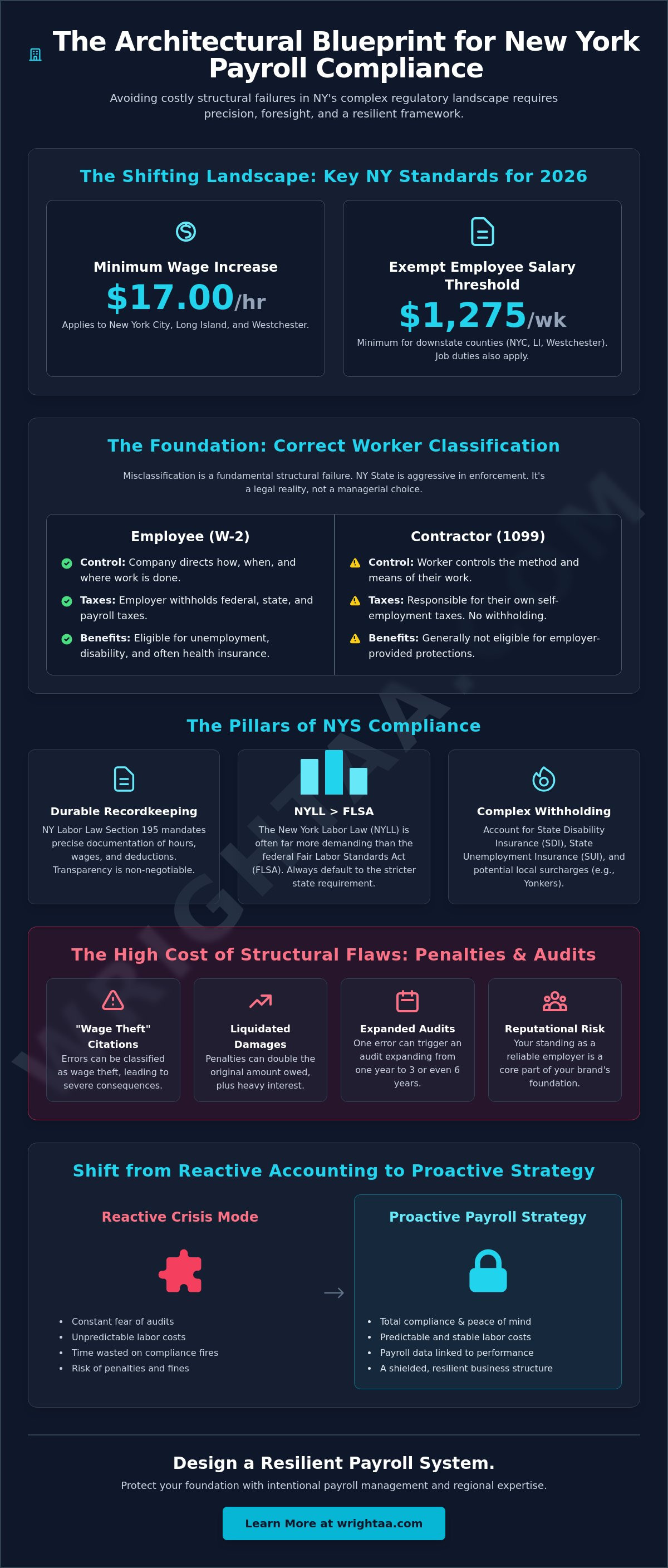
What if the true foundation of your business isn't the services you provide, but the quiet, rhythmic accuracy of your financial structure? In New York, payroll isn't merely a back-office task; it's a complex architectural requirement that demands precision. You likely feel the weight of constant labor law shifts, from the 2026 minimum wage rise to $17.00 in New York City to the intricate math of supplemental withholding rates. It's natural to feel a sense of unease when the Department of Labor updates its standards so frequently.
Avoiding common payroll mistakes NY requires an intentional approach that treats compliance as a pillar of your business's integrity. By understanding the specific thresholds for 2026, such as the $1,275.00 weekly salary requirement for exempt employees in downstate counties, you can protect your enterprise from costly failures. This guide explores the essential New York standards and provides a path toward predictable labor costs. We'll examine the nuances of state disability, unemployment insurance, and recordkeeping to help you achieve total compliance and lasting peace of mind.
Key Takeaways
- Understand the distinction between employees and contractors as a foundational element of your business structure.
- Learn the precise documentation requirements of New York Labor Law Section 195 to ensure your records remain durable and transparent.
- Adopt a posture of intentionality for avoiding common payroll mistakes NY; this foresight serves as a shield against the unpredictability of audits.
- Evolve from reactive accounting to proactive strategy by linking your payroll data to meaningful financial performance metrics.
- Discover how regional expertise across Buffalo, Rochester, and Syracuse provides a grounded perspective on New York's unique regulatory landscape.
The Landscape of New York Payroll Compliance in 2026
New York remains one of the most rigorously regulated states for employers. It's a landscape defined by shifting borders and rising standards. Compliance isn't a static achievement you reach and then ignore. It's a continuous process of alignment, much like maintaining the structural integrity of a historic building in Buffalo or Rochester. In 2026, the focus has shifted toward total transparency. The NYS Department of Labor and the IRS now operate with a level of digital connectivity that makes errors easy to spot. Success in this environment requires a deep understanding of employee compensation in the U.S., specifically how state mandates often build upon, and eventually overshadow, federal requirements.
The relationship between state and federal authorities is one of duality. While the IRS sets the baseline for federal tax obligations, the New York State Department of Labor often introduces more stringent layers of protection for the workforce. This year, the shift toward real-time digital reporting has accelerated. Employers are no longer just filing quarterly summaries; they're providing granular data that allows agencies to cross-reference wages, hours, and classifications with unprecedented speed. Avoiding common payroll mistakes NY is no longer just about accuracy in the moment. It's about building a system that remains resilient under the weight of constant scrutiny.
The Complexity of the New York Labor Law (NYLL)
The New York Labor Law (NYLL) is often far more demanding than the federal Fair Labor Standards Act. For businesses in Western New York, this means tracking local nuances that go beyond national norms. You aren't just answering to one entity. You're balancing the expectations of the NYS Department of Labor with specific tax withholding requirements and local surcharges in areas like Yonkers or New York City. Avoiding common payroll mistakes NY starts with intentionality. It's the practice of listening to legislative updates before they become operational crises. This proactive stance ensures that your business structure remains upright even as the regulatory soil shifts beneath it.
The Cost of Inaction: Penalties and Audits
A single structural flaw in your payroll process can lead to significant financial strain. "Wage theft" citations in New York aren't just administrative events. They carry heavy interest and liquidated damages that can quickly exceed the original amount owed. When a small administrative error triggers a Department of Taxation inquiry, the ripple effect can be devastating. An audit of one year often expands to three or six years, uncovering legacy issues you thought were settled. Beyond the ledger, there's a profound reputational risk. In tight-knit business communities like Syracuse and Rochester, your standing as an employer is part of your brand's foundation. Protecting that foundation requires a commitment to structural excellence and professional oversight.
Structural Failures: Misclassification and Salary Thresholds
The integrity of a financial structure begins with the ground on which it's built. In the context of New York business, that ground is worker classification. Misclassifying an individual as an independent contractor when they function as an employee is a fundamental structural failure. It's a mistake that doesn't just skew your books; it invites the full weight of state scrutiny. New York remains aggressive in its pursuit of tax revenue, and worker classification is a primary lever for enforcement. Avoiding common payroll mistakes NY starts with accepting that classification is a legal reality, not a managerial preference.
Establishing "exempt" status for your staff is not an arbitrary choice. It's a precise legal designation that must be defended with data. Many owners mistakenly believe that placing an employee on a salary automatically removes the requirement for overtime pay. However, New York law is clear: a job title is secondary to the actual duties performed and the compensation received. For those seeking clarity on specific wage and hour questions, the NY DOL's payroll FAQ serves as a vital resource for navigating these state-specific nuances. Aligning your internal roles with these standards ensures that your business's financial foundation remains unshakeable.
The 1099 vs. W2 Dilemma in New York
Applying the New York State Department of Labor’s criteria for independence requires a nuanced touch. Many believe that seasonal help or part-time contributors automatically qualify as contractors. This is a dangerous misconception. In New York, the right of control is the primary factor in classification, meaning if you direct when, where, and how the work is performed, the individual is likely an employee. Failing to recognize this distinction can lead to significant back-tax liabilities and penalties. Professional payroll services provide the oversight necessary to maintain these boundaries with intentionality.
Exempt vs. Non-Exempt: Beyond the Job Title
As of January 1, 2026, the salary thresholds for executive and administrative employees have reached new heights. In New York City, Nassau, Suffolk, and Westchester counties, the minimum is $1,275.00 per week, which equals $66,300.00 annually. For the rest of the state, including our neighbors in Buffalo and Syracuse, the threshold is $1,199.10 per week. Assuming federal guidelines apply to your New York team is a significant risk. If a salaried employee doesn't meet both the salary level and the rigorous duties test, they're entitled to overtime pay for every hour over forty. This distinction is non-negotiable and requires constant vigilance to ensure your labor costs remain predictable and compliant.
The Nuance of Recordkeeping and NYS Reporting Requirements
If payroll is the structural foundation of your workforce, recordkeeping is the archival blueprint that justifies its existence. New York Labor Law Section 195 mandates a level of documentation that extends far beyond a simple ledger entry. For specialized practices, such as those requiring a CPA for law firms Buffalo NY, the intersection of trust accounting and employee compensation requires meticulous care. Avoiding common payroll mistakes NY involves recognizing that silence in your records is often interpreted as non-compliance. Your records must tell a complete story of every hour worked and every dollar earned.
The New York State Employer's Guide to Payroll outlines the rigorous expectations for withholding and reporting. It isn't enough to pay your team correctly; you must prove the intent and the calculation behind every transaction. Digital archives should mirror the permanence of physical ledgers, ensuring that six years of history remain accessible and unaltered. This commitment to documentation is what separates a reactive business from one that operates with true financial intentionality.
Mandatory Notices and the LS54 Form
One of the most frequent compliance traps involves the "Notice of Pay Rate." New York requires employers to provide a written notice to every new hire before they begin work. This notice must include their rate of pay, pay date, and any allowances claimed. If an employee's primary language isn't English, you're obligated to provide this notice in their native tongue. The financial consequences of oversight are steep. A failure to provide these notices can result in a penalty of $50 per employee, per day, up to a maximum of $5,000 per worker. It's a structural vulnerability that can easily be avoided with a disciplined onboarding process.
Pay Stub Transparency and Wage Statements
Transparency is the hallmark of a well-designed financial system. Every wage statement must itemize specific data points: hours worked, gross wages, deductions, and net pay. If you utilize tip credits or meal allowances, these must be explicitly stated to avoid "wage theft" allegations. Integrating these details into your broader small business accounting in Buffalo, NY creates a clear narrative of financial health. Avoiding common payroll mistakes NY becomes a natural byproduct of this clarity. When your bookkeeping and payroll operate in harmony, you eliminate the shadows where errors typically hide. This level of detail provides the predictable labor costs and peace of mind that every business owner deserves.
Beyond the Ledger: Strategic Payroll for WNY Business Owners
Payroll is often viewed as a recurring administrative chore. It's the rhythmic release of funds to maintain the status quo. However, a sophisticated business owner views these transactions as a source of structural intelligence. When you move beyond simple processing, your payroll data becomes a lens through which you can view the health of your entire enterprise. This transition from reactive to proactive labor strategy is essential for avoiding common payroll mistakes NY while building a more resilient organization. It's about seeing the architecture of your workforce rather than just the cost of its maintenance.
By analyzing labor costs through the lens of financial kpis for small business, you gain clarity on your most significant investment: your people. A reliable and transparent payroll system fosters a culture of deep trust. It signals to your team that their contributions are valued and that your business is built on a stable, ethical foundation. This trust is a quiet but powerful force for retention in the competitive markets of Buffalo, Rochester, and Syracuse. When your financial systems are elegant and accurate, they inspire confidence in everyone they touch.
Integrating Payroll with Proactive Tax Planning
Your payroll strategy is inseparable from your overall business tax planning in Buffalo, NY. For S-Corp owners, the challenge lies in balancing owner compensation with distributions. You must meet the "reasonable salary" standards set by the IRS while optimizing your overall tax position. The synergy between your quarterly filings and your year-end tax strategy ensures that every dollar spent on labor serves a dual purpose: rewarding your team and strengthening your balance sheet. This intentionality prevents the structural cracks that appear when payroll is managed in a vacuum.
Designing a Resilient Cash Flow Model
Managing the timing of tax impounds and net pay is a delicate exercise in liquidity. A sudden shift in labor costs or a misunderstanding of New York's supplemental wage withholding rates can compromise your ability to reinvest in your vision. This is where the value of CFO-level oversight becomes apparent. By predicting fluctuations before they occur, you protect your cash reserves from unexpected shocks. Western New York businesses benefit from localized financial guidance that understands the unique seasonal rhythms of our regional economy. Our payroll services are designed to provide this level of strategic oversight, ensuring your business remains both compliant and competitive.
Designing a Resilient Payroll System with Wright CPAs
At Wright CPAs, we view your business as a structure that requires both a solid foundation and a clear aesthetic vision. Payroll is often the most tactile expression of your relationship with your team. It's a bridge between your operational reality and your long-term goals. We don't just process data; we provide a partnership in financial architecture. This partnership is essential for avoiding common payroll mistakes NY while maintaining the structural integrity of your finances. By focusing on the specific landscapes of Buffalo, Rochester, and Syracuse, we ensure that your systems are tuned to the local regulatory pulse. Our fixed-fee monthly accounting and advisory retainers remove the friction of unpredictable costs, allowing you to focus on the work that truly matters.
The gap between technical compliance and visionary growth is often wide. Many businesses treat their ledger as a static record of the past rather than a blueprint for the future. We bridge this gap by offering a perspective that is both grounded and forward-looking. Our role is to ensure that every administrative detail aligns with your broader mission. This creates a sense of calm and purpose within your organization. When your financial systems are designed with intentionality, they provide the spatial openness you need to innovate and lead with confidence.
The Wright Approach: Human Expertise Meets Modern Tech
We believe that modern technology is a tool, not a replacement for human judgment. While software can automate calculations, it lacks the contextual awareness required for avoiding common payroll mistakes NY. Our approach combines precise digital systems with the steady hand of professional CFO-level oversight. We prioritize deep listening before we begin the design process. This ensures that your payroll system isn't just a technical exercise but a purposeful intervention that supports your specific business culture. We provide the clarity that software alone cannot offer.
Next Steps Toward Financial Clarity
The path to stability begins with a single conversation. Before the pressures of the next tax season arrive, it's beneficial to conduct a comprehensive financial walkthrough of your current systems. This process identifies structural vulnerabilities in your reporting and classification methods before they become liabilities. We invite you to explore how intentional financial management can transform your daily operations from a source of anxiety into a source of strength. You deserve a partner who values substance over spectacle and quality over quantity. Experience the clarity of intentional financial management with Wright CPAs and secure the future of your enterprise.
Securing Your Financial Foundation
A business is only as resilient as the systems that support it. True financial integrity isn't found in a single document, but in the continuous alignment of your operations with evolving standards. The path toward avoiding common payroll mistakes NY begins with a commitment to precision and a deep respect for the regulatory landscape. By aligning your classification practices with New York’s rigorous standards and maintaining meticulous records, you create a structure that can withstand the weight of any audit.
Since 2012, our Buffalo-based team has provided specialized accounting for law firms and closely held businesses. We believe that professional, CFO-level guidance is the difference between a reactive administrative burden and a proactive labor strategy. This oversight ensures that your labor costs remain predictable and your cash flow remains fluid even as the economic environment shifts. It's about building a legacy of compliance that supports your long-term vision.
Your business deserves a foundation built on expertise and intentionality. It's time to move beyond simple processing toward a more sophisticated financial model. Connect with Wright CPAs for a Strategic Payroll Consultation and bring a new level of clarity to your financial architecture. We look forward to helping you design a future defined by stability and quiet confidence.
Frequently Asked Questions
What is the most common payroll mistake for new businesses in New York?
The most frequent error for new New York enterprises is failing to provide the mandatory Notice of Pay Rate at the time of hire. Many owners assume a verbal agreement or a standard offer letter is sufficient; however, the state requires a specific written form. This oversight is a leading cause of early compliance failures. Avoiding common payroll mistakes NY starts with a disciplined onboarding process that satisfies both state labor laws and tax reporting requirements.
How does New York define an independent contractor versus a W2 employee?
New York defines the relationship based primarily on the "right of control" over the worker's performance and schedule. If you determine where, when, and how the work is executed, the individual is likely an employee under the law. This distinction is foundational to your business's structural integrity. Misclassification often triggers audits from the Department of Labor, as the state seeks to protect its tax base and social insurance funds.
Are Buffalo businesses required to provide a written notice of pay rate?
Yes, all businesses in Buffalo and across New York State must provide a written notice of pay rate to every employee. This requirement, established by the Wage Theft Prevention Act, applies regardless of the company's size or industry. The notice must include the employee’s hourly rate, regular payday, and any allowances taken. Failing to maintain these records creates a structural vulnerability that can lead to significant daily penalties and legal exposure.
What are the penalties for late payroll tax filings in New York State?
New York State imposes both failure-to-file penalties and interest on any unpaid tax amounts. The penalty for late filing is typically 5% of the tax due for each month it is late, up to a maximum of 25%. If the tax is paid late, a separate monthly penalty applies alongside accruing interest. These costs can erode your cash flow and signal a lack of internal oversight to state agencies, potentially triggering deeper inquiries.
Can payroll software alone guarantee compliance with NY Labor Law?
Payroll software cannot guarantee compliance with the nuances of New York Labor Law. While automation helps with calculations, it lacks the human judgment required to interpret complex duties tests or shifting legislative updates. Software is a tool, not a strategy. True peace of mind comes from professional oversight that understands the intersection of modern technology and regional regulatory requirements. Avoiding common payroll mistakes NY requires a partnership that goes beyond automated data entry.
How often do New York minimum wage and salary thresholds change?
Minimum wage and salary thresholds in New York currently adjust on an annual basis, typically effective January 1st. Beginning in 2027, these rates will be adjusted annually based on the Consumer Price Index for Urban Wage Earners and Clerical Workers (CPI-W) for the Northeast Region. This shift ensures that labor costs remain aligned with regional inflation. Staying ahead of these adjustments is a key component of maintaining predictable and intentional financial planning.
What is the "ABC test" and how does it apply to my WNY business?
The "ABC test" is a rigorous standard used to determine if a worker is truly an independent contractor. To pass, you must prove the worker is free from your control, the work is outside your usual business, and the worker has their own independent trade. For businesses in Buffalo and Syracuse, this test makes it exceptionally difficult to classify staff as contractors. It requires a deep analysis of your operational structure to ensure your foundation remains secure.
How can IOLTA compliance impact payroll for law firms in Syracuse or Rochester?
IOLTA compliance requires law firms to strictly separate client trust funds from operating capital used for payroll. If a firm in Syracuse or Rochester inadvertently uses trust funds to cover employee compensation, it faces severe ethical and legal consequences. Proper payroll services for law firms ensure that these financial boundaries are never breached. This level of intentionality protects both your professional license and your practice’s long-term financial health.


