

What if the key to financial integrity in your Buffalo law firm lies in a process as straightforward as three-way reconciliation? The fear of commingling client funds, the anxiety over New York State IOLTA audits, and the frustrations of manual bookkeeping can weigh heavily on your practice. You’re not alone in feeling overwhelmed by these challenges. In this article, you’ll master the essential process of three-way reconciliation for your law firm, ensuring IOLTA compliance and achieving financial clarity for your Western New York practice. We’ll explore how to create audit-ready financial records, maintain a clear separation between firm and client funds, and implement automated, intentional financial workflows. Join us as we elevate your understanding of financial integrity and empower your practice.
Key Takeaways
- Understand the concept of three-way reconciliation law firm, aligning bank, book, and matter balances for enhanced financial integrity.
- Identify the essential materials required for a successful reconciliation process, including bank statements and client ledgers.
- Navigate New York's IOLTA requirements with confidence by adhering to the specific record-keeping mandates applicable to your practice.
- Create a structured workflow by establishing a monthly 'Reconciliation Day' to ensure timely and consistent financial oversight.
- Embrace professional oversight as a means to elevate your firm's financial clarity and prepare for future audits with assurance.
The Architecture of Trust: What is Three-Way Reconciliation?
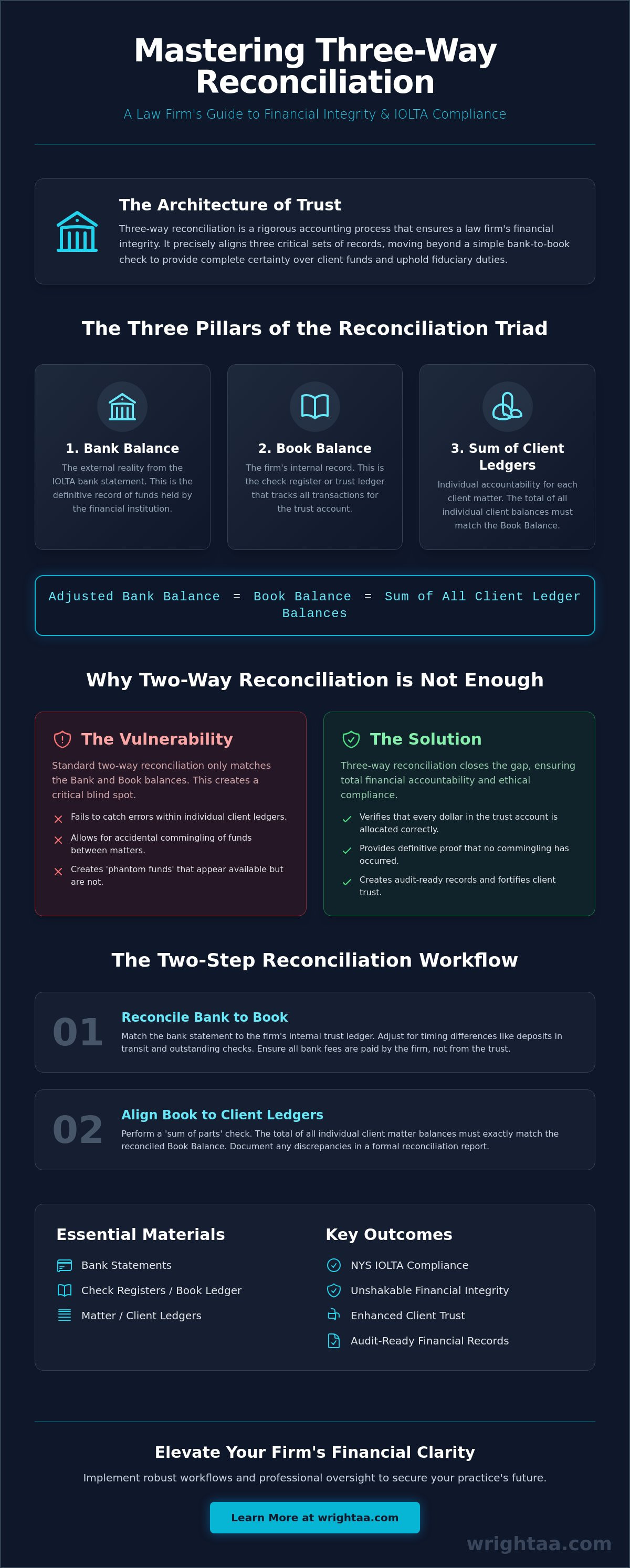
Three-way reconciliation is an essential process for law firms, particularly in ensuring the integrity of trust accounts. This method involves the precise alignment of three critical elements: bank balances, book balances, and matter-specific client balances. By rigorously validating these three components, law firms not only safeguard their financial integrity but also uphold their fiduciary responsibilities.
In contrast to standard two-way reconciliation, which typically aligns only bank and book balances, three-way reconciliation presents a more rigorous and necessary legal triad. This triad ensures that no funds are commingled across different matters, a critical requirement for maintaining trust in legal practice. The mantra of 'close enough' is a structural failure in trust accounting, leading to vulnerabilities that can jeopardize the firm’s reputation and financial standing.
For attorneys in Western New York, the fiduciary duty to protect client funds makes three-way reconciliation non-negotiable. This process is not merely about balancing numbers; it embodies a commitment to ethical practice and client trust.
The Three Pillars of the Reconciliation Triad
- The Bank Balance: This reflects the external reality of the IOLTA statement, providing a clear snapshot of available funds.
- The Book Balance: This is the internal record maintained by the firm, representing the trust ledger's accuracy.
- The Client Ledger: This focuses on individual accountability, revealing the financial standing of every specific matter.
Each of these pillars supports the architectural integrity of a law firm's financial system. When they align flawlessly, the firm can confidently assert that all funds are accounted for and appropriately allocated.
Why Two-Way Reconciliation Leaves Your Firm Vulnerable
Two-way reconciliation might seem sufficient, but it can leave law firms exposed to hidden errors within individual client accounts. Such discrepancies often evade detection, allowing 'phantom funds' to appear available while actually belonging to other matters. This risk underscores the necessity of the triad approach; it is the only way to prove that no commingling has occurred. Without this assurance, a firm cannot fully demonstrate its commitment to ethical financial management.
In conclusion, adopting the three-way reconciliation method is paramount for any law firm striving to uphold its fiduciary duties in a transparent manner. This meticulous approach not only enhances financial accuracy but also fortifies the trust clients place in their legal representatives.
The Anatomy of the Three-Way Process: A Tectonic Breakdown
Understanding the three-way reconciliation process is essential for any law firm striving for financial integrity. This process hinges on three primary raw materials: bank statements, check registers, and matter ledgers. Each component plays a critical role in ensuring that your accounts align, forming the bedrock of a transparent financial system. In essence, the mathematical imperative is simple yet profound: Bank Balance = Book Balance = Sum of Client Ledgers. When these elements are in harmony, your firm can confidently navigate the complexities of financial management.
Timing differences and outstanding checks introduce a level of materiality that must be carefully recognized. These discrepancies can distort your financial picture if not properly accounted for. A well-executed reconciliation serves as a monthly 'audit of craft,' elevating your legal practice's accountability and precision.
Step 1: Reconciling the Bank to the Book
The first step in the three-way reconciliation law firm process involves reconciling the bank account to the book. Adjustments must be made for deposits in transit and outstanding disbursements. This means ensuring that every bank fee is accounted for and that the firm bears these costs, not the trust. By meticulously verifying that the adjusted bank balance matches the firm's general ledger, you create a clear, accurate financial picture.
Step 2: Aligning the Book to the Matter Ledgers
Next, you must align the book to the matter ledgers. This involves a 'sum of parts' check, where total individual client matter balances are accounted for. Identifying discrepancies between total trust cash and individual obligations is crucial. Documenting these findings in a reconciliation report establishes a permanent record of integrity, reinforcing the firm’s commitment to transparency.
In summary, a thorough understanding of the three-way reconciliation process not only safeguards your firm against financial discrepancies but also enhances your practice's reputation. Adopting these principles will lead to a more streamlined operation, where financial integrity reigns supreme. To explore best practices and further enhance your firm's financial management, consider reviewing our resources.
Navigating New York's IOLTA Requirements in Buffalo and WNY
In the intricate landscape of legal practice in New York, adherence to IOLTA (Interest on Lawyer Trust Accounts) requirements stands as a cornerstone of financial integrity for law firms. Specifically, Rule 1.15 of the New York Rules of Professional Conduct mandates stringent standards for handling client funds. For Buffalo law firms, understanding and implementing these requirements is not just a regulatory obligation; it is essential for maintaining trust and credibility.
NYS IOLTA Compliance: A Structural Mandate
Compliance with IOLTA regulations requires a robust structural approach. Monthly reconciliation emerges as the gold standard for New York firms, ensuring that trust accounts are accurately maintained and all transactions are verifiable. The prohibition against commingling client funds with firm assets reinforces the necessity of clear boundaries between client trust and operational funds.
Firms can rely on local expertise, such as Wright CPAs, to navigate these complexities. Their specialized knowledge in law firm accounting in Buffalo, NY, equips firms with the insights needed to achieve compliance and enhance financial practices.
Common Pitfalls in Western New York Trust Accounting
Even seasoned firms can stumble in the nuances of trust accounting. Common pitfalls include:
- Improperly handling credit card processing fees within trust transactions, which can lead to inaccurate financial reporting.
- Allowing 'inactive' client balances to linger in IOLTA accounts for years, risking potential disciplinary action by the New York State Supreme Court.
- Failing to maintain a distinct 'firm funds' buffer for anticipated bank charges, which can complicate financial clarity.
Structural failures in managing IOLTA accounts can lead to serious repercussions, ranging from disciplinary actions to disbarment. For Buffalo law firms, this underscores the critical importance of implementing a disciplined approach to three way reconciliation law firm practices. By prioritizing meticulous record-keeping and compliance with local regulations, firms can safeguard their integrity and enhance their operational resilience.
Implementing a Robust Workflow: From Spreadsheets to Intentionality
In the pursuit of financial integrity, a three-way reconciliation law firm must shift from rudimentary spreadsheets to a more intentional and structured workflow. This transition begins with a thorough evaluation of existing tools. Are you relying on generic accounting software, or have you invested in site-specific solutions tailored for the legal sector?
Establishing a monthly 'Reconciliation Day' can create temporal consistency and allow your team to focus solely on this critical task. By dedicating specific days to reconciliation, you foster a culture of accountability and ensure all discrepancies are addressed in a timely manner. Assigning clear roles also plays a pivotal part in this workflow. The separation of duties between the maker and the reviewer helps mitigate errors and enhances the accuracy of financial reporting.
It’s essential to anticipate inevitable 'tectonic shifts'—the discrepancies that arise during reconciliation. A robust process for reviewing and rectifying these issues will save time and resources in the long run.
Choosing the Right Tectonic Tools
Opting for standard accounting software like QuickBooks may expose your firm to risks, primarily due to its lack of legal-specific workflows. This can lead to oversights that complicate the reconciliation process. On the other hand, integrated practice management software simplifies the 'three-way' report, enabling a seamless connection between client funds, trust accounts, and operating accounts. For insights into selecting the right software, check our guide on law firm bookkeeping services Buffalo.
A 5-Step Monthly Reconciliation Workflow
- 1. Gather all statements and ledgers immediately upon month-end.
- 2. Execute the bank-to-book reconciliation to identify clear errors.
- 3. Perform the matter-to-book sum check to find ledger-level issues.
- 4. Document every adjustment with a written narrative for audit trails.
- 5. Have a partner sign off on the final three-way report to ensure accountability.
Implementing this structured approach not only enhances the accuracy of your financial reporting but also fosters a culture of transparency and diligence. The three-way reconciliation law firm that embraces these practices positions itself for long-term success. For additional support in creating a more efficient reconciliation process, connect with our experts today.
Elevating the Human Experience: Professional Oversight as a Value
In an environment where compliance is often seen as the end goal, Buffalo law firms have the opportunity to transcend basic requirements by embracing financial integrity through three-way reconciliation. Clean books do not merely fulfill legal obligations; they lay the foundation for strategic business tax planning in Buffalo, NY. When financial records are meticulously maintained, firms can better navigate the complexities of tax liabilities, ensuring optimal outcomes for both the business and its clients.
Perhaps one of the most profound benefits of diligent financial oversight is the psychological 'white space' it creates. Knowing that your firm is audit-proof allows for greater focus on client relationships and case work, reducing anxiety related to financial mismanagement. This clarity fosters a culture of trust and professionalism, essential in the legal field.
Many firms adopt a reactive approach to financial oversight, often engaging in project-based cleanup when issues arise. However, fixed-fee advisory services provide ongoing oversight that proves far more cost-effective in the long run. By investing in continuous financial health, firms can avert crises rather than merely responding to them, ensuring that resources are allocated efficiently.
At the forefront of this transformation is Wright CPAs, dedicated to designing financial clarity for Buffalo's legal community. Their tailored services integrate trust accounting into a comprehensive tax strategy, empowering law firms to achieve their full potential.
The ROI of Financial Intentionality
Accurate trust accounting accelerates the billing cycle, significantly enhancing cash flow. Firms that maintain precise records can send invoices promptly, reducing the time between service delivery and payment. This efficiency ensures that the financial resources are readily available for reinvestment.
- Elimination of the 'hidden costs' associated with administrative stress and audit preparation.
- Utilization of financial data to drive law firm profitability analysis in Buffalo.
Designing Your Firm's Financial Future
The role of a CPA extends beyond number crunching; they act as a 'thoughtful maker' in shaping your business structure. Wright CPAs exemplifies this integration, marrying trust accounting with a holistic tax strategy that aligns with each firm's unique goals. Their approach not only safeguards financial health but also enhances long-term sustainability.
Secure your firm's financial foundation today. Schedule a consultation to explore how professional oversight can elevate your firm’s experience and performance.
Secure Your Firm’s Future Today
Understanding the three way reconciliation law firm process is crucial for maintaining financial integrity. By implementing a robust workflow, aligning with IOLTA requirements, and prioritizing professional oversight, Buffalo law firms can foster trust and transparency within their operations. These strategies not only protect your firm's financial foundation but also elevate the human experience for both clients and staff.
Don't leave your financial integrity to chance. Secure your firm's financial foundation with Wright CPAs, where our Buffalo-based experts specialize in NYS IOLTA compliance and offer fixed-fee monthly accounting tailored for law firms. Together, we can build a solid framework for your firm’s success.
Embrace these principles and watch your firm thrive in the ever-evolving legal landscape.
Frequently Asked Questions
Is three-way reconciliation legally required for all New York law firms?
No, three-way reconciliation is not legally mandated for all New York law firms. However, it is highly recommended as a best practice to ensure financial integrity and compliance with New York State Bar Association guidelines. Maintaining accurate records and performing regular reconciliations can help prevent discrepancies and protect client funds.
Can I perform a three-way reconciliation using only QuickBooks Online?
While QuickBooks Online can facilitate aspects of the three-way reconciliation process, it may not be sufficient on its own. To achieve full reconciliation, firms should also incorporate bank statements and trust ledger records. Using specialized legal accounting software alongside QuickBooks can enhance accuracy and streamline the process of three-way reconciliation for law firms.
How often should a Buffalo law firm reconcile its IOLTA account?
A Buffalo law firm should reconcile its IOLTA account at least once a month. Monthly reconciliations help to identify and address discrepancies promptly, ensuring compliance with New York State regulations. Some firms may choose to reconcile more frequently, such as weekly, to maintain a higher level of financial oversight and integrity.
What should I do if my three-way reconciliation numbers don't match?
If your three-way reconciliation numbers don't match, first verify each record for accuracy. Check your bank statements, trust ledger, and client matter ledger for any errors or omissions. If discrepancies persist, consider consulting with a financial professional specializing in legal accounting to identify underlying issues and implement corrective measures.
Can my paralegal perform the three-way reconciliation, or must I do it myself?
Your paralegal can perform the three-way reconciliation, provided they are trained and knowledgeable in the reconciliation process. Delegating this task can free you to focus on legal matters. However, it is essential to review their work to ensure accuracy and compliance with your firm's financial protocols.
What is the difference between a trust ledger and a client matter ledger?
A trust ledger tracks all transactions related to client funds held in trust, including deposits and withdrawals. In contrast, a client matter ledger records all financial activity related to a specific case or client, encompassing both trust and operating account transactions. Understanding the distinctions between these ledgers is crucial for effective financial management and three-way reconciliation in a law firm.
How long am I required to keep three-way reconciliation reports in New York State?
In New York State, law firms are required to keep three-way reconciliation reports for a minimum of seven years. This retention period aligns with the New York State Bar Association's guidelines for maintaining financial records. Keeping these reports accessible aids in compliance audits and ensures that client funds are properly accounted for over time.
What happens if a bank error causes a discrepancy in my trust account?
If a bank error causes a discrepancy in your trust account, contact your bank immediately to resolve the issue. Most banks will investigate the error and provide necessary corrections. In the meantime, document the discrepancy and maintain accurate records to ensure transparency and compliance during the resolution process, which is essential for effective three-way reconciliation.


