

The act of building a business is fundamentally architectural. It begins not with the visible structure, but with the quiet, intentional work of laying a foundation that can withstand the weight of your ambitions. You likely feel the friction between city, county, and state requirements, fearing that a single missed license or a misunderstood tax election will create cracks in your future success. Understanding how to register a business in Buffalo NY requires more than a checklist; it demands a clear perspective on how these legal elements intersect with your financial goals.
We recognize that the bureaucratic landscape can often feel opaque. It's natural to seek clarity when choosing an entity or calculating the precise costs of Erie County publication requirements. This guide serves as your strategic roadmap, offering a step by step approach to establishing a compliant presence in Western New York. We'll explore everything from the $25 Erie County DBA filing to the $200 state articles of organization, providing the financial clarity you need to navigate the registration process with confidence and purpose.
Key Takeaways
- Select an entity structure that serves as a durable blueprint for your personal liability and long-term tax strategy.
- Navigate the administrative layers of how to register a business in Buffalo NY through the Erie County Clerk and state departments.
- Ensure your physical site harmonizes with the Buffalo Green Code and specific municipal licensing requirements at 65 Niagara Square.
- Establish your business’s unique financial fingerprint by securing a federal EIN and formalizing your state Articles of Organization.
- Build a resilient financial foundation by implementing intentional bookkeeping systems that prioritize clarity and informed decision-making.
The Architectural Choice: Selecting Your Business Entity in Buffalo
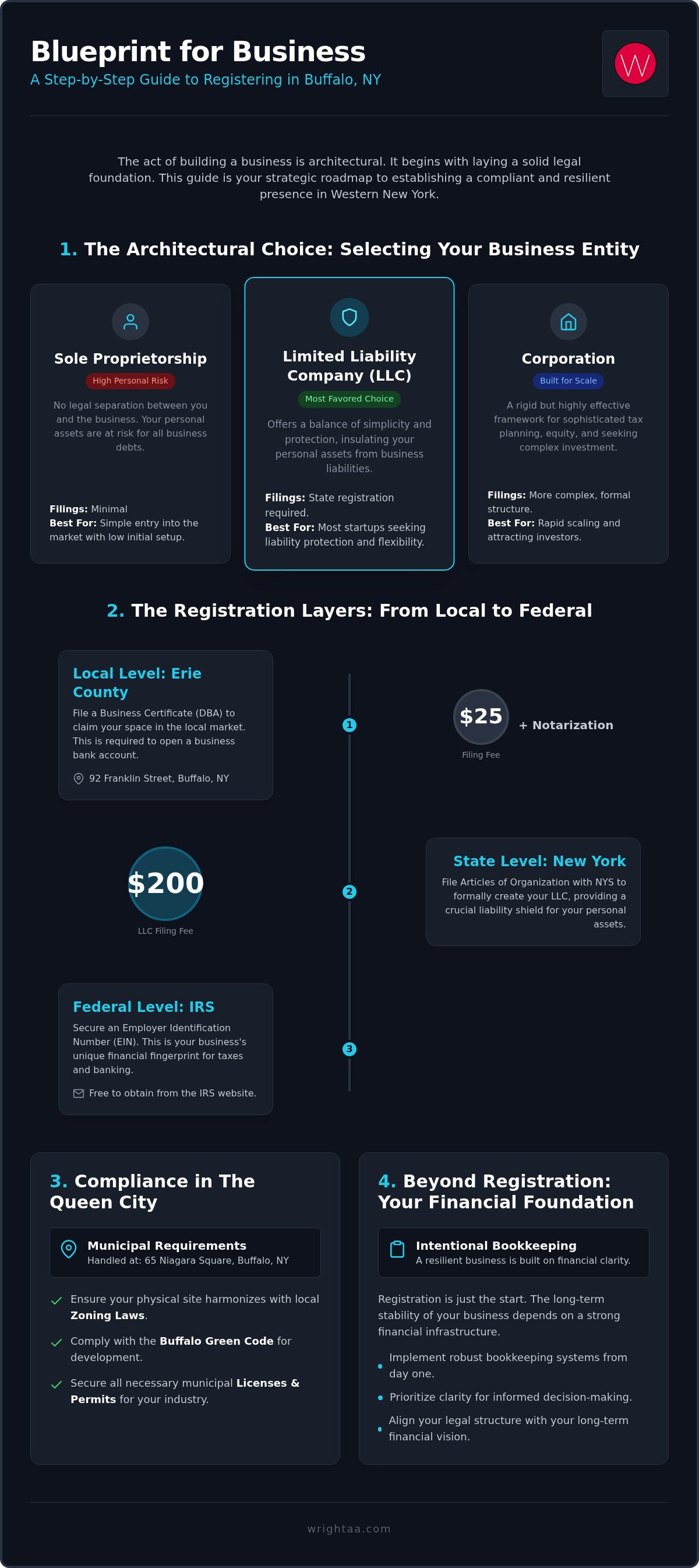
Choosing your business structure is the first material decision in your journey. It is the blueprint that defines your personal liability and dictates your future tax obligations. While some may view this as a mere administrative checkbox, it's actually the structural frame upon which your entire financial life will rest. Understanding various types of business entities helps clarify how your personal assets will be shielded from the inevitable stresses of commerce.
Entry-level forms like the Sole Proprietorship or General Partnership offer an unencumbered path into the market. They require minimal filings, but they come with a significant structural flaw; there is no separation between the individual and the enterprise. Your personal assets are the collateral for every business debt. For many exploring how to register a business in Buffalo NY, these options represent a high-risk foundation that often fails to support long-term growth or protection.
Most Buffalo startups favor the Limited Liability Company (LLC). It involves a $200 filing fee with the state and offers a sophisticated balance between the simplicity of a partnership and the protection of a corporation. It's a flexible material, allowing for various management structures while insulating your personal life from business liabilities. If you are designing for rapid scaling or seeking complex investment, Corporations provide a more rigid but highly effective framework for sophisticated tax planning and equity distribution.
The Tax Implications of Your Choice
Tax landscapes shift based on the structure you inhabit. In a Sole Proprietorship or LLC, you typically face pass-through taxation, where business income flows directly to your personal return. This can lead to heavy self-employment tax burdens if you don't manage it with foresight. Strategic shifts, such as electing S-Corp status, can significantly alter this environment. You can explore these nuances further in our guide on S-Corp vs. LLC: Tax Implications in New York State.
Intentionality in Business Formation
Generic online filing services often treat business formation as a commodity. They provide a standard shell that frequently ignores the specific tax nuances of New York State. An intentional approach aligns your legal structure with your five-year financial vision. It considers your local context and your specific material needs. A CPA acts as a structural engineer in this phase, ensuring that the entity you choose today can support the weight of the business you intend to build tomorrow. This process requires deep listening and contextual awareness before the first document is filed.
Registering at the Local Level: Erie County Business Certificates
If the entity choice is your blueprint, the local registration is the ground upon which you break. For sole proprietors and general partnerships, this process centers on the Business Certificate, commonly known as a DBA or "Doing Business As." This document serves as the public record of your professional identity within the Western New York landscape. It is a foundational requirement that bridges the gap between your personal identity and your commercial presence.
The Erie County Clerk, Michael P. Kearns, oversees this vital registry at 92 Franklin Street. Filing here is more than a legal formality; it's the specific act of claiming your space in the local market. Without this certificate, you cannot open a business bank account or enter into formal contracts under your business name. Learning how to register a business in Buffalo NY begins with this local tether, ensuring your enterprise is recognized by the county before you attempt to scale toward state or federal levels. You can find additional City of Buffalo business resources to help navigate these early municipal requirements.
Steps to File a DBA in Erie County
The path to a valid Business Certificate is methodical. First, you must conduct a name availability search in the Erie County Clerk’s database to ensure your chosen title isn't already in use. Once confirmed, you'll complete the Business Certificate form, known as Form CC7. This document requires notarization, which can often be handled directly at the Clerk's office. The filing fee is a fixed $25, a modest investment in your business’s structural integrity. If you're feeling overwhelmed by these initial steps, our team offers new business formation consulting to ensure every detail is handled with precision.
The Importance of Certified Copies
A single filing is rarely enough to support the weight of daily operations. You should always request at least two certified copies of your Business Certificate, which cost $5 each. One copy is typically required by your financial institution to establish your business accounts, while others may be requested by vendors or for professional licensing. These documents are the physical proof of your right to operate. As your business evolves, you may eventually transition from a local DBA to a state-level entity like an LLC. Maintaining meticulous local records ensures this future migration is seamless and lacks the bureaucratic residue that often complicates growth. It's about building a clean, compliant history from the very first day.
The State and Federal Layer: NYS Registration and EINs
If the local certificate is the ground, the state and federal registrations are the structural layers that define your entity's legal height and reach. Moving beyond the local clerk’s office requires an ascent into the digital landscape of the New York State Department of State (DOS). This phase of how to register a business in Buffalo NY is where your business gains its official status as a recognized legal person. The NYS Business Express portal serves as the primary interface for this assembly, streamlining what was once a fragmented paper process into a cohesive digital workflow.
This structural layer is where you finalize the separation between the creator and the creation. For LLCs, this involves filing Articles of Organization, while Corporations require a Certificate of Incorporation. These documents are the permanent records of your business’s birth. They establish the rules of your internal governance and your relationship with the state. Neglecting these filings or failing to maintain them through biennial statements creates a fragile foundation that can collapse under future scrutiny.
Obtaining Your Federal Tax ID (EIN)
The Employer Identification Number (EIN) is your business’s financial fingerprint. It’s a unique nine-digit identifier issued by the IRS that functions much like a social security number for your enterprise. Even if you don't plan to hire employees immediately, securing an EIN is a sophisticated design choice. It allows you to keep your personal social security number private and is essential for opening commercial bank accounts or applying for local permits. The application process on the IRS website is free and provides immediate results. In the context of your broader tax planning, the EIN is the cornerstone that allows for professional bookkeeping and clear financial reporting.
New York State Department of State (DOS) Filings
Formalizing an LLC in New York requires a $200 filing fee for the Articles of Organization. Corporations face a $125 minimum fee, which includes a progressive tax based on the volume of shares issued. You must also designate a Service of Process agent, typically the Secretary of State in Albany, to receive legal notices on your behalf. Beyond the initial filing, New York requires a biennial statement every two years. This $9 filing is a rhythmic necessity to keep your business in good standing. It’s a small but vital act of maintenance that prevents your business from falling into "inactive" status.
One unique element of the New York landscape is the LLC publication requirement. Within 120 days of formation, you must publish a notice in two local newspapers for six consecutive weeks. While this sounds like a burdensome relic, it's actually a significant advantage for those in Western New York. In Erie County, the cost of publication typically ranges from $300 to $500. This is a stark contrast to New York City, where the same requirement can exceed $1,500. Once the six weeks are complete, you file a Certificate of Publication with a $50 fee to the state, finalizing your LLC's structural integrity.
Compliance in the Queen City: Buffalo Licenses and Zoning
If the state registration provides your legal identity, the municipal compliance phase determines your physical right to exist within the Buffalo city limits. This is where the abstract concept of your enterprise meets the tangible reality of 65 Niagara Square. Understanding how to register a business in Buffalo NY requires a deep awareness of local licensing and the Buffalo Green Code, ensuring your operations don't conflict with the city's unified development ordinance. This local layer is often where the most significant bureaucratic friction occurs, making it a critical phase in your financial architecture.
The Office of Licenses serves as the gatekeeper for specific trades and activities. While not every business requires a municipal license, many common sectors, ranging from general contractors to food vendors, must secure city-specific permits. These fees typically range from $60 to $480, depending on the nature of your work and the scale of your operations. It's a layer of compliance that ensures safety and order within our shared urban environment. Failing to secure these permits can lead to fines that disrupt your cash flow before you've even served your first customer.
Navigating 65 Niagara Square
The process within City Hall is often a coordinated effort between various departments. Depending on your business type, you may need to interface with the Fire, Health, and Police departments before a final license is issued. For instance, retail and food service startups must pass rigorous health and safety inspections to ensure the built environment is safe for public use. It's wise to contact the Office of Licenses for pre-application guidance to avoid the $30 fee associated with returned checks or the delays caused by incomplete paperwork. If you need assistance structuring your initial compliance strategy, our business formation consulting can help you navigate these municipal requirements with precision and calm.
Zoning and Home-Based Businesses
Before you sign a lease or install equipment, you must verify that your site is legally viable for its intended use. The Buffalo Green Code is a modern, form-based code that prioritizes the relationship between buildings and the street, rather than just the activities inside them. When researching how to register a business in Buffalo NY, checking if your industrial activity is permitted in a retail district is a vital step toward long-term stability. This level of foresight prevents costly relocations or legal friction later in your journey. For a broader view of these requirements, consult our Starting a Business in Buffalo, NY: A Checklist for Financial Intentionality. Aligning your physical location with the city’s vision is a fundamental act of financial and operational discipline that protects your investment.
Beyond Registration: Building Your Financial Infrastructure
The filing of documents marks the completion of the exterior shell. However, a structure remains uninhabitable without the internal systems that allow it to function. Once you've navigated the complexities of how to register a business in Buffalo NY, the focus shifts to the interiority of your enterprise. This is where you establish the conduits for capital and the systems for observation that transform a legal entity into a living business. Establishing your commercial bank account is the first threshold, utilizing the credentials secured in previous phases to separate your personal life from the professional environment you've created.
Building this infrastructure requires a move from the role of a founder to that of a CEO. It's a shift from mere creation to intentional stewardship. Proactive tax planning isn't an annual event but a daily discipline that begins the moment your registration is confirmed. By designing your financial foundation with the same rigor used in your initial formation, you ensure that every transaction provides clarity rather than just data. This clarity is the light that allows you to see the path toward sustainable growth in the Western New York landscape.
Setting Up Your Accounting Foundation
Your bookkeeping system is the nervous system of your business. It must be calibrated to the specific rhythms of your industry, utilizing a chart of accounts that reflects your unique operational reality. Choosing the right software is only the beginning; the true value lies in how that data is curated and interpreted. Many local entrepreneurs find that fixed-fee accounting for Buffalo businesses provides the predictability needed to manage costs without sacrificing expert oversight. Implementing rigorous cash flow management in these early stages is your primary defense against the volatility of the first year.
The Wright Approach to Growth
As your business matures, the complexity of its internal environment will naturally increase. Scaling requires a more sophisticated level of strategy that often exceeds the capacity of a solo founder. Utilizing outsourced CFO services allows you to integrate high-level financial expertise into your leadership team without the overhead of a full-time executive. By tracking specific financial KPIs for small business from the outset, you gain the ability to make decisions based on evidence rather than intuition. This is the final stage of your architectural journey. We invite you to Design your financial future with Wright CPAs, LLC, ensuring your business stands as a testament to both vision and discipline.
Breaking Ground on a Resilient Future
Establishing your business in the Queen City is an act of both courage and precision. You've learned that the process involves more than filing a single document; it requires an intentional alignment of your legal structure with your long-term vision. By securing your EIN and navigating the Buffalo Green Code, you've moved from an abstract idea to a tangible, compliant presence. This foundation is what allows your enterprise to weather the shifting economic seasons of Western New York.
Mastering the specifics of how to register a business in Buffalo NY is the first step toward a durable financial architecture. To ensure your structure remains sound, we offer local Buffalo expertise paired with proactive tax strategies and a fixed-fee monthly advisory model. This approach provides the clarity you need to focus on your craft while we manage the technical depths of your financial landscape. Begin your journey with a New Business Formation Consult. Your vision deserves a foundation as permanent and thoughtful as the city itself, built with the intentionality of Wright CPAs, LLC.
Common Inquiries on Financial Foundations
Do I need a lawyer to register a business in Buffalo, NY?
You aren't legally required to hire an attorney to register your business. Many entrepreneurs navigate the process independently or with the strategic oversight of a CPA. While the filings themselves are administrative, the underlying choices regarding entity structure and tax elections carry long-term weight. For specialized industries, seeking professional counsel—such as through the West Coast Health Law Group for medical practice startups—ensures your foundation is built with structural integrity from the start, avoiding the need for costly repairs later in your journey.
How much does it cost to register an LLC in New York State in 2026?
The state filing fee for Articles of Organization is $200. Beyond this initial cost, you must account for the mandatory publication requirement and the $50 filing fee for the Certificate of Publication. There's also a biennial statement fee of $9 due every two years. These costs represent the necessary investment in establishing a durable and compliant legal framework for your enterprise, providing the separation you need between creator and creation.
What is the "Publication Requirement" for NY LLCs and does it apply in Buffalo?
New York law requires all newly formed LLCs to publish a notice in two local newspapers for six consecutive weeks. This requirement absolutely applies to businesses in Buffalo. Fortunately, Erie County offers a more affordable landscape for this mandate compared to other regions. Publication costs here typically range between $300 and $500, making it a manageable step in the process of how to register a business in Buffalo NY.
How long does the business registration process take in Erie County?
A local Business Certificate (DBA) can often be processed immediately if you visit the Erie County Clerk in person. State-level registrations for LLCs or Corporations vary based on current processing volumes. While standard filings may take several weeks, New York offers expedited services for an additional fee, ranging from $75 for two-day processing to $200 for a two-hour turnaround. Planning for a timeline of two to four weeks allows for a steady, unhurried implementation.
Can I register a business in Buffalo if I live in a different city like Rochester?
Residency doesn't dictate your ability to establish a business in the Queen City. You can register a business in Buffalo regardless of whether you live in Rochester, Syracuse, or elsewhere. The registration is tied to the physical or operational presence of the entity within Erie County. This flexibility allows you to position your business within the specific geographic and cultural context that best serves your strategic goals and long-term vision; if those goals involve the neighboring Ontario market, you can check out UU Law Office for specialized corporate legal support.
What is the difference between a DBA and an LLC for a Buffalo freelancer?
A DBA is a professional alias that allows you to conduct business under a name other than your own. It offers no separation between your personal assets and business liabilities. In contrast, an LLC creates a distinct legal structure that insulates your personal life from the risks of the enterprise. For a Buffalo freelancer, the choice depends on the desired level of protection and the complexity of the financial foundation you wish to build.
Where do I go in person to file business papers in Buffalo?
Local filings, such as Business Certificates, are handled at the Erie County Clerk’s office located at 92 Franklin Street. If your business requires specific municipal licenses or zoning verification, you'll need to visit 65 Niagara Square. These physical sites are the administrative anchors for your project. Visiting these offices in person can often clarify the nuances of how to register a business in Buffalo NY more effectively than digital interaction alone.
Do I need a separate license to run a business out of my home in Buffalo?
Home-based businesses must comply with the Buffalo Green Code, which governs land use within the city. While you may not need a separate license for every home-based venture, you must ensure your activity is permitted within your residential zone. Certain professional services are generally allowed, but activities that alter the character of the neighborhood or involve significant foot traffic may require a special use permit or additional municipal oversight to remain compliant.


