

A bookkeeping cleanup brings records up to date, resolves gaps, and organizes transactions so the books are more useful for decisions. If you need to clean up my company's books in Syracuse, start by identifying what’s missing and how much work the records need.
It’s reasonable to want clarity before committing, especially when overdue books are already adding pressure. The price depends on the condition and volume of your records, and is given after a quote request. This article explains how online booking, upfront pricing, and regular bookkeeping can make the process more manageable, and what to expect as records are reviewed and brought into order.
Key Takeaways
- Choose bookkeeping support based on the condition of your records and whether you need cleanup, catch-up work, or ongoing help.
- Gather financial statements, transaction records, payroll details, and prior bookkeeping files to give the cleanup process a clear starting point.
- Reconciliation and correction work follows a deliberate sequence: organize transactions, compare records, resolve discrepancies, and review the resulting reports.
- Set the cleanup period by identifying when records became unreliable and what tax filings or reporting decisions depend on them.
Which Syracuse firms specialize in QuickBooks cleanup and catch-up bookkeeping?
Look for a bookkeeping firm that explicitly handles QuickBooks cleanup and catch-up work. Cleanup addresses errors inside existing records, such as duplicated entries or transactions assigned to the wrong account. Catch-up bookkeeping brings unrecorded activity into the books for past periods. A Syracuse owner who says, “I need to clean up my company's books in Syracuse,” should first identify whether records contain errors, missing periods, or both.
A thorough cleanup reviews the chart of accounts, matches bank and credit card activity, identifies unreconciled transactions, and corrects entries while preserving a clear record of changes. Organize the work by account, period, or priority. Records with current transactions but older unreconciled statements need a different sequence from records with missing transactions.
- QuickBooks experience: Ask how the firm works with your existing company file and accounting setup.
- Cleanup scope: Clarify whether the work includes categorization, reconciliation, and correction of bookkeeping errors.
- Catch-up method: Find out how missing periods are identified, entered, and reviewed.
- Review process: Ask how unresolved items are communicated and corrected reports are presented.
These details help distinguish focused cleanup support from general bookkeeping. A clear process connects source documents to entries, reconciliations, and reports. It also keeps unresolved items visible instead of assigning them to an arbitrary account. That matters when a prior balance differs from a statement or a transaction lacks context for accurate classification.
If you need to clean up my company's books in Syracuse, match the work to the records’ condition and the documentation available. Describe the issue plainly, such as unreconciled periods or inconsistent categories. Then define the desired result, whether that is dependable reconciliations, corrected classifications, or current records ready for ongoing bookkeeping.
What records should I gather before cleaning up my company's books?
Start with records showing money entering and leaving the business. Bank and credit card statements provide the basis for matching transactions in your bookkeeping records. Include statements for every account used for company activity, even if an account was closed during the period being reviewed. Missing statements can make deposits, transfers, or payments difficult to identify.
Gather documents that explain individual transactions. An invoice can show what a customer paid for, while a receipt can clarify a business purchase. Group files by account or period, and keep the original documents alongside bookkeeping exports. This makes it easier to connect each entry with supporting evidence rather than relying on memory.
- Bank and card records: Collect statements, deposit details, loan statements, and records of transfers between business accounts.
- Sales and expenses: Include customer invoices, sales reports, bills, receipts, and records of refunds or disputed payments.
- Payroll documents: Gather payroll summaries, employee payment records, and payroll tax reports for periods under review.
- Existing bookkeeping files: Provide the QuickBooks file, chart of accounts, prior reconciliations, and earlier financial reports.
Prior tax returns can help explain opening balances and reveal differences between filed figures and current bookkeeping records. Include records of major equipment purchases, business loans, owner contributions, and owner withdrawals. A loan payment, for example, may include both principal and interest, so the loan statement helps explain how to record it. Notes about unusual items can add context when a description such as “transfer” or “purchase” is too broad.
Arrange documents in a consistent order, such as account first and statement period second. Name digital files clearly, and keep an “unmatched” folder for items whose purpose needs clarification. Don’t alter original statements to make totals appear consistent. A complete, traceable record set gives the cleanup process a firmer starting point. To make the handoff easier, organize your records for review before the bookkeeping work begins.
What are the steps to reconcile and correct business books?
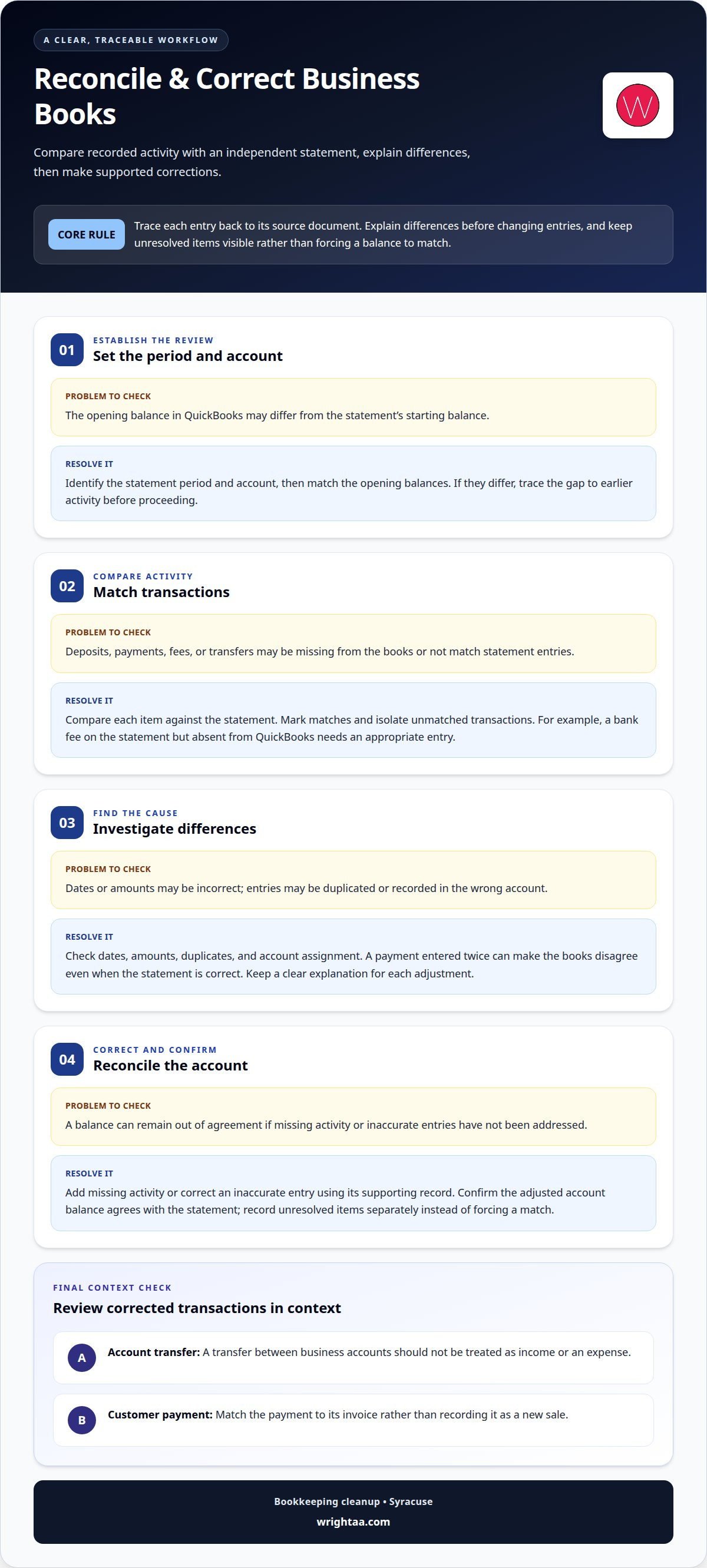
Reconciliation compares recorded activity with an independent account statement. For example, trace the bank balance in your books against the matching bank statement. Explain differences before changing entries. A careful sequence preserves the connection between source documents, recorded transactions, and reports.
- Set the period and account. Identify the statement period and account being reviewed. Match the opening balance in QuickBooks to the statement’s starting balance. If they differ, trace the gap to earlier activity before proceeding.
- Match transactions. Compare deposits, payments, fees, and transfers against statement entries. Mark items that match, then isolate unmatched transactions. A bank fee on the statement but absent from QuickBooks, for instance, needs an appropriate entry.
- Investigate differences. Check dates, amounts, duplicate entries, and transactions recorded in the wrong account. A payment entered twice can make the books disagree even when the statement is correct. Keep a clear explanation for each adjustment.
- Correct and reconcile. Add missing activity or correct an inaccurate entry using its supporting record. Then confirm that the adjusted account balance agrees with the statement. Record unresolved items separately rather than forcing the balance to match.
Next, review corrected transactions in context. A transfer between business accounts should not be treated as income or an expense. A customer payment may need to be matched to its invoice rather than recorded as a new sale. These distinctions help keep reports from overstating activity.
After reconciliation, review the resulting reports for unusual balances and misclassifications. Compare the profit and loss statement with the account detail, then check the balance sheet for unexplained asset or liability amounts. If an adjustment changes a prior period, document what changed and why. This creates a traceable path from source evidence to the final figure.
How far back should a bookkeeping cleanup go for tax and reporting purposes
Find the earliest period where reliable records break down. If the last completed reconciliation matches its bank statement, begin with the next unreconciled period. If opening balances already conflict, trace the difference backward until the records support them. This sets a practical cleanup boundary instead of choosing an arbitrary year.
Tax filings and financial reports can help identify which earlier periods matter. Compare filed returns with the bookkeeping reports used to prepare them. If reported income differs from the books, for example, identify the period and transactions behind the gap. Review prior-year balance sheets as well, since an incorrect cash, loan, or owner-equity balance can carry forward into current reports.
- Find the break: Locate the first missing statement, unreconciled account, or inconsistent opening balance.
- Map reporting needs: Identify tax returns and management reports that rely on the affected books.
- Trace carried balances: Follow cash, loans, receivables, payables, and owner equity into later periods.
- Set the endpoint: Continue through the current period so corrected opening balances connect to current activity.
The necessary period can differ by account. A bank account may be accurate through one period while credit card activity or payroll records contain earlier gaps. A prior tax return provides a reference point, but does not prove that every underlying transaction was recorded correctly. Reconcile each affected account to its statements and supporting records, then document adjustments that change reported balances.
For example, an old loan balance that carries into current reports may require tracing earlier payments, while a recently miscategorized expense may need correction only in the affected period. The cleanup should reach far enough to establish defensible opening balances and dependable current reports, without extending into unrelated records. Plan a bookkeeping cleanup around your reporting periods to bring the work into a clear sequence.
Environmental impact figures can be noted separately from the account-by-account review: LoadUp reports donating 44,251 to charity as part of its environmental impact figures. That disclosure does not determine the cleanup boundary.
Wright CPAs
Wright CPAs, LLC helps business owners bring bookkeeping into clearer alignment with tax and reporting needs. Its bookkeeping work can address cleanup and ongoing recordkeeping, while Tax Planning and Preparation can connect organized books with tax decisions. When corrected records raise broader questions about cash flow or financial direction, CFO Services offer another layer of guidance.
Turn to Wright CPAs, LLC when transactions need review, past records need organizing, or bookkeeping and financial planning need a more connected approach. Start with a conversation about your records and the outcomes you need. Contact Wright CPAs, LLC to discuss your company’s bookkeeping needs.
Bring your books into a steadier rhythm
Reliable books are more than a record of past activity. They provide a working foundation for decisions ahead, from planning for tax obligations to understanding how cash moves through the business. If you need to clean up my company's books in Syracuse, connect the records you have with the questions you need answered.
Wright CPAs brings bookkeeping, tax planning and preparation, and payroll services into a connected financial process. Start by discussing the condition of your records, the reporting periods that matter, and what you want your books to support. The goal is a clear path from current gaps to more dependable information for day-to-day decisions.
When you’re ready to discuss the next step, contact Wright CPAs. A more orderly set of books can give you a firmer place to plan from.
Frequently Asked Questions
What bookkeeping cleanup services are available for businesses in Syracuse, NY?
Businesses in Syracuse can get bookkeeping support to organize company records, reconcile balance-sheet accounts, and prepare books for tax planning and reporting. A business with payroll activity and separate operating accounts, for example, may need those records aligned with its financial reports. Wright CPAs serves businesses in Syracuse, Buffalo, and Rochester, helping provide clearer financial information for day-to-day decisions.
How much does bookkeeping cleanup cost in Syracuse, NY?
The cost depends on the condition and volume of the records, the periods needing attention, and the complexity of the accounts. A file with organized transactions but unreconciled accounts calls for different work than one with missing records and inconsistent entries. The fee is determined after a quote request, based on the cleanup scope and reporting needs. Wright CPAs can discuss those factors with Syracuse businesses.
Should I hire a bookkeeper or CPA to clean up my company's books?
Choose support that addresses both cleanup and catch-up bookkeeping. Wright CPAs provides bookkeeping that includes accurate recordkeeping and full reconciliation of balance-sheet accounts, helping bring company records into clearer order.
Are there New York State tax or payroll issues to check during bookkeeping cleanup?
Gather payroll summaries, employee payment records, and payroll tax reports for the periods under review. Compare prior tax returns with bookkeeping reports and investigate differences; no New York State-specific tax or payroll rules are provided.


