

What if the value of a CPA came not just from a list of services, but from how clearly your financial information helps you make decisions? For a veterinary practice, reliable books should do more than support tax filing. They should help you understand cash flow, operating costs, and the choices ahead. Finding a CPA for veterinarians Rochester NY practices can rely on starts with identifying what you need from that relationship.
If your reports leave questions unanswered or tax preparation feels disconnected from decisions you make throughout the year, you may need support that links those pieces. This guide covers what to assess in bookkeeping, tax planning, payroll, financial reporting, and business guidance, and how to evaluate whether an accounting firm’s approach fits a veterinary practice.
Wright CPAs, LLC serves veterinarians from its Rochester headquarters, combining clean, tax-ready books with proactive tax strategy. The firm also serves businesses in Buffalo and Syracuse. The sections below explain how clearer reporting and cash flow visibility can support informed decisions, and how to prepare for a practical conversation about your practice’s needs.
Key Takeaways
- Look beyond a service list. Consider whether accounting support helps clarify the financial decisions your veterinary practice faces.
- Understand how tax-ready bookkeeping and proactive tax planning play different, complementary roles in managing practice finances.
- Compare CPAs by the clarity of their deliverables, reporting cadence, communication, and fit with your practice’s needs.
- Prepare for a CPA conversation by defining your priorities, gathering available financial records, and noting questions you want answered.
- When evaluating a CPA for veterinarians Rochester NY, consider how organized books, cash flow visibility, and financial guidance can support informed decisions.
What should a Rochester veterinary practice expect from a CPA?
Veterinary owners balance patient care with decisions about staffing, expenses, equipment, and daily operations. Financial support should bring these responsibilities into view together, rather than leaving the numbers in a file that only matters at tax time. A CPA for veterinarians Rochester NY practices work with should help make financial records understandable and useful for decisions.
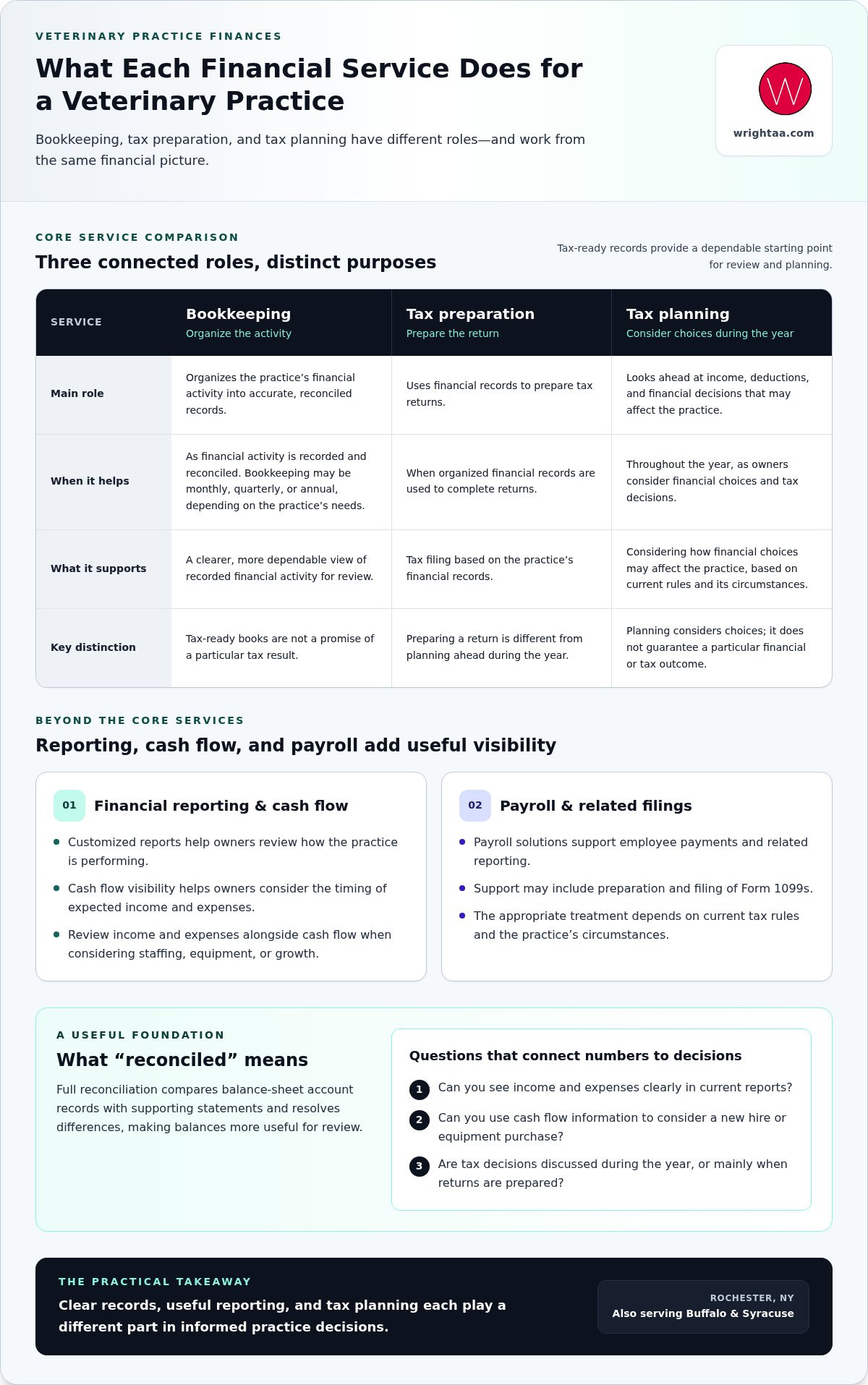
Each service has a distinct role. Bookkeeping organizes a practice’s financial activity. Tax preparation uses those records to prepare returns, while tax planning considers financial choices throughout the year. Payroll solutions support employee payments and related reporting, including preparation and filing of Form 1099s. Customized financial reporting and cash flow management help owners understand how money moves through the practice and assess decisions about staffing, investment, or growth.
Tax-ready books are accurate, reconciled records organized so financial activity can be reviewed and used in tax preparation. They give owners and their CPA a more dependable starting point for review and planning. They do not promise a particular tax result.
Which financial questions should practice owners bring to a CPA?
Start with what your current numbers show. Can you see income and expenses clearly? Do you have a useful picture of cash flow, or do you mainly find out what is available after bills are paid? Your answers can reveal whether your bookkeeping and reporting cadence give you the information you need to run the practice.
- Are tax decisions discussed during the year, or mainly when returns are prepared?
- Can you use current reports to evaluate staffing needs or a planned equipment purchase?
- Do your financial statements help you assess whether the practice is ready for growth?
Bring a specific decision to the conversation. If you are weighing a new hire, for example, ask what financial information would help you understand the effect on cash flow. A useful CPA relationship makes the records easier to interpret and connects them to the questions in front of you.
Why does Rochester location matter when choosing a CPA?
A Rochester-based CPA gives your practice a local point of contact. As you compare support, focus on whether the firm can explain what reporting you will receive, how bookkeeping and tax planning fit together, and how financial information can inform decisions. Local context can be useful, but avoid assuming that a location alone determines the right accounting approach.
Wright CPAs is based in Rochester, NY, and serves regional business owners, including veterinarians and other professional service providers. The firm also serves Buffalo and Syracuse. Its approach brings clean books, proactive tax planning, customized reporting, and cash flow visibility into one financial picture. When considering a CPA for veterinarians Rochester NY, it can also help to understand the professional designation. The Certified Public Accountant (CPA) designation has specific professional requirements in the United States, and the linked overview provides general background. For your practice, the important next step is to connect professional accounting support to the financial questions you need answered.
What accounting and tax services can support a veterinary practice?
Accounting support is most useful when each service has a clear role. Tax-ready bookkeeping means accurate, reconciled records organized to support tax preparation and review. It gives an owner and CPA a more dependable view of recorded activity, but it is not the same as tax planning. Tax preparation uses financial records to complete returns; comprehensive tax planning looks ahead at income, deductions, and financial decisions that may affect the practice. The right approach depends on current rules and the practice’s circumstances.
Reporting and cash flow management add another layer. Customized reports help owners review how the practice is performing, while cash flow visibility helps them consider the timing of expected income and expenses. These are tools for making decisions, not promises of a particular financial result. For a broader perspective on how tax decisions fit into business planning, Wright CPAs discusses strategic business tax planning.
How do bookkeeping and reporting help owners see practice finances?
Bookkeeping can be monthly, quarterly, or annual, depending on the practice’s needs. Full reconciliation involves comparing balance-sheet account records with supporting statements and resolving differences, so balances are more useful for review. Customized reports can then bring financial activity into focus. Owners can examine income and expenses alongside cash flow instead of relying on a single total to understand performance. The AVMA Practice Management Resources also offers veterinary-focused business and financial tools.
When should a veterinary practice consider tax and payroll support?
Tax preparation addresses return filing. Comprehensive tax planning considers financial choices during the year, while estimated tax planning focuses on whether and how estimated payments apply to the practice. Payroll solutions support payroll needs and related filings, including preparation and filing of Form 1099s. The appropriate treatment depends on current tax rules and the practice’s specific facts. Raise questions as circumstances change instead of treating every issue as a filing-season task.
For a CPA for veterinarians Rochester NY practices can work with, consider how the services fit together: organized records support review, planning helps frame tax questions, and reporting gives owners information for operational decisions. Wright CPAs provides bookkeeping, tax planning and preparation, payroll solutions, customized reporting, and cash flow management for veterinarians and other professional service providers. To see how these services can fit your practice, explore Wright CPAs’ accounting and tax support.
How can you compare CPAs for veterinarians in Rochester, NY?
Start with the work your practice needs, then compare what each accounting relationship would deliver. A service list may include bookkeeping, tax, payroll, and advisory support, but it does not explain how often you will receive information or how clearly it will connect to decisions. When comparing a CPA for veterinarians Rochester NY practices are considering, assess service scope, reporting cadence, communication, and fit with your priorities rather than relying on a broad label.
A general CPA may still be a good fit. The practical question is whether the firm’s approach aligns with your practice’s needs. Notice whether the conversation considers your business structure, available records, and decisions ahead, or stays at the level of a standard service checklist. The questions a CPA asks can help you understand how they will get to know your financial picture.
| Service area | Compare the deliverables | Consider the fit |
|---|---|---|
| Bookkeeping | Which records are maintained, reconciled, and delivered? | Does the frequency support your need for current, organized information? |
| Tax planning | Is support limited to preparing returns, or does it include planning during the year? | Does the approach address your questions about income and deductions? |
| Payroll | What payroll work and related filings are included? | Does the support match how your practice handles payroll and contractor reporting? |
| Financial reporting | Which reports are prepared, and how often are they reviewed? | Can you understand the reports and use them to assess practice performance? |
| Advisory support | What ongoing review or CFO-level guidance is provided? | Does the level of involvement suit your desired role in financial decisions? |
What should you look for beyond annual tax preparation?
Distinguish a once-a-year filing need from ongoing financial support. If you want organized books throughout the year, clarify the bookkeeping frequency and what information you will receive. If you are weighing tax decisions or want a clearer view of cash flow, consider whether proactive planning and regular reporting belong in the relationship. Reports should be understandable and tailored to business decisions, not simply delivered without context.
How can you judge whether an advisory relationship is a good fit?
Look for a clear explanation of how financial information can inform a decision, such as evaluating staffing needs or considering an investment in the practice. Communication matters: complex numbers should be explained in terms you can use. Compare the proposed review cadence with the oversight you want, from periodic financial check-ins to more ongoing CFO-level guidance. A good fit makes the scope and next steps clear.
Before deciding, write down your priorities and compare each firm’s answers against the same criteria. This keeps the choice grounded in practical fit rather than promises or assumptions about veterinary credentials.
How can a veterinary practice prepare for a CPA conversation?
A productive first conversation does not require perfectly organized books or a complete picture of every financial question. It helps to know what is working, what feels unclear, and what kind of support you want. A CPA for veterinarians Rochester NY practices turn to can then understand the priorities behind the numbers, whether you need help preparing taxes, improving reporting, or thinking ahead about cash flow.
Use this simple sequence to prepare:
- Define your priorities. Identify the financial questions or decisions you most want to address.
- Gather records you already have. Bring available bookkeeping, tax returns, payroll records, and financial reports.
- Write down open questions. Note anything you cannot easily interpret or want to understand better.
- Describe the support you want. Consider whether you need help with an immediate filing, ongoing records, or broader planning.
Which records and questions can help organize the discussion?
Recent financial statements, tax documents, and bookkeeping records can give the conversation a useful starting point. Existing payroll information and financial reports may add context. Do not delay a discussion because a record is missing or a statement raises questions. Explain what you have and where the gaps are. That helps clarify what support you need.
- What would make the practice’s financial reports easier to understand?
- Would tax planning during the year help you think through decisions before filing time?
- Where do you need more visibility into cash coming in and going out?
- What payroll support would help with employee payments or Form 1099 preparation and filing?
Describe the concern in everyday terms. “I’m not sure how much cash is available for upcoming expenses” is a useful place to begin, even if you do not yet know which report would answer it. For related perspective, Wright CPAs explores small business accounting and financial clarity.
How can you clarify the practice’s financial priorities?
Separate what needs attention now from what you want to understand over time. An upcoming tax filing may call for preparation support. Unclear cash flow, hard-to-interpret reports, or questions about future practice decisions may point toward ongoing bookkeeping, planning, or advisory support. You do not need to arrive with a solution. Explain what feels uncertain and what a clearer financial picture would help you decide.
Once you have gathered your questions and available records, discuss your practice’s financial needs with Wright CPAs. Start with the priorities you have identified and the support that would make the numbers more useful.
How Wright CPAs supports veterinarians in Rochester, NY
Wright CPAs is based in Rochester and serves veterinarians and other professional service providers. The firm connects clean, tax-ready books with proactive tax planning, giving practice owners a clearer foundation for understanding financial activity and considering what comes next. Bookkeeping, tax support, payroll, reporting, cash flow management, and CFO-level guidance each address a different need, from organizing records to making financial information more useful for business decisions.
What does Wright CPAs bring to a veterinary practice’s financial picture?
Founded by Tom Wright, CPA, MST, the firm emphasizes clarity and practical financial information. Bookkeeping can be monthly, quarterly, or annual, depending on the practice’s needs. Customized reporting is tailored to business demands, helping owners review information that matters to their operations rather than relying on a one-size-fits-all format.
The services can work together as parts of a financial picture:
- Bookkeeping organizes practice records and supports a clean, tax-ready foundation.
- Tax preparation and planning address filing needs and bring attention to tax decisions throughout the year.
- Payroll solutions support payroll needs, including Form 1099 preparation and filing.
- Customized financial reporting gives owners information arranged around business demands.
- Cash flow management and CFO-level guidance help owners consider financial information in the context of practice decisions.
These services do not promise a specific tax or business outcome. Their value is in creating a clearer view of the records, questions, and financial choices in front of you. Wright CPAs also explains outsourced CFO services and business strategy for owners considering ongoing financial guidance.
What is a practical next step for Rochester veterinary owners?
Begin with the question that feels most pressing. Perhaps your books need more structure, your reports are difficult to interpret, or you want to discuss tax planning, payroll, or cash flow. Describe the concern in your own words, then consider what kind of support would make the financial picture clearer. You do not need to arrive with every answer. A focused priority is a useful starting point.
If you are considering a CPA for veterinarians Rochester NY practices can work with, a conversation with Wright CPAs can connect your accounting, tax, and cash flow priorities to relevant support. Talk with Wright CPAs about your veterinary practice.
Give your next financial decision a clearer foundation
Better financial clarity does not require solving every question at once. Start with the decision that feels hardest to make, then consider what information would help you approach it with greater confidence. That focus can shape a more useful conversation with a CPA for veterinarians Rochester NY practice owners can work with, whether the next step concerns current records or longer-term direction.
Bring the question, not a perfect plan. A thoughtful discussion can connect your practice’s needs with relevant accounting, tax, or financial guidance without assuming a particular outcome. From there, you can decide what kind of support makes sense for the way your practice operates.
Start a conversation with Wright CPAs about your veterinary practice.
Frequently Asked Questions
How do I find a CPA for veterinarians in Rochester, NY?
Start by matching the support you need with the firm’s accounting and tax services. Ask how the firm can help you understand a specific concern, such as uneven cash flow or planning for a major practice purchase. When choosing a CPA for veterinarians Rochester NY practice owners can work with, consider location and communication style too. Wright CPAs is based in Rochester and serves businesses in Buffalo and Syracuse.
Does a veterinary practice need a CPA who specializes only in veterinary accounting?
No. A CPA does not have to work exclusively with veterinary practices to be useful. Focus on whether the firm understands your business needs, listens to your questions, and can explain how its tax, bookkeeping, or advisory support applies to your practice. Describe a real decision, such as reviewing a new service or evaluating staffing, and consider whether the discussion helps you understand the financial questions involved.
Can a CPA help a veterinary practice with bookkeeping and tax planning?
Yes. A CPA can support both bookkeeping and tax planning, connecting recorded activity with financial choices. If income or expenses change, for example, organized records can help you and your CPA review what happened and discuss planning considerations. The appropriate tax treatment depends on current rules and your practice’s circumstances. Raise questions about specific transactions rather than assuming a general answer applies.
What should I bring to a first meeting with a CPA?
Bring the records you already have, such as recent financial statements, prior tax returns, bookkeeping reports, or payroll information. You can also note changes that may affect the practice’s finances, including a new business location, a change in ownership, or a planned purchase. These details help frame the discussion. If a document is missing or a figure is unclear, note the question rather than trying to resolve it beforehand.
How often should a veterinary practice review its financial reports?
Choose a review rhythm based on how often you need financial information to guide decisions. A practice weighing current staffing or cash flow may benefit from reviewing reports more frequently than one using them mainly to track broader trends. Consistency matters: compare similar periods, look for changes that need explanation, and note questions for your CPA. Adjust the reporting cadence as the practice’s needs evolve.
Can a CPA help with payroll and Form 1099 preparation for a veterinary practice?
Yes. CPA support can include payroll solutions and preparation and filing of Form 1099s. To make the discussion specific, outline how payroll is handled now, which records are available, and where you need help understanding the process. You might ask how payroll information can be organized alongside the practice’s other financial records. Treatment and reporting requirements depend on current rules and the details of each situation.
What is the difference between tax preparation and tax planning for a veterinary practice?
Tax preparation uses the practice’s records to prepare its tax returns. Tax planning looks ahead, helping owners consider how business decisions and financial activity may affect their tax picture. Before making a significant purchase, for instance, you can ask what information your CPA needs to discuss possible tax implications. Planning does not promise a particular result, and guidance should reflect current rules and your practice’s specific facts.


