

A financial model is not merely a spreadsheet; it is the structural blueprint of your ambition. In the evolving landscape of Central New York, your numbers must do more than simply add up. They must breathe with the rhythm of the local market. Many founders find that a quiet disconnect often exists between their visionary pitch and the underlying data, leading to a loss of credibility during critical due diligence. Mastering financial projections for investors Syracuse requires a shift from abstract optimism to a grounded, intentional precision that reflects the specificities of our region.
It's natural to feel the tension of these expectations when presenting to local groups like the Orange Business Angel Network or Armory Square Ventures. You want your model to reflect the true cost of scaling in a region impacted by the Micron expansion, where the Upstate minimum wage has reached $16.00 per hour. This guide will show you how to bridge that gap, ensuring your projections provide the clarity and confidence needed to secure capital. We will explore how to build a defensible model that accounts for local labor escalators and integrates the unique resources found at the INSPYRE Innovation Hub.
Key Takeaways
- Transform your business vision into a defensible narrative that aligns with the disciplined expectations of the Central New York investment community.
- Calibrate your financial projections for investors Syracuse by benchmarking margins against regional averages and accounting for the specificities of the Upstate market.
- Establish a methodical framework for your operational model, ensuring that every assumption in your income and cash flow statements is rooted in verifiable data.
- Identify the regional tax dynamics and economic variables that must be layered into your model to withstand the scrutiny of sophisticated investors.
- Gain insight into the transition from static spreadsheets to dynamic CFO-level oversight, ensuring your venture remains scalable and resilient.
The Role of Financial Projections in the Syracuse Investment Landscape
Financial projections are more than a collection of cells in a spreadsheet. They represent the narrative of your business's future potential, translated into the language of capital. In Syracuse, where industrial heritage meets a burgeoning tech ecosystem at the INSPYRE Innovation Hub, these numbers serve as the foundation for every conversation with capital providers. Your financial model acts as a structural blueprint; it outlines how your venture will occupy space in the market and how it will eventually sustain itself. For those seeking financial projections for investors Syracuse, the goal is to move beyond mere estimation and toward a disciplined architectural plan.
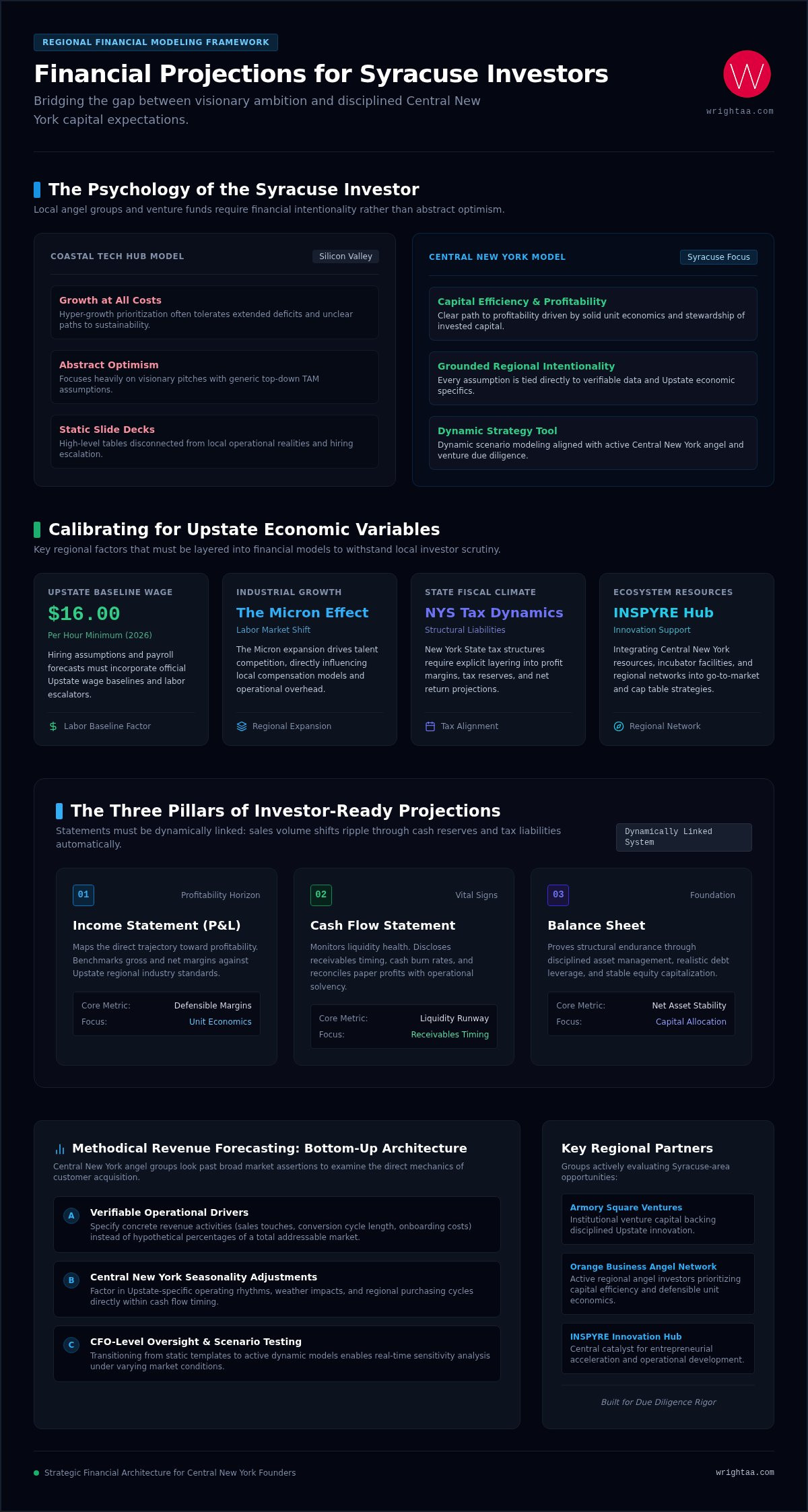
The role of these projections is dual. Internally, they function as a roadmap that guides your operational decisions. Externally, they serve as a trust-builder. Syracuse investors often prioritize capital efficiency over the hyper-growth models seen in coastal tech hubs. While a Silicon Valley firm might accept "growth at all costs," a Central New York investor typically looks for a clear path to profitability and a deep understanding of unit economics. This grounded approach creates a sense of stability, suggesting that the founder is a steward of capital rather than just a dreamer.
The Psychology of the Syracuse Investor
Local angel groups and venture funds in our region possess a mindset that is simultaneously conservative and growth-oriented. They understand the specific challenges of the Upstate economy, from the nuances of New York State tax structures to the "Micron effect" on local labor costs. Demonstrating an awareness of these factors is essential. When you present financial projections for investors Syracuse, you're proving that you have listened to the environment. Financial intentionality means every assumption in your model is backed by a reason. It shows you aren't just filling out a template; you're designing a resilient structure.
Beyond the Pitch Deck: The Spreadsheet as a Strategy
Your financial model must be more than a static table in a slide deck. It should be a dynamic tool that adheres to rigorous financial modeling principles, allowing you to test different scenarios. This level of preparation ensures your financial story matches your operational reality. If your starting a business in Buffalo NY checklist includes hiring plans, your Syracuse projections must reflect the actual 2026 minimum wage of $16.00 per hour. When your strategy and your spreadsheet align, you create a sense of calm authority that investors find compelling. This alignment transforms a simple forecast into a defensible strategy for long-term success.
The Three Pillars of Investor-Ready Projections
A resilient financial model rests on three distinct yet interconnected pillars. These pro forma financial statements provide a comprehensive view of your venture's health. The Income Statement maps your path to profitability, while the Cash Flow Statement monitors the vital signs of liquidity. The Balance Sheet demonstrates long-term stability and intentional asset management. For financial projections for investors Syracuse, these documents must be dynamically linked. A change in sales volume should ripple through your cash reserves and tax liabilities automatically. This level of technical rigor proves that you understand the fundamental mechanics of your business.
Investors scrutinize these pillars to see if they hold weight under pressure. They look for the relationship between revenue growth and the capital required to sustain it. If your P&L shows a profit but your Cash Flow Statement shows a deficit, you must be prepared to explain the timing of your receivables. This transparency builds a foundation of trust that is essential for any successful capital raise in Central New York.
Projecting Revenue with Precision
Investors in Central New York generally favor bottom-up forecasting over top-down assumptions. Rather than claiming a percentage of a massive market, show the specific steps required to acquire each customer. Revenue Drivers are the specific actions that generate income. This approach is particularly vital when accounting for the seasonality of the Syracuse market. Whether your cycle is tied to the academic calendar of local universities or the logistical shifts of a snowy winter, your revenue model must reflect these environmental realities. If you require assistance in mapping these variables, consulting with a strategic partner can provide the necessary perspective.
The Expense Model: Fixed vs. Variable Costs
Your model must clearly distinguish between the costs that remain static and those that scale with your growth. In Syracuse, certain expenses require careful calibration. Local labor rates are rising, and regional logistics can fluctuate based on energy costs and infrastructure. Applying disciplined small business accounting Buffalo NY principles to your Syracuse startup ensures that no overhead is overlooked. Your "Burn Rate" is the final measure of this discipline. It determines your runway and dictates exactly when you'll need the next infusion of capital. A precise expense model within your financial projections for investors Syracuse shows that you aren't just spending; you're investing with intention.
Calibrating Your Projections for Central New York Investors
Designing a financial model requires an intimate understanding of the site it occupies. In Central New York, this means aligning your expectations with regional benchmarks rather than national abstractions. While broad data provides a starting point, investors look for a calibration that reflects the specificities of the New York State economy. This includes accounting for the standard 6.5% corporate franchise tax rate and the rising operational costs driven by the Micron megafab project. Your financial projections for investors Syracuse must withstand the scrutiny of those who know this landscape's unique contours.
Successful models often incorporate a layer of "stress testing." This involves simulating regional economic shifts; perhaps a sudden increase in technical labor costs or a shift in commercial lease rates as the region grows. By following the SBA guidelines for business financial projections, you can ensure your multi-year forecasts include the necessary depth to handle these variables. It's about building a structure that is both elegant and resilient.
Industry-Specific Modeling for Syracuse
The structure of your model should mirror your industry's physical realities. For manufacturing ventures in CNY, the focus often shifts toward heavy CAPEX and meticulous inventory management. Tech and SaaS startups, conversely, must articulate their Customer Acquisition Cost (CAC) and Lifetime Value (LTV) with clinical precision. Professional service practices also face unique hurdles. For instance, a firm might require the specialized oversight of a CPA for law firms Buffalo NY when navigating the regulatory and financial nuances of expanding into the Syracuse market. Each industry requires a different lens to view its future.
The Role of Local Tax Strategy
Tax strategy is not a seasonal event; it is a permanent architectural intervention. In Syracuse, leveraging the Central New York Innovation Hot Spot at the INSPYRE Innovation Hub can unlock up to five years of corporate franchise tax exemptions and sales tax refunds. Integrating these benefits into your financial projections for investors Syracuse requires sophisticated business tax planning Buffalo NY to ensure every credit is captured. Proactive planning allows you to project a more accurate bottom line. It demonstrates to investors that you aren't just reacting to tax obligations but actively managing them. This foresight is what separates a static spreadsheet from a visionary financial strategy.
How to Build Your Financial Model: A Methodical Walkthrough
Constructing a financial model is a patient exercise in translation. It requires you to take the abstract elements of your strategy and render them into a quantitative reality. To produce financial projections for investors Syracuse can trust, you must follow a disciplined, step-by-step build. This process ensures that every number has a purpose and every assumption has a foundation. It's the difference between a speculative sketch and a professional blueprint.
The build begins with the gathering of historical data and the definition of your core assumptions. Once the foundation is set, you can frame the operational model, which includes detailed plans for headcount, marketing spend, and sales velocity. From here, you develop the three-statement financial forecast, ensuring the P&L, Cash Flow Statement, and Balance Sheet are dynamically linked. You must also include a "Sources and Uses" table. This section provides a clear accounting of how investor funds will be deployed and what milestones they will unlock. Finally, perform a sensitivity analysis to identify which variables possess the greatest power to alter your outcomes.
Setting Realistic Assumptions
Investors in Central New York are often wary of "hockey stick" growth curves that lack supporting data. Your model should present three distinct scenarios: conservative, base, and aggressive. This range demonstrates that you've considered multiple paths for your venture. Sensitivity analysis is the process of testing how changes in assumptions impact outcomes. By adjusting variables like customer churn or the 2026 Upstate minimum wage increase to $16.00 per hour, you prove that your business is built to withstand regional economic shifts. If you find the technical build overwhelming, our CFO advisory team can help you design a model that stands up to scrutiny.
KPIs that Syracuse Investors Watch
Local capital providers look for specific markers of health that indicate long-term viability. They prioritize financial kpis for small business such as Gross Margin and EBITDA to gauge operational efficiency. Your break-even point must be presented with absolute clarity, showing exactly when the venture stops consuming capital and begins generating it. Strong unit economics serve as the ultimate proof of a scalable business. They demonstrate that your core transaction is profitable even before you layer in the complexities of overhead and growth. In the Syracuse market, where capital efficiency is highly valued, these metrics are the language of credibility.
Beyond the Spreadsheet: CFO-Level Insights for Syracuse Growth
A financial model is not a memorial to a past decision. It is a living instrument. Many founders treat their projections as a hurdle to be cleared for a single pitch, yet the true value of financial projections for investors Syracuse lies in their ongoing application. When a model is static, it loses its ability to guide the venture through the shifting currents of the Central New York economy. A dynamic model allows you to transition from reacting to the market to intentionally shaping your place within it.
One of the most vital practices for maintaining this clarity is the Budget vs. Actual (BVA) analysis. This process acts as a regular structural inspection of your business. By comparing your projected figures against your actual performance, you identify where your assumptions held firm and where the environment required a different response. This level of discipline does more than just keep you on track; it provides powerful leverage. When you can demonstrate a history of meeting or exceeding your projections, you negotiate from a position of strength with vendors, landlords, and regional banks.
Leveraging Fractional CFO Guidance
The transition from founder-led finance to sophisticated oversight is a pivotal moment in a company's lifecycle. There is a fundamental duality between the role of a bookkeeper and a strategic CFO partner. A bookkeeper records the history of the site; a CFO designs its future. Utilizing outsourced CFO services Buffalo NY provides Syracuse ventures with high-level expertise at a predictable monthly fee. This partnership ensures that your financial reporting is professional, sensory, and ready for the scrutiny of a board meeting. It allows you to focus on your craft while an expert manages the architectural integrity of your capital.
Conclusion: Designing Your Financial Future
The path from raw data to investor confidence is paved with intentionality. By building financial projections for investors Syracuse that are grounded in regional reality, you create a narrative that is both visionary and defensible. In Central New York, where the economic landscape is being reshaped by large-scale industrial shifts and a vibrant startup ecosystem, financial clarity is your most durable asset. It is the difference between a venture that merely exists and one that thrives with purpose. If you are ready to refine your vision and secure the capital your venture deserves, book a consultation with Wright CPAs to refine your Syracuse financial strategy.
Designing for Resilience and Growth
Building a business in Central New York requires a disciplined approach to the numbers. You've seen how a methodical walkthrough transforms raw data into a defensible narrative. By calibrating your financial projections for investors Syracuse to reflect regional tax incentives and labor costs, you demonstrate a level of intentionality that commands respect. Clarity is not an accident; it's a deliberate design choice that signals your readiness for professional stewardship. When your financial model breathes with the local market, it becomes a bridge between your vision and the capital required to build it.
Securing capital is only the beginning of the journey. To maintain this momentum, you need the right architectural support behind your finances. Whether you're seeking specialized law firm accounting or strategic business consulting, professional oversight ensures your venture remains scalable and resilient. You can elevate your financial strategy with Wright CPAs through our fixed-fee monthly retainers and dedicated CFO-level guidance for Syracuse businesses. Your path to capital is now defined. It's time to build with confidence and purpose in a region poised for transformation.
Frequently Asked Questions
How far into the future should my financial projections go for investors?
Most investors expect a three to five-year forecast. This duration allows you to demonstrate the transition from initial capital consumption to sustainable profitability. While the first year requires monthly detail, subsequent years can move to a quarterly or annual cadence. This timeframe provides enough room to show the realization of your strategic goals without descending into pure speculation. It offers a clear view of your long-term vision and exit potential.
What are the most common mistakes in Syracuse business financial models?
One frequent error is failing to account for the actual costs of doing business in Central New York. This includes overlooking the 2026 Upstate minimum wage of $16.00 per hour or ignoring the impact of the Micron project on local commercial rents. Inconsistent data between the pitch deck and the model also damages credibility. Investors value grounded, defensible numbers over hyper-growth scenarios that lack local market awareness and technical rigor.
Do I need a CPA to create financial projections for my startup?
While you can draft initial numbers yourself, a professional review adds a layer of structural integrity. Financial projections for investors Syracuse carry more weight when they've been vetted for technical accuracy and tax alignment. A strategic partner can help you identify overlooked variables and ensure your model adheres to professional standards. This collaboration transforms a simple spreadsheet into a sophisticated tool for capital acquisition, providing the clarity that sophisticated investors demand.
How do I account for New York State taxes in my financial forecast?
Your model must incorporate the standard 6.5% New York State corporate franchise tax rate for businesses with income under $5 million. It's also essential to factor in the 8.00% combined sales tax rate in Onondaga County for taxable transactions. Proactive tax planning allows you to layer in potential credits, such as those available through the Central New York Innovation Hot Spot at the INSPYRE Innovation Hub, which can significantly improve your projected bottom line.
What is a "Sources and Uses" statement, and why do investors care?
A Sources and Uses statement provides a transparent accounting of where your capital originates and exactly how it will be deployed. Investors scrutinize this to ensure their funds are being used for growth-oriented activities, such as product development or strategic hiring, rather than just covering past debts. It serves as a commitment to financial intentionality. This statement proves that you have a specific, disciplined plan for every dollar of their investment.
How often should I update my financial projections after receiving investment?
Projections should be updated at least quarterly to reflect your actual performance. A monthly Budget vs. Actual analysis is even more effective for maintaining operational control and investor trust. This practice allows you to adjust your strategy in real time based on the reality of the Syracuse market. Regular updates ensure that your financial model remains a relevant guide rather than a static document that no longer reflects your venture's physical reality.
Can I use a template for my Syracuse business projections?
A template can serve as a useful starting point for the basic structure of your three-statement model. However, it requires deep customization to reflect the specificities of Central New York. Generic templates often miss local tax nuances, regional labor trends, and the unique incentives available in Syracuse. To be truly investor-ready, your model must feel like a custom-designed blueprint. It should be rooted in the specific geographic and cultural context of your venture.
What is the difference between a pro forma and a financial projection?
A pro forma statement often reflects hypothetical scenarios or "what-if" situations based on specific events, such as a major capital infusion. A financial projection is your best estimate of future performance based on current assumptions and market conditions. Both are essential for financial projections for investors Syracuse. They allow you to demonstrate both your expected path and your resilience under different conditions, providing a comprehensive view of your venture's future potential.


