

Bookkeeping rarely goes wrong all at once; small inconsistencies can gradually blur the financial picture. Review your financials at least monthly, and consider weekly reviews when cash flow tightens or growth accelerates. The common bookkeeping mistakes to avoid often begin with a transaction coded to the wrong account, a receipt recorded late, or a charge missing from the books. Regular reviews bring these details into view before they affect your understanding of the business.
It makes sense to want a clear, reliable view of where money comes from and where it goes. Accurate records depend on a steady routine, not a last-minute effort at tax time. This article explains how often to review your financials and how consistent coding, prompt receipt recording, and accurate transaction tracking help prevent errors. You’ll also learn how reconciliation and a closer look at unusual entries can make your books more useful for everyday decisions.
Key Takeaways
- Use consistent account categories so transactions are easier to interpret and compare over time.
- Keep business and personal finances separate, with records organized for a clearer review.
- Record transactions regularly and attach receipts while the details are still easy to recall.
- Reconcile account balances and investigate unfamiliar entries to catch errors before they distort your financial picture.
1. Consistent transaction coding and chart of accounts
A chart of accounts gives each transaction a clear place in your financial records. Keep categories consistent so similar purchases land in the same account each time. For example, code a vendor’s monthly software payment as a software expense every month, rather than switching categories. Consistency makes reports easier to interpret and helps reveal changes in cash flow. Review categories when your business adds a revenue stream or a new type of purchase.
Two common bookkeeping mistakes to avoid are entering incorrect details and assigning transactions to inconsistent categories. Prevent both with a repeatable process: match the date, amount, vendor, and payment method against the receipt and bank activity before coding an entry. Accounting software can import transactions, but review them for duplicates and incorrect categories. Choose tools with encryption and multifactor authentication, and connect them to the business bank account where appropriate.
Misclassifying employees, contractors, or business expenses can distort payroll and financial records. A U.S. business that misclassifies an employee as an independent contractor may face government fines and damages owed to employees. A business may have to file 1099 forms for contractors, and failing to file them can create compliance risk and potential penalties, according to the Internal Revenue Service. Incorrect expense coding can also make reports less useful for tax preparation.
Another common bookkeeping mistake to avoid is letting unclear coding decisions pile up. Review vendor payments and receipts regularly, and correct errors while the details are still familiar. If a contractor relationship or expense category is difficult to classify, seek guidance from a bookkeeping or accounting professional. As transaction volume grows, professional support can help keep records consistent and give owners more time to focus on operating decisions.
Take a proactive approach to accounting by reviewing your chart of accounts whenever business activity changes. Secure, integrated tools can reduce manual work, while a bookkeeper can help maintain records and reconcile accounts. Together, a clear coding structure and regular oversight give financial reports a dependable foundation.
2. How often should I review my financials?
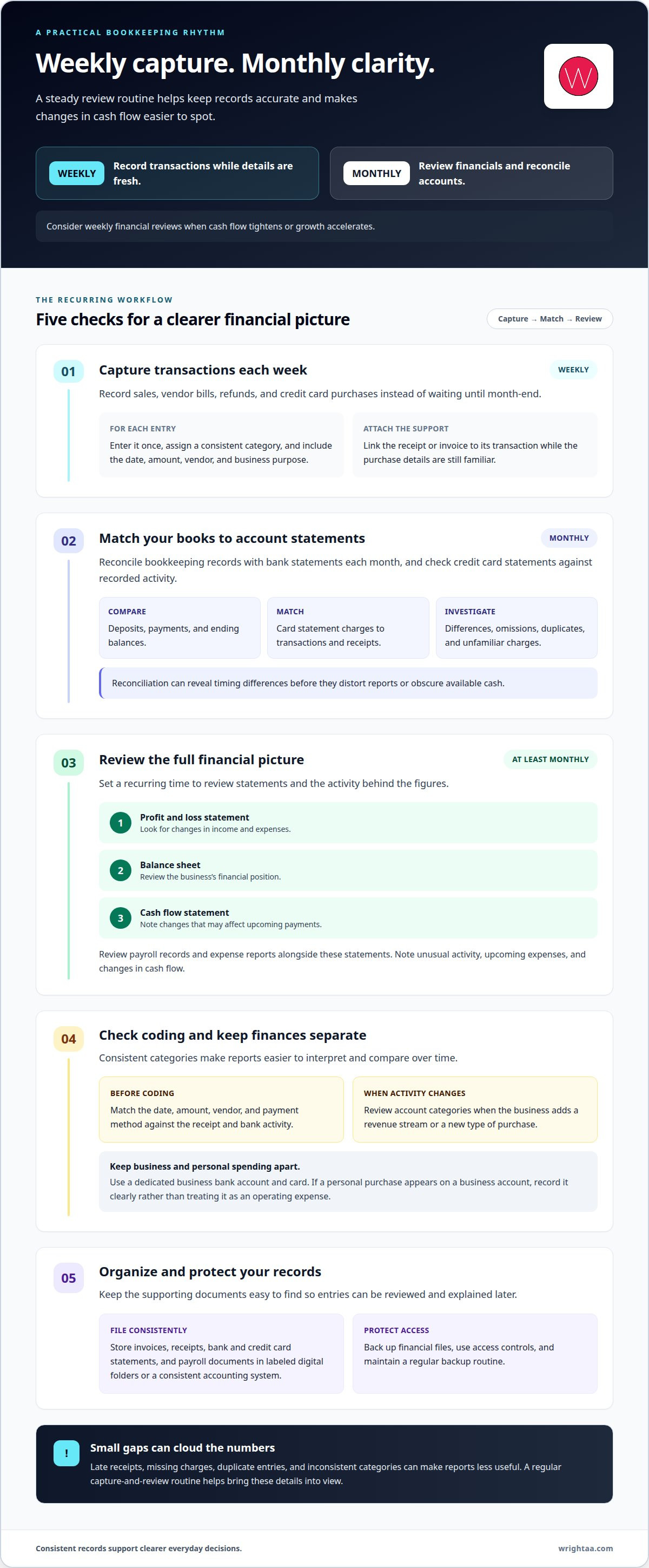
Review financials at least monthly, and consider weekly reviews when cash flow tightens or growth accelerates. Set a recurring time to examine the profit and loss statement, balance sheet, and cash flow statement. Monthly reviews help business owners spot changes while there is still time to adjust spending or plan upcoming payments. Review payroll records and expense reports alongside these statements so the figures reflect the activity behind them.
Reconcile bookkeeping records with bank statements monthly. Compare recorded deposits, payments, and the ending balance with each statement, then investigate any differences. For credit cards, match statement charges to recorded transactions and receipts. Reconciliation can uncover omissions, duplicates, unfamiliar charges, or timing differences before they distort reports. It also gives business owners a clearer view of available cash, rather than relying on a balance that may not reflect pending activity.
Keep business and personal finances separate. Use a dedicated business bank account and card for company income and purchases, then categorize each transaction in your accounting software. Mixing personal and business expenses makes records harder to interpret and can complicate tax preparation. For LLCs and corporations, combining finances can also jeopardize liability protection. If a personal purchase appears on a business account, record it clearly rather than treating it as an operating expense.
Organize records as transactions occur. Store invoices, receipts, bank and credit card statements, and payroll documents in labeled digital folders or a consistent accounting system. Back up customer data and financial files so you can restore records if a device is lost, hacked, or stolen. Use access controls and a regular backup routine to protect those files.
Use each review to note unusual activity, upcoming expenses, and changes in cash flow. If reports raise questions about operating decisions, business consulting support can help connect the numbers to a practical plan.
3. Recording transactions and receipts in real time
Record transactions weekly instead of waiting until month-end. A Friday routine can capture sales, vendor bills, refunds, and credit card purchases while the details are still familiar. Enter each transaction once, assign its category, and attach the supporting receipt or invoice. This sequence reduces forgotten expenses and makes later reconciliation less dependent on memory. Include the transaction date, amount, vendor, and business purpose with each entry.
Use a digital bookkeeping system to photograph receipts and connect each image to its transaction. Check the captured amount and date, then categorize the expense while the purchase is still fresh. For emailed invoices, save the original file and label it with the vendor and invoice date. When a payment clears, update its status in the system. These small steps keep receipts and invoices organized and easier to find.
Keep expense receipts to support the amounts recorded in your books. A receipt for office supplies, for example, should be linked to the matching expense entry, not left in an unlabeled folder. Missing receipts and disorganized invoices can mean lost deductions and create compliance risks. Keep paper receipts together until you capture them digitally, then retain them according to your record-keeping process. A clear trail also helps explain unusual charges during a later review.
Automate repeatable tasks such as invoicing, expense tracking, payroll integration, and routine reporting. Accounting software can reduce manual spreadsheet entry, which becomes more error-prone as transaction volume grows. Automation still needs review: confirm imported entries, correct duplicates, and check that receipt images match recorded expenses. Small businesses can outsource recurring data entry or bookkeeping when weekly records become difficult to maintain. Keep judgment-based decisions, such as interpreting an unusual business expense, under appropriate human review. A weekly routine and careful receipt capture keep the transaction trail current and useful.
4. Accurate bookkeeping and transaction tracking
Accurate bookkeeping follows each dollar from its source to its final use. Record income when received, payments when made, and transfers without treating them as revenue or expenses. For every entry, preserve the date, amount, account, and business purpose. Compare bookkeeping records with bank activity and resolve differences rather than adjusting balances without explanation. This transaction trail helps owners see how sales, costs, and cash flow relate.
Common errors include omitted transactions, duplicate entries, reversed numbers, and charges assigned to the wrong account. These mistakes can carry through to tax filings when returns are prepared from incomplete or incorrect records. Missing income, unsupported expenses, or overlooked filing obligations can create compliance risks; late tax filings and payments can result in penalties and interest. Review financial reports regularly, investigate unusual transactions, and link supporting records to each entry.
Cash-basis and accrual-basis records recognize activity at different times. Cash-basis accounting records income when payment arrives and expenses when paid. Accrual accounting records revenue and expenses when they are earned or incurred. To avoid mixing methods, document the basis used for each report and apply it consistently. Some businesses use cash-basis records for tax purposes while reviewing accrual reports internally, so label reports clearly before comparing results.
Build a repeatable control into bookkeeping and accounting: record activity, review account balances, reconcile differences, and correct errors with a clear audit trail. For petty cash, assign a custodian and compare receipts with the remaining cash. For sales subject to sales tax, record and separate the tax at the point of sale. Accounting software can centralize transaction history, but owners still need to review entries and backups. If records are difficult to maintain or interpret, consult for bookkeeping support to establish a consistent process.
Wright CPAs, LLC: Bookkeeping
Wright CPAs, LLC provides bookkeeping support to help keep business records organized, transactions accurately tracked, and financial reports useful for decisions. Turn to the firm when recurring entries, reconciliations, or growing transaction volume make it difficult to maintain a clear view of your books.
Reliable bookkeeping also gives business owners a stronger foundation for tax preparation and planning. Wright CPAs, LLC connects day-to-day records with Tax Planning and Preparation, Payroll Services, and CFO Services when those needs arise. The right support depends on the work involved, from maintaining orderly records to understanding how cash flow and financial results inform business decisions.
If your books need steadier attention, contact Wright CPAs, LLC to discuss bookkeeping support.
Build a steadier financial routine
Reliable books are more than a record of past activity. They create a working foundation for decisions about hiring, spending, and growth. Common bookkeeping mistakes are easier to avoid when someone owns the process and financial information stays current enough to guide action.
As your business changes, adapt your bookkeeping process with it. New staff, additional payment channels, or a different mix of customers can affect how transactions are recorded and reviewed. Periodically assess whether your routine still reflects how the business operates. Clear records make it easier to discuss what is working and where financial decisions need closer attention.
Wright CPAs, LLC offers Bookkeeping, Tax Planning and Preparation, and Payroll Services to support connected financial needs. If you’re ready to strengthen your bookkeeping process, contact Wright CPAs, LLC. A deliberate next step can help bring greater clarity to the decisions ahead.
Frequently Asked Questions
What is an accounting error?
An accounting error is an unintended inaccuracy in a financial record. For example, a purchase might be entered twice, or a payment amount might have transposed digits. That differs from deliberately hiding or altering information. To correct an error, preserve the original entry’s history, record the correction clearly, and retain the supporting document. An unexplained change makes the record harder to understand later.
What are the most common bookkeeping mistakes small businesses make?
Typical problems include omitted income, duplicate expenses, reversed digits, incorrect account assignments, and incomplete vendor records. For example, a customer payment applied to the wrong invoice can make one balance appear overdue while another looks settled. Trace the entry to the original invoice and deposit to find the mismatch. Reviewing open customer balances can reveal this kind of posting error.
How should businesses track receipts, invoices, and expenses accurately?
Give each document a consistent, searchable name that includes the vendor, date, and invoice number. Keep the source file connected to its accounting entry, and retain credit memos with the related invoice. If a vendor invoice is paid in installments, record the bill and each payment as separate activity. This helps prevent counting the same expense twice and clarifies what remains unpaid.
How often should small businesses update their books and reconcile accounts?
Update transaction records weekly and reconcile bank and credit card accounts monthly. During the weekly review, identify uncategorized entries and missing documents. During the monthly review, resolve statement differences and examine account balances. A founder may benefit from more frequent cash-flow reviews when cash is tight or growth is accelerating. Adjust the review routine as transaction volume and business needs change.


