

A plumbing company’s books should track the work, not just money moving through its bank account. Effective accounting for plumbers in Buffalo connects each job’s revenue with labor, parts, and overhead, while keeping cash flow visible as costs come due and customer payments arrive.
That’s what makes plumbing accounting different from routine small-business bookkeeping. A service call, a renovation, and a long-term commercial project each place different demands on job costing and financial records. The right accounting approach helps reveal which work is profitable and where cash may be under pressure.
This article explains how job-based accounting works, why bookkeeping and separate business records matter, and how tax planning, payroll, and financial reporting fit into a plumbing business. It also covers what industry-specific accounting should address, so you can understand how clear, useful financial information can support your business.
Key Takeaways
- Job-based records can show how labor, parts, and overhead shape profitability across service calls and larger projects.
- Separating business and personal finances gives bookkeeping a clearer foundation and helps support accurate expense records.
- Tax and payroll obligations call for organized records; the Internal Revenue Service requires electronic filing once a business reaches 10 or more information returns.
- Industry-focused accounting connects project costs and financial reporting, helping plumbing businesses assess performance and plan with greater clarity.
How is accounting for plumbers different from regular small-business accounting?
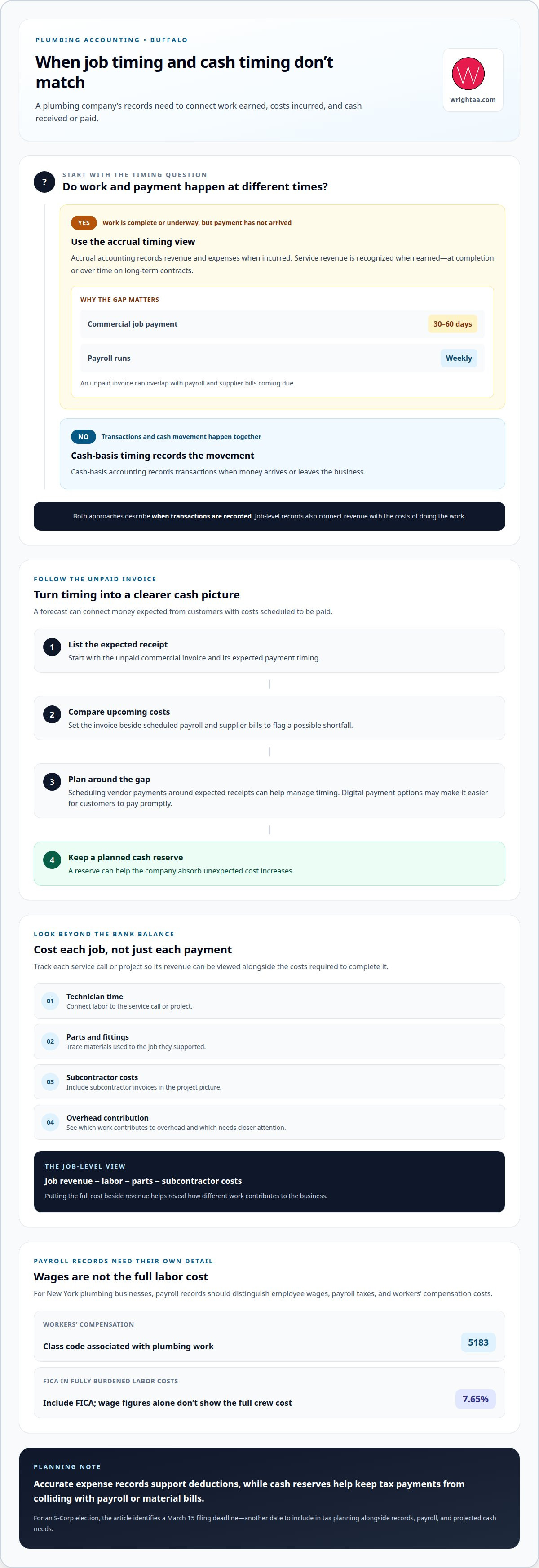
Accounting for plumbers in Buffalo needs to follow job timing as well as bank activity. Cash-basis accounting records transactions when money arrives or leaves. Accrual accounting records revenue and expenses when incurred. This distinction matters when a contractor finishes work before payment. Service revenue is recognized when earned, at completion or over time on long-term contracts. Commercial jobs may take 30 to 60 days to pay, while payroll runs weekly. Accounting for plumbers in Buffalo connects these different timelines to a clearer financial picture.
A financial forecast can connect unpaid invoices with upcoming costs. For example, an accountant can compare an unpaid commercial invoice with scheduled payroll and supplier bills, then flag a possible shortfall. Scheduling vendor payments around expected receipts can help manage timing, while digital payment options may make it easier for customers to pay promptly. A planned cash reserve can also help a plumbing company absorb unexpected cost increases.
For New York plumbing businesses, payroll records should distinguish employee wages, payroll taxes, and workers’ compensation costs. Workers’ compensation class code 5183 is associated with plumbing work. Employers also include 7.65% FICA in fully burdened labor costs, so wage figures alone don’t show the full cost of a crew.
An accountant can track revenue, labor, parts, and subcontractor costs for each service call or project. A repair job’s records can bring together technician time, fittings, and subcontractor invoices, showing the full cost beside the revenue. This job-level view helps identify which work contributes to overhead and which needs closer attention.
Accurate expense records support deductions, while cash reserves help keep tax payments from colliding with payroll or material bills. According to the Internal Revenue Service, the S-Corp election has a March 15 filing deadline. A professional can include that date in tax planning and align records, payroll, and projected cash needs.
Bookkeeping support for separating plumbing business and personal accounts
Separate business and personal accounts give every plumbing transaction a clear place. A bookkeeper can reconcile business bank and credit-card statements and flag personal charges paid with company funds. For example, a hardware-store receipt for a household repair should not be recorded as job materials. Consistent classification supports accurate income reporting, expense tracking, and tax deductions.
Records should connect each transaction to its purpose. Keep bank statements, customer invoices, receipts, vendor bills, payroll records, subcontractor invoices, and equipment purchase documents organized. Job files can show which service call used specific parts. These records support tax preparation and help explain transactions if they are requested for examination.
Bookkeeping should also reflect how work is priced. For flat-rate service, records can connect the fixed charge with technician time and parts used. For time-and-materials work, invoices should distinguish labor hours from materials so job costing shows how each contributes to revenue. Inventory tracking can link purchased items with the parts used on jobs, instead of leaving material costs in a general expense category.
Track retainage separately within project receivables. A bookkeeper can record the withheld amount, related invoice, project, and release condition apart from cash received. This keeps reported income distinct from outstanding balances and makes future collections easier to monitor.
Bookkeeping software can bring bank activity, invoicing, payroll, and inventory records into a consistent reporting process. An accounting professional can organize categories and reconcile connected records, keeping a parts purchase traceable to its job allocation. Outsourcing may make sense when reconciliations fall behind, invoice tracking becomes difficult, or management lacks timely job reports. The right approach depends on transaction volume and the level of project detail the business needs.
With plumbing business bookkeeping, organized records can support clearer reporting and more reliable costing across jobs.
Accounting and tax services for plumbing businesses
Tax records are easier to use when each transaction has a clear purpose. A plumbing business can organize income and expenses by service line, such as drain clearing, fixture installation, and remodel work. Comparing results across those categories helps an owner see which services contribute most to revenue and where costs need closer attention.
Documented business expenses support deduction claims. Keep receipts and job records for materials, labor, tools, vehicles, and equipment. Depreciation allocates tangible asset costs over their useful life; plumbing businesses may also consider Section 179 for eligible vehicles, tools, and equipment. Clear records help tax preparation distinguish current expenses from capital purchases.
Tax obligations can involve income, sales, and payroll taxes. Plumbing contractors in Buffalo and elsewhere in New York need accurate records and timely returns for each applicable obligation. A tax professional can organize records by tax type and review how business activity affects filings, rather than treating every payment as the same kind of expense.
Subcontractor records also matter. Keep records of payments to subcontractors and check applicable information-reporting requirements when preparing tax filings. According to the Internal Revenue Service, electronic filing is required once a business reaches 10 or more information returns. Organized vendor details make reporting more orderly.
Field-service and accounting software can support connected records when service-call details flow into invoicing and bookkeeping. For example, a completed repair can carry its customer, service line, labor, and materials into the financial record. Revenue categories can then distinguish repair income from installation or renovation income. Keeping customer contact details and service records together can help maintain continuity from the initial request through invoicing. This gives the owner a clearer view of revenue, expenses, and customer activity.
Job costing tracks revenue, labor, parts, and overhead by project and service call, while COGS covers materials, labor, and direct service expenses. Owners owe estimated taxes four times a year.
Construction and plumbing industry specialization
Plumbing construction accounting connects financial records to the way projects are built. A new-construction contract, a renovation, and a repair call have different schedules and cost patterns. Job costing assigns direct labor and materials to each project, then allocates indirect costs such as office overhead. This makes project results more useful than relying on a single company-wide profit figure.
Gross margin targets also vary by work type. New-construction plumbing targets 10-18%, while service and repair work targets 40-55%. Remodel and renovation work targets 25-40%. These figures offer benchmarks for reviewing estimates and completed jobs, not guaranteed results. If a project’s actual margin falls below its target, the records can reveal whether labor, materials, or overhead drove the difference.
For a commercial construction job, an accountant can organize costs by project phase and compare them with the budget. This can help flag cost overruns in time to inform decisions about labor, purchasing, and remaining work. Separate records for vehicles, equipment, and property also help account for capital expenditures. Depreciation allocates tangible asset costs over their useful life, helping distinguish asset costs from routine job expenses.
When comparing Buffalo accounting firms, look at how clearly they handle project-level costing, indirect cost allocation, and construction financial reporting. Ask how their reports would show a service call beside a renovation, or compare a project budget with actual costs. Useful accounting connects job performance with cash needs and credit decisions, helping a business understand both profitability and its capacity to take on work.
For plumbing contractors who need clearer project-level financial insight, discuss your plumbing business accounting needs and the records that would make job performance easier to assess.
Allocating direct and indirect costs to specific plumbing projects helps assess each project’s financial performance. Consistent project-level records make it easier to see how costs shape results across different kinds of work, rather than relying on company-wide totals alone.
The accounting firm says a plumbing company doing $1M-$15M in revenue is the type of business it serves. Contractors can use that fit as a starting point when discussing whether the firm’s project costing and reporting approach matches their needs.
Wright CPAs: Law Firm Accounting
Wright CPAs helps business owners connect bookkeeping, payroll, and tax planning. For a plumbing business, its services can support clearer revenue and expense records, payroll processing, and tax preparation based on organized books.
Turn to Wright CPAs when job activity has outgrown basic recordkeeping, tax planning needs attention, or payroll and bookkeeping are difficult to coordinate. The firm offers bookkeeping, payroll solutions, tax preparation, and tax planning to support financial clarity and help owners use financial information in business decisions. Its Law Firm Accounting service is designed for law firms; plumbing businesses can focus on the firm’s relevant bookkeeping, payroll, and tax services.
Contact Wright CPAs to discuss accounting support for your plumbing business.
Make Your Next Financial Decision With Clarity
A useful next step in accounting for plumbers in Buffalo is to decide what you need your financial information to clarify. You might be weighing whether to take on more construction work, adjust service-call pricing, or prepare for a staffing change. Naming the decision gives your accounting work a practical direction.
Bring that priority to an accounting professional. A focused discussion can identify which records and reports will help you assess the decision and which financial details deserve closer attention. The aim is not simply to keep records current, but to make them useful as your business changes and new decisions arise.
Start a conversation with Wright CPAs about plumbing accounting. With a clear question and thoughtful financial support, you can move forward with greater confidence.
Frequently Asked Questions
What’s the first step to working with an accountant to get my plumbing business finances under control?
Start by identifying the decision or financial strain you want help with, such as unclear owner draws or a tax balance that’s difficult to plan for. Gather recent business bank statements, filed tax returns, payroll summaries, and a list of questions. An accountant can use these to understand the current picture and determine which records or bookkeeping processes need attention first.
What accounting services do plumbers in Buffalo, NY need?
Plumbing businesses often need bookkeeping, tax planning and preparation, payroll services, and cash flow guidance. The right mix depends on the company’s structure, employees, project workload, and reporting needs. Buffalo plumbers can look for support that connects day-to-day records with tax planning. Businesses in Rochester or Syracuse can also benefit from accounting guidance that reflects their operations in those markets.
How can an accountant help plumbers manage cash flow, invoicing, and customer payments?
An accountant can help establish a regular process for reviewing unpaid invoices, recording incoming payments, and comparing expected deposits with upcoming obligations. For example, tracking an invoice awaiting approval separately from one that is simply unpaid can guide a more relevant follow-up. Bookkeeping and cash flow management can give owners a clearer view of collection patterns and support decisions about payment timing.


