

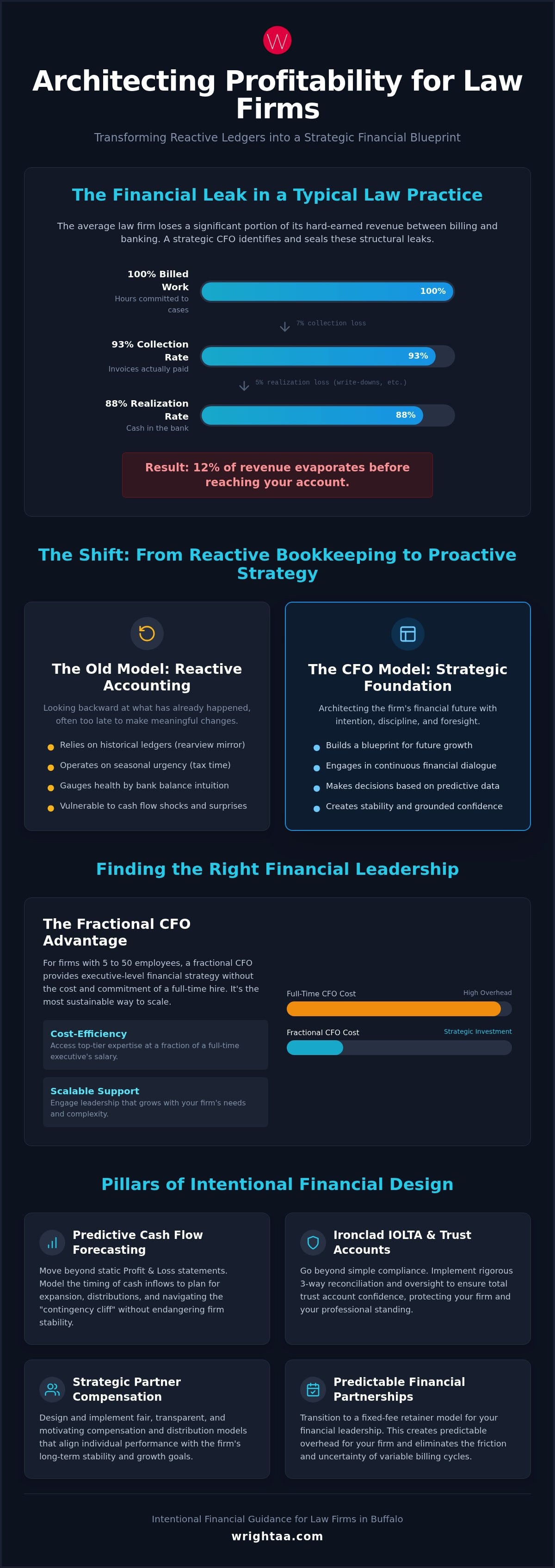
About one in five hours worked at your firm never converts to actual cash. For many practices, this 88 percent realization rate isn't a failure of talent. It's a lack of structural integrity in the financial foundation. When you seek CFO services for law firms Buffalo, you're looking for more than a simple ledger. You're searching for an architect to design a predictable, intentional rhythm for your practice. A firm's financial health should feel as solid and enduring as the historic buildings that define our city's skyline.
It's exhausting to balance the weight of IOLTA compliance with the volatility of contingency cycles and slow billing. You feel the tension between today's overhead and tomorrow's expansion. This article explores how fractional CFO leadership transforms reactive accounting into a strategic blueprint for profitability. We'll examine the path toward total trust account confidence and how fixed-fee models create the clarity you need to scale. You will discover a roadmap for partner compensation and tax efficiency that honors the legacy you've built.
Key Takeaways
- Understand why a strategic CFO acts as a structural engineer for your firm, shifting the focus from historical ledgers to intentional future growth.
- Discover how specialized CFO services for law firms Buffalo provide the executive leadership needed to bridge the gap between billable hours and actual cash realization.
- Compare the cost-efficiency of fractional leadership against full-time hires to find the most sustainable scale for firms with five to fifty employees.
- Learn to architect partner compensation and distribution models that align with long-term stability and precise performance metrics.
- Transition to a fixed-fee retainer model to ensure predictable overhead and eliminate the friction of variable billing cycles from your financial partners.
The Shift from Reactive Ledgers to Structural Blueprints
Traditional bookkeeping acts as a rearview mirror. It captures the light of events already passed. For a law firm partner, relying solely on historical ledgers is like navigating a ship by looking at the wake. You see where you've been. The obstacles ahead remain obscured. When you engage CFO services for law firms Buffalo, you stop simply recording history and start architecting it.
There's a profound difference between the annual ritual of "doing taxes" and the continuous discipline of designing a tax-efficient future. One is a compliance requirement; the other is a strategic intervention. In Buffalo's specific regulatory environment, this distinction determines whether a firm merely survives the fiscal year or builds a lasting legacy. Intentional financial structure reduces the emotional burden of firm ownership, replacing the anxiety of the unknown with a quiet, grounded confidence.
The Limitations of the Traditional CPA Model
The traditional CPA model often functions on a cycle of seasonal urgency. Once-a-year tax preparation leaves firms vulnerable to sudden cash flow shocks, as decisions are made in the vacuum of the present moment. This creates a "reactive trap" where partners look at their bank balances to gauge health rather than analyzing underlying data. It's a fragile way to build a practice.
Transitioning to a model of constant financial dialogue is essential. Without this ongoing perspective, firms often miss the subtle signals of inefficiency until they become structural cracks. Relying on a bank balance for decision-making ignores the dualities of law firm economics, such as the gap between unbilled work and actual cash realization. Data should guide your growth, not your intuition about what's left in the vault.
CFO Services as a Strategic Foundation
A Chief Financial Officer serves as the essential bridge between legal excellence and business profitability. While attorneys focus on the nuance of the law, the CFO focuses on the nuance of the firm's economic health. They evaluate financial materiality, identifying which variables truly move the needle for your specific practice area. CFO services are the intentional design of a firm's economic future.
By implementing CFO services for law firms Buffalo, you create a foundation that supports long-term scale. This role isn't about simple data entry; it's about the deep listening and contextual awareness required to build a sustainable business model. It ensures that every tactical decision, from hiring a new associate to leasing office space, aligns with the broader architectural vision of the firm.
Navigating the Unique Economic Dualities of Law Firms
Law firms exist in a state of constant tension between internal effort and external reward. While a standard business might recognize revenue at the point of sale, a legal practice often waits months or years for realization. Research indicates that the average collection rate for law firms is 93 percent, while the realization rate sits at 88 percent. This means nearly one in five hours worked evaporates before it reaches your account. CFO services for law firms Buffalo provide the necessary oversight to identify where this leakage occurs and how to tighten the structural seams of your billing cycle.
Managing the "contingency cliff" requires a delicate balance. High-risk, high-reward cases provide the fuel for growth, but they also create periods of extreme cash volatility. A CFO maintains the equilibrium of the firm's capital, ensuring that operational overhead is covered during the long silences between settlements. In Western New York, where economic growth is steady but specific, local firms must be intentional about their reserves. This financial discipline allows you to pursue complex litigation without compromising the firm's daily breath.
The Discipline of Cash Flow Forecasting
A Profit and Loss statement is a static document. It lacks the dimension of time. To truly understand your firm's health, you must move beyond the P&L toward predictive modeling. This is especially vital for practices with long case lifecycles. By understanding the timing of cash inflows, you can plan for expansion or partner distributions without endangering the firm's stability. For a deeper look at these principles, explore our Small Business Guide to Cash Flow Management.
IOLTA and Trust Account Integrity
Trust accounting is not merely a technical task; it's a matter of professional survival. In New York, 3-way reconciliation is a rigorous requirement that demands absolute precision. A CFO oversees this process, ensuring that trust account balances, client ledgers, and bank statements align perfectly. This level of oversight reduces the risk of disciplinary action and protects the firm's reputation. Designing internal controls is a poetic act of protection for both the practice and the clients it serves. If you're ready to bring this level of intentionality to your practice, consider how specialized law firm accounting can stabilize your foundation.
The Fractional CFO vs. Full-Time Leadership
For firms with 5 to 50 employees, the need for executive financial leadership is undeniable. However, the traditional path of hiring a full-time executive often creates a structural imbalance. The median base salary for a full-time Chief Financial Officer in the United States is $269,750 before accounting for benefits and bonuses. For many practices, this represents a significant commitment of capital that might be better deployed elsewhere. Choosing CFO services for law firms Buffalo allows you to access high-level expertise without the weight of an executive salary.
A Buffalo-based fractional CFO understands the specific geographic and cultural context of Western New York. They recognize the local economic landscape, where average commercial lease rates hover around $16 per square foot and the median salary for local lawyers ranges from $97,473 to $131,098. This local awareness ensures that financial strategies aren't just theoretical. They're built on the actual costs and opportunities present in our city. This curated approach provides the flexibility to scale your leadership as your firm evolves.
Calculating the Realized Value of Outsourcing
The realized value of a fractional model lies in its disciplined focus. Instead of a full-time W-2 employee who may spend time on administrative minutiae, an advisory retainer centers on high-impact strategy. It's a purposeful intervention that targets specific goals like tax efficiency or firm-wide profitability. By delegating financial leadership to a trusted partner, you reduce the internal noise that often distracts from legal work. This allows the partners to focus on their craft while the financial foundation remains secure and monitored.
Integrating CFO Expertise into Your Firm's Culture
Integration is a steady, unhurried process. A fractional CFO doesn't replace your existing legal administrators; they collaborate with them. This partnership creates a steady rhythm of monthly strategy meetings and reporting that keeps everyone aligned with the firm's long-term roadmap. Implementing new financial technologies often feels like a source of friction. A strategic partner helps smooth this transition, ensuring that modern tools are used to provide clarity rather than confusion. It's about building a culture where data informs every decision with serenity and purpose.
Designing for Profitability and Long-Term Scale
Scale is not simply the accumulation of more files. It's the intentional arrangement of resources. Without a blueprint, growth often leads to structural instability. CFO services for law firms Buffalo provide the analytical depth required to ensure that every new case contributes to the firm's long-term health. This process begins with a rigorous examination of the data that defines your daily operations. It requires a shift in perspective, moving from viewing the firm as a series of tasks to seeing it as a cohesive, breathing structure—a principle that becomes clear when you discover The Probate & Estate Planning Co. and their specialized approach to probate and asset protection.
A healthy firm maintains a rhythmic awareness of its performance. We look beyond the surface to track utilization rates, realization rates, and collection cycles. These metrics act as the sensory input for your business. They identify which practice areas are truly profitable and which are merely consuming resources. For example, a high-revenue department might actually be a net loss when you account for administrative friction and slow collection times. To understand how these measurements apply to your broader strategy, consider our guide on Financial KPIs for Small Business. This data allows you to make decisions based on substance rather than spectacle.
Succession and Strategic Exit Design
Many attorneys spend their careers building a job rather than an asset. A CFO's role includes architecting partner compensation and distribution models that reward performance while preserving the firm's capital. This clarity is essential for succession planning. Whether you're preparing for a buy-out or a transition to new leadership, a disciplined financial history increases the firm's valuation. It transforms a collection of cases into an enduring legacy. When the financial foundation is transparent and well-documented, the firm becomes a much more attractive intervention for potential successors or buyers.
Modern technology serves as the mortar between the bricks of your financial structure. By leveraging integrated systems, you create a frictionless environment where data flows naturally from billing to reporting. This reduces the emotional weight of firm ownership. It replaces manual entry with automated precision, allowing you to focus on the human elements of your practice. If you're ready to design a more intentional future for your practice, our team provides the CFO services necessary to stabilize and scale your firm with confidence.
Partnering with Wright CPAs, LLC: Intentional Legal Guidance in Buffalo
Buffalo law firms operate within a specific cultural and economic context. At Wright CPAs, LLC, we've spent over a decade refining our approach to CFO services for law firms Buffalo. We understand that legal professionals are often weary of the very billing structures they impose on others. This is why we utilize a Fixed-Fee Monthly Retainer model. It creates a predictable environment where overhead is a known variable, not a source of monthly anxiety. This approach honors the relationship between the firm and its financial partners, removing the friction of billable-hour surprises.
Our commitment to Western New York extends beyond simple accounting. We view the growth of the regional legal community as a vital part of the city's broader economic architecture. By stabilizing individual firms, we contribute to a more robust professional landscape. This vision is grounded in the belief that financial clarity is a prerequisite for both professional excellence and personal peace. It's about building something that lasts in a city that values endurance.
The Wright CPAs, LLC Philosophy
We approach accounting as an architectural discipline. Just as a well-designed building responds to its site and structure, our financial strategies respond to the specific needs of your practice. We blend traditional methods with modern sensitivities, ensuring that your firm remains compliant while leveraging the latest technological tools. Our focus is always on improving the business owner's daily life. For a law firm partner, this means creating a financial environment that feels quiet, purposeful, and entirely under control. It's a poetic intersection of humanity and the built business environment.
Your Next Step Toward Financial Clarity
Beginning a financial walkthrough with us is a deliberate and unhurried process. During a strategic consultation, we listen deeply to the challenges your firm faces, from realization gaps to succession concerns. We don't offer generic solutions. Instead, we design a customized service plan that fits your firm's specific structure. This roadmap serves as a consistent philosophical guide for your firm's future. It's a disciplined approach that prioritizes quality over spectacle.
You'll learn how our proactive leadership can transform your reactive ledgers into a strategic blueprint for growth. If you're ready to move toward a more intentional economic future, Book a Consult for Law Firm Accounting in Buffalo, NY. Let's begin the work of architecting your firm's long-term profitability and scale with the precision it deserves.
Architecting Your Firm's Financial Legacy
Financial management is more than the act of balancing ledgers. It's the intentional creation of a structure that supports your professional vision. We've explored how transitioning from reactive accounting to proactive leadership provides the clarity needed to navigate the unique dualities of the New York legal market. By utilizing CFO services for law firms Buffalo, you replace the friction of variable billing surprises with the quiet stability of a fixed-fee model. This shift allows you to focus on the craft of law while your economic foundation remains secure and monitored.
Since 2012, Wright CPAs, LLC has served the legal communities of Buffalo, Rochester, and Syracuse with a rigorous focus on structural integrity and NY IOLTA compliance. Our goal is to improve your daily life by removing the weight of financial uncertainty. You can build a firm that functions as a true asset, ensuring your legacy is as enduring as the city's own architecture. Design a more profitable future for your firm; Book a Strategic Consultation with Wright CPAs, LLC. Your practice's potential is a site waiting for the right blueprint, and we're ready to help you build it.
Frequently Asked Questions
What is the difference between a law firm bookkeeper and a fractional CFO?
A bookkeeper focuses on the accurate recording of past transactions, acting as the firm's historian. In contrast, a fractional CFO serves as a strategic architect. While they ensure the books are clean, their primary role is to interpret data to guide future growth. They analyze realization rates and overhead to design a more profitable structure. This shift from recording history to designing the future is the core of specialized CFO services for law firms Buffalo.
How much do CFO services for law firms in Buffalo typically cost?
Our services at Wright CPAs, LLC utilize a Fixed-Fee Monthly Retainer model rather than hourly billing or variable project costs. This structure provides your firm with predictable overhead and eliminates the friction of billable-hour surprises from your own vendors. The specific investment depends on the complexity of your practice and the level of advisory support required. We design a customized service plan during our initial consultation to ensure the fee aligns with the value delivered.
Can a fractional CFO help my firm with IOLTA compliance in New York?
Yes, oversight of trust account integrity is a fundamental component of our leadership. We implement rigorous internal controls and oversee the 3-way reconciliation process required by New York State. This ensures that your bank statement, checkbook balance, and individual client ledgers align perfectly every month. By delegating this oversight to a professional, you reduce the risk of disciplinary action and maintain total confidence in your firm's regulatory standing. It's a vital part of protecting your practice.
When is the right time for a growing Buffalo law firm to hire a CFO?
Most firms consider specialized leadership when they reach between five and fifty employees or when financial complexity outpaces the partners' capacity. If you find yourself making decisions based on bank balances rather than data, it's time for a structural intervention. CFO services for law firms Buffalo are particularly valuable when you're navigating the dualities of rapid growth, such as managing the contingency cliff while trying to scale your associate team and maintain operational overhead.
How does a CFO help with partner compensation and distributions?
A CFO architects compensation models that reward performance while preserving the firm's long-term capital. We move beyond simple formulas to design distributions based on utilization rates, realization, and collection cycles. This ensures that partner pay is both fair and sustainable. By bringing financial intentionality to this process, we reduce internal friction and align the partners' personal goals with the firm's overall economic health. It's about building a stable environment for every stakeholder in the firm.
Do you work with firms in Rochester and Syracuse as well as Buffalo?
Wright CPAs, LLC is deeply committed to the legal communities across Western and Central New York. While our foundation is in Buffalo, we provide the same level of intentional financial guidance to firms in Rochester and Syracuse. Our team understands the regional economic landscape and the specific New York regulatory environment that impacts practices in these cities. This local awareness allows us to provide curated advice that feels both grounded and visionary for firms throughout the region.
How often will we meet with our fractional CFO?
We establish a steady, unhurried rhythm of communication that typically includes monthly strategy meetings. These sessions serve as a financial walkthrough where we review your performance data and adjust your strategic blueprint as needed. Between these formal meetings, we remain available for ongoing dialogue regarding major firm decisions or tax planning opportunities. This consistent engagement ensures that your financial foundation remains a permanent, thoughtful intervention rather than a seasonal task. It keeps the partners focused on the legal craft.
Will a CFO help us choose better legal billing software?
Yes, we help you leverage modern technology to create a frictionless financial environment. Choosing the right legal billing software is essential for capturing accurate data and improving realization rates. We evaluate your firm's specific site and structure to recommend tools that integrate seamlessly with your accounting and payroll systems. Our goal is to ensure your technology stack serves as the mortar that holds your firm's financial architecture together with precision. It's about creating a clear, automated path for data.


