

For an IT consultant, the right tax plan depends less on a technical specialty than on how income arrives and where the work happens. A strong contract month may be followed by a quieter stretch, while client expenses, equipment purchases, and recordkeeping raise practical questions. Tax planning for IT consultants Syracuse professionals can use should reflect those details, not rely on a generic checklist.
Coordinating federal and New York State tax responsibilities with business decisions can be challenging, especially when your work model changes. This guide explains how to identify relevant planning questions, compare tax-planning support, and prepare useful documents for a CPA conversation. It also distinguishes proactive planning from annual tax preparation, and shows how organized bookkeeping and cash-flow visibility can make those discussions more productive.
Wright CPAs, LLC is based in Buffalo and serves clients in Syracuse, Rochester, and Buffalo. The sections ahead offer a practical framework for reviewing your income, expenses, business structure, and location-specific questions before speaking with an advisor.
Key Takeaways
- Map your client mix, contract terms, and payment timing to identify planning questions specific to your work model.
- Compare tax-planning support by reviewing planning cadence, filing scope, bookkeeping coordination, and communication.
- Before relying on a deduction or changing your business structure, confirm eligibility and gather records that support the business purpose.
- Prepare prior returns, revenue details, expense records, business-structure information, and current bookkeeping for a focused CPA discussion.
- Consider whether tax planning, preparation, bookkeeping, payroll, or cash-flow guidance should be coordinated in your engagement.
What tax planning for IT consultants in Syracuse should cover
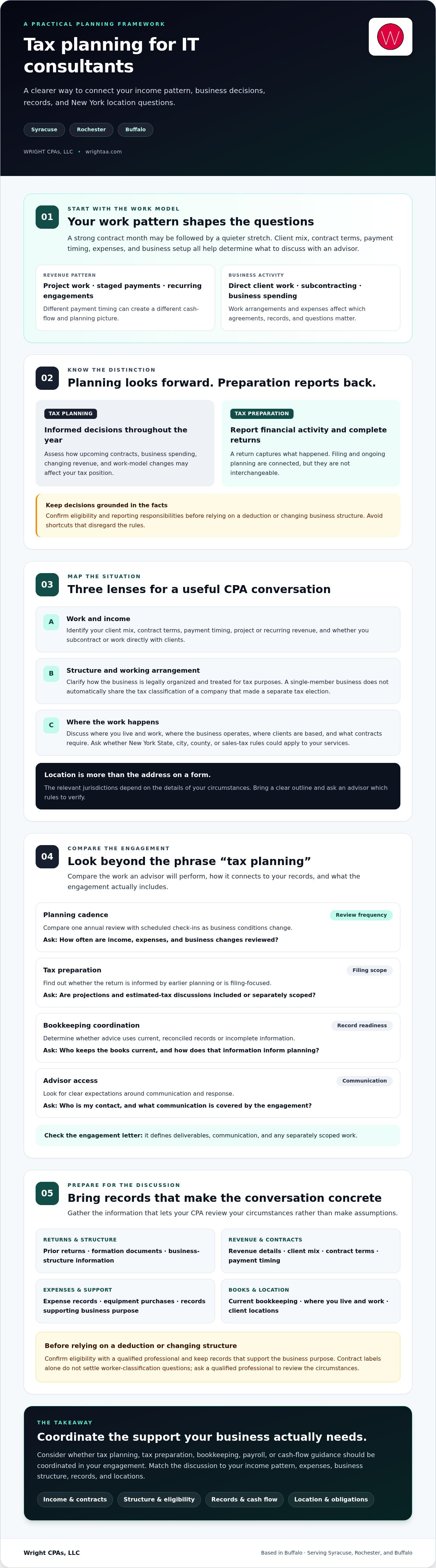
Tax planning means making informed decisions throughout the year. Tax preparation reports financial activity and completes required returns. The two are connected, but they serve different purposes: a return captures what happened, while ongoing planning helps you assess how upcoming contracts, business spending, and changes in your work may affect your tax position. Any strategy should use the legal use of the tax regime, not shortcuts that disregard eligibility or reporting responsibilities.
For tax planning for IT consultants Syracuse professionals need, start with how the business actually operates. Your client mix, contract terms, payment timing, and business setup shape which questions are worth raising. A large project paid in stages can create a different cash-flow and planning picture from steady recurring engagements. Subcontracting work may also call for different agreements and records than working directly for clients.
How an IT consultant’s work model affects tax questions
Solo project work, subcontracting, and recurring client engagements can each produce a different pattern of revenue, expenses, and obligations. Before discussing strategy, identify how the business is legally organized and how it is treated for tax purposes. A single-member business, for example, does not automatically have the same tax classification as a company that has made a separate tax election. Bring formation documents and prior returns so your CPA can review the facts rather than make assumptions.
Review client contracts as well. Their terms, your working arrangement, and your degree of independence may raise worker-classification questions. A contract’s label alone does not settle the issue, so ask a qualified professional to review the circumstances.
Why Syracuse and New York context belongs in the discussion
Location is part of the planning picture, but it is more than the address on a form. Discuss New York State obligations with your advisor and ask whether city, county, or sales-tax rules could apply to the services you provide. The answer may depend on where you live, where your business operates, where your clients are located, and what your contracts require. Those details do not always point to the same place.
Your income model shapes the timing and structure of tax questions; your locations help determine which jurisdictions belong in the conversation. Bring a clear outline of where you live and work, where your clients are based, how you are paid, and how your business is structured. That gives your advisor a practical starting point for identifying which rules to verify for your circumstances.
Which tax-planning capabilities should a Syracuse IT consultant compare?
Compare the work an advisor will perform, not just the phrase “tax planning” on a service page. Filing a return, reviewing scenarios during the year, and keeping records ready for decisions are related needs, but they are not interchangeable. For tax planning for IT consultants Syracuse business owners can use effectively, look for an engagement that reflects variable project income, subcontracting, recurring contracts, and your business structure.
| Capability | What to compare | Questions to ask |
|---|---|---|
| Planning cadence | One annual review or scheduled check-ins as business conditions change | How often are income, expenses, and business changes reviewed? |
| Tax preparation | Return filing alone or filing informed by earlier planning | Are projections and estimated-tax discussions included, or separately scoped? |
| Bookkeeping coordination | Tax advice based on current, reconciled records or incomplete information | Who keeps the books current, and how does that information inform planning? |
| Advisor access | Defined communication and response expectations | Who is my contact, and what communication is covered by the engagement? |
Year-round planning versus annual return preparation
Filing-focused help may suit a consultant who needs a return prepared and has straightforward records. Proactive support adds conversations about changing revenue, expenses, and business decisions before the year closes. Ask whether scenario reviews and estimated-tax discussions are part of the proposed work. Then review the engagement letter: it defines the deliverables, communication, and any separately scoped work.
Entity and compensation choices also need a fact-specific review. The right analysis depends on your business structure, tax classification, income, and circumstances; no one setup fits every consultant. The IRS’s Independent contractor defined resource is a starting point for understanding classification. Ask an advisor to consider how your actual work arrangements apply.
Bookkeeping, cash flow, and tax advice working together
Planning is only as useful as the records behind it. Ask whether the books will be reconciled and usable before projections are discussed, and how cash-flow information will inform tax estimates or scenario reviews. Wright CPAs offers bookkeeping and cash-flow services alongside tax planning and preparation. Confirm which services fit your needs and whether they are included in the proposed engagement. Its article on strategic business tax planning in Buffalo may also offer a useful companion perspective.
If you are comparing options, review Wright CPAs’ tax planning and preparation and ask how the proposed scope would address your consulting business.
How to evaluate an IT consultant’s tax strategy without chasing shortcuts
A deduction, entity election, or accounting app cannot guarantee a lower tax bill. A sound recommendation starts with your facts: how the business earns income, which expenses support that work, how the business is structured, and what records are available. For tax planning for IT consultants Syracuse professionals should weigh a strategy’s potential tax effect against the administration, cash-flow demands, and compliance responsibilities it may involve.
Technology-related costs such as computers, software subscriptions, cloud services, or professional development may be worth discussing. However, a category alone does not make an expense deductible. The expense must meet applicable rules and have adequate supporting records. Keep invoices, receipts, and a clear business purpose, then ask your advisor to verify eligibility for your circumstances.
What a credible recommendation should explain
Ask the advisor to explain the assumptions behind a recommendation, the rules being applied, the trade-offs, and the records you will need. A useful answer should distinguish established tax treatment from an idea that needs further research or confirmation. Request written next steps, including who will handle them and when. For general self-employment filing context, see Forbes’ Ultimate Guide To Filing Self-Employment Taxes.
Be cautious of advice focused only on a projected tax reduction. A strategy may also require additional recordkeeping, payroll or filing responsibilities, or changes to how cash moves through the business. Ask what implementation involves and how the recommendation fits your broader operating needs.
Questions about estimated taxes, expenses, and entity choices
Ask how projected income and tax payments will be reviewed as client work changes during the year. A quarterly estimated-tax guide can help you prepare questions, but your advisor should assess your own figures and applicable requirements. For expenses, bring examples and supporting documents rather than assuming a software tool or broad label establishes deductibility.
Entity and compensation decisions deserve the same careful review. Ask how a proposed change fits your income, ownership, administrative capacity, and wider tax circumstances. For a deeper comparison of New York S corporations and LLCs, consult the article on that topic; do not treat one structure as the default recommendation. The same applies to software: it can organize information, but it cannot replace a review of the underlying facts.
A practical checklist for choosing tax-planning help in Syracuse
Use a deliberate process to compare support and keep the decision tied to your consulting business rather than broad promises. For tax planning for IT consultants Syracuse business owners can evaluate, work through these steps:
- Define your needs. Decide whether you need return preparation, planning during the year, bookkeeping coordination, or a combination.
- Compare scope. Check what planning reviews, projections, bookkeeping, and tax preparation are included.
- Ask practical questions. Clarify who handles your work, how communication happens, and how changing income is considered.
- Review engagement terms. Confirm deliverables, responsibilities, and any work that would be separately scoped.
- Decide based on fit. Compare the written scope against your priorities, not marketing language alone.
Confirm the firm’s arrangements for Syracuse-area clients directly. Wright CPAs, LLC is based in Buffalo and serves clients in Syracuse, but that does not necessarily mean it has a Syracuse office or offers in-person meetings. Ask how the proposed engagement would work for your location and circumstances.
Documents and facts to gather before an introductory conversation
Bring recent business and personal tax returns, year-to-date financial statements, and a clear note on whether your bookkeeping is current and reconciled. Summarize your business structure, tax classification, revenue sources, and client or subcontracting arrangements. Include expense records and contracts relevant to your questions.
Also flag significant planned changes, such as a new business arrangement or a shift in how you work. If you are unsure whether New York State, city, county, or sales-tax filing obligations apply, list the question for professional review rather than guessing.
Questions to ask a prospective CPA
Ask who will handle planning, how often you will communicate, and what the engagement covers beyond annual return preparation. Find out how bookkeeping and cash-flow information may inform planning discussions, and whether bookkeeping, cash-flow management, and tax preparation are included or separately scoped. Clear answers help you understand the working relationship before you commit.
Wright CPAs offers tax planning and preparation alongside bookkeeping and cash-flow services. To discuss whether its services and engagement scope fit your Syracuse-area IT consulting business, contact Wright CPAs about tax-planning support.
Working with Wright CPAs for Syracuse IT consultant tax planning
Wright CPAs, LLC is based in Buffalo and serves clients in Syracuse, Rochester, Buffalo, and throughout the United States. Its services include tax planning and preparation, bookkeeping, payroll, cash-flow management, and CFO-level guidance. For tax planning for IT consultants Syracuse professionals need, consider how these capabilities might fit your circumstances rather than assuming every service belongs in one engagement.
Tax preparation addresses filing, while proactive planning can help you consider business decisions during the year. Current books and cash-flow information may provide useful context for those conversations. Payroll or CFO guidance may also be relevant, depending on how your consulting business is organized and what support you are seeking. Confirm the proposed scope directly. Services, deliverables, communication, and fees depend on the agreed engagement.
What a first planning conversation can clarify
Bring a short list of immediate tax questions, the records you have available, and upcoming business decisions, such as a contract change or a shift in how you operate. The conversation can help identify which questions need attention and what information may be needed next. Ask which planning and preparation services are included, what falls outside the proposed scope, and how the work would be carried out for a Syracuse-area client.
Wright CPAs serves Syracuse, but is based in Buffalo; do not assume that service coverage means it has a local office or that meetings take place in person. Confirm communication arrangements and service availability for your situation before deciding.
When ongoing accounting and advisory support may fit
If revenue, expenses, or project commitments shift through the year, recurring bookkeeping and advisory support may provide continuing financial visibility. Current records and cash-flow information can make planning conversations more grounded. Wright CPAs offers fixed-fee monthly accounting and advisory retainers, but a retainer is a service model, not a guaranteed fit. Ask which services it would include, how often information is reviewed, and whether the arrangement suits your needs.
Before agreeing to an engagement, review its responsibilities, deliverables, communication terms, and fees. The right arrangement should reflect your business structure, records, and priorities, not a promise of a particular tax result.
If you are considering support, contact Wright CPAs to discuss your consulting work, current questions, and possible next steps. A clear conversation can help determine whether the proposed scope fits.
Build a tax plan around the way your consulting business works
Effective tax planning starts with your actual income pattern, business structure, expenses, and locations, then turns those details into decisions you can review throughout the year. Compare advisors by the work included in their engagements, not by broad promises. Keep records organized and ask how recommendations account for both potential benefits and the responsibilities they bring.
For tax planning for IT consultants Syracuse business owners can put into practice, preparation matters. Gather your returns, current financial records, contracts, and questions about New York or local obligations before speaking with a CPA. A clear scope can help distinguish annual filing from ongoing planning and show whether bookkeeping or cash-flow support belongs in the picture.
Wright CPAs is based in Buffalo and serves clients in Syracuse, Rochester, Buffalo, and throughout the United States. The firm offers tax planning and preparation alongside bookkeeping and business advisory services. Discuss your work, the records you have, and the support you are seeking to determine whether the proposed engagement fits. Discuss your Syracuse consulting business with Wright CPAs to take the next step with a clearer view of your options.
Frequently Asked Questions
Is tax planning different from tax preparation for an IT consultant?
Yes. Tax preparation reports income and expenses for a filing period and prepares required returns. Tax planning considers decisions throughout the year, such as changes in project income, business spending, or business structure, and how they may affect tax obligations. For an IT consultant, preparation addresses what happened; planning helps you discuss what may happen next. Ask a CPA which activities are included in the engagement, since filing and ongoing planning are distinct services.
Can an IT consultant in Syracuse deduct a home office, computer, or software?
Possibly, but a purchase or home workspace is not automatically deductible just because you use it for consulting. Eligibility depends on the applicable rules and your specific use and circumstances. A computer or software used partly for personal purposes may need different treatment from an item used solely for business. Keep receipts, invoices, and notes explaining business use, then ask a tax professional to verify which costs qualify and how to report them.
How do New York State taxes affect an independent IT consultant in Syracuse?
New York State income-tax responsibilities should be part of a Syracuse consultant’s planning discussion. Syracuse does not have a city-specific income tax, but that alone does not determine every filing obligation. Your residence, business location, client locations, business structure, and the services you provide may matter. Ask a tax advisor whether any state, county, city, or sales-tax requirements apply to your particular work, and verify current rules before making filing decisions.
Do Syracuse IT consultants need to make estimated tax payments?
It depends on your income, withholding, and tax circumstances. Independent consultants may receive income without tax withheld, so ask a tax professional whether estimated payments apply and how projected earnings affect the calculation. Review the estimate as contracts and payment timing change, rather than relying only on last year’s figures. Payments, if required, do not replace filing the relevant tax returns. Confirm current federal and New York State requirements with an advisor.
Should an IT consultant use an LLC or elect S corporation tax treatment?
There is no single best choice for every IT consultant. An LLC is a legal business structure, while S corporation treatment is a tax classification that may be available if requirements are met. A recommendation should consider your ownership, income, administrative responsibilities, payroll needs, and overall tax circumstances. Ask a CPA to explain assumptions, ongoing obligations, and trade-offs before making a change. Do not choose an entity or election based only on a promised tax reduction.
What records should an IT consultant bring to a tax-planning meeting?
Bring recent personal and business tax returns, current year-to-date financial statements, and a summary of your business structure and tax classification. Include revenue by client or contract, expense records with receipts, and notes on bookkeeping status. Contracts and information about planned business changes can help frame your questions. If you are unsure about New York State or local filing responsibilities, write those questions down for professional review rather than assuming an obligation does or does not apply.
Can a Buffalo-based CPA work with an IT consultant in Syracuse?
Yes. A CPA does not need a Syracuse office to serve a consultant in the city, but you should confirm how the engagement will work and what communication arrangements are available. Wright CPAs, LLC is based in Buffalo and serves clients in Syracuse, Rochester, Buffalo, and throughout the United States. Its offerings include tax planning and preparation alongside bookkeeping and advisory services. Ask which services fit your needs and what the proposed engagement includes.


