

What if a tax move that lowers your federal bill produces a different result on your New York return? Tax savings for high income earners Buffalo depend on more than choosing a familiar strategy. Timing, eligibility, income sources, and state rules all shape the outcome.
It’s reasonable to want a clear answer before increasing retirement contributions, realizing investment gains, or making a charitable gift. But the right choice depends on your income, assets, and plans, and federal and New York treatment may not align. In 2026, New York’s divergence from certain federal depreciation and research deduction rules makes coordinated planning especially important. Business owners also need to consider how company income affects their personal tax picture.
This guide covers planning opportunities that may fit high-income individuals, including retirement contributions, tax-aware investment decisions, charitable giving, and estate considerations. You’ll learn how to assess their potential effects across federal and New York taxes, what to review before year-end, and how a CPA can connect decisions made throughout the year with tax-return results. Wright CPAs, LLC, a Buffalo-based firm, approaches tax planning as an ongoing process, not simply an annual filing exercise.
Key Takeaways
- Tax savings for high income earners Buffalo depend on individual eligibility and circumstances, not income alone.
- Compare retirement and health savings account options against current rules before making contribution decisions.
- Evaluate each strategy for timing, liquidity, documentation, and its separate federal and New York tax effects.
- Use a four-step planning rhythm: gather records, model scenarios, implement decisions, and review the results.
- Coordinated tax planning and preparation can connect personal finances with business interests and tax-return outcomes.
Tax savings for high-income earners in Buffalo start with a clear tax picture
Tax planning coordinates financial decisions to manage tax liability within the law. It can include deciding when to receive income, make eligible contributions, sell assets, or give to charity. The goal isn’t to pursue a deduction in isolation. It’s to understand how each decision fits your broader financial picture. Legitimate planning follows applicable rules; legal tax avoidance is distinct from illegal tax evasion.
Income level alone doesn’t determine which options are available or useful. Eligibility, filing status, income type, assets, timing, and personal goals all matter. A strategy that suits one taxpayer may be unavailable or have unintended consequences for another.
Federal and New York State tax planning also require separate consideration. A decision may affect each return differently, and state rules don’t always mirror federal treatment. Evaluate potential savings rather than assuming them, using current rules and your complete circumstances. If you’re researching “tax savings for high income earners Buffalo,” start by identifying the income, obligations, and plans that shape your tax picture.
Which Buffalo taxpayers may benefit from proactive planning?
Executives and professionals may need to account for compensation, bonuses, or equity-related income. Investors may have gains, losses, and income from assets to consider. For closely held business owners, personal taxes are often connected to business income and decisions made throughout the year.
A promotion, business sale, inheritance, marriage, or retirement can change which tax questions matter. These events don’t automatically make a particular strategy appropriate. They’re reasons to review how income, timing, and future plans interact.
What information shapes a useful tax strategy?
A useful review considers income sources, filing status, deductions, assets, and expected changes. Prior returns offer valuable context, but they reflect past circumstances. Review current-year income and decisions separately, especially if compensation, investments, or business activity has changed.
Tax planning looks ahead and guides decisions; tax preparation reports financial activity and applies relevant rules to a return. The two work best together. Ongoing planning can inform choices before year-end, while preparation connects those choices and records to your federal and New York returns.
Tax strategies high-income Buffalo residents can evaluate with a CPA
Once you understand your income and tax picture, compare potential strategies with current rules and your wider financial needs. A contribution or gift may affect taxable income, but eligibility, timing, documentation, and federal and New York treatment all matter. A CPA can model those factors before you decide. For an overview of common approaches, see Charles Schwab’s guide to tax strategies for high-income earners.
Retirement contributions and health savings accounts
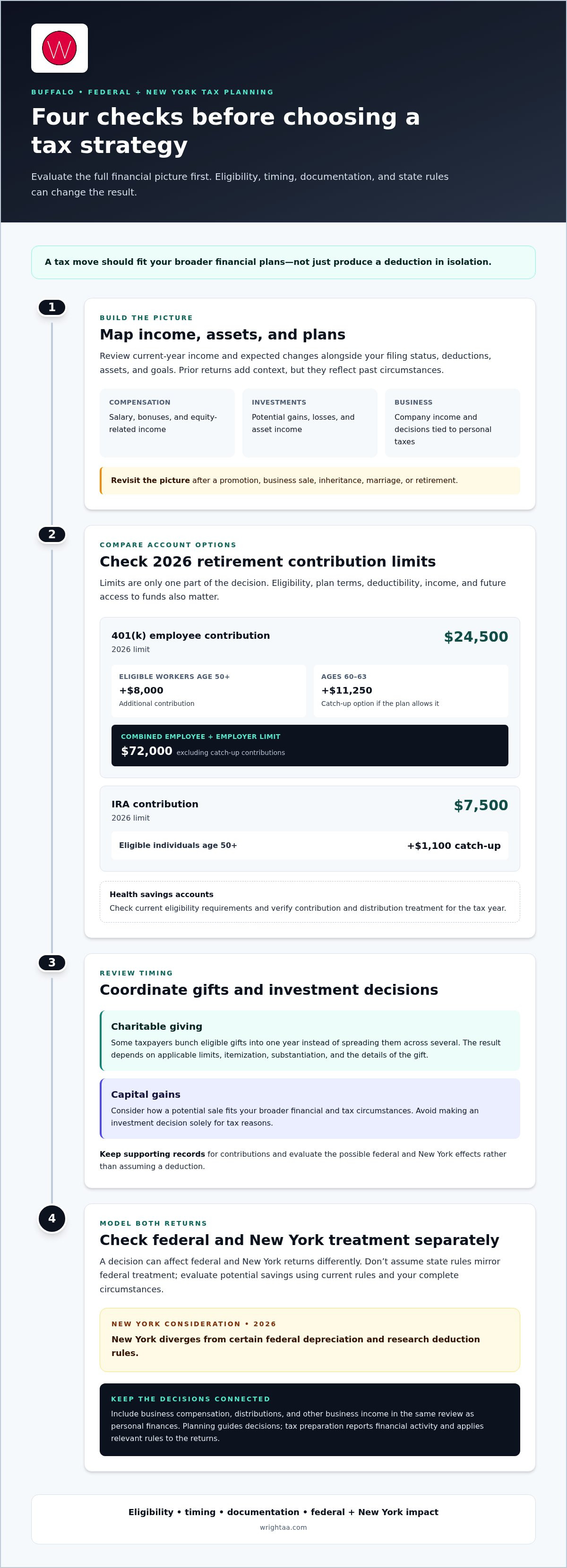
Workplace retirement plans and individual retirement accounts may offer tax advantages when contributions and the taxpayer meet applicable rules. For 2026, the employee 401(k) contribution limit is $24,500. Eligible workers age 50 or older may contribute an additional $8,000; those ages 60 to 63 may have an $11,250 catch-up option if their plan allows it. The combined employee and employer limit is $72,000, excluding catch-up contributions. The 2026 IRA limit is $7,500, with an additional $1,100 catch-up contribution for eligible individuals age 50 or older.
These limits don’t determine which account is right for you. Income, plan terms, contribution eligibility, deductibility, and future access to funds can change the analysis. Health savings accounts also warrant a careful review: eligibility depends on current requirements, and contribution and distribution treatment should be verified for the tax year. Before contributing, compare account options with your cash needs and longer-term plans.
Charitable giving, investment income, and business income
Consider the timing of income and donations when planning charitable gifts. Some taxpayers bunch eligible gifts into one year rather than spreading them across several, but the tax result depends on applicable limits, itemization, substantiation, and the details of the gift. Keep records that support the contribution, and evaluate federal and New York effects instead of assuming a deduction.
Capital gains timing can also affect your tax return. Consider how a potential sale fits your broader financial and tax circumstances, rather than making an investment decision solely for tax reasons. Business owners should include compensation, distributions, and other business income in the same coordinated review. Strategic business tax planning in Buffalo can connect business decisions with personal tax considerations.
When evaluating tax savings for high income earners Buffalo, focus on which options fit your full circumstances, not which strategy is most familiar. Wright CPAs’ tax planning and preparation can help bring those decisions into a coordinated plan.
Does high income guarantee tax savings? Understand the trade-offs
A higher income can make tax planning more consequential, but it doesn’t automatically open the door to every deduction, account, or strategy. Eligibility may depend on income type, filing status, plan terms, and other rules. Even if an option is available, it may not suit your cash needs or longer-term plans. When assessing tax savings for high income earners Buffalo, compare the potential tax effect with the decision’s full financial cost.
How federal and New York tax treatment can differ
Federal and New York State returns don’t always treat the same item alike. For 2026, New York has decoupled from certain federal depreciation and research-and-development deduction provisions, so a business-related expense may require different calculations on each return. The federal SALT deduction cap also remains $10,000, which is one consideration for taxpayers weighing state and local tax deductions. Check current state conformity, deductions, and other rules before relying on a federal result. Focus this review on federal and state treatment without assuming a separate Buffalo or Erie County personal income tax rule.
Compare the trade-offs before acting
A tax reduction and a tax deferral aren’t the same. If a taxpayer qualifies and meets the rules, a deduction may reduce taxable income for a particular year. Deferral generally shifts the timing of tax, which can mean tax is owed later. Weigh any current-year benefit against possible future tax exposure, liquidity, recordkeeping, and the circumstances that could trigger tax later.
Tax benefits depend on eligibility and current law, not income level alone. Use this comparison as a starting point, then verify the applicable 2026 figures, limits, and treatment for your situation.
| Planning area | What to evaluate | Potential trade-off |
|---|---|---|
| Retirement account contributions | Eligibility, plan terms, contribution limits, and federal and New York treatment | Reduced access to contributed funds; tax may be due later depending on account rules |
| Charitable giving | Timing, substantiation, applicable deduction rules, and whether bunching fits | A gift uses assets; a deduction isn’t automatic |
| Investment or business decisions | Timing of gains or income, documentation, and separate state calculations | A tax benefit shouldn’t outweigh investment, operating, or cash-flow needs |
A move that looks favorable on one return can have a different effect on the other or create a future cost that changes the overall result. Model both returns and preserve records before acting. A coordinated review can help distinguish a genuine tax reduction from a timing shift, and a suitable strategy from one that only appears attractive on paper.
A year-round tax-planning checklist for high earners in Buffalo
Tax planning works best as a sequence, not a rush to assemble documents at filing time. A year-round process gives you time to identify changes, compare options, and act while a decision is still available. Timing depends on the decision and the applicable rules. Planning before year-end can help surface questions, but it can’t guarantee a particular tax result.
- Gather records. Organize recent federal and New York returns, current income statements, account details, charitable receipts, and relevant business records.
- Model scenarios. Compare how possible changes may affect income, withholding or estimated payments, and federal and state tax outcomes.
- Implement decisions. Take appropriate actions within applicable deadlines and eligibility rules, and retain supporting documentation.
- Review. Revisit assumptions as income, plans, or tax rules change, then carry unresolved questions into the next planning cycle.
What to review during a tax-planning meeting
Start with changes in wages, bonuses, business income, and investment activity. Discuss withholding or estimated payments, major transactions, and upcoming events such as a business transition, asset sale, or change in compensation. Scenario modeling can show how different choices might affect projected tax results and cash flow. It supports informed decisions, but it can’t guarantee savings or predict every change in circumstances.
End the meeting with a written record of decisions, deadlines, assumptions, and follow-up responsibilities. This shared reference helps keep planning connected to the actions taken later in the year.
How to prepare for an annual tax review
Bring prior federal and New York returns alongside current-year records and a reasonable income forecast. Flag potential charitable gifts, asset sales, compensation changes, and business decisions, even if they’re not final. Raising these items early gives a CPA more time to assess timing and available options under the rules in effect.
For business owners, personal and company finances can overlap. Small-business accounting in Buffalo can provide useful context for organizing that side of the picture. A consistent review helps turn tax savings for high income earners Buffalo taxpayers are considering into specific questions, records, and decisions to evaluate, rather than assumptions. The same coordinated approach can support business owners in Rochester and Syracuse.
Explore tax planning with Wright CPAs to connect year-round decisions with tax planning and preparation.
Work with Wright CPAs on a tax plan built around your Buffalo circumstances
A useful tax plan reflects how you earn income, what you own, whether you have business interests, and which decisions are ahead. Wright CPAs is a Buffalo-based firm providing tax planning and preparation for individuals and businesses. Its approach connects planning decisions with the information needed to prepare your returns, keeping year-round choices and filing outcomes in view.
Tax rules and personal circumstances change. A CPA evaluates potential options using current rules and your specific information, rather than assuming a familiar strategy will fit. The process can clarify which questions deserve attention, what records support the analysis, and how a decision may affect federal and New York returns. It can’t promise a particular result, but it can provide a more deliberate basis for decisions.
What a coordinated tax-planning relationship can address
Ongoing reviews can revisit income changes, upcoming transactions, business activity, and developments in tax rules as the year unfolds. This gives you a chance to raise questions before a decision is final, rather than treating tax planning as a filing-season task. Accounting and advisory support can also connect personal planning with financial records and business needs.
For business owners considering financial forecasting alongside tax planning, outsourced CFO services in Buffalo may help address the broader picture. Coordinating forecasts with tax review can frame questions about cash flow, compensation, and business decisions without treating a possible tax benefit as the only objective.
Take the next step toward a more intentional tax plan
For an initial discussion, gather your current federal and New York returns, recent income details, relevant account or business information, and a short list of questions. Include decisions on the horizon, such as a planned asset sale, charitable gift, compensation change, or business investment. These details give a CPA useful context for evaluating timing and applicable rules.
Planning before the next filing deadline gives you more time to identify questions and consider actions that may still be available. If you’re assessing tax savings for high income earners Buffalo, start with a conversation grounded in your financial picture. Start a tax-planning conversation with Wright CPAs.
Build a tax plan with the year in view
For tax savings for high income earners Buffalo, start with a clear picture of your income, assets, and goals. A strategy should fit your circumstances, not just your income level. Because federal and New York rules can differ, evaluate potential actions across both returns before moving forward.
Planning works best throughout the year. Review income changes and upcoming decisions early, compare options with current rules, and keep records of what you decide. This steady process can connect financial choices with tax preparation without assuming every strategy will be available or produce a particular result.
Wright CPAs is a Buffalo-based full-service tax, accounting, and consulting firm founded in 2012. The firm provides proactive tax planning and preparation for individuals and businesses, bringing personal circumstances and business interests into a coordinated view.
Start shaping your next steps before the next filing deadline. Start a tax-planning conversation with Wright CPAs and move forward with a plan grounded in your situation.
Frequently Asked Questions
How can high-income earners reduce their taxes in New York?
High-income earners in New York can manage tax exposure by coordinating eligible retirement contributions, charitable gifts, investment-gain timing, and business-income decisions, then reviewing federal and state effects together. Start with income sources, withholding or estimated payments, filing status, and expected transactions. No single tactic fits everyone: eligibility, liquidity, documentation, and current law matter. A CPA can model alternatives using your actual information rather than assuming a deduction or credit will apply.
Are tax-saving strategies for high earners different in New York State?
Yes. New York State may not follow federal treatment for every deduction or calculation, so a strategy’s federal result may differ on the state return. For 2026, New York decoupled from certain federal depreciation and research-and-development deduction provisions, while the federal SALT deduction cap remains $10,000. For tax savings for high income earners Buffalo, review both returns and verify current state conformity and other rules before acting.
Can retirement contributions reduce taxable income for high-income earners?
Potentially. Eligible pre-tax contributions to workplace plans may lower current federal taxable income, subject to plan terms and applicable rules; review New York treatment separately. For 2026, the employee 401(k) contribution limit is $24,500, before eligible catch-up contributions. Traditional and Roth IRAs have different tax treatment, and contribution eligibility or deductibility can depend on your circumstances. Confirm limits and treatment for the tax year before setting contributions.
Can charitable donations lower my federal and New York taxes?
Charitable gifts may affect federal and New York taxable income if you meet applicable requirements, but a donation doesn’t automatically create a deduction. The result can depend on whether you itemize, the type and timing of the gift, applicable limits, and adequate records. Before making a large contribution or bunching gifts into one year, consider the cash-flow impact and review the potential federal and state treatment.
When should high-income earners in Buffalo start tax planning?
Start before year-end, and revisit the plan when income or circumstances change. An earlier review can leave time to examine compensation, estimated payments, gifts, asset sales, or business decisions, although the actions still available depend on deadlines and current rules. Individuals and business owners in Buffalo, Rochester, and Syracuse can bring current returns, income records, and expected changes to a CPA, then document assumptions and next steps rather than waiting until return preparation.
Does a high income mean I can use every tax deduction or credit?
No. A high income doesn’t automatically make every deduction, credit, or account available. Eligibility may depend on filing status, income source, coverage, plan terms, contribution limits, and other conditions. Some tax benefits phase out or have documentation requirements; federal and New York rules may also differ. Assess each option against current law and your financial priorities, including liquidity and possible future tax exposure, before making a decision.


