

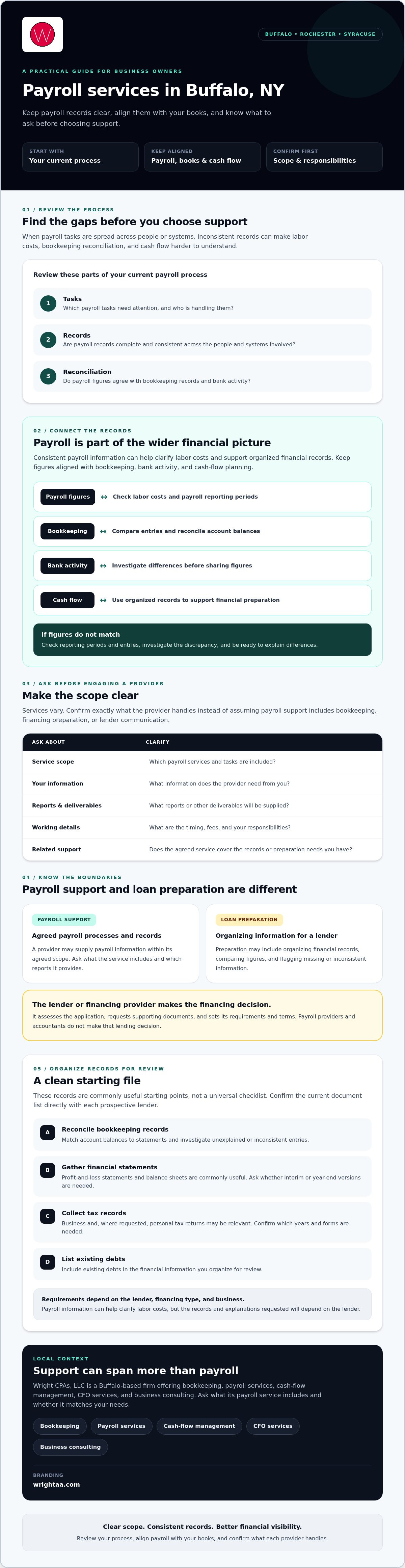
Choosing payroll services Buffalo NY businesses can rely on starts with understanding what your company needs from payroll and how those records fit into its finances. Whether you’re comparing providers or managing payroll in-house, incomplete or inconsistent records can make it harder to track labor costs, reconcile books, and explain cash flow. That uncertainty is common, especially when payroll tasks are spread across different people or systems.
A clear process makes payroll easier to review and helps keep financial records organized. This guide explains what to consider when evaluating payroll support, how to keep payroll information aligned with your books, and how those records can support broader financial preparation. You’ll also learn what to ask before engaging a provider.
Wright CPAs, LLC is a Buffalo-based firm offering bookkeeping, payroll services, cash-flow management, CFO services, and business consulting. Its services may be relevant to businesses looking for support with payroll and their broader financial picture. Ask the firm what its payroll service includes and whether it matches your needs. Businesses in Buffalo, Rochester, and Syracuse can use these questions to assess their payroll process and decide what support to seek.
Key Takeaways
- Review your current payroll process and identify which tasks, records, or reconciliations need attention.
- Ask providers what their payroll services include, what information they need from you, and what remains your responsibility.
- Keep payroll figures consistent with bookkeeping records, bank activity, and cash-flow planning.
- Payroll services Buffalo NY businesses use can contribute to organized records, but confirm what a provider handles and what reports it supplies.
- Before engaging an accountant or payroll provider, clarify the scope, deliverables, timing, fees, and your responsibilities.
Buffalo Business Loan Help: What Support Can and Cannot Do
Payroll support and financing preparation are different services. Payroll services generally help a business manage payroll-related processes and records, while business loan preparation involves organizing financial information for a lender. What a provider handles varies, so ask about its services instead of assuming payroll support includes bookkeeping, financing preparation, or lender communication.
Payroll and accounting support can help keep financial information organized; only a lender or financing provider decides whether to offer financing and on what terms. That distinction matters when choosing help. A payroll provider may handle agreed payroll tasks, while an accountant may work with bookkeeping, tax records, or cash-flow information. A loan broker may connect borrowers with financing providers, and public financing programs set their own processes and criteria. Confirm each provider’s role rather than assuming one professional handles every part of the process.
What does help with a business loan application usually involve?
Preparation may include organizing financial records, comparing figures across documents, and flagging missing or inconsistent information for the owner to investigate. Reviewing cash flow can also help an owner prepare to explain how the business expects to manage repayments alongside operating expenses. Payroll information can help clarify labor costs, but the records and explanations a lender needs will depend on that lender’s requirements.
For example, if bookkeeping records and bank statements show different balances, resolve the discrepancy before sharing figures. If payroll reports and the books show different labor costs, check the reporting periods and entries so you can explain the difference. Owners searching for payroll services Buffalo NY should ask whether a provider’s service includes the records or reports they need. Wright CPAs offers bookkeeping, payroll, cash-flow management, CFO services, and business consulting. Ask the firm what its payroll service includes and whether it can support any related preparation needs.
Who makes the financing decision?
The lender or financing provider assesses the application, requests supporting documents, and sets its requirements and terms. A payroll provider may supply payroll information within its agreed scope, and an accountant can help an owner understand or organize financial information. Neither makes the lending decision. A broker’s role, if engaged, is distinct from both payroll services and underwriting. A public financing program may have its own administrator, application process, and eligibility rules.
Buffalo-area owners may encounter resources such as the Buffalo State Small Business Development Center, Erie County Industrial Development Agency, SCORE Buffalo Niagara, or Invest Buffalo Niagara. Their roles and current offerings can differ. Before relying on any named New York financing resource, check its official information for current availability, application steps, and eligibility. For a general overview of small business financing, including debt and equity approaches, consider how each option fits the business’s purpose and obligations.
Prepare Buffalo business finances before starting a loan application
Before approaching a lender, create a consistent picture of the business’s financial position. The records below are commonly useful starting points, not a universal checklist. Requirements depend on the lender, financing type, and business, so confirm the current document list directly with each prospective lender. The U.S. Small Business Administration’s overview of SBA loan programs can also help owners understand where to begin when exploring government-backed financing.
Which financial records should an owner organize?
Use this sequence to prepare a clean, reviewable file:
- Reconcile bookkeeping records. Match account balances to statements and investigate unexplained or inconsistent entries before sharing figures.
- Gather financial statements. Profit-and-loss statements and balance sheets are commonly useful. Ask whether the lender wants interim or year-end versions.
- Collect tax records. Business and, where requested, personal tax returns may be relevant. Confirm which years and forms the lender needs.
- List existing debts. Note balances, payment amounts, and terms so current obligations are visible alongside any proposed borrowing.
- Summarize cash flow. Organize information on incoming revenue, operating costs, payroll, and planned spending. Keep supporting records together where available.
These materials aren’t guaranteed to satisfy every application. A lender may request additional documents, such as business entity records or identification, so use its instructions as the final checklist. When payroll information is involved, confirm which periods and reports the lender wants and check that the figures agree with the rest of your records.
How can an owner assess financial readiness?
Look beyond the year-end totals. Compare expected cash coming in with existing debt payments, routine operating expenses, payroll, and the spending planned for the loan. A clear cash-flow view can help you explain how repayment might fit into the business’s operations. It can also surface pressure points, such as seasonal revenue or a large upcoming expense, that need context.
Note bookkeeping gaps, irregular revenue, and assumptions that would benefit from clearer documentation. For example, if sales rise and fall by season, organize records that show the pattern rather than relying on a general estimate. Check that payroll costs in your books match payroll reports for the same period. Consistent records, including those maintained through payroll services Buffalo NY businesses use, can contribute to a more coherent financial picture, though the lender decides what it will accept.
Accounting or CFO guidance may help an owner interpret financial information and prepare questions. Wright CPAs lists bookkeeping, cash-flow management, CFO services, and payroll services. Ask what each service includes and whether the firm’s support matches your needs. Owners seeking help with small-business accounting and cash-flow management can discuss their current records and the specific questions they’re trying to resolve.
Compare business financing options and application requirements carefully
A financing option should fit the business’s purpose and cash flow, not just appear quick to access. Compare how funds can be used, when repayment begins, what documents may be requested, and who makes the decision. Terms depend on the provider and applicant, so use this framework to guide questions, not as a substitute for current offer documents.
Loan terms and documentation vary by lender and product. Confirm both directly before applying, and review the full repayment obligation rather than focusing on approval speed alone.
| Financing category | Common purpose | Repayment structure to examine | Documentation and decision-maker |
|---|---|---|---|
| Term loan | A defined business expense or planned investment | Scheduled payments over an agreed term; check payment timing and total obligation | The lender sets its document requirements and evaluates the application |
| Business line of credit | Working capital needs that may change over time | Review how draws, repayments, and any applicable charges work | The provider evaluates the business and determines the available terms |
| Equipment financing | Purchasing or replacing business equipment | Ask about payment schedule and whether the equipment serves as collateral | The financing provider sets requirements and makes the decision |
| Equity investment | Business growth where an owner is open to sharing ownership | It generally isn’t repaid like a loan, but may involve giving up an ownership interest | Potential investors assess the opportunity and decide whether to invest |
What should Buffalo business owners compare?
Start with intended use, then test the proposed payments against existing obligations and expected cash flow. Ask whether collateral is required, what happens if revenue changes, which documents the provider needs, and whether the agreement includes conditions beyond scheduled payments. A fast decision doesn’t necessarily mean a better fit. Read the offer carefully and ask questions before sharing sensitive financial information or signing.
Payroll is a recurring operating cost, so include it when assessing whether proposed payments fit the business’s cash flow. Businesses comparing payroll services Buffalo NY providers alongside financing should keep those decisions distinct. Evaluate payroll services based on the tasks you need handled, the records you need to maintain, and the provider’s stated scope.
When might outside financial guidance help?
Bookkeeping, cash-flow management, or CFO guidance may help clarify financial records and show how a proposed obligation could affect operations. Payroll support may also help a business keep payroll information organized, depending on the provider’s services. Wright CPAs lists bookkeeping, payroll, cash-flow management, and CFO services. Ask what support is available and whether it covers your needs. A scope discussion can clarify what financial guidance includes, without assuming the firm selects lenders, negotiates terms, or submits applications.
How to assemble and review a business loan application
A careful application process gives the lender a clearer view of the request and its supporting records. Requirements differ, so use the selected lender’s current instructions and document checklist as your guide. Keep a copy of everything submitted and note when each item was provided.
- Define the funding purpose. Describe what the business plans to fund and how the expense relates to its operations. Keep the request specific and consistent across the application and supporting materials.
- Gather the requested documents. Use the lender’s checklist to collect financial statements, tax records, debt details, and other materials it requests. Don’t assume another lender will ask for the same information.
- Review the figures. Check that application amounts agree with bookkeeping records and supporting documents. Confirm dates, business name, entity details, and reporting periods across each file.
- Prepare explanations. Make a concise note about unusual changes, irregular revenue, or one-time events that could be unclear without context. Keep explanations factual and supported by records where possible.
- Submit through the requested process. Protect sensitive financial information by following the lender’s instructions for secure delivery. Save a copy of the submission and record the date.
What should owners check before submitting?
Read through the application once for accuracy, then compare key figures with their original records. For example, if a reported balance differs from a supporting statement, resolve the discrepancy or ask the lender how to present it before submitting. Payroll information should also align with the business’s other financial records. Confirm that payroll reports cover the same period as the figures in the application and that labor costs match your bookkeeping records.
Share only the information requested, and use the lender’s stated secure process rather than sending sensitive records through an unverified channel. If accounting or CFO guidance could help you review your financial information, confirm the provider’s scope first. Wright CPAs offers bookkeeping, payroll, cash-flow management, and CFO services. Ask whether those services fit your needs and what work is included. You can discuss bookkeeping and cash-flow support with the firm.
What happens after an application is submitted?
A lender may ask for clarification or additional documents as it reviews the application. Respond accurately, follow the lender’s instructions, and keep a simple log of requests, responses, dates, and contact details. If a requested figure needs correction, explain the change clearly rather than sending a revised document without context.
Review timelines and outcomes vary by lender, financing type, and application. Follow up using the lender’s stated process, and avoid treating a request for more information as a decision either way.
Find business loan application guidance in Buffalo that fits your needs
The right support depends on the work you need done. A payroll provider may handle agreed payroll tasks, an accountant may help clarify financial records, and a lender evaluates applications and sets financing terms. Before engaging anyone, define the gap you want help addressing, such as organizing payroll records, understanding cash flow, or preparing to discuss your finances with a lender.
Questions to ask a financial advisor or accountant
Ask specific questions before agreeing to work together. A clear scope helps you understand who is responsible for each step and what remains between you and the lender.
- What does the support include? Ask whether the provider handles payroll tasks, organizes records, reviews cash flow, or prepares you for lender discussions.
- What will I receive? Confirm expected deliverables, timing, fees, and your own responsibilities for supplying or verifying information.
- Is lender communication included? If so, clarify what communication means and whether you’ll review or approve information before it’s shared.
- Where are the boundaries? Ask how the provider distinguishes accounting guidance from the lender’s financing decision and from legal advice.
These questions are useful whether you’re speaking with a payroll provider, accountant, business advisor, lender, or another professional. Don’t assume that a provider’s general description of “payroll support” or “loan help” includes bookkeeping, application preparation, lender communication, or advice about financing terms. Ask for the scope in plain language, and make sure it matches the help you’re seeking.
Discuss your financing-readiness needs with Wright CPAs
Wright CPAs is a Buffalo-based firm offering bookkeeping, payroll services, cash-flow management, CFO services, and business consulting. These services may be relevant to organizing payroll records and understanding a business’s financial picture. The firm’s specific role in financing preparation, loan application assistance, or lender communication isn’t confirmed. Ask what its current services include before relying on them for those needs.
Owners searching for payroll services Buffalo NY may also be reviewing how payroll records fit into their broader financial picture. Organized payroll information and clear cash-flow records can help you understand recurring labor costs and prepare for financial conversations, but they don’t determine whether a lender will approve an application.
If you’re unsure which financial support fits your next step, describe the payroll or accounting tasks you’re working through and ask what the firm can address. Discuss your business’s financial needs with Wright CPAs to clarify whether its payroll, accounting, or CFO services may be a fit.
Move Forward With Financial Clarity
A clear payroll process starts with knowing which tasks need attention and how the related records connect to your books. Review payroll reports against bookkeeping records, check that reporting periods match, and include payroll costs in cash-flow planning. If you’re preparing for financing, compare options by purpose, repayment structure, and their effect on cash flow rather than relying on speed alone.
Consistent bookkeeping and payroll records can help create a more complete financial picture. Whether you use payroll services Buffalo NY businesses rely on or manage payroll internally, confirm what records are maintained and that the figures align with your financial statements. If you’re in Buffalo, Rochester, or Syracuse, ask providers how their services fit your business’s existing accounting process. Remember, organized records can support clearer financial conversations, but the lender alone decides whether to offer financing.
Wright CPAs is a Buffalo-based accounting and consulting firm founded in 2012. Its services include payroll, bookkeeping, cash-flow management, and CFO services. Ask the firm what its payroll service covers and whether it fits your needs. Discuss your business’s financial needs with Wright CPAs to clarify a practical next step.
Frequently Asked Questions
Can an accountant help with a business loan application?
An accountant may help organize financial records, identify inconsistencies, or clarify cash-flow information for a lender discussion. The exact support depends on the accountant’s services and agreed scope, so ask what’s included before engaging them. Accountants don’t make lending decisions or guarantee approval. The lender evaluates the application, sets its own requirements, and decides whether to offer financing and on what terms.
What documents do I need for a small business loan application?
Commonly useful records include business financial statements, tax returns, existing debt details, and cash-flow information. A lender may also request business entity documents, identification, or other materials. There’s no single document list that applies to every application. Ask the prospective lender for its current checklist, including which reporting periods it needs, then verify that the submitted figures match your underlying records.
How do I know if my Buffalo business is ready to apply for a loan?
Start by checking that your books are current, balances are reconciled, and unexplained differences have been investigated. Compare available cash flow with existing obligations and planned spending, then consider how a new payment could affect operations. Accurate payroll records, whether managed in-house or through payroll services Buffalo NY businesses use, can support a consistent financial picture. Readiness doesn’t ensure approval; the lender makes that decision.
Does Wright CPAs help businesses prepare loan applications?
The firm’s available information doesn’t confirm that Wright CPAs directly prepares business loan applications or handles lender communications. Wright CPAs is a Buffalo-based accounting and consulting firm founded in 2012, with services that include bookkeeping, payroll, cash-flow management, and CFO services. Buffalo-area businesses should contact the firm to ask whether its current services fit their financing-preparation needs and clarify the specific work included before engaging it.
What happens after I submit a business loan application?
After submission, a lender may review the materials and request clarification or additional documents. Respond accurately, follow its instructions, and keep a record of requests, responses, and dates. Review timelines and outcomes vary by lender, financing type, and application, so don’t treat silence or a request for more information as a decision. Contact the lender through its stated process if you need to check on next steps.
How do I compare business financing options in New York?
Compare each option’s intended use, repayment schedule, total obligations, collateral considerations, and documentation requirements. Ask who makes the financing decision and how payments could affect business cash flow. Buffalo, Rochester, and Syracuse owners should verify current program availability, terms, and eligibility directly with the relevant provider or official source. Don’t choose based on speed alone; read the full offer and raise questions before signing.
Can I apply for a business loan if my cash flow varies seasonally?
Seasonal cash flow doesn’t automatically prevent a business from applying, but its effect depends on the lender and the business’s circumstances. Organize records that show revenue and expenses across the business’s operating cycle, and prepare a clear explanation of predictable busy and slower periods. Compare expected payment timing with those patterns. The lender assesses the application and determines whether the business meets its requirements.


