

An S corporation election isn’t an automatic tax win. If you’re asking, “is an S corp right for my business NY,” compare the potential tax effect with the added work of payroll and ongoing compliance.
The answer can be difficult to assess because an S corporation is a tax election, not a separate legal business entity. Your business structure, profit pattern, owner compensation, and filing responsibilities all shape the decision. New York adds another layer, and the details may differ for businesses operating in New York City.
This article gives you a practical framework for weighing the benefits and obligations. You’ll learn what to consider about federal and New York tax treatment, payroll, and compliance, and how consistent bookkeeping can make the numbers easier to assess. Coordinated tax planning, payroll, and financial records help you evaluate the election as an ongoing business decision, not just a form to file.
Key Takeaways
- Separate your business’s legal structure from its tax treatment before weighing an S corporation election.
- Compare your profit patterns and owner responsibilities with the ongoing payroll and filing work an election brings.
- Use the checklist to gather financial records, ownership details, and growth plans before modeling the decision.
- Include New York and, where relevant, New York City requirements in your tax and filing analysis.
- To answer “is an S corp right for my business NY,” review eligibility, tax scenarios, payroll, and filing timing with a tax professional.
Is an S Corporation Right for Your New York Business? Start With the Tax Election
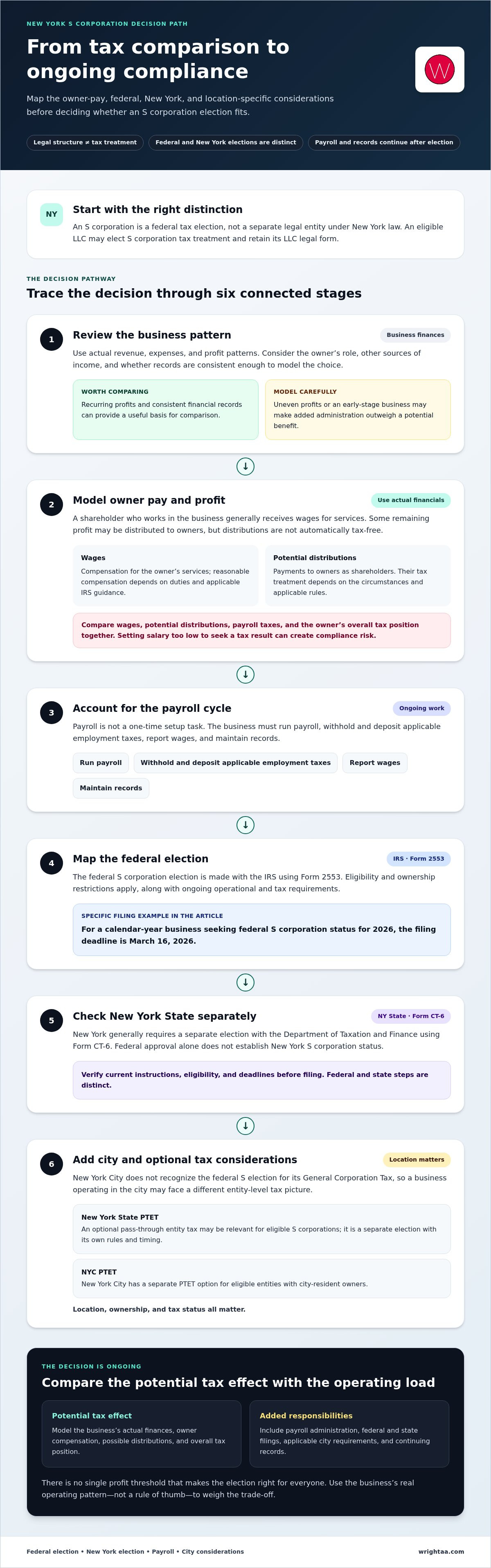
Start by separating the legal structure from the tax treatment. An S corporation isn’t a standalone legal entity under New York law. It’s a federal tax election available to eligible businesses. An LLC that qualifies may elect S corporation tax treatment and retain its LLC legal form. The entity and its tax classification are related, but they aren’t the same thing. For a high-level overview of federal treatment, see this explanation of the S corporation.
Changing tax treatment doesn’t remove the responsibilities of running the business. The central question is whether a potential tax benefit is likely to justify payroll and continuing compliance. There’s no single profit threshold that makes the election right for everyone. Owner duties, income stability, other sources of income, and the business’s ability to manage payroll and records all affect the analysis.
What does S corporation status change for a business owner?
With S corporation tax treatment, business income and losses generally pass through to shareholders for reporting on their personal federal tax returns. The legal structure, such as an LLC, remains in place. A shareholder who works in the business generally receives wages for that work, while some remaining profit may be distributed to owners. Distributions aren’t automatically tax-free; their treatment depends on the circumstances and applicable rules.
Eligibility and ownership restrictions apply, and the business must meet ongoing operational and tax requirements. Federal S corporation status doesn’t by itself settle how New York treats the business. A business generally needs a separate New York election, so include state filings in the analysis from the start.
Which New York business owners should examine the election?
Businesses with recurring profits may have a useful basis for comparing their current tax setup with an S corporation election. Consistent financial records make it easier to assess whether a possible tax effect could outweigh payroll administration and additional filing work. Look at the owner’s role as well as the business’s revenue.
For an early-stage business or one with uneven profits, the added administration may outweigh a potential benefit, particularly if profits fluctuate or the business can’t support a regular payroll process. That doesn’t rule out an election. It means you should model the business’s actual circumstances rather than rely on a rule of thumb.
If you’re asking, “is an S corp right for my business NY,” your location is one part of the analysis, not the answer. Owners in Buffalo, Rochester, and Syracuse need to consider their federal tax position alongside New York requirements. Coordinated bookkeeping, payroll, and tax planning can help show whether the election fits the business’s operating pattern.
How S Corporation Taxes, Owner Pay, and New York Filings Fit Together
An S corporation election changes more than how profits appear on a tax return. It also creates ongoing payroll and filing responsibilities. A shareholder who performs services for the business generally must receive reasonable compensation for that work before the business treats additional amounts as distributions. The IRS considers the services performed and other facts, not simply the owner’s preferred tax outcome. Its guidance on S corporation requirements is a useful starting point.
Payroll isn’t a one-time setup task. The business must run payroll, withhold and deposit applicable employment taxes, report wages, and maintain records. Owner compensation also affects the comparison. Model wages, potential distributions, payroll taxes, and the owner’s overall tax position together, using actual financials. Setting a salary too low to produce a desired tax result can create compliance risk.
How do salary and distributions affect the decision?
Salary is compensation for services the owner provides. Distributions are payments to owners in their capacity as shareholders, and they don’t automatically avoid tax. Appropriate compensation depends on the owner’s duties and applicable IRS guidance. Before electing, estimate a defensible wage and assess how payroll and total taxes would change based on the business’s actual revenue, expenses, and profit pattern.
What New York requirements should owners put on the checklist?
Federal and state steps are distinct. The federal election is made with the IRS using Form 2553. For a calendar-year business seeking federal S corporation status for 2026, the filing deadline is March 16, 2026. New York generally requires a separate election with the Department of Taxation and Finance using Form CT-6; federal approval alone doesn’t establish New York S corporation status. Verify current instructions, eligibility, and deadlines before filing.
State and city tax treatment also differ. New York City doesn’t recognize the federal S election for its General Corporation Tax, so a business operating in the city may face a different entity-level tax picture. An optional New York State pass-through entity tax may be relevant for eligible S corporations, but it is a separate election with its own rules and timing. NYC has a separate PTET option for eligible entities with city-resident owners. Location, ownership, and tax status all matter.
If you’re asking “is an S corp right for my business NY,” map the federal election, New York election, payroll cycle, and any applicable city requirements before comparing outcomes. Coordinated tax planning and payroll support can connect those obligations to the business’s books and operating plan.
S Corporation vs. Your Current Tax Setup: Compare the Trade-Offs
A useful comparison looks beyond the tax return. The table below contrasts common federal tax treatment for a sole proprietor or single-member LLC, a partnership-taxed LLC, and an eligible business that elects S corporation status. The legal structure and the business’s state and local tax treatment still matter.
| Factor | Common default treatment | S corporation election |
|---|---|---|
| Tax treatment | Business income generally passes through to the owner or owners. The details depend on the entity and tax classification. | Income and losses generally pass through to shareholders for federal tax reporting. Owner wages and distributions are treated differently. |
| Owner pay | Owners typically take draws or distributions rather than wages, depending on the business structure. | An owner who works in the business generally receives reasonable compensation through payroll. |
| Payroll and filings | Payroll may not be required for owners, though employees create payroll responsibilities. | Owner payroll, employment tax filings, and additional business tax filings become part of the recurring workload. |
| Records and eligibility | Requirements depend on the legal and tax structure. Ownership plans may allow more flexibility. | Careful payroll and distribution records are important. Federal eligibility and ownership restrictions apply. |
Use this as a starting point, not a universal ranking. For a New York-specific discussion of how entity choice and tax treatment can interact, see New York S corporation and LLC tax implications.
When might the potential tax benefit justify added administration?
An election may warrant closer modeling when profits are stable, the owner actively works in the business, and the company can maintain compliant payroll and records. Estimate reasonable compensation based on the owner’s work. Higher required wages can reduce the portion of profit treated as distributions, changing the potential tax effect. Compare scenarios using actual books rather than assuming a particular saving.
When might another tax setup remain more practical?
An early-stage business, a low-profit operation, or a company with sharply fluctuating income may find payroll and added filings burdensome relative to a potential benefit. The same may be true for owners who prefer not to take on a more formal payroll and recordkeeping routine. Weigh that preference alongside the tax implications.
Ownership plans and growth can shift the balance. A business expecting new owners, changing roles, or a different legal structure should revisit the comparison before electing. If you’re asking, “is an S corp right for my business NY,” use a side-by-side model that includes reasonable wages, payroll obligations, filing work, and the business’s likely next stage.
Use This New York S Corporation Readiness Checklist Before Electing
Gather the facts before comparing tax outcomes. An election is a tax decision, while the LLC or corporation remains the legal structure. Keep those questions separate, and include planned ownership changes because they may affect eligibility or make a different legal form more suitable.
- 1. Review profit patterns. Gather recent profit-and-loss statements and cash flow information. Compare actual results across periods, then note projected income and expenses. A single strong period may not reflect the business’s continuing ability to support payroll.
- 2. Map owner duties. Describe each owner’s work, responsibilities, and time spent in the business. These details inform compensation assumptions in an S corporation model.
- 3. Assess payroll capacity. Collect current payroll records, if any, and consider whether the business can manage regular pay runs, withholding, deposits, filings, and recordkeeping.
- 4. Review ownership and eligibility. List current owners, planned hires or ownership changes, and the business’s legal structure. Check current federal eligibility rules before modeling an election.
- 5. Identify New York filing context. Note where the business operates and whether New York City rules may apply. Verify current federal and state filing instructions, deadlines, and any relevant city requirements.
What information should you gather before comparing tax outcomes?
Bring recent income and expense records, projections, ownership details, owner duties, and payroll information. Add planned purchases, expected hires, and growth plans, since these can change cash needs and the assumptions behind a tax comparison. Model each option with consistent assumptions and current federal and New York rules. Small business accounting in Buffalo can help keep the underlying records organized for that review.
How does the decision differ for a startup and an established business?
A startup may have uncertain early income and competing demands on cash, so near-term operating needs deserve close attention. An established firm can examine recurring profit patterns, payroll readiness, and whether its records support a dependable comparison. Neither stage determines the answer on its own.
For owners in Buffalo, Rochester, and Syracuse, local business conditions may shape operations, but they don’t automatically create different tax rules by city. Consider the business’s actual locations and tax status. For a structured review, explore proactive business tax planning in Buffalo. If you’re asking, “is an S corp right for my business NY,” bring these records and plans to your S corporation tax-planning review.
Plan an S Corporation Election With a New York Tax Professional
A sound election decision follows a clear sequence: confirm federal eligibility, model tax scenarios with the business’s actual records, estimate reasonable owner compensation, assess payroll capacity, and map the federal and New York filings. Include the work and obligations that come with the election in any tax comparison.
Timing needs its own review. Federal election deadlines, New York filing steps, and any relief for a late election depend on current rules and the business’s specific facts. Verify the applicable instructions before acting rather than assuming a prior-year deadline or exception still applies. New York City treatment may also need separate consideration based on where the business operates and the owners’ tax status.
What should a personalized S corporation review answer?
A review should estimate outcomes using reliable financial records, owner duties, a reasonable compensation analysis, and current federal and New York rules. It should also identify the practical commitments before an election: payroll processing, bookkeeping detail, filing responsibilities, and the cash needed to meet business and tax obligations.
The analysis shouldn’t end with the first forecast. A change in profit, ownership, location, or the owner’s role can alter the assumptions. A useful plan identifies which changes should prompt another review, keeping the election aligned with the business as it develops.
How can Wright CPAs support the decision and ongoing planning?
Wright CPAs brings tax planning and preparation together with bookkeeping, payroll, and business consulting. Current financial reporting helps owners see how profit, compensation, and cash flow interact, while coordinated planning can map the election and its continuing requirements. Treat this as an ongoing business decision, not simply a form filing.
For owners asking, “is an S corp right for my business NY,” a focused review can turn the question into a practical comparison of eligibility, tax scenarios, payroll capacity, and state filing needs. Wright CPAs serves businesses in Buffalo, Rochester, Syracuse, and across the United States, bringing local context to Western New York businesses while keeping federal and state considerations in view.
Discuss business tax planning with Wright CPAs to consider how an S corporation election fits your records, operations, and growth plans.
Make Your Next Tax Decision With a Clearer View
An S corporation election is worth considering when its potential tax effects justify the added payroll and filing responsibilities. The decision depends on your profits, owner compensation, eligibility, and New York tax context, including any applicable city rules. Base it on your records, not a universal profit threshold.
If you’re still asking, “is an S corp right for my business NY,” make the answer part of ongoing planning. Changes in income, ownership, or operations may call for a fresh review. Coordinated bookkeeping, payroll, and tax planning can keep the decision connected to how your business actually runs.
Founded in 2012, Wright CPAs is a full-service tax, accounting, and consulting firm offering tax planning and preparation, bookkeeping, payroll, business consulting, and CFO services. Based in Buffalo, the firm serves clients in Buffalo, Rochester, Syracuse, and nationwide. Discuss S corporation tax planning with Wright CPAs and take the next step with a clearer view of your business’s options.
Frequently Asked Questions
Is an S corporation right for a small business in New York?
For a small business in New York, an S corporation may be worth evaluating if profits recur, the owner can manage compliant payroll, and a tax comparison supports the added administration. There’s no universal income threshold that settles the question. If you’re asking “is an S corp right for my business NY,” consider eligibility, ownership, owner compensation, federal and state filing requirements, and your full tax situation before making an election.
Can an LLC elect S corporation tax treatment in New York?
Yes, an eligible LLC may generally elect federal S corporation tax treatment while remaining an LLC under New York law. The election changes the business’s tax classification, not automatically its legal form. Federal and New York requirements are separate, and forms, eligibility rules, and deadlines can differ. Review current instructions for both jurisdictions and consider how the election fits the LLC’s ownership and operating plans before filing.
How much income do I need before electing S corporation status?
There’s no single income amount that makes an S corporation election right for every business. The analysis depends on expected profit, reasonable owner compensation, payroll responsibilities, filing and bookkeeping demands, and the owner’s broader tax circumstances. A business with changing income may need to compare several scenarios rather than rely on one year’s results. Use actual records and current federal and New York rules to model the trade-offs.
Do S corporations pay New York State taxes?
New York tax and filing responsibilities depend on the business’s status, income, owners, and applicable state and local rules. Federal S corporation treatment doesn’t eliminate New York obligations. Review New York State treatment separately, as well as New York City rules if the business’s location or owners make them relevant. Consider current forms, payment requirements, and eligibility using official guidance or with a tax professional familiar with the business’s circumstances.
Does an S corporation owner have to take a salary?
An owner who performs services for an S corporation generally must receive reasonable compensation for that work, subject to applicable IRS requirements. Compensation should reflect the services performed and business circumstances, not simply a preferred tax result. Paying wages also means handling payroll withholding, deposits, and reporting. Review the owner’s duties, compensation, and payroll procedures against current rules and business records as part of the election analysis.
Can I elect S corporation status after starting my business?
A business may be able to elect S corporation status after it has started, but eligibility, effective dates, filing deadlines, and any late-election relief depend on current rules and the specific facts. Federal and New York steps may both apply. Don’t assume an election is automatic or retroactive. Review timing before filing or changing payroll and accounting procedures, especially if you’re operating in Buffalo, Rochester, or Syracuse.
Is an S corporation worth it if my business income changes each year?
Variable income doesn’t automatically rule out an S corporation election, but it can make the outcome less predictable. Compare realistic higher- and lower-profit scenarios, including reasonable owner compensation, payroll obligations, and ongoing compliance work. Consider whether the business can maintain those processes when revenue fluctuates. Owners in Buffalo, Rochester, Syracuse, and elsewhere should revisit the analysis if profits, ownership, location, or operations materially change.


