

A financial target can look precise on paper and still leave you unsure what to do next. Financial goal setting for your business becomes useful when each number is connected to a decision: what to adjust, when to act, and how to tell whether the plan is working. Without that connection, revenue, cash flow, and cost targets can feel more like guesses than guides.
Broad priorities can be hard to measure, and financial reports may show what happened without clarifying what to do next. Uncertainty around income, cash flow, and expenses can make even a reasonable target feel risky. You don’t need to plan for every possible outcome. Instead, set goals with enough clarity to guide action and enough flexibility to respond as conditions change.
This 2026 guide explains how to connect financial goals to business priorities, define measurable targets, and choose practical steps to move toward them. You’ll also learn how dependable bookkeeping and reporting support progress tracking, and how a manageable review rhythm can help you make timely decisions as your business evolves.
Key Takeaways
- Financial goal setting for your business starts with reliable records and targets tied to clear business priorities.
- Separate financial goals from forecasts, budgets, and performance measures so each has a distinct purpose.
- Compare liquidity, profitability, revenue growth, debt, and owner compensation to identify which financial priorities need attention.
- Turn each target into practical actions, assign responsibility, and connect the plan to your operating budget.
- Review actual results against targets, investigate meaningful differences, and decide on the next action.
What financial goal setting for your business actually means
Financial goal setting for your business means choosing a specific financial outcome to guide decisions over a defined period. A useful goal states what should change, how you’ll measure progress, and when you’ll review the result. That turns a broad intention, such as “be more stable,” into a reference point for decisions about spending, growth, and cash.
A business financial goal is a measurable financial outcome the business intends to reach within a stated period, used to guide decisions and actions.
Goals also make trade-offs visible. A business pursuing rapid growth may use cash for hiring or equipment, while one focused on resilience may choose to preserve liquidity. Increasing owner compensation, reducing debt, and funding operations can each be worthwhile, but they may compete for the same resources. A business plan can place financial aims alongside broader operational priorities, helping owners see how each goal fits the direction of the business.
How financial goals differ from forecasts and budgets
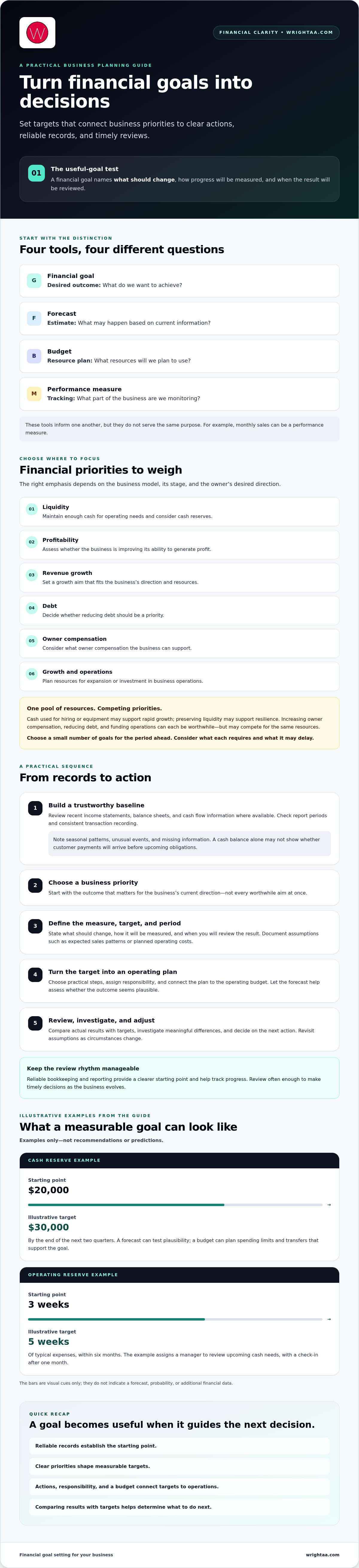
A goal states a desired outcome. A forecast estimates what may happen based on current information. A budget allocates resources to support planned activity, while a performance measure tracks one part of the business, such as monthly sales. These tools inform each other, but answer different questions: What do we want to achieve? What seems likely? What resources will we plan to use?
For example, a business might set an illustrative goal to increase its cash reserve from $20,000 to $30,000 by the end of the next two quarters. Its forecast estimates whether projected receipts and expenses make that outcome plausible. Its budget sets spending limits and planned transfers that could support the goal. The figures and timeframe in this example are illustrative, not a recommendation or prediction.
Which business priorities can financial goals support?
Goals can give shape to several priorities: maintaining enough liquidity for operating needs, improving profitability, funding planned growth, reducing debt, setting owner compensation, or investing in operations. The right emphasis depends on the business model, its stage, and the owner’s desired direction. A seasonal business may give more weight to cash reserves, while a business preparing to expand may focus on the resources growth requires.
Trying to advance every priority at once can dilute attention and put pressure on available cash. Choose a small number of goals for the period ahead, then consider what each requires and what it may delay. Reliable bookkeeping and reporting help establish a clear starting point, so targets reflect the business’s actual position rather than aspiration alone.
How to set financial goals for your business, step by step
A workable process connects the business’s current financial picture to a few priorities, then gives each goal an owner, an action, and a date to check progress. Reliable bookkeeping records are the starting point. For practical guidance on organizing those records, see this small business accounting guide.
Start with the financial picture you already have
Review recent income statements, balance sheets, and cash flow information where available. Check the period each report covers and whether transactions have been recorded consistently. Note seasonal patterns, unusual events, and missing information that could make the baseline misleading. For example, a cash balance on its own won’t show whether expected customer payments will arrive before upcoming obligations.
A trustworthy baseline gives every target a reliable point of comparison. If records are incomplete, address that gap before treating a target as a firm measure of progress.
Turn a business priority into a measurable goal
Choose a priority, then define a measure, a target, and a period. Document the assumptions behind the target, such as expected sales patterns or planned operating costs, and revisit them if circumstances change. The U.S. Small Business Administration’s guide to financial projections offers a framework for setting out financial expectations alongside a business plan.
For example, suppose a business wants more cash available for routine expenses. An illustrative goal could be to build its operating reserve from three weeks of typical expenses to five weeks within six months. The figures and timeframe are illustrative. The owner might assign the goal to a manager, ask them to review upcoming cash needs, and schedule a check-in after one month.
Use this sequence to carry the goal from intention into practice:
- 1. Review your position. Establish a baseline from dependable records and note any gaps or patterns.
- 2. Choose priorities. Select the business needs that matter most for the period ahead.
- 3. Set targets. Specify the measure, desired outcome, and period. Keep the target grounded in documented assumptions.
- 4. Assign actions. Name a person responsible and identify the first practical step.
- 5. Schedule reviews. Set a date to compare actual results with the target and decide what to do next.
Keep assumptions visible rather than letting them become invisible promises. If sales, costs, or timing shift, review the goal and its actions against the new information. Bookkeeping, cash flow management, and CFO-level financial guidance can help business owners interpret the numbers and plan next steps. To connect financial records with planning, explore Wright CPAs’ business financial guidance.
Which financial goals should your business prioritize?
The right financial goal depends on the decisions your business needs to make. Liquidity goals guide choices about cash timing and obligations. Profitability goals help assess margins, costs, and pricing. Growth goals focus attention on the resources and capacity expansion will require. Debt management and owner compensation shape other important trade-offs.
Before choosing, consider current conditions, upcoming obligations, operational capacity, and your objectives. A useful metric should illuminate a decision, not simply add another number to monitor. For definitions and examples of common measures, see this financial KPI guide.
| Goal type | Suitable measure | Practical review question |
|---|---|---|
| Liquidity | Cash available relative to near-term obligations | Will available cash cover expected payments when they come due? |
| Profitability | Gross or operating margin | Are pricing and costs supporting the level of profit the business needs? |
| Revenue growth | Revenue over a defined period | Can the business serve additional sales with its current capacity? |
| Debt management | Outstanding debt or scheduled payments | Is the repayment plan compatible with operating needs? |
| Owner compensation | Planned compensation compared with actual payments | Does the current plan align with business cash needs and owner objectives? |
Match a financial goal to the decision it should guide
Revenue alone can’t show whether cash will be available at the right time. A liquidity goal should account for when customer payments arrive and obligations fall due. Profitability measures need context too: margins may shift with costs, pricing choices, or the way the business operates. Growth targets should be tested against staffing, equipment, and other capacity so expansion doesn’t outpace the resources needed to deliver.
Choose goals that answer distinct questions. If the business needs more room to meet near-term obligations, liquidity may take priority over expansion. If costs are compressing margins, a profitability goal may be more useful than a revenue target on its own.
Can you set useful goals when forecasts are uncertain?
Yes. A goal helps structure decisions, but it can’t guarantee an outcome. If demand, costs, or available capacity are difficult to predict, use a range of scenarios as planning tools. For example, compare a lower-demand case with a stronger-demand case, then consider what actions each would require. Treat these as working assumptions, not promises.
Revisit assumptions when material conditions change. Financial goal setting for your business is most useful when targets remain connected to real operating conditions, rather than being treated as fixed despite new information.
How to turn financial goals into a realistic business action plan
A financial goal becomes useful when it changes what someone does next. Translate each target into a short sequence of actions, the resources those actions require, a person responsible, and a date to review progress. Keep the plan focused: a few clear steps are easier to carry out and assess than a long list of intentions.
Build actions, ownership, and timing into the plan
For each goal, identify the first practical action and who will complete it. Clarify what that person needs, such as current bookkeeping reports, sales information, or approval to adjust planned spending. Set a milestone that helps reveal delays early, but avoid extra reporting that doesn’t inform a decision.
For example, if the goal is to increase capacity, actions might include assessing current workload, identifying the resources required, and deciding when to proceed. Assign an owner to each step and set a review date. Link the actions to the operating budget so planned resources are visible, while treating projected results as estimates rather than guaranteed outcomes.
Align goals with cash flow and tax planning
A plan can appear affordable on paper and still strain cash if payments arrive after expenses are due. Check the timing of expected collections against planned spending, payroll, and other obligations. A goal centered on profit or growth still depends on having cash available when an action must be taken. This small business cash flow guide offers context for thinking through cash timing.
Consider tax implications as part of planning, especially if a goal involves a major change in spending, income, or business activity. Flag questions for a qualified tax professional rather than assuming a particular outcome. If tax planning could affect the decision, review this guide to strategic business tax planning.
- Action: What specific step moves the goal forward?
- Resources: What time, information, or budget does it require?
- Owner: Who is responsible for completing or coordinating it?
- Review date: When will you assess progress and decide what happens next?
These details connect financial goal setting for your business to day-to-day decisions without making the plan rigid. If you want help aligning cash flow, tax planning, and business priorities, explore Wright CPAs’ CFO services.
How to track financial goals and adjust your plan over time
A target becomes useful through review. Set a cadence that fits the goal, the records available, and how quickly the business needs to make decisions. A cash position that can shift quickly may call for closer attention than a longer-term profitability goal. Keep the rhythm consistent enough to spot changes, but light enough to sustain.
Regular reviews turn financial measures into timely business decisions. The purpose isn’t to explain every fluctuation. It’s to understand what matters, decide whether the plan still fits, and identify the next action.
What should a business financial goal review include?
Compare the measure and target with the actual result for the same period. Then revisit the assumptions behind the goal and note changes in business conditions. If results differ, check whether the gap reflects timing, incomplete records, or a pattern that may call for a decision. A delayed customer payment, for instance, may affect one period’s cash position without changing the longer-term outlook.
Close each review with a brief record of what was decided, who is responsible, and when progress will be checked again. That creates continuity from one meeting to the next without turning the process into a reporting exercise for its own sake.
- Measure and target: What was the intended result for this period?
- Actual result: What do the records show?
- Context: Did assumptions or business conditions change?
- Next step: What decision or action follows, who owns it, and when will it be reviewed?
When can outside financial guidance help?
Outside perspective may be useful if reports are difficult to interpret, cash pressure keeps recurring, or goals lack clear ownership. Dependable bookkeeping can provide a clearer foundation for tracking results. Cash flow management can connect planned actions with the timing of receipts and obligations, while tax planning can bring tax considerations into business decisions. CFO-level guidance may help owners use financial information to assess priorities and next steps.
Wright CPAs is a Buffalo-based firm serving local and nationwide clients, with bookkeeping, tax planning, cash flow management, and CFO services for business owners. Business owners in Buffalo, Rochester, and Syracuse can discuss their goals with Wright CPAs if they’d like support making financial goal setting for their business part of a steady decision-making process.
Make your next financial decision with greater clarity
Strong financial goal setting for your business begins with a clear priority and a measurable target. It becomes practical when you connect that target to specific actions, an owner, and a review date. As results and conditions change, use regular check-ins to decide whether to stay the course or adjust the plan.
You don’t need to solve every financial challenge at once. Choose the goal that matters most now, ground it in reliable records, and make the next step clear. A steady process can bring more purpose to decisions about cash, growth, costs, and owner compensation.
Wright CPAs, founded in 2012, is a Buffalo-based firm serving clients locally and throughout the United States. Its services include bookkeeping, tax planning, cash flow management, and CFO services to support business owners as they plan and track progress. If you’re ready to shape a clearer path forward, discuss a financial plan for your business with Wright CPAs.
Frequently Asked Questions
What is financial goal setting for a business?
Financial goal setting for a business means defining measurable financial outcomes for a stated period and using them to guide decisions. A goal might focus on maintaining operating cash, improving profit margins, or reducing debt. It differs from a forecast, which estimates likely results, and a budget, which plans how resources will be used. A clear goal includes a measure, a target, a timeframe, and a way to review progress.
How do I set financial goals for my small business?
Start with reliable bookkeeping records and review your current financial position. Choose a priority, such as improving liquidity or funding planned growth, then define a measurable target and timeframe. Document the assumptions behind it. Next, assign an owner, identify the first action and resources needed, and set a review date. At each review, compare actual results with the target and decide whether to continue, adjust, or investigate a difference.
What are examples of financial goals for a business?
Examples include maintaining cash for upcoming obligations, improving a chosen profit margin, increasing revenue over a defined period, reducing outstanding debt, or setting a sustainable owner compensation plan. A business might also set a goal to fund an operational need, such as equipment or additional capacity. Choose measures that match the decision you need to make, and confirm that the goal fits your business model, obligations, and available resources.
How often should a business review its financial goals?
Review goals at a cadence suited to the measure, the quality of available records, and the speed of business decisions. Cash flow may need more frequent attention than a longer-term goal tied to profitability or debt reduction. At each review, compare actual results with the target, check whether assumptions still hold, and record the next action, its owner, and the next review date. Keep the process consistent and manageable.
Can a business set financial goals when revenue is unpredictable?
Yes. Uncertain revenue doesn’t make goal setting pointless; it makes assumptions and flexibility more important. Use planning scenarios or ranges to consider how different demand levels could affect cash, costs, or capacity. Treat these as planning tools, not promises. Review them when conditions change, and identify actions that could help the business respond. A goal can guide decisions even when the eventual result isn’t certain.
Which financial metrics should a small business use to track its goals?
Choose metrics that answer a specific business question. Cash available compared with upcoming obligations can help monitor liquidity; gross or operating margin can help assess profitability; revenue over a defined period can track growth. Debt balances or scheduled payments may suit debt goals, while planned compensation compared with actual payments can inform owner compensation. Use consistent records and time periods so comparisons are meaningful, and avoid tracking measures that don’t inform a decision.
Should I work with a CPA to set financial goals for my business?
A CPA may help if reports are unclear, cash pressure recurs, or financial targets lack practical actions and ownership. Bookkeeping can support reliable tracking, while tax planning, cash flow management, and CFO services can inform decisions. Wright CPAs, founded in 2012, is based in Buffalo and serves clients throughout the United States. Business owners in Buffalo, Rochester, and Syracuse can explore support connecting financial information with their goals.


