

A rent roll shows what came in, but not what each property retained after operating costs. Effective bookkeeping for property managers Syracuse teams rely on connects income and expenses to reconciled records, so activity across a portfolio doesn’t blur into one business-wide total.
When rental income and operating costs are hard to sort by property, month-end reconciliation and owner reporting can take longer than they should. Clear records make it easier to understand each property’s activity and give owners timely, useful updates.
This guide explains how to assess bookkeeping support for rental operations, compare service models, and set a reporting rhythm that fits your business. You’ll learn what to clarify about scope, software access, property-level tracking, tax-ready records, and recurring responsibilities. The goal is a steady process: reconciled books, reports that support decisions, and a bookkeeping relationship with clear boundaries.
Key Takeaways
- Separate the management company’s finances from property- and owner-related records to make business activity easier to understand.
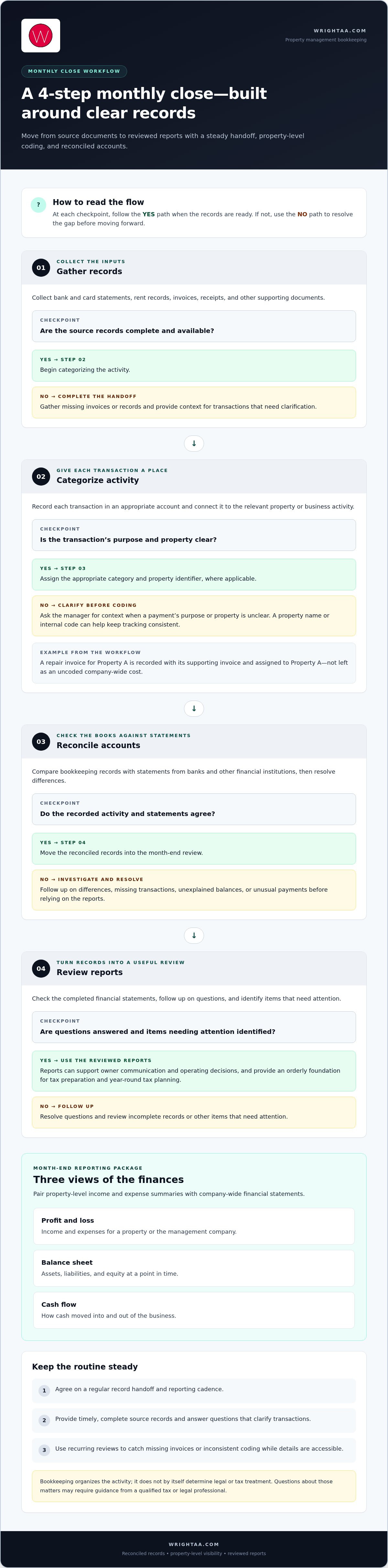
- Build a monthly close around gathering records, categorizing transactions, reconciling accounts, and reviewing reports.
- When comparing bookkeeping for property managers Syracuse businesses use, look beyond transaction entry to recurring reconciliations, clear reporting, and tax coordination.
- Use a practical checklist to define property coding, report needs, record handoffs, and communication expectations before setting a bookkeeping routine.
- Wright CPAs serves Syracuse clients from its Buffalo base, with fixed-fee monthly accounting and advisory retainers that can include ongoing bookkeeping and financial reporting.
What bookkeeping for property managers in Syracuse should make clear
Useful bookkeeping turns transactions into organized, reconciled records that show how a property business is operating. For bookkeeping for property managers Syracuse, that means distinguishing the management company’s finances from activity tied to each property and its owner. Rent collected on an owner’s behalf, for example, shouldn’t automatically be treated as the company’s management income.
The right structure depends on the portfolio, ownership arrangements, and the manager’s responsibilities. A property owned by the management company may be recorded differently from one managed for a client. Bookkeeping creates a clear record of activity; it doesn’t, by itself, decide the legal or tax treatment of a transaction. Those questions may require guidance from a qualified tax or legal professional. For a high-level introduction to the principles, see this overview of bookkeeping.
Which records should be organized by property?
Start with rental receipts, management income, operating expenses, and vendor payments. Assign a consistent property identifier to each relevant transaction, such as a property name or internal code. Without one, it can be difficult to assign repair or utility costs accurately across a portfolio.
Owner funds and other client money call for careful, situation-specific accounting. Keep records clear about whose funds are involved and how related balances are tracked. The appropriate handling depends on the arrangement and applicable requirements, so don’t assume all receipts belong in the management company’s operating results.
What should useful monthly reports show?
A useful review can pair property-level income and expense summaries with company-wide financial statements. That lets a manager see how individual properties are performing without losing sight of the company’s own revenue, costs, assets, and obligations.
Reconciliation strengthens these views. Comparing recorded activity with account statements helps identify missing transactions, unexplained balances, or unusual payments that need follow-up. A monthly reporting package may include:
- Profit and loss: income and expenses for a property or the management company.
- Balance sheet: assets, liabilities, and equity at a point in time.
- Cash flow: how cash moved into and out of the business.
These reports support owner communication, operating decisions, and tax preparation by keeping the underlying records organized. They don’t settle tax classifications or replace professional advice. A well-defined bookkeeping process makes the numbers easier to review and gives each report a clear purpose.
How a Syracuse property manager's monthly bookkeeping workflow fits together
A dependable monthly close follows a clear sequence, turning receipts and account activity into records managers can review and reports owners can understand. For bookkeeping for property managers Syracuse, the timing should fit the business’s operating needs, while the essential steps remain consistent:
- Gather records: Collect bank and card statements, rent records, invoices, receipts, and other supporting documents.
- Categorize activity: Record each transaction in an appropriate account and connect it to the relevant property or business activity.
- Reconcile accounts: Compare bookkeeping records with financial institution statements and resolve differences.
- Review reports: Check the completed financial statements, follow up on questions, and identify items that need attention.
The manager’s role is central. Timely, complete source records give the bookkeeper a sound foundation, and answers to questions clarify transactions that lack context. Agreeing on a regular handoff and reporting cadence makes responsibilities clear on both sides. A steady routine also helps surface missing invoices or inconsistent coding before they carry into later months.
From bank activity to organized property records
Match bank and card activity to source documents, then assign clear bookkeeping categories. Where the accounting setup allows, property tags or classes can separate transactions for reporting. Hypothetical example: If a vendor invoice is for a repair at Property A, record the expense with the supporting invoice and assign it to Property A rather than leaving it as an uncoded company-wide cost.
This preserves the trail from transaction to property record. If a payment’s purpose or property isn’t clear, the manager may need to provide context before it can be categorized accurately.
From reconciliations to a useful month-end review
Reconciliation compares recorded activity with statements from banks and other financial institutions. Afterward, the manager and bookkeeper can review unresolved items, unusual changes, and incomplete records. A recurring close creates a regular opportunity to investigate discrepancies and correct coding while the details are still accessible.
Once the books are reviewed, financial reports can support owner communication and operating decisions. Finalized records also provide a more orderly foundation for tax preparation and year-round tax planning, without determining tax treatment or guaranteeing a particular outcome. The IRS Real Estate Tax Center offers information on real-estate tax topics. To learn about recurring bookkeeping connected with accounting and reporting, visit Wright CPAs bookkeeping support.
How to compare bookkeeping services for property managers in Syracuse
Compare the work behind the reports, not just the software or frequency of data entry. For bookkeeping for property managers Syracuse businesses need, assess service scope, property-level organization, reporting cadence, communication, and tax-planning coordination. A clear scope shows whether the arrangement supports owner reporting or only records transactions.
Scope, software, and reporting: what the comparison should include
Distinguish transaction processing, account reconciliation, financial reporting, payroll coordination, and catch-up work. These are separate tasks, and a service may include some without including all. Put responsibilities, record handoffs, and review timing in writing. QuickBooks and Xero are examples of accounting platforms, not substitutes for a defined bookkeeping process or evidence of any particular firm’s software integrations.
Property-management software and bookkeeping serve related but different purposes. Property tools may organize operational information, while bookkeeping organizes financial activity and supports reconciliation and reporting. Software can store records, but it doesn’t replace accounting review.
| Service model | What to expect | Considerations |
|---|---|---|
| Periodic transaction entry | Transactions are entered or categorized at agreed intervals. | Clarify who reconciles accounts, reviews coding, and prepares reports. Entry alone may leave those tasks with the manager. |
| Recurring reconciliations and financial reporting | Account activity is reconciled on a regular schedule, with financial reports prepared for review. | Agree on property-level organization, report timing, source-record handoffs, and how questions are resolved. |
How to judge fit for a Syracuse portfolio
Match the arrangement to the portfolio’s size, ownership structure, and internal processes. A manager handling properties for multiple owners may need distinct records and reporting flows from an operator managing a smaller set of company-owned rentals. Define which reports support owners, internal decisions, and tax preparation.
Consider how bookkeeping connects with tax planning and cash flow management. Consistent records can provide a more useful basis for those conversations, without guaranteeing a tax result. Wright CPAs is based in Buffalo and serves clients in Syracuse, Rochester, and Buffalo, so a remote working relationship can still be grounded in the client’s local business context. Keep questions about New York requirements separate from bookkeeping scope and review them against current authoritative guidance.
A practical checklist for choosing property-management bookkeeping in Syracuse
A strong bookkeeping relationship makes responsibilities and review points clear. Before moving ongoing work, identify any backlog, inconsistent categories, or unreconciled accounts. That gives the manager and accounting team a shared starting point instead of carrying old gaps into a new routine.
Use this checklist to define what the work needs to support:
- Property coding: How will transactions be assigned to the right property, owner, or management-company activity?
- Reconciliations: Which accounts will be reconciled, and how often will unresolved differences be surfaced?
- Reports: Can you review examples of the recurring reports included in the engagement? Decide what owners need, what supports internal operations, and what helps prepare for tax work.
- Record handoffs: Which statements, invoices, receipts, and other source records must the manager provide, and how will missing documents be flagged?
- Communication: Who answers bookkeeping questions, how are open items tracked, and when are completed reports reviewed?
Questions that reveal the bookkeeping process
Clarify how transactions are organized and reconciled, what happens when records are incomplete, and which recurring reports are included in the agreed scope. Define how the manager’s responsibilities differ from the accounting team’s: who supplies documents, explains unusual transactions, reviews reports, and follows up on open questions? Clear answers turn expectations into a workable process.
Signals that the service matches your operating needs
Look for a documented month-end routine, not transaction entry alone. Communication should make missing information and next steps easy to see, and reports should align with actual management decisions. For broader context on financial structure, Wright CPAs’ article Small Business Accounting in Buffalo, NY: Designing Financial Clarity offers a related perspective. Its guide Financial KPIs for Small Business: A Guide to Clarity in Western New York can also help frame which measures matter to your operation.
The right arrangement reflects the portfolio’s ownership structure and internal workflow. For bookkeeping for property managers Syracuse businesses, a clear scope can connect property records with owner communication, operating reviews, and tax planning without confusing those distinct needs. Learn more about Wright CPAs services.
Bookkeeping support for Syracuse property managers through Wright CPAs
Wright CPAs, LLC is based in Buffalo and serves clients in Syracuse with bookkeeping and accounting support. For a property manager, an ongoing relationship can establish a steady routine for organizing financial activity, reviewing reports, and keeping records current. The aim is practical clarity: a better view of business activity and a sounder foundation for decisions.
What an ongoing accounting relationship can bring together
Wright CPAs’ fixed-fee monthly accounting and advisory retainers can include ongoing bookkeeping and financial reporting. The agreed engagement defines the work and reporting responsibilities rather than assuming every portfolio needs the same outputs. Accurate, current records can also inform conversations about cash flow and tax planning, while payroll support can fit into the broader accounting picture where relevant.
This connection matters to property managers. A clearer view of income, expenses, and cash movement can make it easier to raise questions and plan ahead. Bookkeeping supports tax preparation and planning, but it doesn’t determine tax treatment or promise a specific result. The records and reports provide a foundation for informed discussion.
For a broader perspective on planning, The Architecture of Finance: Strategic Business Tax Planning in Buffalo, NY explores how tax strategy can fit within a business’s financial structure.
A clear next step for Syracuse property managers
Start by outlining your current workflow: how records are gathered, where month-end questions tend to arise, and which reports you need for owners or internal decisions. That overview can help shape a conversation about recurring bookkeeping responsibilities, financial reporting, cash flow management, and tax planning.
Wright CPAs serves Syracuse clients from its Buffalo base. If you’re considering ongoing bookkeeping support, identify the reporting questions you want answered and the routines you’d like to make more consistent. This provides a practical starting point for defining a monthly accounting and advisory relationship with a scope and cadence suited to your business.
Build a steadier bookkeeping rhythm for your rental business
Strong bookkeeping for property managers Syracuse businesses can rely on starts with records organized by property, reconciled on a dependable schedule, and shaped around the reports owners and managers need. A clearly defined service scope also makes responsibilities, record handoffs, and communication easier to manage.
Wright CPAs offers bookkeeping alongside tax planning, payroll, and cash flow management. Its Buffalo-based team serves clients in Syracuse, Rochester, and Buffalo, connecting ongoing financial records with broader business planning where it fits the engagement.
To make month-end work more orderly, explore Wright CPAs’ bookkeeping and accounting support and discuss a recurring process for clearer records and more confident decisions.
Frequently Asked Questions
What does bookkeeping for property managers include?
Bookkeeping for property managers generally includes recording income and expenses, organizing transactions, reconciling accounts, and preparing financial reports. For a rental operation, records should distinguish the management company’s own activity from transactions associated with individual properties or owners. The agreed scope may also cover payroll coordination or catch-up work. Bookkeeping supports clear financial records and tax preparation, but it doesn’t determine the legal or tax treatment of a transaction.
How should a property manager organize bookkeeping by property?
Use a consistent property name or identifier to tag each relevant income and expense transaction. Record rental receipts, management income, vendor payments, and operating costs in clear categories, then keep the management company’s activity distinct from property- or owner-related records. For example, link a repair invoice to the property it concerns. Consistent coding makes reports easier to review and helps prevent costs from blending across a portfolio.
Can a bookkeeper prepare owner reports for rental properties?
A bookkeeper can prepare owner-facing reports when that work is included in the agreed engagement and the underlying records are complete. Useful reports may summarize a property’s income and expenses, with reconciled balances ready for review and explanation. Before work begins, define which reports owners need, how often they’re prepared, and who reviews them. Report scope can vary with ownership arrangements, management responsibilities, and the information available.
How often should a property management business reconcile its accounts?
Monthly reconciliation is a practical rhythm for keeping financial records current and reviewing activity while transaction details are still accessible. Compare recorded transactions with bank and card statements, then investigate differences, unusual charges, or missing documentation. The appropriate cadence depends on the business’s operating needs and account activity. Agree on a month-end schedule that gives the manager time to provide records and respond to bookkeeping questions.
What software is commonly used for property-management bookkeeping?
Property managers may use accounting platforms such as QuickBooks or Xero alongside software designed to organize rental operations. The right setup depends on how the business tracks property activity, handles records, and prepares reports. Software can help store and categorize transactions, but it doesn’t replace reconciliations or accounting review. Before settling on a workflow, clarify which system holds the financial records and how source documents reach the bookkeeper.
How do I choose a bookkeeping service for a Syracuse property management business?
Compare the work included, property-level organization, reconciliation schedule, report examples, communication process, and tax coordination. Clarify who provides records, resolves questions, and reviews completed reports. A written scope distinguishes transaction entry from recurring reconciliations and financial reporting. A remote relationship can work for Syracuse businesses when the handoffs and reporting cadence are clear. Wright CPAs is based in Buffalo and serves clients in Syracuse, Rochester, and Buffalo.
Can bookkeeping support help with tax planning for a property management business?
Yes. Organized, current books can give a tax professional a clearer record of business income, expenses, and cash activity to inform tax-planning conversations. Bookkeeping supports the process, but it doesn’t by itself determine tax treatment or guarantee a particular outcome. Wright CPAs offers bookkeeping alongside tax planning, payroll, and cash flow management, serving businesses in Syracuse, Buffalo, Rochester, and elsewhere. The specific work depends on the agreed engagement.
What records should a property manager provide to a bookkeeper each month?
Provide bank and card statements, rent and management-income records, vendor invoices, receipts, and other documentation needed to explain transactions. Include a consistent property identifier or enough context to assign each item to the correct property or business activity. Also share details about transactions that may not be clear from a statement alone. Agree on a regular handoff process so missing documents and open questions can be addressed during the monthly close.


