

What if the transition to a financial partner was treated with the same intentionality as designing a permanent structure? Many entrepreneurs view the act of deciding what to bring to a new accountant as a chore of compliance, yet it's actually the first step in building a resilient financial architecture. You might feel an underlying anxiety about missing deductions or the shifting requirements of New York State tax nexus. It's a common frustration when previous advisors have treated your business as a static set of forms rather than a living, evolving entity.
We agree that your wealth deserves a steady, methodical approach to reach its full potential. This guide provides a comprehensive checklist of the documents and insights needed to move toward a proactive tax strategy. We'll examine how to organize your historical data, including new requirements like Form 1099-DA for digital assets and the specific impacts of the One Big Beautiful Bill Act. You'll gain the clarity required for a seamless transition that honors your history while securing your future growth.
Key Takeaways
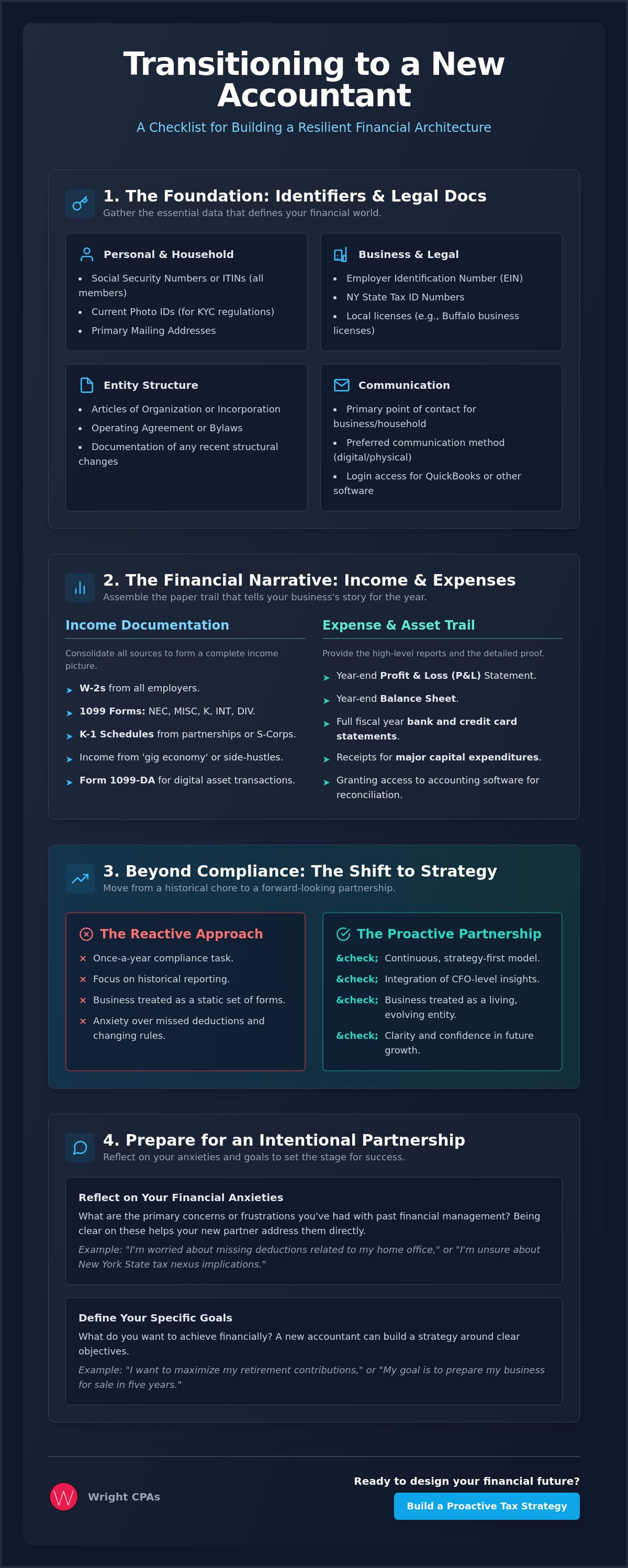
- Establish a secure foundation by gathering the essential identifiers and entity documentation that ground your financial structure.
- Assemble a comprehensive financial narrative through year-end reports and income statements that reflect the true rhythm of your business.
- Identify precisely what to bring to a new accountant to facilitate a transition rooted in proactive strategy rather than mere historical reporting.
- Prepare for a more intentional partnership by reflecting on your primary financial anxieties and the specific goals you wish to achieve.
- Shift from once-a-year compliance to a continuous, strategy-first model that integrates CFO-level insights into your daily operations.
The Foundation: Personal and Legal Business Identifiers
Before a structure rises, the site must be surveyed and the boundaries marked. In the same way, establishing a foundation of identifiers is the first step in deciding what to bring to a new accountant. This isn't merely a task of data entry. It's the process of defining the legal and personal coordinates of your financial world. You'll need Social Security Numbers or ITINs for every member of your household, ensuring that the human element of your tax return is clearly defined. For your business interests, the Employer Identification Number (EIN) acts as the primary anchor for all future strategy and reporting.
Geography dictates the materials used in a building, and your location in Western New York introduces specific requirements. Your accountant needs your New York State tax ID numbers and any specific Buffalo business licenses that govern your local operations. Providing current photo IDs is also a requirement to satisfy "Know Your Client" (KYC) regulations. This layer of documentation ensures that the professional relationship is built on a bedrock of verified facts. Gaining a deeper understanding accounting records allows you to see these identifiers as more than just numbers; they're the primary keys to your financial history.
Entity Structure and Ownership Details
The internal logic of your business is found in its formation documents. Articles of Organization or Incorporation reveal the original intent of the entity. However, the Operating Agreement or Bylaws provide the specific rules that govern daily life. Your accountant needs to see these to understand profit distributions and ownership percentages, especially for S-Corps and Partnerships. If you've adjusted your business structure during the fiscal year, these changes must be documented to avoid structural weaknesses in your tax plan. Knowing exactly what to bring to a new accountant regarding your entity's history prevents future friction during the filing process.
Contact and Communication Preferences
A successful partnership relies on a steady, unhurried rhythm of communication. Provide current mailing addresses for all stakeholders to ensure no official correspondence is missed or delayed. We also need to define how information moves between us. Whether you prefer the tactile nature of physical documents or the efficiency of digital delivery, setting these preferences early creates a sense of calm and purpose. Identifying a primary point of contact for your household or business ensures that the dialogue remains focused and intentional.
Financial Narratives: Income, Expenses, and the Paper Trail
If the identifiers established previously were the site survey, your financial records represent the building's actual form. Every W-2 and 1099 serves as a structural beam in the story of your year. You must consolidate all 1099-NEC, MISC, K, INT, and DIV forms, along with any K-1 schedules from partnerships or S-Corps. These are the primary components of your income narrative. It's equally vital to capture income from the "gig economy" or side-hustle projects, as these often go overlooked in less intentional planning. When you decide what to bring to a new accountant, the paper trail of your income is the most critical material you can provide.
Clarity is also found in the specific details of your spending. Exporting your year-end Profit & Loss (P&L) and Balance Sheet reports provides the high-level view, but the underlying bank and credit card statements for the full fiscal year offer the necessary proof. It's particularly important to organize receipts for major capital expenditures and business investments. These large-scale interventions in your business often have unique depreciation rules that require precise documentation. Referencing an official IRS tax preparation checklist can help ensure no standard document is left behind. For more complex needs, our tax strategy services help transform these raw numbers into a forward-looking plan.
The Role of Bookkeeping in the Transition
Granting your accountant direct access to QuickBooks or other financial software allows for a deeper walkthrough of your data. This access helps identify "unreconciled" accounts that might otherwise distort your financial reality. A professional perspective on small business accounting in Buffalo NY ensures that your local market context is reflected in your books. This level of clarity is the prerequisite for any sophisticated tax strategy. Knowing exactly what to bring to a new accountant regarding your ledger ensures that the transition is seamless and grounded in truth.
Categorizing Expenses for Maximum Deduction
Maximum deductions are not found by accident; they're the result of rigorous categorization. You must separate home office, travel, and meal expenses according to current IRS guidelines to ensure they stand up to scrutiny. Document your charitable contributions with bank records or letters of acknowledgment from the recipient organizations. Tracking health insurance premiums and retirement plan contributions is also essential. These elements, when properly organized, reduce the complexity of the filing process and minimize your tax liability through disciplined planning.
Beyond Compliance: Documents for Strategic Tax Planning
Moving beyond the immediate income and expenses requires a look at the historical timeline of your finances. While the current year matters, the trajectory of your business is found in the previous three years of federal and state tax returns. These documents act as the blueprint for where you've been and where the potential for future growth lies. When you determine what to bring to a new accountant, including these prior returns allows for a thorough review of past decisions. It ensures that no carryover credits or losses from previous years are abandoned during the transition.
To build a proactive strategy, you must also provide depreciation schedules for all fixed assets and property. These schedules track the aging of your physical investments and dictate how they impact your tax liability over time. Similarly, consolidating loan agreements and amortization schedules for business debt provides a clear view of your financial obligations and interest deductions. As you gather your tax documents, treat these records as the structural assessment of your business's health. They are the materials that allow us to design a more resilient financial future.
Payroll tax reports are another essential layer. Specifically, you should provide federal Forms 941 and 940, along with the New York State NYS-45. These reports verify that your employment obligations are met and help identify any regional tax nuances that might affect your standing. By providing this data, you allow your new partner to see the full scope of your operation. This transparency is the prerequisite for a partnership rooted in trust and clarity.
The Importance of Historical Tax Data
A new accountant needs to see your tax history not just for compliance, but to find missed opportunities. Prior returns reveal patterns in income and deductions that inform business tax planning in Buffalo NY. We check for consistency across jurisdictions and ensure that all carryover losses or credits are properly transitioned into the new plan. This historical context turns a static return into a dynamic strategy. It's the difference between looking back at where you've been and looking forward to where you can go.
Specialized Documents for Law Firms and Professionals
For legal practices, the documentation requirements are more precise. Providing IOLTA bank statements and three-way reconciliation reports is vital for maintaining ethical and financial integrity. We also look for documentation of professional liability insurance and state bar dues. This rigorous attention to detail ensures compliance with CPA for law firms Buffalo NY standards. It allows your practice to flourish within a secure financial framework, free from the anxiety of overlooked regulatory details.
Preparing for the Transition: Questions and Expectations
The transition to a new financial partner is a deliberate act. It requires a mental inventory that matches the physical one. While previous sections detailed the physical documents, deciding what to bring to a new accountant also involves preparing your narrative. You must reflect on why you are seeking a new partnership. Perhaps you were frustrated by a lack of communication; perhaps you felt your previous advisor only spoke to you once a year. Identifying your top three financial anxieties or goals for the coming year allows us to prioritize the structural changes your business needs most.
Create a list of "pending" items from your previous accountant to ensure no project is left unfinished. This might include an unfiled amendment or an unresolved state tax notice. You should also determine your preferred frequency for advisory meetings. A steady, unhurried rhythm of check-ins creates more value than a frantic tax-season scramble. Review your current financial kpis for small business to identify what data is currently missing from your view. If you're ready to move toward a more intentional partnership, explore our CFO services for a higher level of financial design.
The "Onboarding" Mindset
The first meeting is a diagnostic for your financial health. It's a walkthrough of your current structure to find where the foundation is strong and where it needs reinforcement. Transparency about "messy" books is always better than hiding them. We're here to provide a solution, not a judgment. Establishing a clear timeline for the full transition of records ensures that the process is unhurried yet methodical. Knowing exactly what to bring to a new accountant during this initial phase sets the tone for the entire relationship.
Setting Fixed-Fee vs. Hourly Expectations
A sophisticated partnership relies on predictable billing. We prefer the value of monthly retainers over sporadic, hourly billing. This model encourages constant dialogue rather than fear of the clock. Proactive advisory differs fundamentally from once-a-year tax preparation; it's a commitment to ongoing financial architecture. Defining the scope of work early prevents "scope creep" and ensures that both parties understand the boundaries of the engagement. This clarity allows us to focus on the poetry of your business growth rather than the technicalities of an invoice.
For those seeking to benchmark these service models against industry standards, Skyplex Management provides an analysis of what modern bookkeeping support entails and how pricing structures are evolving to meet the needs of small business owners.
Designing Your Future with Wright CPAs
At Wright CPAs, we view accounting not as a seasonal chore, but as the ongoing maintenance of a well-designed structure. Most firms focus on the reflection of the past. We focus on the intention of the future. When you've gathered your records and understood what to bring to a new accountant, you've done more than just organized paperwork. You've cleared the site for a new project. Our proactive tax strategy moves beyond the mechanical act of form-filling. We provide CFO-level guidance specifically tailored for the unique economic environments of Buffalo and Rochester. This isn't just about compliance; it's about the intersection of your business goals and the regional landscape.
This partnership utilizes modern, secure technology for document sharing. It eliminates the friction of physical distance while maintaining a high level of security for your sensitive data. We believe that financial clarity isn't a destination, but a continuous state of being. It's about having a steady hand at the helm of your cash flow management and business consulting needs. By using precise, sensory-driven data, we help you understand the behavior of your capital within your specific market. This awareness allows for a more grounded approach to growth.
Our Approach to New Client Onboarding
The initial discovery session is where we map your financial architecture. We don't just look at the numbers; we look at the human goals behind them. We handle the heavy lifting of the document transition so you don't have to feel the weight of the move. By integrating your bookkeeping, tax prep, and long-term strategy into a single rhythm, we create a sense of calm and purpose. This holistic approach ensures that every financial decision supports the overall design of your life. Knowing exactly what to bring to a new accountant during this phase allows us to begin our work with a complete and accurate site map.
Ready for a More Intentional Partnership?
You don't need to wait for a specific date on the tax calendar to seek a better path. Now is the best time to switch. Delaying the transition only prolongs the period of financial uncertainty. Whether you're a law firm in downtown Buffalo or a growing business in Rochester, our team is ready to listen. Booking your initial consultation is a simple act of intentionality. It's the first step toward a more refined financial life. We invite you to experience a partnership where quality is prioritized over quantity and substance over spectacle.
The Path to Intentional Wealth
Transitioning your financial records is an act of architectural significance. It marks the moment you choose substance over spectacle. By identifying what to bring to a new accountant, you've prepared the site for a more resilient structure. You've moved beyond the mere collection of forms and toward the creation of a strategy that honors your history while securing your future growth.
We provide specialized expertise in law firm accounting and a proactive tax strategy that remains steady throughout the year. Our fixed-fee monthly advisory model removes the friction of unpredictable costs, allowing us to focus on the long-term health of your practice. Your wealth deserves a partner who values quality and contextual awareness. Design a more intentional financial future with Wright CPAs. Your vision is ready for a solid foundation.
Frequently Asked Questions
How many years of tax returns should I bring to a new accountant?
You should provide federal and state tax returns for the previous three years. This historical window allows for a thorough review of your financial trajectory and ensures no carryover credits or losses are abandoned. While a single year shows a snapshot, three years reveal the structural patterns of your wealth and business growth. This data serves as the blueprint for our future strategy.
Do I need to bring physical receipts, or are digital copies enough?
Digital copies are typically sufficient and often preferred for their ease of integration into modern financial software. Ensure your scans are clear and organized by category. While physical receipts are the original artifacts, a well-curated digital archive provides the same legal protection while allowing for a more serene and organized transition. It creates a cleaner environment for professional analysis.
What if my previous accountant is not responding to my requests for records?
You are legally entitled to your completed tax returns and any original records you provided to a prior firm. If communication has ceased, you can request transcripts directly from the IRS or state authorities. We can help you navigate this process to ensure your financial history remains intact. A lack of response shouldn't prevent you from seeking a more intentional partnership.
Is it better to switch accountants at the beginning of the year or mid-year?
Switching mid-year is often the most intentional choice for your business. It allows for proactive tax strategy and structural adjustments before the pressure of the filing season begins. Waiting for the beginning of the year often leaves little room for meaningful intervention. A mid-year transition provides the unhurried space needed to design a better financial future and establish a steady rhythm.
What specific documents do I need if I own multiple LLCs?
When deciding what to bring to a new accountant, you must provide the Articles of Organization and EIN for every specific LLC. Include the separate Profit and Loss statements and Balance Sheets for each entity. This ensures that the boundaries between your various business interests are clearly defined and legally respected. It allows us to see the full architecture of your holdings.
Will my new accountant need access to my payroll software directly?
Direct access to your payroll software is highly beneficial for maintaining financial clarity. It allows for a seamless walkthrough of your employment data and ensures that all quarterly filings are reconciled with your general ledger. This transparency reduces the risk of administrative friction. It allows for a more integrated approach to your business operations and employee obligations.
What is the most common document people forget when switching accountants?
The depreciation schedule is the document most frequently overlooked during a transition. This record tracks the aging of your fixed assets and is essential for calculating accurate tax deductions over time. Without it, your new accountant must reconstruct the history of your property and equipment. This can delay the strategic planning process and affect the accuracy of your future filings.
Can a new accountant help me fix errors on previous years returns?
A new partner can certainly help you amend previous returns to correct errors or claim missed deductions. This process begins with a structural review of your historical filings to identify where the original intent was not fully realized. Fixing these past oversights is often the first step in establishing a more grounded and accurate financial foundation for your future growth.


