

Firing your accountant is not merely a professional ending; it is a deliberate act of design to improve the structural integrity of your business. When your financial foundation feels unstable due to reactive communication and missed opportunities, the silence can become a heavy burden. You likely feel a sense of hesitation, perhaps fearing the awkwardness of the termination conversation or the risk of missing a critical New York tax deadline during the switch. Learning how to fire your accountant is the first step toward a more intentional relationship with your firm's future.
You deserve a partnership built on clarity and foresight rather than last-minute corrections. We understand that the transition requires a delicate balance of technical precision and professional grace. In this guide, we will provide a strategic roadmap to help you navigate the departure from a mediocre firm toward a proactive partnership. We will explore the mechanics of a clean break, from revoking system access to ensuring your compliance remains undisturbed, so you can finally experience the peace of mind that comes with a well-ordered financial house.
Key Takeaways
- Recognize the distinction between a passive tax preparer and a proactive strategist who anticipates the structural needs of your growing business.
- Navigate the delicate process of how to fire your accountant by securing a successor and reviewing existing agreements to ensure a professional, seamless departure.
- Implement a rigorous security protocol to protect your tax portals and financial data, maintaining total control over your digital environment throughout the transition.
- Optimize the timing of your transition by utilizing the "summer window" to avoid high-risk blackout periods and ensure a serene onboarding process.
- Evolve your financial oversight from simple compliance to a sophisticated advisory model that provides ongoing clarity and strategic depth through predictable monthly partnerships.
Recognizing the Signs of Professional Misalignment
A business is a living structure. When the financial foundation begins to show cracks, the instinct is often to patch the surface rather than questioning the underlying design. Many business owners eventually realize their relationship with their CPA has become purely transactional, lacking the intentionality required for growth. This realization is often the catalyst for learning how to fire your accountant and seeking a partnership that offers more than just retrospective data entry.
The "Reactive Trap" is a common symptom of this misalignment. It occurs when your CPA only initiates contact in April, long after the opportunities for strategic intervention have passed. This seasonal rhythm leaves you in a state of perpetual catch-up. Silence creates anxiety. When communication is sparse, you lose the vital clarity needed to navigate cash flow shifts and evolving tax liabilities. Adherence to high ethical standards for accountants requires more than just technical accuracy; it demands a commitment to the client's ongoing financial health. When an accountant fails to provide this, the silence becomes an expensive liability.
The Reactive vs. Proactive Duality
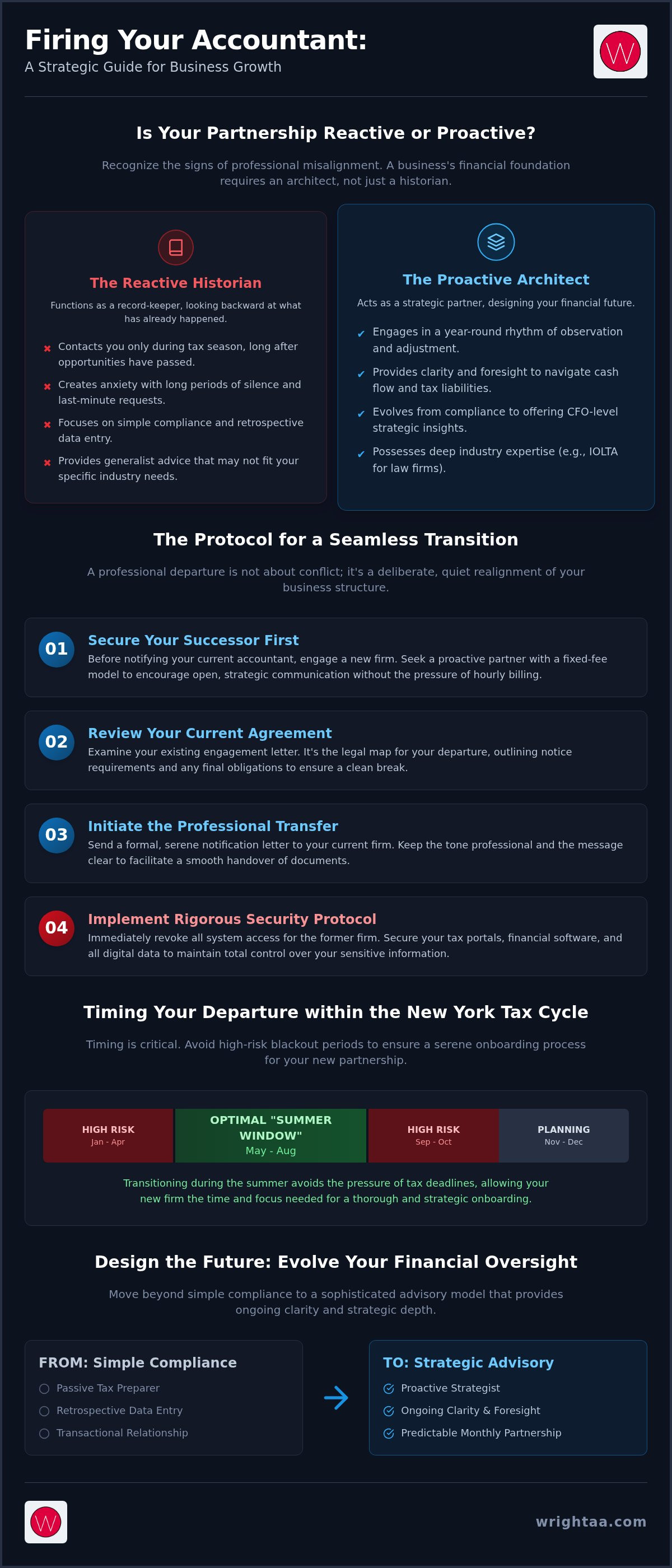
A reactive accountant functions as a historian. They look backward, cataloging what has already happened and filing reports on a past you can no longer change. In contrast, a proactive partner acts as an architect. They design strategies to mitigate future risks and optimize wealth before the fiscal year concludes. For businesses in Western New York, this distinction is vital. Effective business tax planning Buffalo NY requires a year-round rhythm. It's a continuous process of observation and adjustment, ensuring that your tax strategy evolves alongside your operations.
When Industry Expertise Becomes Essential
As a business matures, generalist advice often reaches its limit. Law firms, in particular, face unique structural requirements that demand specialized knowledge. Managing IOLTA compliance and intricate trust accounting is not a task for a generalist. A firm in Syracuse or Rochester might understand basic tax law, but they may lack the specific geographic and regulatory context your practice requires. Selecting a specialized CPA for law firms Buffalo NY ensures that your financial records are both compliant and strategically aligned. If your current firm cannot provide CFO-level insights, you've outgrown the service. You need a successor who understands the specific materials of your industry. Understanding how to fire your accountant is about reclaiming that strategic space for future growth.
The Protocol for a Seamless Transition
A transition is a structural realignment. It requires a sequence of deliberate, quiet actions to ensure the integrity of your financial data remains intact. Before you address the current firm, you must establish the new foundation. This process is not about conflict; it's about movement toward a more resilient business model. By following a structured protocol, you can ensure that the departure is as professional as it is necessary.
The first step in learning how to fire your accountant is securing a successor. You wouldn't dismantle a structure before the new blueprint is finalized. Review your current engagement letter with care. It serves as the legal map for your departure, outlining notice requirements and any final obligations. Understanding these boundaries allows you to move forward with confidence and clarity, ensuring that no technical details are overlooked during the shift.
Selecting Your Successor with Intentionality
Seek a partner who values strategic depth over simple compliance. Modern small business accounting Buffalo NY should feel like an ongoing partnership. It's a relationship defined by real-time visibility and shared purpose. Fixed-fee models are particularly effective here. They remove the hesitation of hourly billing and encourage a steady, unhurried flow of communication. This ensures that every conversation is focused on your growth rather than the clock, allowing for a more poetic and purposeful financial strategy.
Once your new firm is prepared, initiate the professional transfer. This involves a formal, serene notification letter to your current accountant. Keep the tone professional and the message clear. Simultaneously, request a full transfer of your digital and physical files. After the notice is delivered, take steps to secure your perimeter. Revoke third-party access to payroll systems and bank feeds. This ensures a clean break and protects the privacy of your financial environment during the changeover.
The Professional Ethics of Record Transfer
In New York, professional ethics dictate how your records are handled during a transition. You have an inherent right to your financial data, including ledgers, journals, and filed tax returns. However, it's important to distinguish between these client records and an accountant's internal work papers, which are their own property. A successful transfer provides your new firm with clean, reconciled data. This prevents the need for costly cleanup work and allows your new strategist to begin their work immediately. If you're ready to start designing a more proactive financial framework, following this protocol will make the transition feel like a natural evolution rather than a disruption.
Essential Documentation and Security Measures
Securing your financial perimeter is a quiet, necessary discipline. When you determine how to fire your accountant, you must first gather the elements that define your business's history. These documents are the raw materials your new successor will use to build a more resilient strategy. This phase is about reclaiming ownership of your data, ensuring that the transition from one steward to another is marked by precision rather than chaos.
The transition requires a meticulous audit of your digital and physical artifacts. You aren't just moving files; you're transferring the blueprint of your firm's financial health. For law firms and closely held businesses, this includes specialized records that generalists often overlook. By organizing these materials early, you protect your business from the anxiety of missing information during the onboarding of your new proactive partner.
The Business Transition Document Checklist
Your new strategist needs a clear view of the existing structure. Prepare a comprehensive portfolio that includes the following essentials:
- Federal and state tax returns for the previous three years.
- Current year-to-date Profit & Loss statements and Balance Sheets.
- Detailed depreciation schedules and fixed asset listings.
- Specialized ledgers, such as IOLTA trust reports or specific industry compliance records.
It's essential to obtain a final trial balance from the previous firm, as this provides the exact numerical foundation for your new accountant to begin their work without ambiguity. Without this document, your successor must reconstruct your financial history, which creates unnecessary friction and potential errors.
Digital Sovereignty and Access Control
Digital sovereignty is the ability to control your own environment. You must audit who resides within your cloud-based accounting systems. Change administrative passwords for platforms like QuickBooks or Xero immediately after the termination notice is delivered. Most modern software allows you to revoke "Accountant Access" specifically, which preserves your team's workflow while ending the previous firm's oversight. There is a profound serenity in knowing your data is secure and that your financial environment is now under your exclusive control.
Managing the transition of payroll authority is equally critical. You must ensure there is no gap in access to state tax portals or IRS e-services. A minor delay in updating permissions can lead to missed tax payments or filing errors, which are entirely avoidable with a planned handover. By securing these digital keys, you ensure the transition feels like a seamless walkthrough of a well-designed space, moving toward a future of greater clarity and intentionality. Mastering how to fire your accountant means leaving nothing to chance, especially the security of your business's most sensitive information.
Timing Your Departure Within the New York Tax Cycle
Timing is the silent architect of a successful transition. In the rhythm of a fiscal year, certain windows offer the spatial openness required for deep strategic work, while others are crowded with the noise of compliance. Determining how to fire your accountant requires more than a simple decision; it requires an awareness of the seasonal cycles that govern New York business operations. Aligning your departure with these natural lulls ensures that your new foundation is laid with precision rather than haste.
The "Summer Window," spanning from May to August, represents the ideal time for Western New York businesses to initiate a change. Following the April 15 individual and corporate tax deadlines, the accounting landscape enters a period of relative serenity. This pause provides your new successor with the necessary time to conduct a thorough walkthrough of your financial history. It allows for a deliberate onboarding process, ensuring every material detail is understood before the pressure of year-end planning begins.
The Buffalo Business Calendar
Local industry cycles dictate the pace of this transition. For WNY construction firms or seasonal retail operations, the timing must account for peak operational demands. Planning your switch during a quieter quarter allows you to implement new financial kpis for small business without the distraction of a high-volume season. This intentionality ensures your new CPA has the capacity to perform a mid-year tax projection, providing a clear view of your path before the final quarter arrives.
A "Clean Start" approach is often the most effective. By moving at the beginning of a new fiscal quarter, you align the transition with New York State quarterly filing deadlines. This creates a natural boundary between the work of the previous firm and the insights of the new one. It simplifies the handover of payroll authority and ensures that your records remain reconciled and undisturbed throughout the changeover.
The Risk of the Mid-Season Breakup
Initiating a departure between January and April is a high-risk maneuver. This "Blackout Period" is defined by heavy compliance demands, where even a minor delay can result in missed filings for S-Corporations or Partnerships, which face a March 15 deadline in New York. If you are currently facing an active IRS or NYS audit, the complexity increases significantly. In these instances, a mid-season move requires a "transition bridge" agreement between firms. This document ensures that the departing accountant remains responsible for specific deliverables until the successor is fully integrated. To ensure your transition is handled with this level of care, you should connect with a firm that prioritizes strategic timing.
Designing the Future: Cultivating a Proactive Partnership
The act of learning how to fire your accountant is, at its core, a move toward business preservation. It marks the moment you decide that your financial structure should be as intentional as the products or services you create. By moving away from a purely reactive relationship, you open the door to outsourced CFO services Buffalo NY that provide a vision for what your business can become. This shift creates a compounding effect. A proactive tax strategy doesn't just save money in a single quarter; it strengthens the very foundation of your enterprise over the long term.
Fixed-fee monthly retainers are the cornerstone of this new environment. They replace the friction of hourly billing with a steady, unhurried flow of expert advice. When the cost is predictable, the conversation remains focused on substance rather than the clock. This creates a sense of serenity. It allows you to experience the true value of financial intentionality and clean design. Understanding how to fire your accountant is less about the departure and more about the arrival at a higher standard of service.
The Evolution of the Small Business Owner
Entrepreneurs in Western New York are increasingly moving beyond the limitations of traditional data entry. They recognize that "doing the books" is a retrospective exercise, while "designing the future" requires a visionary partner. For those starting a business in Buffalo NY, the early implementation of proactive consulting is a critical step. It ensures that the business is built on a site prepared for growth, with a structure designed to withstand shifting economic climates. Quality is prioritized over quantity, and substance is valued over spectacle.
Why Wright CPAs is the Logical Successor
We serve as the architect for your financial future. Our commitment to proactive tax planning and CFO-level insights ensures that your business remains both compliant and visionary. We utilize a technology-forward approach that provides real-time visibility, allowing you to make decisions based on current facts rather than historical shadows. Our fixed-fee model is designed to foster a deep, disciplined partnership that prioritizes contextual awareness and deep listening. We focus on the intersection of your professional goals and the daily improvement of your financial life.
Schedule a discovery call with Wright CPAs to design your financial future.
The Path Toward Financial Intentionality
A business is a reflection of the systems that support it. When you decide how to fire your accountant, you aren't just ending a service; you're choosing to elevate the structural integrity of your firm. By prioritizing strategic timing during the summer window and reclaiming your digital sovereignty, you ensure that the transition is marked by calm rather than chaos. This evolution allows you to move beyond simple compliance toward a future defined by proactive partnership and clarity.
At Wright CPAs, we specialize in the unique financial needs of law firms and closely held businesses. Our Buffalo based team provides a fixed-fee advisory model that fosters deep, intentional communication while maintaining a national reach. We believe that accounting is an act of design, and your business deserves a blueprint built for growth. Elevate your financial strategy with a proactive partner and reclaim the peace of mind that comes with a well-ordered financial house. Your firm's next chapter begins with a single, deliberate step toward excellence.
Frequently Asked Questions
Can my current accountant refuse to give me my files?
No, your accountant cannot legally withhold your primary financial records. Under New York professional ethics, you have an inherent right to filed tax returns, journals, and ledgers. While they may retain their internal work papers, they must release the materials necessary to maintain your compliance. This ensures the structural integrity of your business remains undisturbed throughout the transition process.
Do I need to give a specific reason for firing my accountant?
You aren't legally obligated to provide a specific reason for the termination. When you determine how to fire your accountant, a clear and professional notice is sufficient. You don't need to justify your decision or engage in a lengthy dialogue. Keeping the communication brief and focused on the transfer of data preserves professional boundaries and maintains a sense of serene intentionality.
How much notice should I give my CPA before leaving?
Review your engagement letter first, as it dictates the specific notice period required by your current agreement. If no clause exists, a 30 day notice is often considered a professional courtesy. This unhurried pace allows both firms to coordinate the transfer of files without the friction of a sudden disruption. It ensures that every material detail is handled with the necessary precision.
Will firing my accountant trigger an IRS audit?
Changing your CPA does not inherently trigger an IRS audit. The IRS views the selection of a new service provider as a standard business occurrence. As long as your filings remain accurate and compliant, the transition itself shouldn't raise any red flags. A proactive successor will review your past returns to ensure they meet current standards, providing you with renewed peace of mind.
Is it better to fire my accountant before or after tax season?
The summer window, typically between May and August, is the most strategic time to make a change. Making the move after the April 15 deadline allows for a clean break from the previous tax year. It gives your new partner significant time to perform a mid-year projection. Learning how to fire your accountant during this lull ensures your onboarding is thorough and unhurried.
What should I do if my accountant made a major mistake on my taxes?
Address the error immediately by requesting a correction or having your successor firm file an amended return. While you remain responsible for the underlying tax liability, an accountant's error may require them to cover associated penalties. Your new strategist can perform a deep audit of the mistake to ensure your future filings are built on a more resilient and accurate foundation.
How do I tell my accountant I am leaving in a professional way?
Communicate your decision through a formal, written termination letter that is both brief and professional. Avoid emotional language or detailed grievances. Instead, focus on the logistical requirements of the transition, such as the date services will cease and the method for file transfer. This disciplined approach ensures the relationship ends with the same grace and intentionality with which it began.
What is the most important document to get from my old accountant?
The final trial balance is the most critical document for a successful transition. This report provides the exact numerical foundation your new firm needs to begin their work without ambiguity. Without a clean trial balance, your successor must reconstruct your financial history, which creates unnecessary friction. Obtaining this document ensures your new financial structure is built on a site that is already prepared.


