

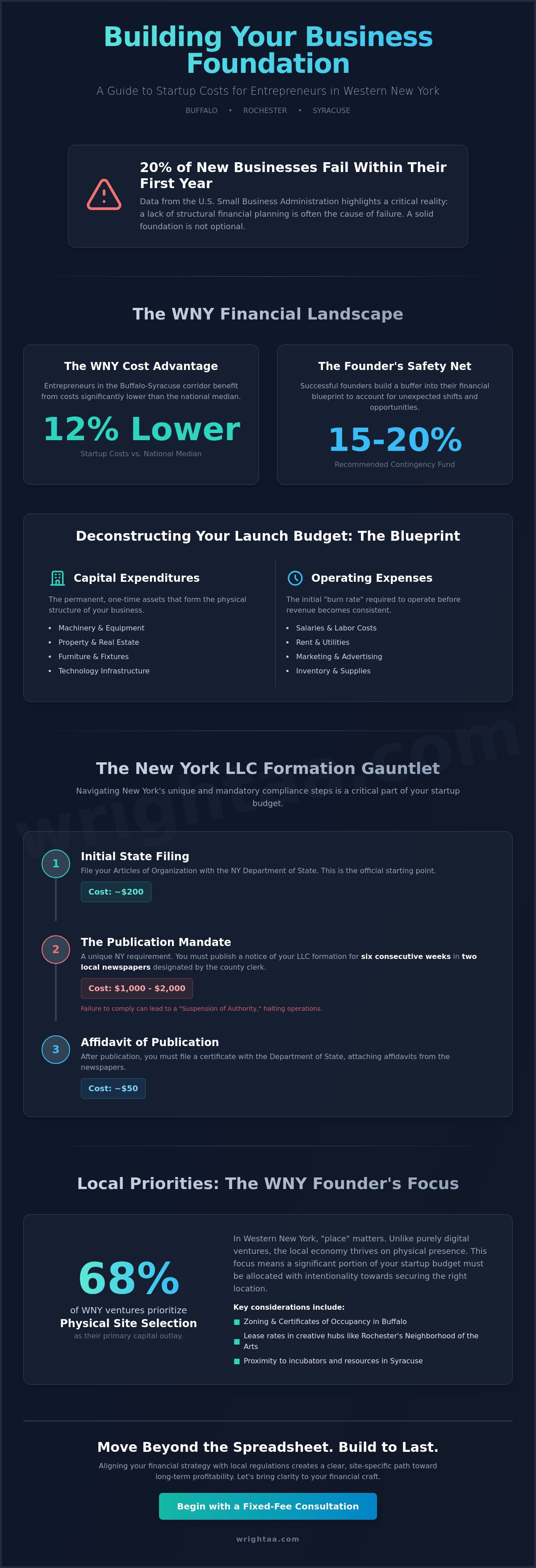
The integrity of a building depends on the soil beneath it. In the same way, the viability of a new venture rests on the tectonic details of its financial foundation. Many founders treat capital as an abstract concept, but the actual startup costs western new york business owners encounter are rigorous and site-specific. Data from the U.S. Small Business Administration indicates that 20% of new businesses fail within their first year, often due to a lack of structural financial planning. Section 206 of the New York Limited Liability Company Law adds to this complexity, mandating a six-week publication requirement in two local newspapers before a business is fully recognized.
You understand that a sustainable business requires a balance between intentional design and fiscal discipline. We'll guide you through a sophisticated framework for calculating and optimizing the materiality of your launch budget in Buffalo, Rochester, and Syracuse. This exploration covers the hidden fees of New York entity formation and the specific tax implications of your chosen region. By aligning your financial strategy with local regulations, you create a clear, site-specific path toward long-term profitability. This process is about elevating the human experience through a business that's built to last.
Key Takeaways
- Distinguish between capital assets and operating burn rates to establish a foundation that respects the materiality of your initial investment.
- Navigate the site-specific regulatory hurdles and publication mandates that define the baseline for startup costs western new york.
- Anticipate the dialogue between evolving labor costs and seasonal utility shifts to ensure your operational rhythm remains steady through the winter.
- Select an entity structure that aligns with your long-term vision, ensuring your tax strategy is designed for both durability and spatial growth.
- Move beyond the spreadsheet with fixed-fee advisory services that prioritize the human experience and bring clarity to your financial craft.
The Materiality of Launch: Defining Startup Costs in WNY
Every enduring structure begins with a quiet, intentional preparation of the ground. In business, startup costs represent this essential foundation; they're the capital required to stabilize the site before a single dollar of revenue flows inward. For founders in the Buffalo-Syracuse corridor, calculating these expenses requires a site-specific dialogue. National averages often fail to capture the unique economic vernacular of the region. The startup costs western new york entrepreneurs face are often 12% lower than the national median, yet they require precise calibration to avoid structural failure.
Startup costs are the tectonic plates of a business structure. They provide the underlying stability upon which every subsequent floor is built. Distinguishing between capital expenditures, the permanent assets like machinery or property, and operating expenses, the initial burn rate, is vital. While understanding startup fundamentals is a necessary first step, local nuances dictate the final budget. A digital venture in a Syracuse incubator faces a vastly different financial profile than a brick-and-mortar storefront in Buffalo’s Elmwood Village.
Fixed vs. Variable Materiality
Fixed costs are the rigid elements of the blueprint. In Rochester’s Neighborhood of the Arts, lease rates for creative spaces provide a predictable, if substantial, baseline. By contrast, variable costs for 2026, such as marketing reach and inventory procurement, shift with the market's breath. Professional fees for legal and accounting services often fluctuate based on the complexity of the craft. Successful founders include a contingency layer of at least 15% to 20% in their financial blueprint. This buffer accounts for the unexpected shifts that occur during the assembly of a new enterprise.
The Intentionality of Pre-Launch Planning
A building reflects the research conducted before the first stone is laid. In Buffalo’s revitalized districts, like the Larkin District or Canalside, market research informs the scale of the startup costs western new york founders must anticipate. According to 2023 regional economic reports, 68% of local ventures prioritize physical site selection as their primary capital outlay. This intentionality ensures that the budget isn't just a list of numbers, but a reflection of the local landscape. Clear financial documentation serves a dual purpose. It provides internal guidance and acts as a signal of discipline when seeking local WNY startup funding. Investors look for a rigorous commitment to detail, seeing the budget as proof of the founder's respect for the materiality of growth.
Site-Specific Regulatory Costs: Navigating NY Compliance
Every structure begins with a foundation, and for a business in New York, that foundation is defined by the Department of State. The initial $200 filing fee is a modest entry point, yet it's only the first layer of the administrative materiality that defines your venture. Understanding New York State business requirements is essential for ensuring your project rests on stable ground. These startup costs western new york entrepreneurs face are often influenced by the specific geography of their chosen county, requiring a disciplined approach to budgeting.
The LLC Publication Hurdle
New York maintains a unique, traditional requirement for LLCs that feels like a holdover from a different era. You must publish a notice of your business formation in two local newspapers for six consecutive weeks. In Erie or Monroe County, this ritual typically costs between $1,000 and $2,000. It's a mandatory investment in public transparency. If you neglect this step, the state may issue a "suspension of authority," effectively halting your operations. This process requires patience, much like waiting for concrete to cure before adding a second story. You'll need to file an Affidavit of Publication, which adds another $50 to your administrative tally.
Local Permits and the Vernacular of Compliance
The regulatory landscape changes as you move across the Thruway. Each city possesses its own vernacular of compliance, dictating how a business interacts with its neighborhood. In Buffalo, the focus often settles on zoning and the Certificate of Occupancy, ensuring the physical site aligns with its intended use. Rochester requires specific business permits for storefronts and signage to maintain the aesthetic integrity of its commercial corridors. Syracuse introduces health department fees for wellness or food-service ventures, which can add several hundred dollars to your initial budget.
- Buffalo: Zoning compliance and Certificate of Occupancy fees vary by square footage.
- Rochester: Specific signage permits ensure your brand integrates with the streetscape.
- Syracuse: Health department fees for food-service startups typically range from $150 to $400 annually.
- Onondaga County: Professional licensing for tech and law firms requires specific local filings.
Whether you're launching a tech startup in Syracuse or a law firm in Buffalo, professional licensing fees represent a commitment to the craft of your industry. These costs are part of the broader startup costs western new york landscape that requires careful mapping. Designing a space that honors these regulations while reflecting your vision is a delicate balance. A thoughtful approach to designing your physical space can help align your site-specific needs with these legal constraints, creating a sense of purpose from the first day of operation.
The Craft of Capital: Labor, Utilities, and WNY Operations
Building a firm is a tectonic act. It requires a precise alignment of resources and a deep understanding of the local landscape. In the region, the financial framework of a new venture rests on the integration of human talent and the physical realities of the climate. Founders must look beyond the surface of startup costs western new york to understand the deeper layers of operational materiality. Every dollar spent is a choice that shapes the permanence and purpose of the organization.
Labor and Human Integration
By 2026, the New York State minimum wage will reach $16.50 per hour. This figure represents the baseline of a larger dialogue between employer and employee. The true cost of an employee extends beyond the hourly rate. It's necessary to account for New York payroll taxes, which typically add 10% to 12% to the base salary. Utilizing professional payroll services is a disciplined way to maintain compliance with evolving state labor laws. Cities like Syracuse and Rochester are becoming hubs for competitive talent; they offer a sophisticated workforce that seeks a balance between professional rigor and the quiet quality of life found in the region.
Founders should budget for the following human capital requirements:
- Workers Compensation: Mandated for all employees to protect against workplace injury.
- Disability and Paid Family Leave: Required coverage that supports the human experience of the team.
- General Liability: A foundational layer of protection for the firm's physical and digital assets.
Operational Vernacular: Utilities and Logistics
The environment dictates the budget. A Buffalo winter is a physical force that shapes the operational vernacular of any firm. Heating costs through National Grid or RG&E can spike by 30% or more during the coldest months. This "materiality of climate" requires intentional budgeting for insulation and energy efficiency within a workspace. Supply chains for manufacturing or retail must remain resilient against lake-effect weather patterns that occasionally disrupt regional transit. Reflecting the broader economic environment, the cost-of-living index for New York is projected to reach 139.1 in 2026. This metric underscores the necessity of a patient, methodical approach to capital allocation.
Digital infrastructure serves as the invisible scaffolding of a modern firm. Investing in spatial software and cloud-based technology allows for seamless collaboration across different sites. These tools represent the digital materiality of the 21st-century studio, ensuring that the firm's output remains precise and visionary. When calculating startup costs western new york, the intersection of traditional utility needs and modern technology creates a comprehensive picture of what it takes to sustain a thoughtful business in this specific geographic context.
Designing for Longevity: Entity Selection and Tax Strategy
The structure of a business is its first permanent gesture. Much like selecting a site for a new build, the choice of a legal entity determines how a venture interacts with its environment. In the context of startup costs western new york, this decision dictates your tax materiality for the duration of the firm's life. It's a choice between the fluid simplicity of an LLC and the disciplined framework of an S-Corp.
The S-Corp vs. LLC Dialogue
An LLC offers a clean slate; it's the vernacular architecture of the modern business world. Initial filing fees in New York are relatively modest at $200 for the Articles of Organization. However, the publication requirements in counties like Erie or Monroe often add $600 to $1,000 to the initial capital outlay. Choosing an S-Corp election introduces higher upfront administrative craft. It requires payroll systems and stricter record-keeping. Despite these costs, the structure yields long-term self-employment tax savings that an LLC cannot match.
Many Buffalo founders transition their structure as they scale. They move from a flexible LLC to a more rigid S-Corp to optimize their fiscal site. This evolution follows the Business Entity Selection in New York framework. It ensures the structure supports the weight of future growth. From a CFO's perspective, this selection isn't just about taxes. It's about investment readiness and the spatial organization of equity.
Deducting the Foundation
Financial rigor begins before the first dollar of revenue. IRS Section 195 allows entrepreneurs to deduct up to $5,000 in startup costs in the first year of operation. This deduction is available as long as total costs remain under $50,000. These are the investigatory costs. They represent the research and site visits required to validate a vision. Organizational costs, such as legal fees for drafting an operating agreement, fall into a distinct category but follow similar rules for amortization.
Using a Starting a Business in Buffalo, NY Checklist helps founders categorize these expenses with precision. This proactive planning turns heavy startup costs western new york into immediate deductions. It preserves capital for the craft of building the actual business. Consider these primary categories for deduction:
- Investigatory Costs: Market analysis, site surveys, and travel to potential business locations.
- Organizational Costs: Legal fees for incorporation and state filing fees.
- Pre-opening Expenses: Employee training and initial advertisements.
The goal is to align your tax strategy with your physical growth. A well-designed financial foundation allows for a more poetic expression of the business itself. Build your vision on a foundation of intentional financial design.
Elevating the Human Experience: Building with Wright CPAs
Building a business is an act of creation. It requires the same intentionality as designing a physical space. While the initial startup costs western new york entrepreneurs face often focus on the immediate materiality of inventory or leases, the long-term structure requires a deeper foundation. We move beyond the cold rows of a spreadsheet. Our partnership is a holistic dialogue between your vision and the economic realities of the Buffalo, Rochester, and Syracuse markets. We provide CFO-level guidance that treats your financial health as a tectonic element of your success. This isn't just about compliance; it's about the craft of sustainable growth.
The regional landscape is shifting. Entrepreneurs in 2024 are finding that traditional accounting models don't serve the pace of modern innovation. You need a financial architect who understands the specific vernacular of the Western New York economy. We help you look past the immediate expenses to see the spatial relationship between your capital and your goals. By integrating sophisticated tax strategy with operational oversight, we ensure your business has the breathing room it needs to thrive.
Fixed-Fee Monthly Advisory
Hourly billing is the clutter of the accounting world. It creates an unnecessary barrier between the founder and the advisor; it often discourages the very questions that prevent structural failure. We believe in predictable costs that mirror the stability of a well-built structure. Our fixed-fee model ensures year-round oversight rather than a single, stressful tax season. This approach allows for Small Business Accounting in Buffalo, NY to be a source of clarity rather than a recurring variable. You gain a steady rhythm of financial insight that aligns with your operational pulse. This predictability is vital when managing startup costs western new york, as it removes the anxiety of the "billable hour" from your decision-making process.
- Elimination of surprise invoices to protect your cash flow.
- Continuous monitoring of financial health to catch issues before they escalate.
- A collaborative environment where communication is encouraged, not penalized.
Your Site-Specific Consult
The transition from a visionary maker to a disciplined owner is a subtle shift in perspective. It requires a site-specific strategy that accounts for the unique tax landscape of our region. Our proactive approach focuses on the integration of your personal goals with your business's fiscal architecture. We help you design a 2026 financial roadmap that is both resilient and ambitious. We analyze the light and shadow of your balance sheet to find hidden efficiencies. It's time to move past the noise and focus on the craft of ownership. Schedule your intentional financial consult to begin the process of building with precision. Your legacy deserves a foundation that is as enduring as the materials you use to build it.
The Architecture of Financial Resilience
Navigating the complex landscape of startup costs western new york requires more than a simple spreadsheet. It demands an appreciation for the materiality of your business foundation. Successful ventures in the Buffalo region must balance the weight of New York State regulatory compliance with the precise craft of operational efficiency. By aligning your entity selection with long-term tax strategies guided by the 2024 New York tax code, you create a structure that isn't just functional but built for longevity. This intentional approach ensures your business remains rooted in its specific geographic context while reaching for future growth.
A business is a living dialogue between its vision and its environment. We provide the tectonic support needed to transform these financial elements into a cohesive whole. Our team offers proactive CFO-level guidance for Buffalo entrepreneurs, utilizing a modern technology stack to ensure absolute financial clarity at every stage. Through our fixed-fee monthly advisory, your budgeting remains predictable and steady, allowing you to focus on the human experience of your work. Every great structure starts with a single, thoughtful line.
Elevate your business with Wright CPAs; schedule a consult to begin building with intention. Your vision deserves a foundation that's as enduring as the city itself.
Frequently Asked Questions
How much does it cost to register an LLC in New York State in 2026?
Filing Articles of Organization for a New York LLC in 2026 requires a $200 state fee. This initial investment establishes the legal foundation of your venture. Much like selecting a site for its structural integrity, this filing creates the framework where your vision resides. You'll submit this payment to the New York Department of State to secure your entity's standing and define your business materiality.
What is the LLC publication requirement in Erie County, and how much does it cost?
The LLC publication requirement in Erie County costs between $150 and $350 depending on the specific newspapers designated by the county clerk. New York State Law Section 206 mandates that you publish a notice of formation for six consecutive weeks. This process ensures your presence is recorded within the local vernacular; it anchors your business to the cultural and geographic context of Western New York.
Do I need a lawyer and a CPA to start a business in Buffalo?
You aren't legally required to hire a lawyer or CPA to start a business in Buffalo, though professional guidance ensures your structural integrity. Think of these advisors as master craftsmen who refine your business blueprint. A CPA manages the complex materiality of tax compliance, while a lawyer drafts the spatial boundaries of your contracts. Investing in their expertise early prevents costly structural failures as you scale.
How much should I budget for business insurance in Western New York?
Budget approximately $500 to $1,200 annually for general liability insurance when calculating startup costs western new york. This coverage acts as a protective envelope for your enterprise, much like a building's facade shields its interior. Costs fluctuate based on your industry and physical footprint. Securing this policy early provides the quiet confidence needed to focus on the craft of your daily operations and long term growth.
Can I deduct my startup costs on my first tax return?
You can deduct up to $5,000 in startup costs on your first tax return, provided your total investment stays below $50,000. IRS Section 195 allows this immediate recovery of initial capital. Any costs exceeding this threshold must be amortized over 180 months. This financial integration helps balance the early weight of your investment with long term fiscal health; it's a vital part of your structural planning.
Is it cheaper to start a business in Syracuse vs. Rochester?
Syracuse is generally 3% more affordable than Rochester when comparing the overall cost of living and commercial rent. While both cities share a similar industrial heritage, Syracuse offers a slightly lower barrier to entry for spatial acquisition. Choosing between these locations requires a dialogue between your budget and the specific site context of your target market. Each city possesses a unique regional rhythm and economic vernacular.
What is the 2026 minimum wage for small businesses in Buffalo, NY?
The minimum wage for small businesses in Buffalo will reach $16.00 per hour on January 1, 2026. This scheduled increase reflects New York’s commitment to elevating the human experience within the local workforce. When you plan your labor startup costs western new york, integrate this rate into your financial model to ensure your business remains grounded in ethical and legal realities as you expand your team.
What are the hidden costs of hiring my first employee in New York?
Hidden costs of hiring include an additional 11% to 15% on top of the base salary for payroll taxes and mandatory insurance. You'll pay 7.65% for FICA taxes and varying rates for New York State unemployment insurance. Workers' compensation and disability insurance add further layers of expense. These elements are essential components of the human infrastructure required to sustain a growing professional practice and ensure operational stability.


