

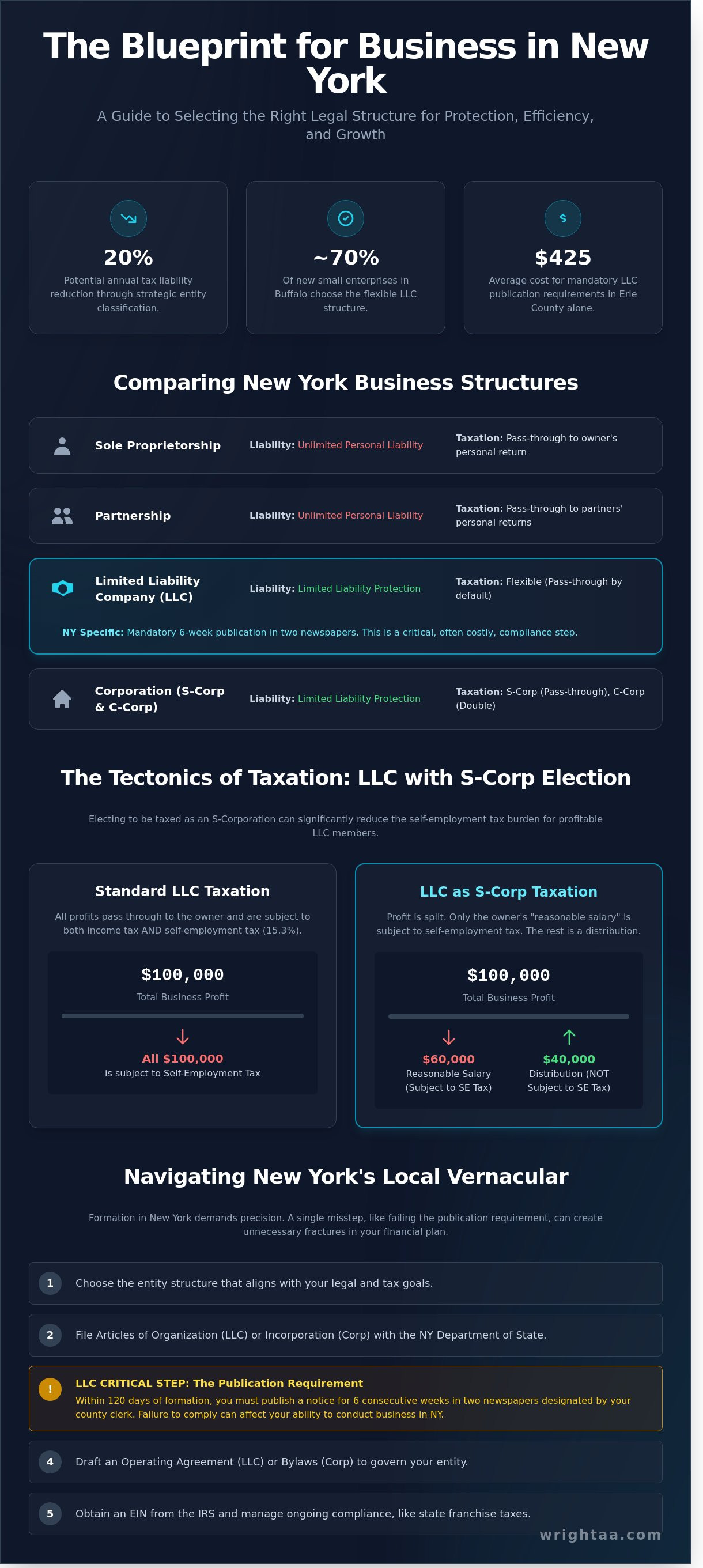
The most enduring material in your enterprise is not the glass of a Syracuse high-rise or the timber of a Rochester studio. It is the invisible architecture of your legal structure. Mastering business entity selection New York requires a craftsman’s precision to ensure your foundation is both resilient and compliant with local vernacular. A single misstep in Erie County, where mandatory publication requirements can cost an average of $425 in legal notices, creates an unnecessary fracture in your early financial plan.
You likely feel the quiet anxiety of personal liability or the frustration of navigating New York’s specific filing fees. It is a common burden for the thoughtful entrepreneur. This guide will show you how to choose a structure that shields your personal assets and optimizes your tax strategy, potentially reducing your annual tax liabilities by 20 percent through strategic classification. We provide a clear, disciplined framework for building a secure business presence across Buffalo, Rochester, and Syracuse while ensuring every regulatory detail is handled with intentionality.
Key Takeaways
- Understand how the spatial planning of your business structure creates a vital dialogue between legal protection and long-term tax efficiency.
- Analyze the unique materiality of various structures to master the business entity selection New York requires for a site-specific and secure foundation.
- Explore the tectonic advantages of S-Corporation elections to refine your fiscal craft and reduce the burden of self-employment taxes.
- Navigate the specific publication requirements and regional fees that define the local entrepreneurial vernacular in Buffalo, Rochester, and Syracuse.
- Discover how a deliberate, unhurried approach to entity consulting can elevate your business from a technical exercise to a poetic success.
The Architecture of Enterprise: Why Entity Selection Matters in New York
Building a company is a tactile act. Like the first line drawn on a site plan, business entity selection New York represents the spatial planning of your future. It defines how your venture sits within the landscape of the market. For the thoughtful maker in Buffalo or Rochester, this choice isn't a mere formality. It's the craft of balancing legal protection with tax efficiency. A fragile foundation leads to structural fractures as you scale. You must consider how the light of opportunity hits your structure today and how it will shift in a decade.
Choosing between various business structures in the U.S. requires a deep understanding of materiality. You're not just picking a label; you're designing the flow of capital and the mitigation of risk. In 2023, the New York Department of State recorded over 200,000 new business applications. Each represents a unique dialogue between an entrepreneur's vision and the state's rigorous tectonic requirements. A disciplined approach to business entity selection New York ensures that the integration of personal values and corporate governance remains seamless.
The Human Experience of Business Ownership
Structure brings clarity. When your entity aligns with the vernacular of your industry, it creates a sense of professional peace. This intentionality at the start ensures that your daily work remains focused on your craft rather than administrative friction. In cities like Syracuse, where the industrial legacy meets modern innovation, a site-specific entity choice provides the breathing room needed for long-term growth. It's about the relationship between your private ambition and public responsibility. If you don't build with intent, the structure eventually dictates your movements.
New York State's Unique Regulatory Landscape
The NYS Department of State oversees a complex regulatory environment that demands precision. New York is often cited as a challenging jurisdiction for entity maintenance because of specific publication requirements and franchise tax nuances. For instance, Section 206 of the Limited Liability Company Law requires a six-week publication process in two specific newspapers within the county of formation. Navigating these rules requires local Western New York expertise. Integrating these legal mandates into your initial design ensures your enterprise remains grounded and compliant from day one. It's a methodical process that rewards the patient intellectual.
Surveying the Landscape: A Comparison of New York Business Structures
The choice of a legal structure is the first act of construction in any venture. Business entity selection New York requires a deep understanding of materiality. You aren't just filing paperwork; you're choosing the stone and timber of your financial house. Sole proprietorships offer the raw simplicity of a single material, yet they lack the tectonic strength to shield personal assets from professional storms. Partnerships create a shared vernacular, but they require a rigorous draft of the operating agreement to ensure the craft remains intact as the business matures.
This decision is inherently site-specific. A law firm in Rochester demands a different structural integrity than a retail boutique in Buffalo. The professional services firm might lean toward a Limited Liability Partnership to balance collective expertise with individual protection. Meanwhile, the shop owner seeks a form that allows for fluid movement between personal and business growth. Every line in your founding documents should reflect this intentionality.
The Limited Liability Company (LLC): Flexibility and Form
In Buffalo, the LLC has become the preferred form for approximately 70 percent of new small enterprises. It offers a minimalist appeal that resonates with the city's industrious spirit. The pass-through nature of the LLC creates a quiet dialogue between the entity and the owner's personal tax obligations, preventing the double taxation that can weigh down a young project. This structure provides a tectonic shift in protection, separating personal holdings from business liabilities through a clean, legal boundary.
The Corporation: Structure and Scale
Corporations in Syracuse often emerge when the need for scale outweighs the desire for simplicity. The C-Corp serves as a visionary tool for those seeking venture capital or public offerings. In 2023, the New York State Department of State recorded a steady rise in corporate filings, reflecting a commitment to institutional growth and rigid governance. This structure builds investor trust through a clear hierarchy of directors and officers. It's a disciplined form that allows a business to outlive its founders, creating a permanent legacy in the local landscape.
Drafting bylaws and operating agreements is an exercise in craft. These documents are the blueprints that dictate how light and authority move through the organization. If you're ready to build with intention, exploring refined spatial strategies can help align your physical environment with your new legal foundation.
The Tectonics of Taxation: Evaluating LLCs and S-Corporations for WNY Owners
The financial architecture of a firm is as vital as its physical foundation. In Western New York, the process of business entity selection New York requires a deep understanding of how pass-through entities interact with the state's rigorous tax code. Many founders operate under the misconception that an LLC is a fixed tax category. It's more accurate to view the LLC as a versatile vessel; its tax treatment is a choice rather than a mandate. By default, a single-member LLC is a disregarded entity, meaning profits flow directly to your personal Buffalo or Rochester tax return. This integration simplifies the reporting process but often exposes the entirety of your hard-earned income to self-employment taxes.
Thoughtful entrepreneurs recognize that choosing your corporate structure involves balancing immediate simplicity with long-term fiscal durability. While the LLC offers a clean, minimalist legal shell, the underlying tax mechanics can be refined to better serve the business's growth. In cities like Syracuse and Buffalo, where the cost of living allows for strategic reinvestment, the way you categorize your income determines the pace at which you can scale your craft.
The S-Corp Election: A Strategic Intervention
The S-Corporation status acts as a refined intellectual layer atop the standard LLC structure. It allows owners to distinguish between their roles as an employee and an investor. By paying yourself a "reasonable" salary, you only pay FICA taxes on that specific portion of income, while the remaining profit distributions remain exempt from self-employment tax. Most Western New York firms find the break-even point for this election between $60,000 and $75,000 in net profit, as the tax savings must outweigh the added administrative costs of payroll and separate corporate filings. For a business generating $100,000 in annual profit, an S-Corp election that allocates a $50,000 salary can save the owner approximately $7,650 in self-employment taxes each year.
New York State Tax Nuances
Precision in business entity selection New York also demands an awareness of regional levies. Unlike New York City, which imposes a General Corporation Tax and an Unincorporated Business Tax, Buffalo and Rochester offer a more streamlined environment. WNY owners are notably exempt from the Metropolitan Commuter Transportation District (MCTD) tax, a burden that affects businesses in the downstate region. However, New York State still requires an annual LLC filing fee based on gross income. This fee ranges from $25 for entities with minimal revenue to $4,500 for those exceeding $25 million in New York receipts. Understanding these site-specific costs ensures that your business structure remains in harmony with its geographic context.
Navigating the Local Vernacular: Publication Requirements and Fees in Buffalo and Syracuse
Establishing a firm in New York involves a unique ritual known as the publication requirement. This mandate is a vestige of transparency, requiring new LLCs to announce their existence to the local community through print. For those navigating business entity selection New York, this step is more than a legal formality; it's an act of public record that anchors the business to its specific geography. The process demands patience and precision, mirroring the deliberate nature of high-quality craft.
The state requires notice in two newspapers for six consecutive weeks. In Erie County, the Clerk designates these publications. The rhythm is steady: one daily and one weekly paper must carry the notice. Once the six-week cycle concludes, the newspapers provide affidavits of publication. You must then file these with the Department of State alongside a $50 filing fee to receive your Certificate of Publication. Choosing the right publications is a matter of following the Clerk's specific list, ensuring the legal materiality of your entity is beyond reproach.
The Cost of Formation in Western New York
In 2026, the state filing fee for an LLC remains $200, while a business corporation is $125. However, the true financial weight lies in the publication costs. In Buffalo and the surrounding Erie County, business owners should allocate between $450 and $600 for these notices. In Rochester and Monroe County, the cost is often lower, typically ranging from $250 to $400. An assumed name or DBA adds a $25 fee in Erie County, acting as a vital layer for brand dialogue. Maintenance is equally precise; biennial statements cost $9 every two years, a small but necessary pulse in your compliance lifecycle.
Local Professional Integration
A Buffalo-based registered agent provides site-specific support that distant national services cannot replicate. They understand the local tectonic shifts in regulations and provide a physical presence within the community. Similarly, a WNY CPA ensures the rhythm of your compliance calendar remains uninterrupted, allowing you to focus on the human experience of your work. This local expertise transforms a technical exercise into a sustainable foundation for growth. You can explore the benefits of fixed-fee accounting for Buffalo businesses to bring clarity and intention to your operational costs.
Build your foundation on solid ground. Contact Wright Architecture to align your business structure with your visionary goals.
Cultivating Clarity: How Wright CPAs Guides Your New York Formation
Structure dictates the flow of capital. At Wright CPAs, we view business entity selection New York as a craft rather than a clerical task. We act as the thoughtful maker of your financial framework, ensuring the tectonic plates of tax law and liability protection align with your long-term vision. Our role is to elevate the human experience of business ownership by removing the friction inherent in IRS and NYS filings. We replace administrative noise with a serene, curated process that prioritizes your peace of mind.
Our approach is steady and unhurried. We believe a permanent financial foundation requires a deliberate dialogue between the owner and the advisor. We don't rush into filings. Instead, we listen to the specific vernacular of your industry, whether you're launching a tech startup in Rochester or a design firm in Syracuse. This methodical integration ensures your entity choice isn't just a legal requirement but a strategic asset that breathes with your business.
Our Fixed-Fee Formation Consulting
A business formation project with us is a comprehensive site-specific analysis. We evaluate how different structures impact your 2024 cash flow, specifically looking at the 15.3% self-employment tax savings available through S-Corp elections. Our fixed-fee model removes the anxiety of hourly billing, creating space for a thorough examination of your financial materiality. We integrate your entity choice with long-term cash flow management, ensuring your structure supports growth without becoming a burden. This methodical partnership provides a sense of calm as you move from concept to operation.
Next Steps in Your Evolution
Your journey toward a more intentional business structure begins with a focused consultation at our Buffalo office. To prepare your site for formation, bring your 2023 personal tax returns and any existing draft of your operating agreement. We'll examine these documents to ensure your new entity integrates seamlessly with your personal financial landscape. This dialogue is the first step in building a business that's both visionary and grounded. Begin your business formation with a strategic consultation to establish a foundation that endures.
Grounding Your Vision in Permanent Structure
The architecture of your enterprise begins with a single, foundational choice. Since 2012, Wright CPAs has worked alongside Western New York entrepreneurs to ensure this first step is both intentional and precise. We've found that business entity selection New York serves as the tectonic plate upon which your entire financial future rests. Whether you're navigating the specific publication requirements of Syracuse or evaluating the tax efficiencies of an S-Corporation in Buffalo, the structure must suit the site. Our team specializes in the nuanced accounting needs of law firms and small businesses, treating every financial framework as a unique piece of craft.
We believe in clarity over complexity. Our fixed-fee advisory models provide a predictable landscape, removing the friction of hourly billing so you can focus on growth. This disciplined approach integrates your long-term goals with the immediate realities of the New York regulatory environment. By prioritizing substance and site-specific strategy, we help you build something that doesn't just function, but flourishes. You deserve a partner who listens to the rhythm of your business before placing a single line on the ledger.
Schedule a thoughtful consultation for your New York business formation
Your legacy deserves a foundation as enduring as the Western New York landscape itself.
Frequently Asked Questions
What is the most common business entity for startups in Buffalo, NY?
The Limited Liability Company (LLC) remains the most frequent choice for entrepreneurs in the Buffalo-Niagara region. Data from the New York Department of State indicates that over 70% of new small businesses select this structure for its inherent flexibility. It provides a protective shell for personal assets while allowing for a simplified management style. This choice reflects a commitment to a durable foundation as the city's economic landscape evolves into a new era of craft and commerce.
How much does it cost to publish an LLC notice in Erie County?
Publishing an LLC notice in Erie County typically costs between $150 and $250. New York Section 206 requires two specific newspapers to run the notice for six consecutive weeks. In Buffalo, these costs are often lower than in Manhattan, where fees can exceed $1,000. You must also pay a $50 filing fee to the Department of State once the affidavits of publication are submitted to complete the legal dialogue.
Can I change my business entity from an LLC to an S-Corp later?
You can transition an LLC to an S-Corp by filing IRS Form 2553. This is a tax designation rather than a change in the physical structure of the company. It allows your business to avoid double taxation on dividends. Most firms make this shift once their annual profit reaches $50,000 or more to maximize self-employment tax savings. This process ensures your business entity selection New York remains aligned with your long-term spatial and financial growth.
Do I need a lawyer or a CPA to form a business in New York?
New York law doesn't mandate the hiring of a lawyer or CPA to form a business. You can file the Articles of Organization independently through the Department of State website for a $200 fee. However, 85% of sustainable businesses consult professionals to ensure their operating agreements are site-specific and robust. Professional guidance helps navigate the nuances of the state's complex regulatory environment while elevating the human experience of business ownership.
What is the New York LLC annual filing fee for 2026?
The New York LLC annual filing fee for 2026 is based on the entity's gross income from the previous year. Fees range from $25 for businesses earning under $100,000 to $4,500 for those exceeding $25 million. This fee is due by the 15th day of the third month following the close of the tax year. It's a recurring cost that ensures your entity remains in good standing with the state's tectonic requirements.
Is a New York S-Corp exempt from state-level taxes?
New York S-Corps aren't entirely exempt from state-level taxes. While they don't pay the standard corporate franchise tax, they must pay a fixed dollar minimum tax. For 2024 and 2025, this amount ranges from $25 to $200,000 based on New York receipts. This ensures that every entity contributes to the state's infrastructure. Proper business entity selection New York requires balancing these recurring costs against the potential for long-term tax benefits.
How long does the business entity selection process take in NY?
The business entity selection and formation process typically takes 7 to 10 business days. If you choose expedited processing, the New York Department of State can complete the filing within 24 hours for an extra $25 fee. This timeline doesn't include the six weeks required for the publication mandate. Planning for a 60-day window ensures all legal requirements are met before your grand opening, creating space for a thoughtful launch.
What happens if I don't complete the New York publication requirement?
Failure to complete the publication requirement results in the suspension of your company's authority to carry on business. Under Section 206 of the Limited Liability Company Law, this suspension happens 120 days after formation. While your contracts remain valid, you lose the legal standing to sue in New York courts. It's a critical detail that maintains the integrity of your professional craft and ensures the legal materiality of your business remains intact.


