

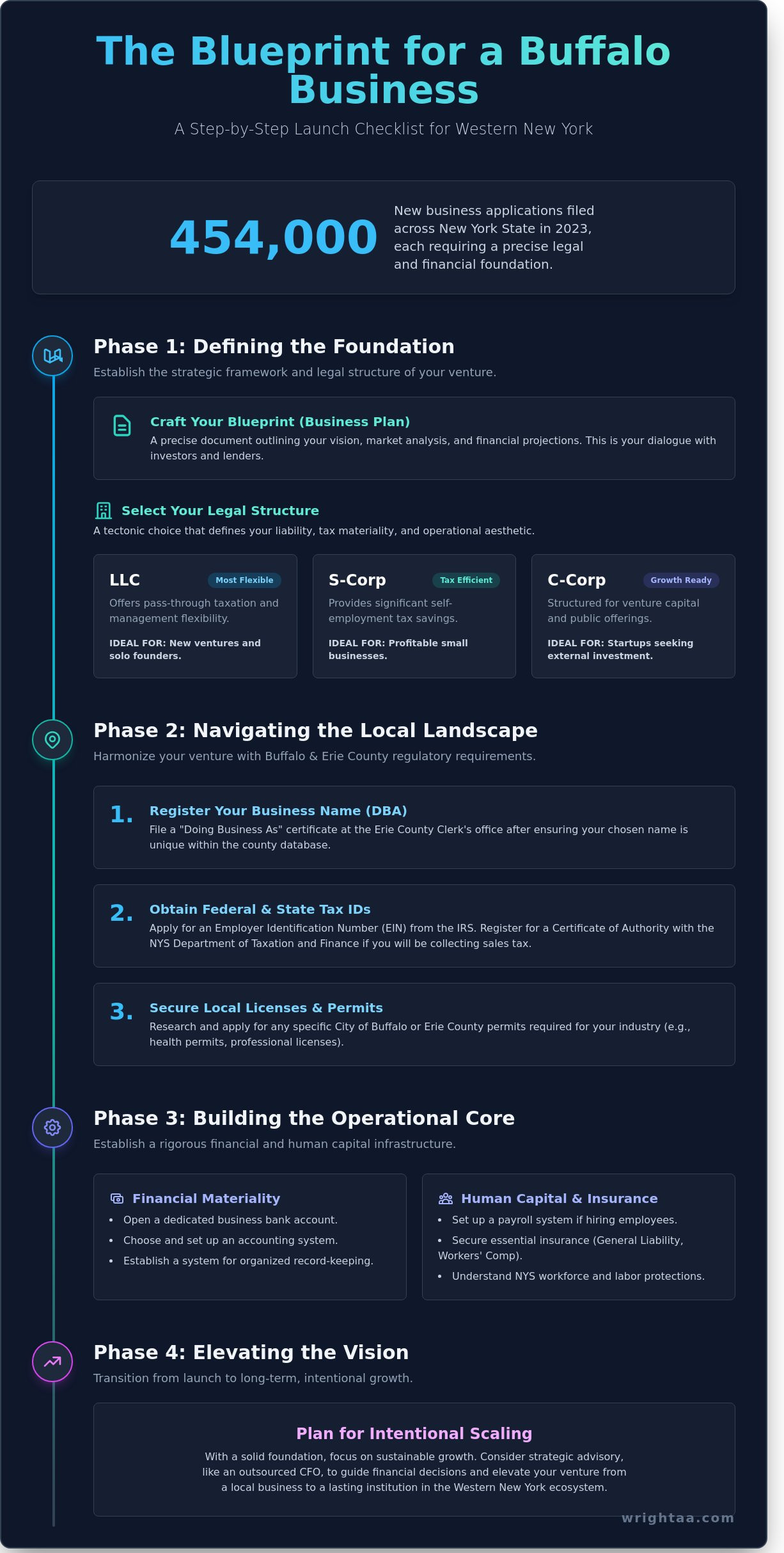
A business is a permanent intervention in the landscape of a city, much like the stone and steel that define our skyline. You understand that a structure is only as resilient as its foundation, yet the density of New York State regulatory codes often feels like a barrier to entry. In 2023, the U.S. Census Bureau recorded 454,000 new business applications across the state, each requiring a precise alignment of legal and financial tectonic plates. To ensure your vision takes root, you need a site-specific new business checklist Buffalo NY that honors both local vernacular and state mandates.
It's true that the dialogue between city, county, and state requirements can become a source of friction for even the most disciplined founder. We promise a sophisticated roadmap that moves beyond basic compliance toward true tax efficiency and spatial integration. This guide provides a step-by-step blueprint for designing a venture that thrives within the Western New York ecosystem. We will walk through the essential layers of entity selection, licensing, and the specific city requirements that transform a concept into a lasting institution.
Key Takeaways
- Identify the strategic blueprints and tectonic entity choices that define your business’s long-term liability and tax materiality.
- Navigate local regulatory requirements with a comprehensive new business checklist Buffalo NY designed to harmonize your venture with regional governance.
- Establish a rigorous financial infrastructure to prevent disorganized records and ensure your tax system is built on a stable foundation.
- Master the craft of operations by integrating local workforce protections and essential insurance into your organizational design.
- Learn how to elevate your vision through intentional scaling and the strategic guidance of an outsourced CFO.
Defining the Foundation: Strategic Planning and Entity Selection in Buffalo
Every enduring structure begins with a blueprint. In the world of commerce, your business plan serves as this foundational document. It's an intentional act of creation that honors the specific materiality of the local market. When you begin your journey, the most critical item on any new business checklist Buffalo NY entrepreneurs encounter is the alignment of vision with local reality. This process isn't merely administrative; it's a tectonic choice that dictates your liability and tax materiality for years to come.
The dialogue between your personal goals and the structural requirements of New York State law must be clear. Your choice of place matters deeply. Whether you're establishing roots in Buffalo, Rochester, or Syracuse, the geographic context influences your initial regulatory path. Understanding the Buffalo, NY Economic Overview reveals a landscape shaped by a $54 billion regional GDP and a diverse workforce. This economic environment demands a strategy that is both site-specific and resilient.
The Business Plan as a Blueprint
A successful plan requires surgical precision. It should capture your vision while grounding it in market analysis and financial projections. You're not just writing for yourself; you're facilitating a dialogue with potential investors and local lenders who value the architectural integrity of a well-conceived venture. Identify site-specific opportunities within the Western New York economy, such as the growing healthcare sector or the revitalized manufacturing corridor. Use this document to articulate how your business will elevate the human experience within the local community.
Selecting Your Legal Structure
Choosing a legal entity is a study in form and function. You must examine the nuances of LLCs, S-Corps, and C-Corps through the lens of New York tax implications. Each structure offers a different aesthetic of risk and reward. For a deeper structural analysis, reference our guide on business entity selection New York. The right choice creates a serene path to asset protection and long-term tax efficiency.
- LLCs: These offer flexibility in management and pass-through taxation, making them a common choice for new ventures.
- S-Corps: This structure can provide significant self-employment tax savings for profitable businesses.
- C-Corps: These are ideal for those seeking venture capital or planning for a future public offering.
Your new business checklist Buffalo NY must prioritize this selection. It's the framework upon which everything else is built. By selecting a structure that reflects your operational philosophy, you ensure that the business remains grounded and purposeful as it grows.
Navigating the Local Landscape: Buffalo and Erie County Regulatory Requirements
Compliance is the craft of ensuring your business is harmoniously integrated with local governance. It's the structural framework that allows your vision to exist within the public sphere. Much like the site-specific nature of a building, your venture must respect the legal topography of Western New York. Registering your business name is the first public declaration of your venture’s identity; it's the moment your concept gains a tectonic presence in the community.
This phase of development requires a methodical approach to the new business checklist Buffalo NY. You're not just filling out forms; you're establishing the legitimacy of your professional craft. For those seeking broader guidance on regional growth, the SBA Buffalo District provides resources that bridge the gap between federal support and local implementation. This ensures your financial and long-term growth strategies are built on solid ground.
Erie County Clerk Filings and DBAs
The identity of your business begins at the Erie County Clerk’s office. This process is the administrative equivalent of laying a foundation. First, conduct a thorough search of the Erie County Clerk database. You must ensure your chosen name is unique and doesn't infringe on existing entities. Second, file a Business Certificate, often called a DBA, if you're operating as a sole proprietorship or general partnership. Finally, secure at least three certified copies of your filing. You'll need these for bank account initialization and other essential contracts. This clarity of identity is the first step in elevating the human experience through your professional work.
City of Buffalo Licensing and Zoning
The City of Buffalo operates within a unique zoning vernacular defined by the Unified Development Ordinance, known as the Green Code. Before committing to a physical location, consult the Buffalo Office of Strategic Planning. They'll verify that your chosen site is zoned for your specific use. This dialogue between site and function is vital for long-term stability. Once the site is confirmed, apply for a general business license through the City of Buffalo License Division. You must also address health, fire, and safety inspections. These aren't mere hurdles; they're prerequisites for physical occupancy that ensure the safety and well-being of your future patrons.
Ensure your professional licenses are in alignment with New York State Education Department standards. Whether you're in a specialized trade or a licensed profession, this alignment ensures your practice meets the rigorous standards of the state. This disciplined approach to regulation reflects a commitment to quality and substance over temporary spectacle. It's a patient process that rewards those who value the permanence of a well-structured enterprise.
Financial Materiality: Establishing Your Tax and Accounting Infrastructure
A business without a rigorous financial system is a structure built on shifting sand. In the same way that a building’s foundation must be engineered to support its specific load, your financial infrastructure dictates your capacity for growth and resilience. Designing your tax framework early prevents the clutter of disorganized records and ensures you don't overlook critical savings. This level of preparation is a primary pillar on any new business checklist Buffalo NY entrepreneurs should follow. It requires establishing a constant dialogue between your banking, accounting software, and tax planning strategies to create a unified financial vernacular.
Recognize that business tax planning Buffalo NY is a year-round discipline, not a seasonal chore. It's the craft of maintaining clarity throughout the fiscal year. When you consult the City of Buffalo Business Guide, you'll find that local compliance is the first step in creating a site-specific enterprise. By integrating these systems from day one, you move beyond mere bookkeeping and toward a strategic architecture of wealth.
Federal and State Tax Registrations
The first tectonic layer of your business is its legal identity. You must apply for an Employer Identification Number (EIN) from the IRS; this acts as your business’s social security number and is required for opening commercial bank accounts. In New York, registration for sales tax and withholding tax is handled through the NYS Department of Taxation and Finance. In Erie County, where the combined sales tax rate is 8.75%, precision in collection and reporting is essential. If your growth strategy includes a broader New York footprint, you must also account for the Metropolitan Commuter Transportation District (MCTD) mobility tax, which applies to certain employers in the downstate region.
Designing Your Chart of Accounts
The layout of your financial data should mirror the minimalist and clean aesthetic of a well-designed space. Select accounting software that offers a clean interface for real-time visibility. It's vital to categorize your expenses with an eye toward future small business tax deductions Buffalo NY. This categorization allows you to see the movement of capital through your "site." For those launching law firms or trust-heavy businesses, implementing a system for 3-way reconciliation is mandatory to maintain professional standards. A thoughtful new business checklist Buffalo NY ensures that every dollar has a designated place, much like every material has a purpose in a structure.
The Craft of Operations: Payroll, Insurance, and Human Capital
Operations represent the structural integrity of your enterprise. In Buffalo, building a team is an act of deep integration. You aren't just hiring staff; you're weaving your business into the local vernacular. This stage is a vital part of any new business checklist Buffalo NY. It requires an appreciation for the local workforce and the regulations that protect them. Payroll is more than a simple transaction. It's a rhythmic commitment to the people who give your business life, mirroring the way a foundation supports a finished structure. When these systems are designed with intention, they provide the stability necessary for creative and commercial growth.
Building Your Buffalo Team
Registering as an employer with the NYS Department of Labor is the first tectonic shift in your business journey. You must align your operations with New York’s rigorous standards for labor. This involves securing Workers’ Compensation and Disability Insurance through the NYS Insurance Fund or authorized private carriers. As of January 1, 2024, New York’s Paid Family Leave benefits provide employees with 67% of their average weekly wage during qualifying absences, a detail that must be integrated into your financial planning. Designing a payroll schedule requires a deliberate balance. It must respect your monthly cash flow while honoring the immediate needs of your employees. To ensure these labor costs remain sustainable over the long term, utilize small business accounting Buffalo NY to design financial clarity within your operations.
Risk Mitigation and Insurance
Insurance serves as the protective envelope of your business. It shields your craft from unforeseen environmental stressors and legal complexities. General liability insurance is the primary layer, but it should be site-specific to the unique risks of your industry. If your work involves specialized expertise or intellectual property, professional liability (E&O) insurance is essential to protect your intellectual craft from claims of error. The digital landscape introduces new vulnerabilities that require a modern response. Industry reports indicate that approximately 43% of cyberattacks target small businesses. This reality makes cyber insurance a necessary component of your risk management strategy. By addressing these needs early, you ensure that your new business checklist Buffalo NY accounts for both physical and digital security.
Establishing these systems creates a sense of spatial breathing room for your future growth. Once the internal structure is sound, you can focus on the physical site of your success. We invite you to explore how intentional design can elevate your business environment.
Elevating the Vision: Long-term Growth and Advisory in WNY
The completion of a structure is never the end of the design process. It is the moment the building begins its life, interacting with the elements and the people who inhabit it. Your venture follows a similar rhythm. Launching is merely the beginning of a long-term dialogue with the market. Sustainable growth requires a level of financial intentionality that mirrors the precision of a master blueprint. To move beyond the initial new business checklist Buffalo NY, you must shift your focus from assembly to stewardship.
Establishing a relationship with an outsourced CFO Buffalo NY provides the tectonic strength needed for scaling. This partnership offers a quiet, confident authority over your fiscal landscape. It allows you to look past daily transactions and see the broader spatial relationships of your capital. Growth is not an accident of effort; it's a result of curated strategy and disciplined oversight.
Strategic Advisory and Financial Oversight
Schedule quarterly strategy sessions to review your performance against your initial blueprint. These meetings are not merely for accounting; they are moments of reflection on the materiality of your progress. You should monitor specific financial kpis for small business to ensure your structure remains sound as you add floors to the enterprise. Clarity in Western New York requires understanding how your local overhead interacts with broader economic shifts.
- Tax Strategy: Adjust your approach as revenue materiality increases to protect your liquidity.
- Capital Expenditures: Leverage CFO-level insights to navigate complex expansions or equipment acquisitions.
- Performance Audits: Use data to identify which areas of your business offer the most light and which remain in the shadows.
Leveraging the Buffalo Ecosystem
A business is inextricably linked to its specific geographic and cultural context. Integrating yourself into the Buffalo business ecosystem is essential for a permanent, thoughtful intervention in the community. Organizations like the Buffalo Niagara Partnership, which represents over 2,500 members, provide the professional vernacular needed to communicate with local leaders and peers.
Explore local grants and incentives provided by the Erie County Industrial Development Agency (ECIDA). In 2023, the ECIDA facilitated significant private investment through tax incentives and low-interest loans. Connect with mentors through SCORE Buffalo Niagara for site-specific wisdom. These experts offer a bridge between traditional building methods and modern sensibilities. By engaging with these resources, you ensure your business isn't just a structure in Buffalo, but a part of Buffalo itself. This commitment to place is what transforms a simple startup into a lasting landmark on the city’s economic horizon.
Building Your Legacy in the Queen City
Building a business in Western New York requires more than a simple list. It demands a dialogue between your vision and the regional landscape. From selecting a legal entity that honors your long-term goals to navigating the specific regulatory requirements of Erie County, every decision forms the tectonic plates of your enterprise. Establishing a robust tax and accounting infrastructure isn't just a technical necessity; it's an act of craft that ensures your foundation remains firm.
Since 2012, Wright CPAs has applied architectural precision to the world of finance. We understand that a law firm or a closely held business needs a site-specific strategy. By following a comprehensive new business checklist Buffalo NY, you integrate your operations into the unique vernacular of the Buffalo, Rochester, and Syracuse markets. We believe that intentional planning elevates the human experience of entrepreneurship. Every line drawn today defines the space you'll inhabit tomorrow.
Begin your journey with a strategic consultation at Wright CPAs. Your vision deserves a structure that's built to endure.
Frequently Asked Questions
Do I need a lawyer or a CPA to start a business in Buffalo?
While New York law doesn't mandate hiring these professionals, their expertise ensures the structural integrity of your enterprise. A CPA manages the fiscal materiality of your venture and navigates the 21% federal corporate tax rate. A lawyer drafts the foundational documents, such as operating agreements, that define your site in the legal landscape and protect your personal assets from professional liabilities.
How much does it cost to register a new business in Erie County?
Registering a "Doing Business As" (DBA) name for a sole proprietorship in Erie County costs $25. You must file this at the Erie County Clerk’s Office located at 92 Franklin Street. If you choose to form an LLC, the New York State filing fee is $200; however, you must also account for mandatory publication costs which typically range from $300 to $600 in the Buffalo region.
What is the difference between a Buffalo business license and an Erie County DBA?
An Erie County DBA is a name registration for individuals, while a Buffalo business license is a specific permit required for certain trades within city limits. The City of Buffalo’s Office of Licenses issues permits for over 40 categories, including contractors and vendors. This distinction is a vital part of your new business checklist Buffalo NY, ensuring your craft aligns with both county identity and municipal regulations.
How do I apply for a sales tax ID in New York State?
You must apply for a Certificate of Authority through the New York State License Center website at least 20 days before you begin making taxable sales. This digital portal integrates your business with the Department of Taxation and Finance. It's a foundational step that allows you to collect the 8.75% combined sales tax required for transactions within Erie County and provides the authority to issue resale certificates.
Is an LLC or an S-Corp better for a new business in Buffalo?
An LLC offers spatial flexibility and protection, while an S-Corp is a tax designation that may reduce self-employment taxes for businesses earning over $75,000 in annual profit. The choice depends on the tectonic scale of your vision. LLCs remain the most common structure in New York, with over 187,000 new business applications filed statewide in 2023, favored for their simplified governance and integration of personal and professional assets.
What are the specific zoning requirements for home-based businesses in Buffalo?
The Buffalo Green Code, adopted in 2017, permits home-based businesses provided they remain secondary to the residential use of the site. You can't use more than 25% of the floor area for your craft. These regulations ensure that commercial activity doesn't disrupt the vernacular rhythm of the neighborhood. Signs are generally restricted to one non-illuminated nameplate to maintain the aesthetic integrity of the streetscape.
How do I set up payroll for my first employee in New York?
You must register as an employer with the New York State Department of Labor and obtain Workers' Compensation insurance. This process includes filing Form NYS-100 to determine your liability under the state’s Unemployment Insurance law. Adhering to this new business checklist Buffalo NY ensures you meet the $15.00 hourly minimum wage requirement established for Upstate New York in 2024 while fostering a sustainable dialogue with your workforce.
What local Buffalo resources are available for minority-owned businesses (MWBE)?
The Beverly Gray Business Exchange Center provides a dedicated space for MWBE firms to access technical assistance and procurement opportunities. Additionally, the Erie County Division of Equal Employment Opportunity offers certification support to help businesses reach the state’s 30% MWBE utilization goal. These resources act as a scaffold, supporting the growth of diverse voices within the regional economy and elevating the human experience of our local commerce.


