

What if your largest annual expense was a deliberate design choice rather than an unavoidable burden? For many New York professionals, the tax season feels like a reactive struggle against a 10.9% top state rate and complex city surcharges. You likely feel the weight of these numbers, especially when multi-state engagements and high self-employment taxes begin to erode your hard-earned margins. It's common to feel that you're overpaying simply because your financial structure lacks the precision your consulting work demands.
We believe that your business should be as well-constructed as the projects you deliver for your clients. By implementing intentional tax saving strategies for consultants NY, you can transform your tax obligations into a strategic advantage. This article provides a clear blueprint for minimizing your liability through entity selection and the specific benefits of the 2026 Pass-Through Entity Tax (PTET). You'll discover how to align your business architecture with your personal lifestyle, ensuring every dollar has a purpose and every deduction is part of a larger, more serene financial vision.
Key Takeaways
- Navigate the complex interplay between New York State income tax and self-employment obligations by implementing sophisticated tax saving strategies for consultants NY.
- Discover how the Pass-Through Entity Tax (PTET) serves as a vital structural workaround for the SALT deduction cap, allowing for state tax payments at the business level.
- Reframe your professional expenses as intentional reinvestments by identifying curated deductions for specialized research, data subscriptions, and expert certifications.
- Evaluate the architectural merits of SEP IRAs versus Solo 401(k)s to effectively protect your revenue and build a resilient financial foundation for the future.
- Shift from reactive accounting to proactive, monthly advisory to ensure your business remains aligned with your personal lifestyle and long-term visionary goals.
The Landscape of New York Taxation: A Consultant’s Context
New York is a complex site for any professional practice. For the independent consultant, the tax environment isn't a mere backdrop but a primary structural constraint. The state's graduated income tax system, with rates reaching up to 10.9% for high earners in 2026, demands a level of financial intentionality that goes beyond basic compliance. Within the broader U.S. taxation landscape, New York stands as one of the most demanding jurisdictions. Understanding the intersection of federal self-employment taxes and state-level obligations is the first step in designing a resilient business.
In 2026, Western New York consultants face a shifting terrain. While some middle-income brackets see a modest 0.2% rate reduction, the high-income surcharges remain firmly in place. This duality requires a proactive approach. Effective tax saving strategies for consultants NY aren't discovered by accident. They're curated through a deep understanding of how your business interacts with the state's specific geographic and legal context. We view tax strategy as an architectural exercise. It's about building a framework that supports your life's work while respecting the reality of the environment.
Understanding the New York State Fixed Dollar Minimum
In New York, every business entity pays for the privilege of existence. The Fixed Dollar Minimum tax ensures that even low-revenue entities contribute a baseline amount to the state's coffers. This tax is determined by your New York receipts. Whether your revenue is under $100,000 or exceeds several million, a specific cost is attached to your entity's presence. Choosing to "do nothing" is not a neutral stance. It's a decision to accept a default tax structure that may not serve your long-term vision. By understanding these thresholds, you can better anticipate the base costs of your professional architecture.
The Dual Nature of Consulting: Business vs. Individual Liability
The state views a consultant through a dual lens. You're simultaneously a business entity and an individual taxpayer. This overlap often leads to a blurring of financial boundaries. Separating these identities provides the clarity necessary for both asset protection and strategic planning. A consultant residing in Buffalo who performs significant services for a client in Manhattan creates a tax nexus that binds their revenue to the specific regulations of the New York City environment. Maintaining this distinction is essential. It allows you to treat your business as a deliberate intervention in the market rather than a simple extension of your personal bank account.
The Pass-Through Entity Tax (PTET): A Blueprint for NY Savings
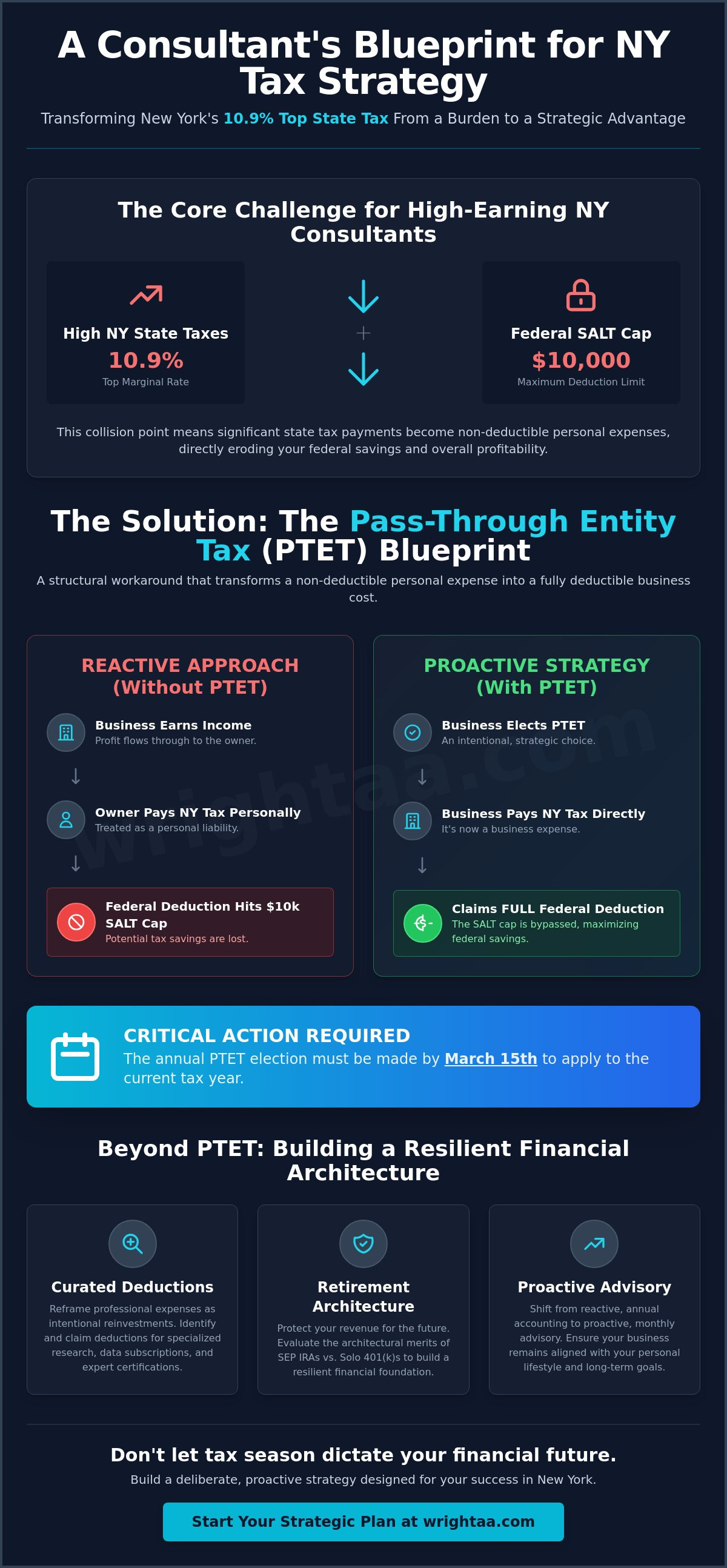
The structural integrity of a consulting practice depends on its foundation. For years, the $10,000 cap on State and Local Tax (SALT) deductions acted as a ceiling, limiting the financial efficiency of high-earning professionals in New York. The NY Pass-Through Entity Tax (PTET) represents a sophisticated shift in this foundation. It allows your business to pay state income tax at the entity level rather than passing that liability directly to your personal return. This isn't just an accounting shift; it's a deliberate design choice that transforms a non-deductible personal expense into a fully deductible business cost for federal purposes.
Among the various tax saving strategies for consultants NY, the PTET election stands as the most impactful intervention for the 2026 tax year. By opting into this regime, you're essentially creating a bypass around the SALT deduction limit. The business pays the New York tax, reduces its federal taxable income accordingly, and provides you with a corresponding credit on your individual state return. It's a rhythmic, tax-neutral cycle at the state level that yields significant federal benefits. Designing a proactive tax strategy around this mechanism requires foresight, as the election must be made by March 15, 2026, to apply to the current year.
Calculating the Benefit: SALT Cap Workarounds
The beauty of the PTET lies in its duality. On one side, your business takes a federal deduction for the state taxes it pays. On the other, you receive an equivalent credit against your New York State personal income tax. For a consultant earning $250,000, this workaround can save thousands in federal taxes that would otherwise be lost to the SALT cap. The timing is precise. Quarterly estimated payments must be made throughout the year to maintain compliance and ensure the benefit is realized when you file. It's a steady, unhurried process of building equity within your own tax structure.
Is Your Consulting Practice Eligible?
Eligibility is defined by the form of your business. New York permits S-Corporations and partnerships to make the PTET election. If you operate as a single-member LLC, you're generally excluded unless you've elected to be treated as an S-Corporation for tax purposes. This distinction often makes S-Corp status the preferred architecture for independent consultants seeking maximum efficiency. The annual election is a firm commitment; once made for the 2026 tax year, it cannot be revoked after the March deadline. We recommend a careful walkthrough of your current entity structure to ensure it supports this level of optimization before the window closes.
Curating Deductions: Beyond the Conventional Home Office
A deduction is more than a simple subtraction. Within the architecture of your business, these figures represent a deliberate reinvestment into the structural integrity of your practice. While basic accounting focuses on office supplies, sophisticated tax saving strategies for consultants NY look toward the specialized materials that define your expertise. This includes high-level research databases, proprietary data subscriptions, and the expert certifications that act as the foundational support for your professional authority. These costs are the finishes that complete a high-end service offering.
For consultants in Western New York, the Section 179 deduction provides a mechanism for immediate expense recovery on high-end equipment. Whether it's advanced computing hardware or specialized technical tools used in your practice, this provision allows you to deduct the full purchase price in the year of acquisition. This pairs with the Qualified Business Income (QBI) deduction, which permits eligible consultants to exclude up to 20% of their business income from federal taxation. These are not merely loopholes; they're structural components designed to foster business growth. Proper long-term planning often involves reviewing Retirement Plans for Self-Employed People to ensure your revenue is protected across every phase of your career.
The Intentional Home Office: NY Specific Nuances
New York maintains a rigorous standard for home office exclusivity. The space must be used regularly and solely for your consulting practice to qualify for a deduction. When calculating the percentage of utilities and maintenance for a Buffalo residence, precision is paramount. You must distinguish between your personal living environment and your professional site with architectural accuracy. Travel within the Syracuse-Rochester corridor also requires careful documentation. While a daily commute to a fixed office is non-deductible, travel to varying client sites is a legitimate business expense. This distinction ensures your professional movement remains tax-efficient and compliant with state expectations.
Professional Development and Thought Leadership Costs
Investing in your own intellectual capital is a hallmark of the visionary consultant. Costs associated with industry-leading summits, masterminds, and high-level business coaching are often deductible as necessary business expenses. These interventions maintain the sharp edge of your professional skills and improve the quality of your output. It's vital to remember that education to maintain or improve your current skills is deductible, but training for a completely new career path is not. By curating these costs thoughtfully, you ensure that every dollar spent on growth also serves to reduce your overall tax burden, keeping your practice both lean and highly capable.
Retirement Architecture: Protecting Revenue for the Future
Retirement planning is the final layer of a well-designed financial structure. It serves as a protective envelope for your revenue. By shifting capital from taxable income into qualified accounts, you reduce your current liability while building a foundation for the future. For the independent professional, this is one of the most effective tax saving strategies for consultants NY. It allows you to control the flow of capital with precision. We view these accounts not merely as savings vehicles, but as structural components of a resilient tax strategy.
The choice between a SEP IRA and a Solo 401(k) depends on the specific volume and rhythm of your income. In 2026, the SEP IRA allows for contributions of up to $72,000 or 25% of compensation, whichever is less. However, it lacks catch-up provisions. For high-income consultants over age 45, a Defined Benefit Plan might be the appropriate intervention. These plans allow for significantly higher contributions than defined contribution plans, often exceeding six figures annually based on actuarial calculations. It is a robust method for sheltering significant revenue during peak earning years, ensuring your professional legacy remains intact.
The Solo 401(k): The Gold Standard for Consultants
The Solo 401(k) offers a dual-layered approach to tax reduction. As the employee, you can defer up to $24,500 of your compensation in 2026. As the employer, you can contribute an additional 25% of net self-employment income. For those age 50 and older, a $8,000 catch-up contribution is permitted. For consultants aged 60 to 63, an enhanced catch-up limit of $11,250 is available in 2026. This brings the total potential contribution to $83,250 for professionals in that specific window. You can choose between Traditional and Roth structures, allowing you to balance immediate tax relief with future tax-free growth.
Health Savings Accounts (HSAs) as a Triple-Tax Advantage
The Health Savings Account is perhaps the most tax-efficient structure within the U.S. code. It offers a triple benefit: contributions are tax-deductible, growth is tax-free, and withdrawals for qualified medical expenses are tax-exempt. By pairing an HSA with a high-deductible health plan, you create a vehicle for both current care and long-term investment. It functions as a secondary retirement account once you reach age 65, as non-medical withdrawals are then taxed at ordinary rates without penalty. Integrating these accounts into your broader plan ensures that your financial architecture remains both flexible and enduring. If you are ready to refine your approach, we can help you design a custom tax strategy that aligns with your long-term vision.
The Wright Approach: Proactive Planning in Western New York
A reactive stance is a choice to accept inefficiency. Many professionals view tax strategy as a seasonal chore, yet professional intervention often pays for itself through the discovery of overlooked credits and structural optimizations. Designing effective tax saving strategies for consultants NY requires a shift from hindsight to foresight. We approach finance with the same rigor a builder applies to a site plan. By implementing fixed-fee monthly advisory, you ensure consistent oversight that prevents the erosion of your margins. This proactive model replaces the anxiety of the unknown with the serenity of a well-executed plan.
Scaling a practice requires more than just high-quality client work. It demands a sophisticated internal framework that remains invisible to the client but essential to the owner. Our outsourced CFO services provide the high-level insight necessary to grow without the weight of administrative bloat. We combine deep local expertise in the Western New York market with modern, visionary tools to ensure your business remains resilient. Effective tax saving strategies for consultants NY are not static. They are living systems that evolve alongside your practice and the changing regulatory environment of 2026.
From Compliance to Vision: The Monthly Retainer Model
Compliance is the baseline; vision is the goal. Year-round bookkeeping serves as the continuous monitoring of your business's health, eliminating the chaos of tax-season surprises. When your records are maintained with architectural precision, you gain access to real-time financial KPIs. These metrics allow for informed decision-making based on data rather than intuition. This is the transition from simple tax preparation to true tax architecture. It's about building a structure that supports your daily life while protecting your long-term revenue. This steady, unhurried oversight ensures that your business stays aligned with your original intent.
Designing Your Next Chapter in Buffalo
Geographic context matters. Partnering with a firm that understands the Buffalo business landscape provides a unique advantage. We understand the specific incentives and constraints of our region, from local tax credits to the rhythm of the Western New York economy. The conversation about your 2026 tax strategy should begin today, not next April. A well-designed plan takes time to implement and refine. If you're ready to transform your tax burden into a strategic advantage, we invite you to Schedule a consultation with Wright CPAs, LLC. Let's begin the process of designing your financial clarity together.
Designing the Architecture of Your Wealth
The transition from a reactive tax season to a proactive financial strategy is an intentional shift in perspective. You've explored how the Pass-Through Entity Tax serves as a structural workaround for SALT caps and how retirement accounts function as essential protective layers for your revenue. These tax saving strategies for consultants NY aren't just technical adjustments. They're the finishes that complete a high-end professional practice. By curating your deductions and optimizing your entity selection, you create a business that respects both your visionary goals and the specific regulatory landscape of New York.
True financial clarity requires a partner who understands the intersection of specialized New York State tax law expertise and the unique needs of the independent professional. Our fixed-fee advisory model provides the predictable, year-round oversight necessary to maintain this architecture. Begin designing your financial future with a strategic tax consultation. It's time to build a foundation that supports your next chapter with confidence and purpose.
Frequently Asked Questions
Is the New York Pass-Through Entity Tax (PTET) mandatory for consultants?
No, the New York Pass-Through Entity Tax is an optional election. Eligible entities must opt in annually by March 15 to participate for the current tax year. While it's a powerful tool for tax saving strategies for consultants NY, it requires a deliberate choice at the business level to transform personal tax burdens into deductible business expenses.
Can I deduct my home office in NY if I also have a co-working space in Buffalo?
You may still qualify for the home office deduction if your residence serves as your principal place of business. New York requires that the space be used regularly and exclusively for your professional practice. If your co-working space in Buffalo is used for specific client meetings while your home office remains the primary site for administrative and creative work, the deduction remains a valid part of your financial architecture.
How much can a solo consultant contribute to a Solo 401(k) in 2026?
In 2026, a solo consultant under age 50 can contribute a total of $72,000 to a Solo 401(k). This total includes an employee deferral of $24,500 and an employer contribution of up to 25% of net compensation. For those age 50 and older, an $8,000 catch-up provision is available, while those aged 60 to 63 can utilize an enhanced catch-up limit of $11,250.
Does New York State recognize the federal S-Corp election automatically?
No, New York State does not automatically recognize the federal S-Corp election. You must file Form CT-6 with the state to be treated as an S-Corporation for New York tax purposes. Failing to complete this separate intervention can result in your business being taxed as a C-Corporation at the state level, which can significantly disrupt your intended tax efficiency.
What is the "Fixed Dollar Minimum" tax for an LLC with no revenue in NY?
An LLC with no revenue in New York is still subject to a baseline cost for its existence. For businesses with New York receipts of $100,000 or less, the fixed dollar minimum tax is $25. This ensures that every registered entity maintains a minimum financial connection to the state, regardless of its current activity or profitability during the year.
How does the Qualified Business Income (QBI) deduction work for consultants?
The Qualified Business Income (QBI) deduction allows eligible consultants to exclude up to 20% of their business income from federal taxation. Since consulting is often classified as a Specified Service Trade or Business (SSTB), the deduction begins to phase out once your taxable income exceeds specific thresholds. Implementing proactive tax saving strategies for consultants NY is essential to maximize this benefit before reaching those limits.
Should I choose an LLC or an S-Corp for my consulting business in Western New York?
The choice between an LLC and an S-Corp depends on your revenue volume and your preference for administrative simplicity. An S-Corp often provides superior savings by reducing self-employment tax on a portion of your income, though it requires more rigorous bookkeeping and payroll. In Western New York, we recommend weighing the additional compliance costs against the potential for deep tax reduction.
What are the most common tax audit triggers for NY consultants?
Common audit triggers for New York consultants include disproportionately high home office deductions and excessive travel expenses relative to total revenue. State agencies also look for discrepancies between your reported income and the 1099 forms filed by your clients. Maintaining precise, sensory records and consistent documentation is the best way to ensure your professional structure remains resilient under state scrutiny.


