

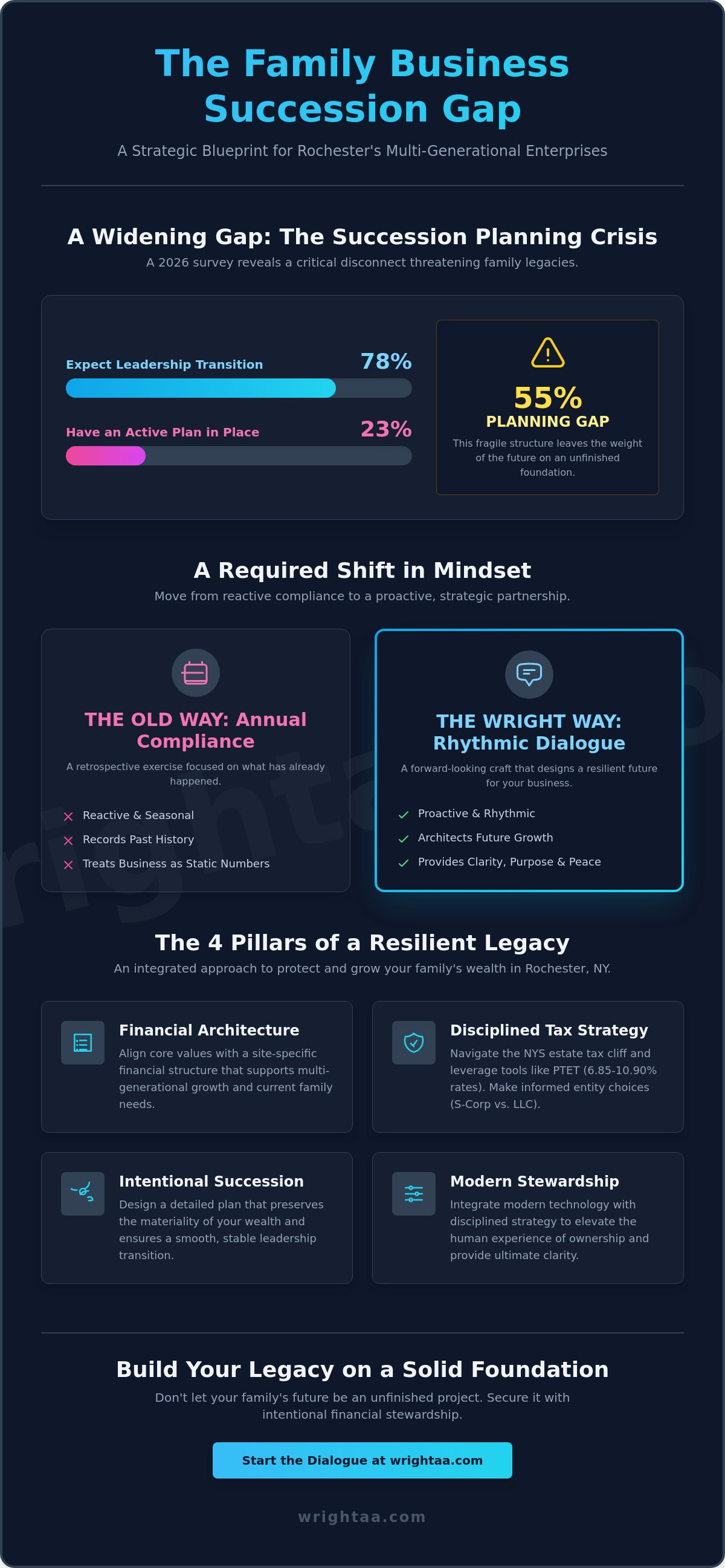
A 2026 survey reveals that 78% of family business executives expect a leadership transition within the next decade, yet only 23% are actively implementing a plan to manage it. This disconnect creates a fragile structure where the weight of the future rests on an unfinished foundation. It's a quiet friction that many founders feel as they balance the immediate needs of their kin against the long-term materiality of the enterprise.
You likely recognize this tension. It's the challenge of preserving a legacy while ensuring the business remains resilient enough to support the next generation. Finding a family-owned business CPA Rochester relies on for guidance means seeking a partner who values the craft of your business as much as you do. This article explores how intentional financial architecture and proactive tax strategy can protect your assets from the New York State estate tax cliff while driving growth. We will look at the specific methods for aligning family dynamics with institutional stability to elevate the human experience of ownership.
Key Takeaways
- Align your family's core values with a site-specific financial architecture that supports both current needs and multi-generational growth.
- Discover how a family-owned business CPA Rochester trusts can help you navigate the 2026 tax landscape and the New York estate tax cliff.
- Shift from annual compliance to a rhythmic, monthly CFO dialogue that provides clarity and purpose for your cash flow decisions.
- Learn the craft of designing a succession plan that preserves the materiality of your wealth during a leadership transition.
- Explore how integrating disciplined tax strategy with modern technology elevates the human experience of stewardship.
Navigating the Intersection of Family Legacy and Financial Complexity
Stewardship is an act of quiet preservation. In Rochester, we understand that a business is rarely just a commercial entity; it is the physical manifestation of a family's history and its future aspirations. This intersection of personal values and financial materiality requires a specialized approach. A What is a family-owned business? It is a delicate ecosystem where the heartbeat of the home informs the logic of the boardroom. Generic accounting often fails these firms because it ignores this dialogue. It treats a closely held business as a static set of numbers rather than a rhythmic, living structure that must support multiple generations.
Rochester's economic landscape has undergone a profound transformation. We have moved from the era of historic manufacturing giants toward a sophisticated vernacular of innovation, optics, and specialized services. This shift demands a site-specific financial strategy. A family-owned business CPA Rochester entrepreneurs rely on must act as a thoughtful maker. They don't just record history; they help design the framework that allows a legacy to endure. When financial architecture is built without considering the specific family context, the structure eventually shows cracks under the weight of transition and growth.
The Tectonic Shifts of Family Business Life Cycles
The life cycle of a family firm is defined by tectonic movements. These are slow, powerful shifts that occur as leadership passes from a founder to the next generation. Transition points are often fraught with friction. Financial intentionality serves as the mortar between these shifting layers. By facilitating honest dialogue and providing a clear map of the business’s health, a CPA ensures that these internal movements don't destabilize the entire enterprise. It's about creating spatial breathing room for both the business to grow and the family to thrive.
Why Rochester Businesses Require Proactive Stewardship
Operating within New York’s regulatory landscape requires a disciplined and proactive hand. Local firms often face a duality: they are deeply rooted in the Rochester community but strive for a national or even global reach. This requires a steward who understands the local environment while planning for broader horizons. Financial stewardship is the intentional practice of guiding a family’s capital to honor its past while securing its future growth. It involves a rigorous commitment to excellence that goes beyond simple compliance to elevate the human experience of ownership.
Strategic Tax Planning: The Foundation of Multi-Generational Longevity
Taxation is not a seasonal burden to be endured; it's a structural element that must be integrated into the very design of your business. Many owners confuse tax preparation with tax planning. Preparation is a retrospective exercise, a simple recording of what has already occurred. In contrast, tax strategy is a forward-looking craft. It involves the intentional arrangement of your financial affairs to minimize liability and maximize the materiality of your family’s wealth. A family-owned business CPA Rochester relies on looks at the entire site, considering how personal tax brackets and corporate obligations interact in a delicate dialogue.
Proactive planning reduces the tax friction of growth by ensuring that every dollar reinvested into the enterprise is shielded from unnecessary erosion. In the 2026 fiscal environment, this requires a disciplined eye on both federal and New York State regulations. For instance, the New York State Pass-Through Entity Tax (PTET) remains a vital tool for closely held businesses. With rates ranging from 6.85% to 10.90%, the decision to opt-in by the March 15 deadline can significantly alter the tax landscape for shareholders. This is the difference between a reactive filing and a site-specific financial architecture.
Structuring for Resilience: Entity Selection in NY
The vernacular of your business structure dictates the flow of capital. Choosing between an LLC and an S-Corp isn't merely a legal formality; it's a foundational decision that impacts how family members receive distributions and how self-employment taxes are managed. You can explore the specific nuances of S-Corp vs. LLC: Tax Implications in New York State to understand how these choices affect your long-term stability. The right structure provides the spatial breathing room necessary for the business to evolve without losing its core identity.
Maximizing Deductions for the Closely Held Business
For Rochester-based firms, the materiality of tax documentation is paramount. We often see overlooked opportunities in research and development credits or local equipment expensing that go unclaimed because the accounting was not proactive. Effective succession planning also begins with tax efficiency. By utilizing the 2026 annual gift tax exclusion of $19,000 per recipient, families can begin the unhurried transfer of equity well before a formal exit. This methodical approach ensures that the transition feels natural rather than disruptive. If you're ready to move beyond basic compliance, consider how an intentional tax strategy can elevate your business’s potential.
Beyond Compliance: CFO-Level Guidance for Rochester’s Businesses
Compliance is a baseline requirement, but it isn't a strategy. For many entrepreneurs, accounting feels like an annual post-mortem, a recording of history rather than a design for the future. A family-owned business CPA Rochester trusts moves beyond these retrospective boundaries. By adopting a CFO-level perspective, we look at the business as a whole site, ensuring that every financial decision aligns with the broader architectural goals of the family legacy. This visionary approach transforms the accounting function from a technical exercise into a poetic one, where data informs the craft of leadership.
The rhythmic nature of monthly accounting provides a steady pulse for the enterprise. Unlike project-based filing, which can feel hurried and reactive, ongoing CFO services create a deliberate flow of information. Modern technology acts as a catalyst in this process. By integrating sophisticated digital tools, we automate the technical materiality of bookkeeping, which in turn creates spatial breathing room for the business owner. This allows you to step back from the tectonic pressures of daily operations and focus on the long-term integration of your personal and professional values. It's about elevating the human experience by removing the clutter of manual data entry.
Fixed-Fee Advisory: Predictable Costs for Intentional Growth
Financial clarity shouldn't come with the anxiety of a ticking clock. The traditional hourly billing model often creates a barrier to meaningful dialogue, causing owners to hesitate before seeking advice. By utilizing a fixed-fee advisory structure, we eliminate this friction, allowing for unhurried consultations that prioritize substance over spectacle. This model provides the transparency needed for Small Business Accounting in Buffalo, NY: Designing Financial Clarity, ensuring that your professional costs remain as predictable as your growth strategy. It is a more sophisticated way to manage the relationship, rooted in trust and mutual purpose.
Cash Flow Management: The Lifeblood of the Legacy
Cash flow is the tectonic force that determines the stability of your business site. Without a clear map, the conflict between family needs and business reinvestment can become a source of profound anxiety. We design cash flow strategies that treat capital as a material to be shaped with intention. By monitoring specific Financial KPIs for Small Business: A Guide to Clarity in Western New York, you gain the insight necessary to navigate seasonal shifts and economic cycles. This disciplined oversight ensures that the business remains resilient, protecting the legacy you've built for the next generation.
Designing Succession: Preserving Wealth Across Generations in WNY
Succession is the most significant tectonic shift a family firm will ever face. It is the moment where the architect steps away from the drawing board, trusting the structure to stand on its own. For a family-owned business CPA Rochester owners look to, this process is about more than just moving assets; it's about the emotional materiality of a life's work. The transition from founder to the next generation requires a serene and curated approach that respects the history of the enterprise. True stewardship requires listening deeply to the legacy before placing a single line on an exit plan. We must ensure the vernacular of the business—its core values and unique culture—survives the transfer of leadership.
A 2026 survey by Deloitte found that while 78% of family business executives expect a transition within a decade, only 23% are actively implementing a plan. This gap creates a fragile environment where the future is left to chance. Planning for this transfer should be unhurried and methodical. Without a clear blueprint, the intersection of New York estate taxes and family dynamics can create profound instability. By designing a transition that respects both the past and the future, we preserve the human experience of the legacy while driving continued growth. It's about creating a permanent, thoughtful intervention that allows the business to thrive under new stewardship.
Valuation and Transition Strategies
Determining the true value of a closely held business is the first step in creating a safe transition. Buy-sell agreements act as the structural beams of this process, providing a clear path forward in the event of unforeseen changes. Preparing the next generation for financial stewardship involves more than just teaching them the books; it requires a disciplined integration into the business's unique rhythm. We help families navigate these waters with clarity and purpose, ensuring that the next generation understands the craft of managing both wealth and values.
Estate Planning Integration
In New York, the estate tax "cliff" is a critical planning point that requires precise attention. While the 2026 federal exemption has risen to $15 million, the New York State basic exclusion remains a much lower $7,350,000. If an estate exceeds the New York limit by more than 5%, the entire exemption is lost, resulting in a significantly higher tax liability. Harmonizing the business balance sheet with personal estate goals is essential to avoid this erosion of wealth. Utilizing tools like gifted equity, and leveraging the 2026 annual exclusion of $19,000 per recipient, allows for a gradual, tax-efficient transfer of ownership. If you're ready to begin the unhurried process of securing your future, explore our succession consulting services to ensure your legacy remains intact.
The Wright Approach: Intentional Financial Stewardship in Rochester
Financial stewardship is a deliberate act of integration. At Wright CPAs, LLC, we believe that accounting is not merely a technical exercise; it's a poetic one that should reflect the values of the family it serves. By combining the precision of modern technology with the artisan's eye for detail, we create a financial architecture that feels both permanent and adaptable. This is the essence of being a family-owned business CPA Rochester trusts. We listen to the site of your business before placing a single line of strategy. Our commitment to elevating the human experience means we prioritize clarity and purpose over simple compliance, ensuring that your financial foundation is as beautiful as the legacy you're building.
Local expertise matters because every business is inextricably linked to its specific geographic and cultural context. Rochester has its own vernacular of commerce, from the historic manufacturing corridors to the modern tech hubs. Navigating this landscape requires a partner who understands the local regulatory environment and the specific tectonic shifts affecting Western New York firms. We bring a quiet, confident authority to your financial planning, helping you move away from the noise of loud marketing and toward a more grounded, visionary way of operating.
A Partnership Built on Dialogue
Every project begins with a dialogue. We don't rush into tax strategy or cash flow management without first understanding the vernacular of your family’s goals. Our process is steady and unhurried, moving from broad philosophical alignment to the material details of your balance sheet. By focusing on proactive stewardship rather than reactive reporting, we help you anticipate shifts before they become crises. Our team operates across Buffalo, Rochester, and Syracuse, ensuring that our refined approach is always accessible to the closely held businesses that drive our region's economy. It's a partnership built on trust, craft, and a shared commitment to excellence.
Your Invitation to Financial Clarity
The transition to a more intentional financial future starts with a single conversation. Moving to a strategic CPA firm shouldn't feel like a disruption; it should feel like the first step toward a more serene and curated business life. We guide you through the process of professionalizing your operations while preserving the core identity of what you've built. This is your invitation to step back from the anxiety of the unknown and focus on the quiet, confident growth of your legacy. We're here to help you design a future that honors your past while creating spatial breathing room for what's next. Elevate your family business with Wright CPAs, LLC.
Architecting the Future of Your Legacy
The stewardship of a family enterprise is a continuous dialogue between the past and the future. It requires a move away from the noise of annual tax filing toward a rhythmic, proactive architecture that supports long-term growth. By integrating CFO-level insights with disciplined tax strategy, you protect the materiality of what you've built. Finding a family-owned business CPA Rochester relies on is the first step toward this intentional integration. It's about ensuring your business site remains resilient through every tectonic shift.
Since 2012, we've dedicated our craft to the specific needs of closely held businesses and law firms. With a local presence in Buffalo, Rochester, and Syracuse, we provide the site-specific expertise needed to navigate the complexities of the New York landscape. We invite you to step into a partnership rooted in clarity and purpose. Discover Intentional Financial Stewardship for Your Family Business and begin the unhurried process of elevating your human experience. Your legacy deserves a foundation as permanent and thoughtful as the work itself.
Frequently Asked Questions
Why does a family-owned business need a specialized CPA in Rochester?
A family-owned business CPA Rochester trusts understands that financial decisions aren't made in a vacuum. They account for the delicate dialogue between personal family needs and the business's long-term materiality. This site-specific approach ensures that your financial architecture supports both your household and your growth goals in a way that a generic firm cannot replicate.
What is the difference between tax preparation and proactive tax planning?
Tax preparation is a retrospective recording of history while tax planning is the intentional craft of designing the future. Preparation simply ensures compliance with past events. Planning arranges your affairs to minimize future liability and maximize wealth preservation through disciplined strategy. It's the difference between looking at a finished building and drawing the blueprints for a new structure.
How can a fractional CFO help my family business grow without adding full-time overhead?
Fractional CFO services provide visionary guidance and sophisticated cash flow management without the structural weight of a full-time executive salary. This model creates spatial breathing room for founders to focus on high-level business development. You gain the disciplined oversight needed for scale while maintaining the lean vernacular of a family firm.
What are the most common tax mistakes Rochester family businesses make?
Many local firms ignore the New York State estate tax cliff, which sits at a $7,350,000 basic exclusion amount for 2026. Exceeding this threshold by just 5% can result in the loss of the entire exemption, creating a massive tax liability. Another common error is failing to opt into the optional New York State Pass-Through Entity Tax by the March 15 deadline.
How do we handle financial disagreements between family members in the business?
We facilitate objective financial dialogues rooted in data rather than emotion. By establishing clear financial KPIs and a transparent cash flow map, we provide a neutral foundation for decision-making. This disciplined structure helps resolve friction by aligning every family member with the business’s overarching architectural goals and long-term stability.
Can Wright CPAs help with succession planning for a Rochester-based firm?
We specialize in the unhurried craft of succession planning for the family-owned business CPA Rochester entrepreneurs depend on for legacy preservation. We help you navigate the tectonic shifts of leadership transfer while preserving the core vernacular of your business. Our approach integrates tax strategy with estate goals to ensure your wealth remains intact across generations.
What are the benefits of a fixed-fee monthly accounting retainer?
A fixed-fee model eliminates the anxiety of hourly billing and encourages deeper, more meaningful consultations. It provides financial clarity for your own budgeting while ensuring our dialogue remains focused on substance over spectacle. This rhythmic approach allows for a more patient and methodical design process for your business's financial future.
How does Wright CPAs utilize modern technology for local Rochester clients?
We use modern cloud-based tools to automate the technical materiality of bookkeeping and payroll. This integration allows us to spend more time on high-level strategy and elevating the human experience for our clients. Technology shouldn't replace the human touch; it should provide the light and space needed for better, more intentional decision-making.


