

A Roth conversion can help shape a lower-tax retirement, but it is not automatically the right first move. Converting tax-deferred assets creates taxable income in the conversion year and may reduce future required minimum distributions. Tax efficient retirement withdrawal strategies coordinate withdrawals with your tax picture over time instead of automatically favoring one account.
It’s natural to focus on whether to convert traditional retirement savings to a Roth account. The timing matters: qualified Roth distributions require the five-year aging period and, generally, that you’re at least 59½ or meet an exemption. Effective tax efficient retirement withdrawal strategies weigh conversion timing alongside other income and withdrawals.
This article explains how to weigh Roth conversions alongside qualified charitable distributions, your mix of taxable, tax-deferred, and Roth accounts, and the order in which you draw from them. Each choice can affect taxable income, Social Security benefits, and required minimum distributions. The goal is to understand how tax efficient retirement withdrawal strategies may shape your tax bill over time.
Key Takeaways
- Time Roth conversions with your other income: a conversion is taxable in the year it happens, while qualified Roth withdrawals follow separate rules.
- If you’re eligible and give to charity, a qualified charitable distribution may keep the donated amount out of adjusted gross income and count toward required minimum distributions.
- Compare withdrawals across taxable, tax-deferred, and Roth accounts; the mix can shape taxable income and the tax treatment of Social Security benefits.
- Build a withdrawal order around your tax picture. For the 2026 tax year, single filers with taxable income up to $49,450 have a 0% federal long-term capital gains tax rate, according to the Internal Revenue Service.
1. Should I take advantage of Roth conversions?
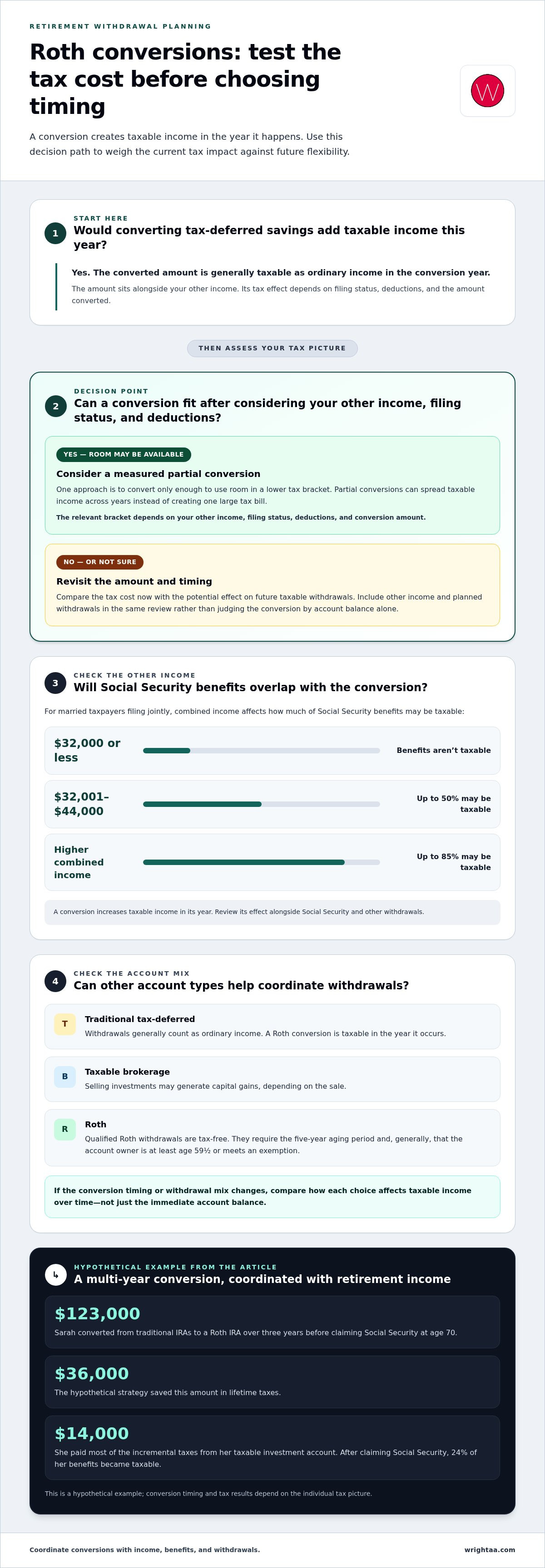
A Roth conversion can make sense when paying tax on a portion of tax-deferred savings now may reduce future taxable withdrawals. The converted amount is taxable as ordinary income in the conversion year. A qualified Roth distribution requires the five-year aging requirement and that the account owner is at least age 59½ or meets an exemption. So weigh today’s tax cost against future flexibility, not just the account balance.
Account type determines tax treatment. Traditional tax-deferred account withdrawals generally count as ordinary income. Taxable brokerage withdrawals may generate capital gains, while qualified Roth withdrawals are tax-free. Coordinating all three can help manage taxable income. For example, you might take a measured traditional withdrawal, then draw from taxable savings or Roth assets as your circumstances allow.
Partial conversions can spread taxable income across years rather than create one large tax bill. One approach is to convert only enough to use room in a lower tax bracket. The relevant bracket depends on your other income, filing status, deductions, and the conversion amount. A hypothetical example describes systematic partial conversions in early retirement to fill the 15% tax bracket.
Social Security timing adds another layer. For married taxpayers filing jointly, benefits aren’t taxable when combined income is $32,000 or less; from $32,001 to $44,000, up to 50% may be taxable. Up to 85% of benefits may be taxable at higher combined income. A conversion increases taxable income in its year, so review its effect alongside benefits and other withdrawals.
In one hypothetical example, Sarah converted $123,000 from traditional IRAs to a Roth IRA over three years before claiming Social Security at age 70. The strategy saved $36,000 in lifetime taxes, while she paid most of $14,000 in incremental taxes from her taxable investment account. After claiming Social Security, 24% of her benefits became taxable. Such examples show why conversion timing and withdrawal coordination belong in the same plan.
2. Qualified charitable distributions
Federal ordinary-income brackets range from 10% to 37%; for 2026, the standard deduction for single filers in the examples is $15,750. The deduction reduces taxable income before tax is calculated, while your filing status and other income affect the bracket applied to each portion.
A qualified charitable distribution, or QCD, moves money directly from an IRA to a qualified charity. In 2026, eligible people over age 70½ can donate up to $111,000 through a QCD. The distribution is excluded from adjusted gross income and can count toward required minimum distributions once those distributions begin. That treatment can make a direct IRA gift worth considering when you already plan to give.
Timing matters. Required minimum distributions generally begin at age 73 for traditional IRAs and most workplace plans, according to the Internal Revenue Service. Under the SECURE 2.0 Act, the starting age rises to 75 for people born in 1960 or later. Eligible QCDs can help meet an RMD without adding the donated amount to adjusted gross income. A gift from a taxable account doesn’t follow this same IRA distribution treatment.
Plan the distribution sequence before taking the RMD. The first RMD may be delayed until April 1 of the year after you reach the applicable starting age, according to the Internal Revenue Service. But the second distribution is then due by December 31 of that same year. Taking both in one year can concentrate taxable income, which may push more income into a higher tax bracket. Roth accounts have no RMDs during the original owner’s lifetime, so include them when mapping withdrawals.
For a practical review, list expected income, charitable gifts, and required minimum distributions together before choosing withdrawals. This makes it easier to assess how a qualified charitable distribution could affect taxable income and bracket exposure. A tax planning and preparation review can help organize these details alongside your filing information and charitable giving plans.
Tax Planning and Preparation can help you assess how a QCD fits your broader tax plan.
3. Proportional withdrawals across account types
A proportional withdrawal draws from each account according to its share of total savings. For example, with $750,000 in a brokerage account and $750,000 in an IRA, each holds half the combined balance. A proportional draw would therefore take half of the planned withdrawal from each account. Recalculate the shares as balances change, rather than relying on a fixed dollar split.
The tax character differs by account. Traditional tax-deferred withdrawals are generally ordinary income, with federal rates ranging from 10% to 37%. Selling investments in taxable accounts can realize capital gains; the federal long-term rates described are 0%, 15%, or 20%, depending on taxable income and filing status. Roth accounts can provide a separate source of qualified, tax-free withdrawals. Proportional drawing can distribute income across these tax treatments instead of concentrating every dollar in one account.
State taxes also affect the calculation. Retirement income rules vary across the United States: states may treat Social Security, pension payments, and IRA withdrawals differently. Your state of residence and income type both matter, so include them when estimating the after-tax amount available to spend. Federal tax treatment alone does not show the full effect of a withdrawal.
Early access has its own cost. In the United States, withdrawals from tax-deferred accounts before age 59½ are generally subject to an additional 10% early withdrawal penalty, with rare exceptions. Traditional distributions may also count as ordinary income. Roth IRA contributions can be withdrawn tax-free before retirement, but earnings are taxed as income; early Roth earnings withdrawals may also face a 10% penalty.
Proportional withdrawals can help moderate taxable income, but they don’t guarantee the lowest bill. In a hypothetical example, proportional withdrawals reduced Joe’s total retirement withdrawal taxes by over 45% and extended the portfolio’s life from just under 23 years to almost 24 years. Use account balances, realized gains, and tax brackets to compare the result with other withdrawal patterns. A taxable-account sale may be more useful in a year when capital gains fit favorably alongside other income.
4. Tax-efficient retirement withdrawal order
A useful withdrawal order coordinates required distributions with taxable and retirement assets. One approach is to take required minimum distributions first, then draw from taxable accounts. In lower-income years, consider additional withdrawals from traditional accounts. Roth IRA assets can provide another source, especially when taxable income is already elevated.
For the 2026 tax year, single filers with taxable income up to $49,450 have a 0% federal long-term capital gains tax rate, according to the Internal Revenue Service. That threshold can make taxable-account sales useful when income and realized gains fit within it. The Internal Revenue Service states that the amended U.S. Net Investment Income Tax adds a 3.8% surtax on investment income when modified adjusted gross income exceeds $200,000 for single filers or $250,000 for married couples filing jointly.
Required minimum distributions generally begin at age 73 for traditional IRAs and most workplace plans, according to the Internal Revenue Service. Roth IRAs aren’t subject to required minimum distributions during the original owner’s lifetime. Account order therefore affects both current income tax and which assets remain available for later years.
To balance tax efficiency with longevity and investment risk, set a spending plan and review it alongside account balances and market performance. Use a mix of account types rather than relying on one fixed sequence. A taxable account may offer flexibility, while traditional withdrawals create ordinary income and Roth assets can preserve options for later years.
Revisit the sequence when income changes, markets shift, or required minimum distributions begin. One modeled strategy based on withdrawals up to a deduction level performed well across most return scenarios. Filling higher tax brackets with tax-deferred withdrawals produced lower final balances than the leading strategy. These comparisons show why the lowest tax rate this year may not lead to the strongest long-term result.
Wright CPAs, LLC can help align withdrawal timing, taxable income, and account decisions through retirement tax strategy.
Wright CPAs: Tax Planning and Preparation
Wright CPAs, LLC provides Tax Planning and Preparation to help organize retirement income, account withdrawals, and tax filing decisions. Consider this support when weighing a Roth conversion, planning for required minimum distributions, or coordinating taxable and tax-deferred withdrawals. A clear view of income and account activity can connect year-round decisions with your annual return.
Tax planning can also help you assess how changes in income affect your withdrawal sequence and charitable giving. Bookkeeping support can keep financial records organized, while CFO Services can provide broader financial guidance when relevant. The goal is a coherent plan that reflects your circumstances, rather than treating each distribution as an isolated tax event.
For help aligning retirement decisions with tax preparation, contact Wright CPAs, LLC or visit wrightaa.com.
Give Your Retirement Plan a Clear Next Step
Your next step is to turn retirement decisions into a working plan. Set a regular time to review income, account activity, charitable giving, and changes in your priorities. This creates a steadier basis for adjusting tax efficient retirement withdrawal strategies as your circumstances evolve, rather than making each withdrawal in isolation.
Wright CPAs provides Tax Planning and Preparation to connect tax decisions with your financial records. Its Bookkeeping and Payroll Services support organized records for households with business income or payroll responsibilities. Together, these services can help clarify how financial activity and tax planning fit into your wider picture.
Use the review to identify the decisions that need attention next, then bring those questions into a focused planning conversation. Contact Wright CPAs to discuss your options. A thoughtful plan can make the path ahead feel more deliberate and manageable.
Frequently Asked Questions
Should I take advantage of Roth conversions?
Consider a Roth conversion when the tax on the converted amount fits your current plan and may reduce future tax pressure. Include wages, investment income, deductions, and Social Security in the conversion-year estimate, then compare a partial conversion with making no conversion. Also identify which funds will pay the tax: using retirement assets for the bill can change the balance left invested.
When should I claim Social Security?
Choose a Social Security claiming date by comparing the income gap you need to cover, expected benefit levels, health outlook, and plans for a spouse. Map the decision against other retirement income, because Social Security can affect how much of your benefits is taxable. For a couple, compare both individuals’ timing together. Retirees in Buffalo, Rochester, or Syracuse can include state and federal income in the same cash-flow assessment.
Which retirement withdrawal order makes the most sense for me?
Start with required distributions and projected spending, then estimate the tax effect of each account source before choosing the next withdrawal. Compare taxable income, realized capital gains, liquid assets, and exposure to market declines. For example, a year with large realized gains might favor a smaller taxable-account sale, while lower ordinary income may leave room for a traditional-account distribution. Revisit the sequence after a major income or portfolio change.
What are the tax rules for withdrawals from traditional 401(k)s and IRAs?
Traditional 401(k) and IRA withdrawals generally count as ordinary income, so include them with other taxable income when estimating your federal bill. Unlike a brokerage sale, the distribution itself isn’t taxed using capital-gains rates. Before age 59½, tax-deferred account withdrawals are generally subject to an additional 10% early-withdrawal penalty, with rare exceptions. A large distribution can also raise taxable income and affect the rate applied to other income.
How are Roth IRA and Roth 401(k) withdrawals taxed in retirement?
Qualified Roth distributions are tax-free after the five-year aging requirement when the owner is at least 59½ or meets an exemption. Roth IRA contributions can be withdrawn tax-free before retirement, but earnings are taxed as income, and early Roth IRA earnings withdrawals may face a 10% penalty. For Roth 401(k) savings, apply qualified-distribution rules to the specific distribution; the “Roth” label alone doesn’t make every withdrawal tax-free.
How do required minimum distributions work, and when must they begin?
Required minimum distributions are withdrawals from applicable retirement accounts, with the starting age depending on birth year and account type. According to the Internal Revenue Service, they generally begin at age 73 for traditional IRAs and most workplace plans; under SECURE 2.0, the starting age is 75 for people born in 1960 or later. An initial distribution can be delayed until April 1 of the following year, but the second is due by December 31 of that same year, according to the Internal Revenue Service.


