

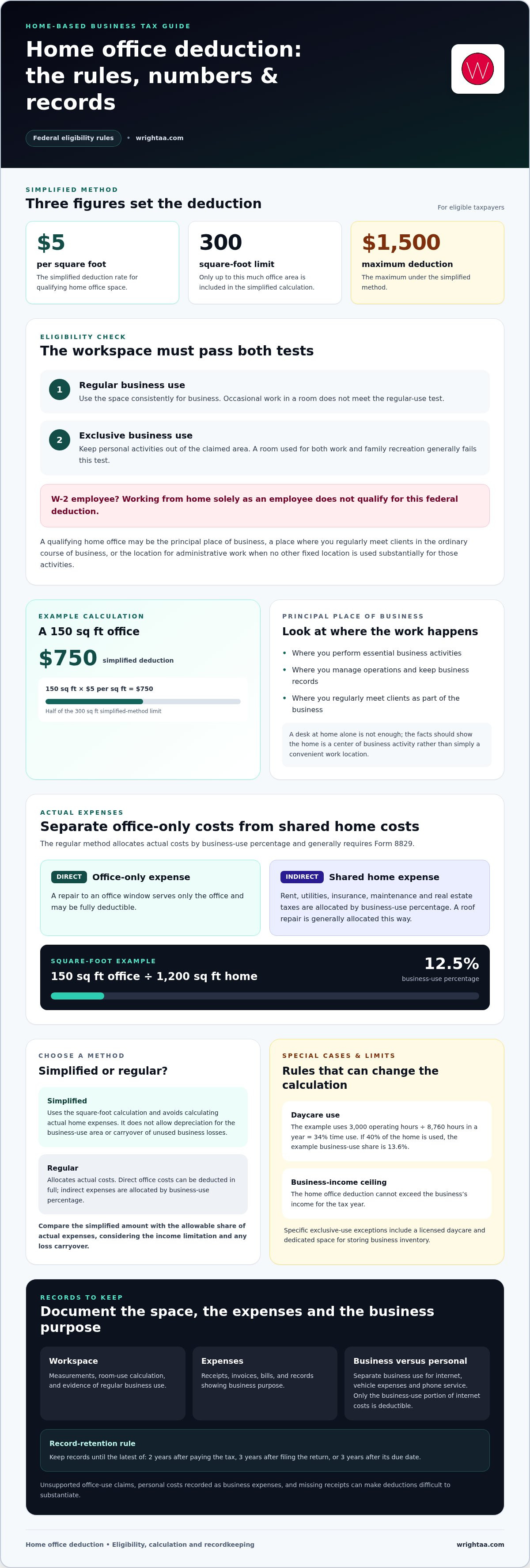
Working from home isn’t enough to qualify for the home office deduction. Generally, the space must be used regularly and exclusively for business, and W-2 employees can’t claim the deduction. For eligible taxpayers, the IRS simplified method allows $5 per square foot for up to 300 square feet, with a maximum deduction of $1,500, an important rule for understanding tax deductions for home-based businesses in NY.
It’s easy to assume a desk, internet bill, or spare room automatically creates a write-off. The rules are more specific: your work arrangement, how you use the room, and whether your home is your principal place of business all affect what may qualify. This guide explains tax deductions for home-based businesses in NY, who may claim the home office deduction, and how the principal-place-of-business test works, so you can separate household costs from business expenses and plan with a clearer picture.
Key Takeaways
- Separate costs tied only to your business space from expenses shared across the home to understand how each may be deducted.
- Assess whether your work status and the way you use the space meet the home office deduction rules.
- Consider where you perform essential business administration and meet clients when evaluating your principal place of business.
- Review the federal rules and recordkeeping steps before deciding which home-based expenses to claim.
1. What can I deduct from my taxes as a home-based business?
Separate home office costs from other business expenses. A home office generally needs regular, exclusive business use; W-2 employees who work from home solely as employees can’t claim this deduction. Self-employed owners may deduct eligible business costs separately, such as qualifying equipment, supplies, and startup expenses. Certain equipment may qualify for an immediate deduction under Section 179, and startup costs may be deductible in the business’s first year.
Direct expenses serve only the office, while indirect expenses support the whole home. A repair to an office window may be fully deductible; a roof repair is generally allocated by business-use percentage. Calculate that percentage by dividing the office’s square footage by the home’s total square footage. For example, 150 square feet in a 1,200-square-foot home equals 12.5%. Rent, utilities, and insurance are indirect costs; lawn care or painting a personal room isn’t a business expense.
Keep receipts, invoices, mileage logs, and records showing business purpose. Retain records for the latest of two years after paying the tax, three years after filing the return, or three years after its due date. Separate business and personal use for internet, vehicle expenses, and phone service. Only the business-use portion of internet costs is deductible. The first home telephone line isn’t deductible, except for long-distance business calls. For 2026, the standard business mileage rate is 72.5 cents per mile from January 1 through June 30, then 76 cents per mile from July 1 through December 31.
Home-based daycare uses both space and time. One example calculates 3,000 operating hours per year against 8,760 hours a year, or 34% of available time. If the business uses 40% of the home, the example’s business-use share is 13.6%. This reflects both the portion of the home used and the hours it serves the business.
Unsupported office-use claims, personal costs recorded as business expenses, and missing receipts can make deductions difficult to substantiate. Keep your room-use calculation and expense records consistent with your actual business activity. The home office deduction also can’t exceed the business’s income for the tax year.
2. What is the home office tax deduction, and who qualifies?
The home office deduction lets eligible business owners deduct qualifying costs tied to a workspace at home. The space generally must be used regularly and exclusively for business. It may qualify as the principal place of business, a place to meet clients in the ordinary course, or a place for administrative activities when no other fixed location is used substantially for those activities. Working at home as a W-2 employee alone doesn’t qualify.
The Internal Revenue Service simplified home office deduction allows eligible taxpayers to deduct $5 per square foot, for up to 300 square feet, with a maximum deduction of $1,500. A 150-square-foot office produces a $750 deduction under this method. It avoids calculating actual home expenses, but doesn’t allow depreciation for the business-use area or carryover of unused business losses.
How do actual-expense and simplified home office deduction methods compare? The simplified method uses the square-foot calculation, while the regular method allocates actual costs and generally requires Form 8829. Under the regular method, direct office costs can be deducted in full; indirect expenses, such as rent, utilities, insurance, maintenance, and real estate taxes, are allocated by business-use percentage.
A sole proprietor or LLC owner may qualify if both the taxpayer and workspace meet the federal tests; the business label alone isn’t enough. An S corporation is treated differently from a sole proprietorship, so owners should distinguish corporate expenses from personal deductions when applying the rules.
To choose a method, compare the simplified amount with the allowable share of actual expenses, then account for the income limitation and any loss carryover. Keep measurements, bills, and evidence of business use together with your return records. For help aligning business activity and tax reporting, business consulting can support a clearer decision.
3. What Makes It Your Principal Place of Business?
The principal-place-of-business test considers where you perform essential work, not simply where you keep a desk. A home office may qualify if it is your main location for self-employed business activities or where you regularly meet clients as part of your business. It may also qualify for administrative or management work if you have no other fixed location used substantially for those activities.
Regular and exclusive use are separate tests. Use the space consistently for business, and keep personal activities out of the claimed area. A room used for work and family recreation generally fails the exclusive-use test. A separate structure, such as a detached studio, may qualify if it is used regularly and exclusively for your trade or profession. Occasional work in a room does not meet the regular-use test.
There are specific exceptions to exclusive use. A licensed daycare can use the home for childcare, and dedicated space for storing business inventory may qualify. For daycare, the calculation considers both the area used and operating time; the example of 3,000 operating hours divided by 8,760 hours a year yields 34% time use. Keep records of the room’s business purpose and schedule.
Employees generally can’t claim the federal home office deduction for W-2 work. Self-employed owners should document where they manage operations, keep records, and meet clients. Those facts help show whether the home is the actual center of business activity rather than a convenient work location.
Home-office depreciation can affect a later home sale. Gain attributable to depreciation allowed or allowable after May 6, 1997, can’t be excluded under the principal-residence exclusion. The Internal Revenue Service says the ownership and use tests are assessed during the 5-year period ending on the sale date; qualifying taxpayers must own the home for at least 2 years and live in it as a main home for at least 2 years. The exclusion is $500,000 for married taxpayers filing jointly, according to the Internal Revenue Service, and $250,000 for a single taxpayer or married taxpayer filing separately. Separate home-business records make the taxable gain calculation clearer.
4. Federal eligibility rules for home-based business deductions
Federal eligibility depends on the taxpayer’s work status, the space’s use, and the expense’s business purpose. Self-employed owners may qualify when their home office meets the regular and exclusive use tests, or the rules for client meetings or business administration. The Internal Revenue Service’s Publication 587 explains how to assess whether a home is the principal place of business. A room used occasionally for work does not meet regular use.
W-2 employees generally can’t claim the federal home office deduction. The Tax Cuts and Jobs Act of 2017 suspended the federal deduction for miscellaneous itemized expenses subject to the 2%-of-AGI floor for 2018 through 2025, and the OBBBA made that change permanent. A person who is both an employee and self-employed should distinguish employee duties from self-employment activities and claim only expenses tied to the business that qualifies.
Separate business costs from household spending before filing. Direct costs that serve only the office may be deducted in full; indirect costs for the entire home must be allocated according to the business-use portion. For example, shared household utilities require a reasonable business-use allocation. Internet costs are deductible only to the extent they support self-employment activity. Document business software purchases and separate business use from personal use.
Apply the rules consistently across the return. A sole proprietor generally reports business income and expenses on Schedule C, while the regular home office method uses Form 8829. Under that method, home-office deductions can’t exceed the business’s income for the tax year; unused deductions may carry forward when the business has a net loss. Keep measurements, expense records, and a clear account of business activity to support the figures reported.
Federal rules can also affect New York filing, so align the business structure, workspace records, and expense allocations before submitting returns. Get help assessing your business tax setup through business consulting.
Wright CPAs: Tax Planning and Preparation
Wright CPAs, LLC helps home-based business owners connect tax planning and preparation with the records behind each deduction. Turn to the firm to separate business costs from household expenses, assess home office calculations, and align tax reporting with your business activity.
Bookkeeping helps keep income and expense records organized, while payroll services support businesses with employees. Owners seeking a broader view of financial decisions can also use CFO services for financial guidance. These services support practical financial tasks for a home-based business, from maintaining current records to preparing for tax filing.
Tax deductions depend on how you use the space, document expenses, and report business activity. For help with tax planning and preparation for your home-based business, contact Wright CPAs, LLC or visit wrightaa.com.
Make Your Next Tax Decision With Clarity
Make recordkeeping part of your business routine rather than a task to leave until filing. A consistent process connects each expense to its business purpose and keeps decisions grounded in how you actually work. This foundation can make tax deductions for home-based businesses in NY easier to assess as your space, responsibilities, or business structure changes.
Wright CPAs offers Tax Planning and Preparation, Bookkeeping, and Payroll Services to support business owners with tax reporting and financial records. If you’re ready to bring your home-based business’s tax planning into sharper focus, contact Wright CPAs for tax guidance. A thoughtful next step can help you move forward with greater confidence.
Frequently Asked Questions
What is the home office tax deduction, and who qualifies?
It’s a federal deduction for certain home costs connected to a qualifying business workspace. Self-employed owners may qualify if their work arrangement and space meet the applicable tests; working remotely only as a W-2 employee generally doesn’t qualify. For example, a consultant who manages client work from a dedicated room assesses that space differently from an employee using a kitchen table for occasional work.
What can I deduct from my taxes as a home-based business?
Potential deductions include eligible business equipment, supplies, and costs tied to a qualifying home office. If you’re researching tax deductions for home-based businesses NY, start by matching each expense to its business purpose. For example, note how software supports client work and keep its purchase record with your accounts. Organizing documents by expense type helps connect claimed costs to business activity.
What Does Not Qualify?
Personal household costs don’t become business deductions simply because the owner works at home. For example, painting a bedroom used for personal purposes isn’t a home-office expense. A home office used only incidentally for business also fails the regular-use test, and an employee working from home solely as a W-2 employee generally can’t claim the federal home-office deduction.
What Makes It Your Principal Place of Business?
Your home may be your principal place of business if you use it for essential management or administrative work and have no other fixed location used substantially for those activities. For example, a self-employed designer who handles scheduling, invoices, and client records at home can assess those duties alongside work performed elsewhere. Regular client meetings at home may also be relevant to the qualification test.
Can I deduct internet if I work from home?
Yes, a self-employed person may deduct the business-use portion of internet costs. If the connection is used equally for business and personal purposes, the example calculation allows a 50% business share. Keep a reasonable record of how you determined the allocation, such as usage patterns or a consistent method, and apply it to the internet expense rather than treating the entire household bill as business-only.
Can you claim the deduction if you've been self-employed for a few months?
Yes, a shorter period of self-employment doesn’t automatically prevent a home-office claim. The workspace still needs to meet the applicable use and business-purpose tests during the period claimed. For tax deductions for home-based businesses NY owners consider, the key is documenting when self-employment activity began and which expenses relate to that work. If you’re also a W-2 employee, distinguish self-employment activity from employee work.


