

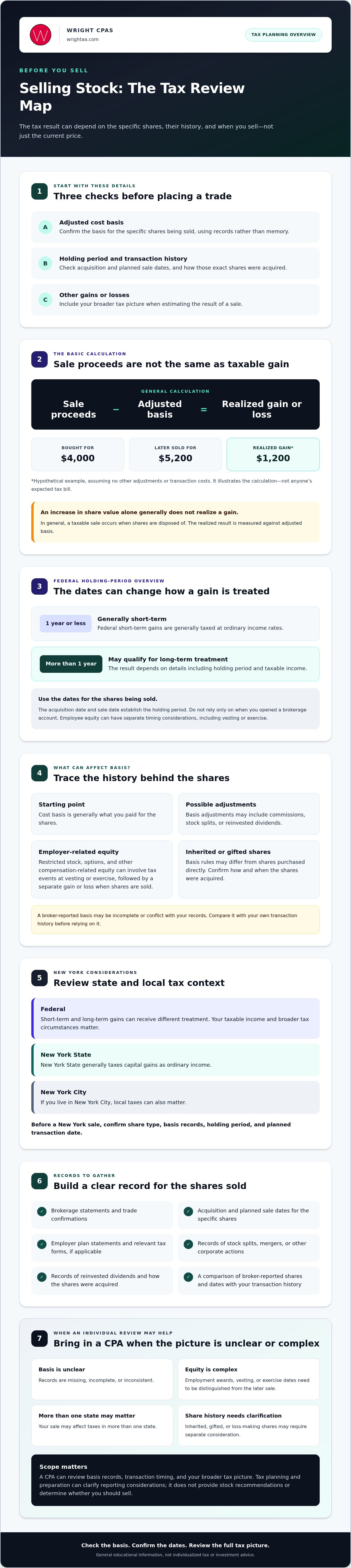
What if the tax cost of selling stock depends as much on its history and timing as on its current price? Good tax advice for selling stock starts with three details: your adjusted cost basis, how long you’ve held the specific shares, and whether you have other gains or losses. Check these before placing a trade so you can estimate the tax result and identify any missing records.
If you’re unsure how much of a sale could be taxable, you’re not alone. Federal tax treatment can differ for short-term and long-term gains, while New York State generally taxes capital gains as ordinary income. Your broader income and, if you live in New York City, local taxes can also matter.
This article covers the main factors to review before a sale, including basis, holding periods, capital losses, and New York considerations. You’ll also find a practical records checklist and examples of when an individual review with a CPA may help. Wright CPAs provides tax planning and preparation, not investment management or securities recommendations.
Key Takeaways
- Sale proceeds are not the same as taxable gain. Adjusted basis helps determine the difference.
- For tax advice for selling stock, check the holding period and transaction history for the specific shares before choosing a sale date.
- Employee equity, inherited shares, and sales at a loss can have different tax considerations. Identify exactly what you own and how you acquired it.
- Before a New York sale, confirm the share type, basis records, holding period, and planned transaction date.
- Consider a CPA review if your basis is unclear, your equity is complex, or the sale may affect taxes in more than one state.
Tax advice for selling stock: what makes a sale taxable?
A stock’s value can rise without creating a capital gain from a sale that you must report. In general, a taxable sale occurs when you dispose of shares. The gain or loss is measured against your adjusted cost basis, not simply by comparing the sale price with what you remember paying. Establishing that basis is the first step in understanding the tax result.
What is a capital gain when you sell stock?
Proceeds are the amount realized from the sale, generally reflecting the sale price and relevant transaction costs. Cost basis is generally what you paid for the shares, with adjustments that may include commissions, stock splits, or reinvested dividends. Subtract adjusted basis from proceeds to calculate a realized gain or loss. It is realized because the sale has occurred; an increase in share value alone generally doesn’t realize it.
Hypothetical example: Suppose someone buys shares for $4,000 and later sells them for $5,200. If there are no other adjustments or transaction costs, the realized gain is $1,200. This shows the calculation, not anyone’s expected tax bill. Keep trade confirmations and account statements, then compare them with tax forms. The Capital gains tax in the United States overview explains the broad distinction between short-term and long-term gains.
For federal tax purposes in 2026, a gain on shares held one year or less is generally short-term and taxed at ordinary income rates. Shares held for more than one year may qualify for long-term capital gains treatment. The result depends on details such as holding period and taxable income, so review your full tax picture rather than assuming a particular rate.
Which stock-sale situations need separate attention?
Shares can have different tax histories. Ordinary shares bought through a brokerage account may be simpler to trace than equity connected to employment. Restricted stock, employee stock options, and other compensation-related equity can involve tax events when shares vest or options are exercised, followed by a separate gain or loss when shares are sold. Review plan records and tax forms to distinguish compensation already reported from the result of a later sale.
Inherited or gifted shares also need a closer look because basis rules may differ from those for shares purchased directly. Before estimating a gain, confirm how and when you acquired the shares. Gather available account and plan documents, then compare them with relevant tax forms.
This is general education, not individualized tax or investment advice. A CPA can review basis records, transaction timing, and your broader tax picture. Tax planning and preparation can clarify reporting considerations, but it does not provide stock recommendations or determine whether you should sell.
How holding period and cost basis change stock-sale taxes
Two details shape the federal tax calculation: how long you owned the shares and the adjusted basis assigned to the shares sold. A date or basis error can change the reported gain and, in some cases, whether it is treated as short-term or long-term. Check both for the specific shares you plan to sell.
How does the holding period affect capital gains tax?
Generally, shares held for one year or less produce a short-term gain or loss; shares held for more than one year may qualify for long-term treatment. The acquisition date and sale date establish the holding period. Confirm the dates for the specific shares being sold rather than relying on when you first opened a brokerage account. Federal short-term gains are generally taxed at ordinary income rates, while long-term gains may receive different treatment. The result depends on your overall tax circumstances, including taxable income. The IRS rules on capital gains and losses provide federal guidance for 2026.
Employee equity may involve additional timing considerations. Restricted shares, options, and other compensation-related awards can have separate tax events before a sale. Review plan documents and employer records, and seek individualized tax advice if vesting, exercise, or sale dates make the timeline unclear.
How do you find and verify your stock cost basis?
Start with brokerage statements and trade confirmations. For shares received through an employer, gather plan statements and relevant tax forms as well. Check whether a stock split, merger, or another corporate action changed the holding, and whether dividends were reinvested. These events can affect basis records. If the basis shown by a broker appears incomplete or conflicts with your records, don’t assume the reported figure tells the full story.
Before filing, compare the shares and dates reported by the broker with your transaction history, and keep records supporting any adjustments. Missing basis can make a gain appear larger than it is; an incorrect basis can distort the calculation in either direction. Tax advice for selling stock can be especially useful when records span multiple accounts, an employer plan, or years of corporate changes.
If records are incomplete or timing is complex, a CPA can review your basis documentation and broader tax picture before a transaction. Wright CPAs provides tax planning and preparation, not investment management or recommendations about whether to sell.
Compare the tax consequences of different stock-sale situations
The tax result can depend on what kind of shares you own, how you acquired them, what happened before the sale, and which rules apply. A brokerage-account purchase may be relatively direct to calculate. Employee awards, inherited shares, and losses call for closer attention to the records behind the transaction.
| Situation | What to review |
|---|---|
| Ordinary shares | Confirm purchase dates, adjusted basis, sale proceeds, and holding period. |
| Employee equity | Review award terms and grant, vesting, exercise, and sale records. Compensation and a later share sale may be separate tax events. |
| Inherited shares | Gather inheritance and valuation records. Basis rules may differ, and inherited assets are generally treated as long-term for federal capital-gains purposes. |
| Shares sold at a loss | Check how the loss may interact with gains and whether a wash-sale rule could affect its treatment. |
Use this comparison as a starting point, not a tax calculation. For an overview of federal treatment of gains and losses, consult the IRS rules on capital gains and losses. A tax professional can help apply current rules to the specific shares and transaction history.
Are employee stock options and restricted stock taxed differently?
They can be. Restricted stock may have a tax event connected with vesting, while an option may raise separate questions at exercise and sale. The details depend on the award type and plan terms, so don’t treat all employee equity as ordinary brokerage shares. Before estimating the gain, assemble grant notices, vesting statements, exercise confirmations, sale records, and related tax forms.
What changes when you sell at a loss or receive shares another way?
A realized capital loss may offset capital gains, subject to applicable rules. If losses exceed gains, federal rules generally allow up to $3,000 of excess net capital loss, or $1,500 for married filing separately, to offset ordinary income in a year; unused losses may generally carry forward. The wash-sale rule may disallow a loss if substantially identical securities are bought within 30 days before or after the sale. Check the full transaction pattern, including activity in other accounts.
Gifted shares may have basis considerations linked to the transfer, while inherited shares follow separate rules. Preserve transfer, valuation, and acquisition records. Tax advice for selling stock is particularly useful when equity awards, a loss sale, or a nonstandard transfer makes the tax history difficult to trace.
What to review before selling stock in New York
A stock sale can have federal and New York tax consequences. The calculations may not align in every detail, and the right treatment depends on your circumstances, including residency and transaction history. Before acting, check current New York State guidance for the tax year of the sale. A federal calculation alone may not settle your state reporting.
How should New York residents consider state tax?
New York generally treats capital gains as part of income subject to its income tax, but the state and federal calculations may differ. Residency matters, too. New York City residents may have local income tax considerations, but city tax shouldn’t be assumed to apply to every New York taxpayer. If you moved during the year or have connections to more than one state, ask a tax professional to review residency and any relevant source-of-income questions.
For a broader view of how tax decisions fit into financial planning, see strategic business tax planning in Buffalo. Individual stock-sale treatment still requires a review of your own records and current state guidance.
What records should you gather before placing a trade?
Before the sale, build a file that shows what you own, how you acquired it, and what has changed since. Gather:
- Share details: Identify whether the shares are ordinary brokerage holdings, inherited or gifted shares, or employee equity.
- Basis support: Collect purchase confirmations, brokerage statements, and records of basis adjustments such as splits or reinvested dividends.
- Equity-plan records: For employee shares, include grant, vesting, and exercise documents, along with relevant tax forms.
- Sale information: Note the planned transaction date and the shares or lots you expect to sell.
- Year-to-date activity: List other realized gains and losses that may affect the overall tax picture.
Compare broker-reported information with your personal records. If the basis, acquisition date, or share history doesn’t match, resolve the discrepancy before relying on an estimate. A CPA can review the documentation, timing, and potential tax implications before the transaction. For tax advice for selling stock in New York, contact Wright CPAs about tax planning and preparation. This is tax support, not investment management or a recommendation to buy or sell shares.
When a CPA can help with tax advice for selling stock
Some stock sales are straightforward to document. Others involve missing basis records, employee equity, a large potential gain, or tax obligations connected to more than one state. These are good reasons to seek an individualized review. A CPA can examine your records, sale timing, reporting considerations, and how the transaction fits into your broader tax picture.
That review can clarify tax questions before you trade, but it isn’t a recommendation to sell or hold a particular investment. A CPA can assess tax considerations; investment decisions remain yours.
What should you bring to a stock-sale tax consultation?
Gather documents that show how you acquired the shares and what has happened since. A complete record gives the tax professional a clearer foundation for reviewing the proposed sale.
- Brokerage statements and transaction history, including purchase confirmations and prior sales.
- Tax forms related to the shares, plus records of any basis adjustments.
- Employee equity documents, such as grant, vesting, and exercise records, if applicable.
- A summary of planned sale details and other realized gains or losses for the tax year.
Bring your questions, too. Ask how basis and holding period should be verified, whether losses or other income may affect the overall picture, and what federal and New York State reporting considerations apply. If a detail is unclear, ask which records or current guidance should be checked before deciding whether or when to sell.
How can Wright CPAs support stock-sale tax planning?
Wright CPAs, LLC provides tax planning and preparation, including tax strategy for individuals. A CPA can review available records, discuss timing considerations, and assess how a planned sale may relate to your wider tax circumstances. Based in Buffalo, the firm serves clients in Rochester and Syracuse, as well as throughout the United States.
Wright CPAs doesn’t provide investment management, stock-picking advice, or securities recommendations. Its role is to clarify tax considerations, not decide which investments to buy or sell. If you’re preparing for a transaction, contact Wright CPAs about stock-sale tax planning.
Prepare your next stock sale with clarity
A planned sale is easier to assess when the key details are in place. Confirm your adjusted basis and holding period, then consider how the share type, realized gains or losses, and New York tax treatment may affect the broader picture. The result depends on your records and circumstances.
Thoughtful tax advice for selling stock can help identify what needs review before you trade. A CPA can assess basis documentation, timing, and reporting considerations, but won’t provide stock-picking advice or determine whether you should sell.
Based in Buffalo, Wright CPAs works with clients in Buffalo, Rochester, and Syracuse, as well as throughout the United States. To discuss tax planning and preparation for a planned sale, discuss your stock-sale tax questions with Wright CPAs.
With organized records and a clearer view of the tax factors, you can approach your next decision with greater confidence.
Frequently Asked Questions
How is stock taxed when you sell it?
Generally, you’re taxed on the gain, not the full sale proceeds. The gain is usually calculated by subtracting your adjusted cost basis from the amount realized on the sale. Federal tax treatment depends in part on how long you held the shares and your taxable income. New York also taxes capital gains as income, so your state tax calculation may differ from your federal one.
How long do you have to hold stock for long-term capital gains treatment?
Generally, you must hold shares for more than one year for a gain to qualify as long-term under federal rules. Shares held for one year or less generally produce a short-term gain, taxed at ordinary income rates. Confirm the acquisition and sale dates for the specific shares being sold. Employee equity and certain other transactions can have additional timing details to review.
Do I pay taxes on stock if I do not sell it?
Generally, an increase in a stock’s value isn’t a realized capital gain until you sell or otherwise dispose of the shares. The gain or loss is usually calculated when that transaction occurs. However, you may still owe tax on income related to shares you hold, such as dividends. Keep dividend records and distinguish that income from any unrealized change in the stock’s market value.
Can I use stock losses to reduce taxes on stock gains?
Generally, realized capital losses can offset capital gains, subject to tax rules. If losses exceed gains, federal rules generally allow up to $3,000 of excess net capital loss, or $1,500 if married filing separately, to offset ordinary income each year; unused losses may carry forward. A wash sale can affect a loss if substantially identical securities are bought within 30 days before or after the sale.
Does New York tax capital gains differently from federal tax?
Yes. New York State generally taxes capital gains as ordinary income, while federal rules may give qualifying long-term gains different treatment. New York City residents may also have city income tax considerations; this doesn’t automatically apply to every New York taxpayer. Whether you live in Buffalo, Rochester, Syracuse, or elsewhere, confirm current state rules and consider residency details before estimating the total tax.
Are stock options taxed when I sell the shares?
Possibly, but tax may arise at more than one point. Depending on the option type and plan terms, exercise may create a tax event; selling the shares can then produce a separate capital gain or loss. Don’t assume all employee options follow the same treatment. Review grant, exercise, and sale records, plus related tax forms, with a tax professional before calculating the outcome.
What records do I need to report a stock sale?
Gather brokerage statements, trade confirmations, transaction history, and tax forms such as Form 1099-B. Keep records of basis adjustments, including stock splits or reinvested dividends, and employee grant, vesting, or exercise documents if relevant. Compare broker-reported details with your own records, since basis information may be incomplete. Tax advice for selling stock can help clarify which documents and reporting considerations apply to your situation.


