

What if the most valuable structure in your Buffalo innovation hub isn't the physical envelope of the building, but the site-specific intelligence generated through your daily technical challenges? For many Western New York creators, determining R&D tax credit eligibility NY feels less like a strategic advantage and more like a labyrinth of conflicting state and federal definitions. It's natural to feel a sense of hesitation when the fear of a New York State Department of Taxation and Finance audit outweighs the promise of a refundable credit.
This guide serves as an intentional blueprint to help you claim what your craft has earned. We'll provide a clear framework to evaluate your projects against the essential four-part test and the looming July 6, 2026 federal amendment deadline for small businesses. You'll learn the vital differences between the 6% Excelsior credit and the 20% Life Sciences incentive, ensuring your financial foundation is as resilient as your designs. We'll show you how to find a local partner who values the materiality of your work as much as the numbers on the page.
Key Takeaways
- Define the relationship between federal and state incentives to create a cohesive financial blueprint for your Western New York business.
- Use the rigorous four-part test to determine your R&D tax credit eligibility NY and ensure your technical documentation reflects the true craft of your innovation.
- Navigate the nuances between the Excelsior Jobs Program and Life Sciences incentives to select the most effective credit path for your specific industry.
- Identify the site-specific criteria required to certify your projects and expenditures within the geographical context of New York State.
- Learn how to treat tax credits as a permanent intervention within a proactive planning framework rather than an isolated year-end exercise.
The Landscape of New York R&D Tax Incentives: A Strategic Overview
The industrial landscape of Buffalo is a study in resilience and adaptation. Much like the restoration of a historic grain elevator, the financial structures supporting our innovation require an appreciation for both legacy and future potential. The R&D Tax Credit isn't just a deduction; it's a foundational tool designed to foster economic growth within the specific cultural context of Western New York. While the federal incentive provides a broad framework under Section 41, New York State offers a more nuanced, site-specific set of credits. For local businesses, understanding R&D tax credit eligibility NY means navigating the intersection of these two distinct layers of support. This duality creates a robust environment for firms that are willing to document their process with the same care they apply to their technical output.
The Intentionality of NY State Credits
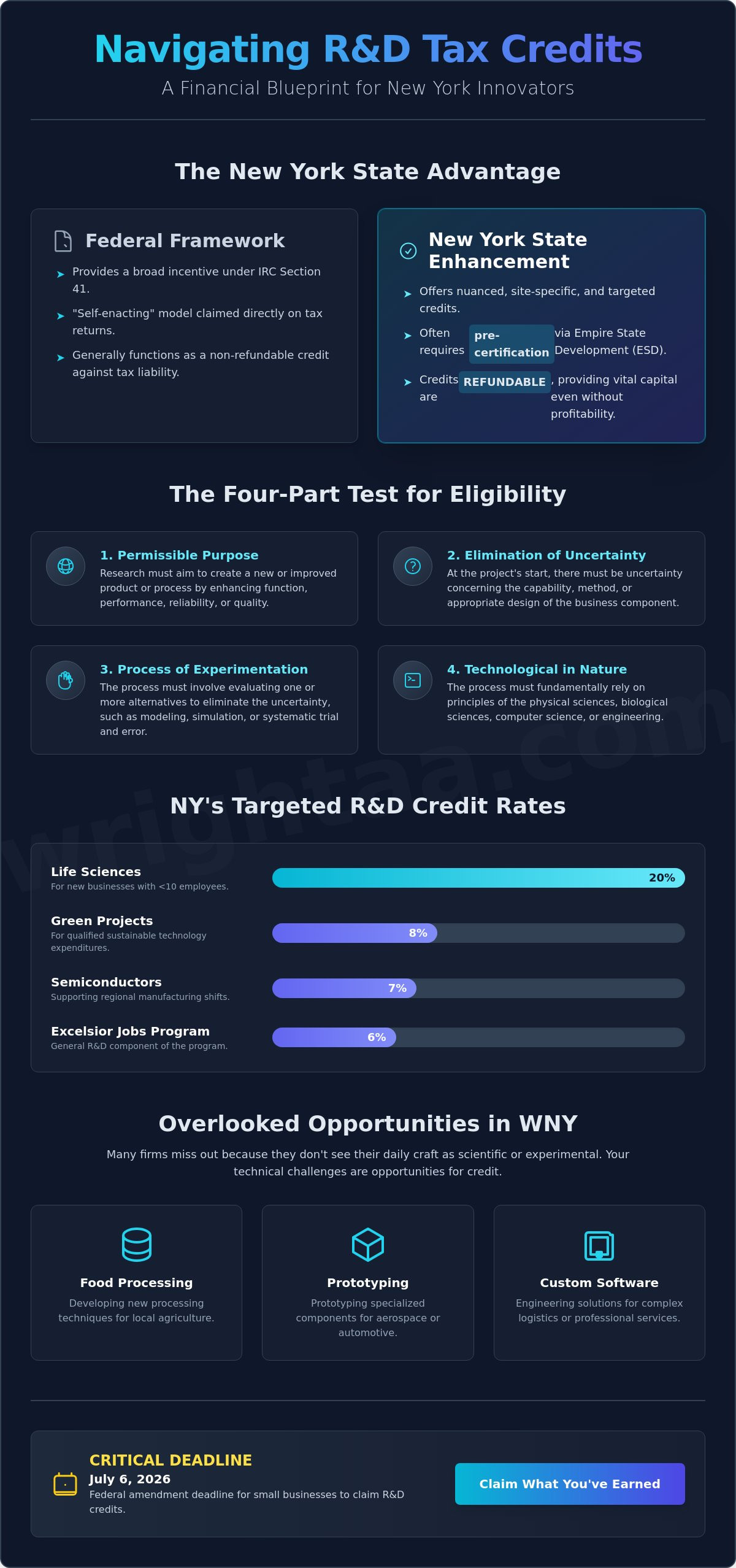
New York's approach is deliberate and curated. Unlike the federal "self-enacting" model where credits are claimed directly on a return, New York often requires pre-certification through Empire State Development (ESD). This process ensures that the capital remains a permanent, thoughtful intervention in the state's economy rather than a fleeting benefit. These credits function as refundable capital, which is particularly vital for startups that haven't yet reached profitability. In the 2025-2026 tax landscape, the state has sharpened its focus on specific sectors:
- Green Projects: Credits are capped at 8% for qualified expenditures in sustainable technology.
- Life Sciences: New businesses can access a 20% credit rate if they employ fewer than 10 people.
- Semiconductor Supply Chain: Specialized rates of up to 7% support the growing tectonic shift in regional manufacturing.
This precision reflects a commitment to the industries that will define the region's future. By requiring certification, the state creates a dialogue between the business and the regulatory environment, ensuring that every dollar of credit is tied to genuine regional advancement.
Why Buffalo and Rochester Businesses Often Overlook Eligibility
There's a common misconception that research only happens within the sterile light of a laboratory. In reality, much of the innovation in Buffalo and Rochester is found in the tectonic shifts of traditional manufacturing and software development. It's in the way a machine shop refines a casting process or how a developer integrates complex data streams to solve a vernacular problem. Qualified Research is a dialogue between problem-solving and technical uncertainty. Many firms miss out because they don't see their daily craft as scientific or experimental. However, the state’s definition is broad enough to include the iterative process of evaluating alternatives. In Buffalo, where the manufacturing heritage is deep, the potential for R&D tax credit eligibility NY is often hidden in plain sight. It's present in:
- Developing new food processing techniques for local agriculture.
- Prototyping specialized components for the aerospace or automotive industries.
- Engineering custom software solutions for complex logistics or professional services.
These activities aren't just business as usual; they are the materials of a sophisticated tax strategy. When you recognize that your technical challenges are actually opportunities for credit, the financial landscape of your business begins to shift into a more purposeful alignment.
The Four-Part Test: The Materiality of Qualified Research
Determining R&D tax credit eligibility NY requires more than a casual inventory of your technical projects. It demands a rigorous evaluation against a four-part framework that serves as the tectonic foundation for every claim. This isn't merely a bureaucratic hurdle; it's a way to define the materiality of your innovation. To qualify, your work must satisfy four distinct criteria established by the internal revenue code and mirrored by state authorities. Each pillar ensures that the credit supports genuine advancement rather than routine business activities.
- Permissible Purpose: The research must aim to create a new or improved business component. This includes enhancing the function, performance, reliability, or quality of a product or process.
- Technical Uncertainty: At the project's inception, the capability, method, or specific design of the solution must be unknown. You're documenting the gap between your vision and your current technical reach.
- Process of Experimentation: You must employ a methodical approach to evaluate alternatives. This involves a structured cycle of modeling, simulation, or systematic trial and error to resolve uncertainties.
- Technological in Nature: The process must fundamentally rely on the principles of physical science, biological science, engineering, or computer science.
When these four elements align, the financial structure of your business gains a new dimension of support. This framework applies whether you are seeking benefits through the Excelsior Jobs Program or the federal credit. It's about proving that your work represents a thoughtful intervention in your field.
Evaluating Technical Uncertainty in WNY Manufacturing
Buffalo's manufacturing sector often meets the uncertainty test through the development of custom tooling and complex process automation. There's a vital distinction between routine maintenance and qualified experimentation. Replacing a worn part is a standard operational task; however, re-engineering a production line to handle a new, volatile material introduces technical risk. In these moments, the outcome isn't guaranteed. You're navigating tectonic shifts in your production capabilities where failure is a real technical possibility. Documenting these specific uncertainties is what secures your R&D tax credit eligibility NY, transforming a technical challenge into a strategic asset.
The Process of Experimentation as a Design Discipline
In the optics and imaging clusters of Rochester, experimentation is a disciplined craft. It moves beyond simple trial and error into a structured scientific method. Every iteration should be captured through contemporaneous documentation, creating a physical and digital record of the innovation. This discipline links financial clarity to the tangible evidence of your work. By maintaining precise records of your hypotheses and results, you elevate the human experience of your technical team, giving their struggles clear economic value. If you're unsure how to translate your daily technical dialogue into a robust tax strategy, reaching out for professional business consulting can help align your documentation with these rigorous standards. This methodical approach ensures your tax plan is as well-crafted as the products you create.
Excelsior vs. Life Sciences: Designing the Right Credit Path
Choosing the right incentive program is a matter of structural alignment. While the federal credit provides the base, New York offers two primary pathways that rarely overlap. Understanding your R&D tax credit eligibility NY involves a careful study of your business's trajectory and specific industry context. The choice isn't merely about the highest percentage; it's about which program integrates most seamlessly with your long-term growth. Each path has its own materiality, requiring a different set of certifications and documentation to remain resilient under scrutiny.
The Excelsior Path for Buffalo Manufacturers
Buffalo's economic fabric is woven with manufacturing and technical craft. For these businesses, the Excelsior Jobs Program is often the vernacular choice. It's a comprehensive framework that includes credits for job creation and investment alongside research. While the R&D component is generally capped at 6% of qualified expenses, it offers a 10-year benefit period. This longevity provides a steady, predictable flow of capital that supports sustained innovation. For green projects, this rate increases to 8%, reflecting the state's shift toward sustainable materiality. Integrating this with the Excelsior Investment Tax Credit creates a multi-layered financial structure that rewards both the research and the physical expansion of your site. It's a permanent intervention designed for businesses that intend to grow deep roots in Western New York.
The Life Sciences Pathway in the Rochester-Syracuse Corridor
For the biotech and pharma startups emerging in the Rochester-Syracuse corridor, the Life Sciences R&D Tax Credit offers a more concentrated incentive. This program is specifically curated for new life sciences companies, providing a 20% credit for firms with fewer than 10 employees and 15% for larger entities. It's a powerful tool for early-stage innovation, though it's constrained by a $500,000 annual cap and a three-year lifetime limit. Syracuse-based startups often leverage the refundable nature of this credit to maintain cash flow during the intensive process of experimentation. It's a shorter, more intense dialogue with the state's tax code, designed to catalyze growth in high-impact sectors where the time to market is long and the capital requirements are heavy.
The distinction between these paths often rests on your entity's status and employee count. New Business status under NY Tax Law Section 210.12 is a critical threshold that can unlock higher refundability. While Excelsior rewards the steady expansion of established firms, the Life Sciences credit is a tactical injection for the nascent stages of discovery. Calculating the ROI requires looking beyond the immediate tax year. A Buffalo manufacturer might find more value in a 6% credit that lasts a decade than a 20% credit that expires in three years. This decision is a central part of determining your R&D tax credit eligibility NY and should be made with an eye toward the permanent intervention of your business in the regional economy.
The R&D Eligibility Checklist for WNY Businesses
Securing R&D tax credit eligibility NY requires a methodical walkthrough of your business structure and operations. It is not enough to innovate; you must certify that your innovation happened within the specific boundaries of the Empire State. This checklist serves as a site-specific guide to ensure your financial foundation is prepared for state scrutiny. Each point represents a layer of compliance that must be addressed with intentionality to build a resilient claim.
- Entity Status: Determine if your business qualifies as a "New Business" under NY Tax Law Section 210.12. This status is a vital lever for achieving full refundability of the credit.
- Location: Verify that 100% of the claimed Qualified Research Expenses (QREs) were incurred within New York State borders. The state is rigorous about geographical context.
- Activity: Ensure every project passes the federal Four-Part Test. This is the tectonic baseline for both federal and state incentives.
- Certification: Initiate the Consolidated Funding Application (CFA) with Empire State Development. New York requires this proactive dialogue to grant the final certificate of tax credit.
Step 1: Identifying Qualified Research Expenses (QREs)
In Buffalo, wages often form the primary materiality of a claim. You must capture the time of engineers and craftspeople who are directly engaged in solving technical uncertainties. Supplies also qualify, representing the physical prototypes or experimental chemicals used during the process of experimentation. If your project involves third-party testers, remember the 65% rule applies to contract research, and these partners must also be located within New York to maintain your R&D tax credit eligibility NY.
Step 2: Engaging the Regional ESD Office
Building a relationship with the Western New York Regional Office in Buffalo or the Finger Lakes Regional Office in Rochester is a strategic necessity. These offices provide the initial vetting for tech-sector applicants and manufacturers. By engaging these regional experts early, you create a dialogue that clarifies state expectations before the tax year ends. This step ensures that your application is not just a submission, but a well-vetted project aligned with regional economic goals.
Step 3: Documenting the Narrative of Innovation
A sophisticated financial strategy requires more than just a list of expenses. It demands a narrative that links your technical challenges to your financial records. Integrating small business accounting Buffalo NY with your R&D tracking ensures that every project shift is documented in real-time. This level of CFO-level oversight is what differentiates a speculative claim from a permanent financial intervention. The credit is only as strong as the documentation supporting it. To ensure your documentation is as well-crafted as your innovation, consider a consultation for tax planning and strategy to align your records with state requirements.
Strategic Integration: Elevating Your Business Through Intentional Planning
Design has the power to elevate. In the same way a well-placed window invites light into a room, a well-structured tax plan invites liquidity into your business. R&D credits shouldn't be treated as a seasonal afterthought or a sudden discovery at year-end. Instead, they function best as a permanent intervention within your broader fiscal structure. True financial health requires a dialogue between your current operations and your future growth. By centering R&D tax credit eligibility NY within your long-term vision, you ensure that every technical challenge becomes a site-specific asset.
For businesses with under $31 million in revenue, the July 6, 2026 deadline for federal amendments represents a finite window to capture retroactive value. This is why intentionality matters. When you treat tax strategy as a core design discipline, you move away from reactive filings and toward a curated financial landscape. Wright CPAs, LLC provides the CFO-level guidance necessary to navigate the complexities of Empire State Development certification. Our goal is to ensure your credits are not just claimed, but defended through rigorous documentation and tectonic clarity.
Designing a Multi-Year Tax Strategy
Building a resilient tax structure for Western New York growth requires balancing various incentives. It's not just about the research credit; it's about how it integrates with the Investment Tax Credit and other state-level programs. This is the foundation of proactive tax planning for Buffalo, NY businesses. Your financial kpis for small business must reflect this reinvestment, showing how R&D credits reduce the effective cost of innovation. We call this the Architecture of Finance. It's a disciplined approach to building wealth that respects the vernacular of your specific industry.
The Wright Approach to R&D Craft
Our "thoughtful maker" philosophy applies as much to complex tax codes as it does to physical design. We understand that your business is inextricably linked to its geographic and cultural context. For those starting a business in Buffalo NY, early vetting of R&D tax credit eligibility NY is a critical step in establishing a sustainable foundation. Wright CPAs, LLC operates on a fixed-fee advisory model, ensuring our partnership is based on substance rather than spectacle. This allows for an unhurried, methodical dialogue about your business's future. Schedule an intentional tax strategy session with Wright CPAs, LLC to begin designing a more purposeful and resilient financial future.
Designing a Resilient Financial Future
Innovation in the Buffalo-Rochester corridor is more than a technical exercise; it's a cultural contribution. By establishing your R&D tax credit eligibility NY, you anchor your firm’s intellectual craft in a sustainable financial reality. We've moved from the broad landscape of incentives to the specific materiality of the four-part test. Now, the focus shifts toward the long-term integration of these credits as a permanent feature of your business architecture.
Wright CPAs, LLC provides the steady, contemplative guidance needed to navigate this terrain. Our proactive planning services for Buffalo, Rochester, and Syracuse focus on substance over spectacle. With CFO-level oversight and a predictable fixed-fee monthly advisory model, we help you build a financial structure that is as intentional as your most refined designs. This ensures your tax strategy remains as resilient as the products you build.
Elevate your tax strategy with a consultation at Wright CPAs, LLC. Let's build a legacy of innovation that is both visionary and grounded.
Frequently Asked Questions
What is the primary difference between the federal and NY R&D tax credit?
The federal credit is self-enacting, while New York requires a formal certificate of tax credit from Empire State Development (ESD). This pre-certification process ensures that your work aligns with the state's economic vision before you claim the benefit. For many local firms, determining R&D tax credit eligibility NY starts with this specific administrative dialogue.
Can a Buffalo-based S-Corp claim the New York R&D tax credit?
Yes, Buffalo-based S-Corps are eligible to claim these credits. As a pass-through entity, the credit typically flows to the individual shareholders to offset their personal New York State income tax liability. This structure allows closely held businesses to reinvest capital directly into their technical craft and regional operations.
How does a company become "certified" by Empire State Development (ESD)?
Certification is achieved through the Consolidated Funding Application (CFA) process. You must submit a detailed project narrative and financial data to Empire State Development for a rigorous review. Once approved, the state issues a certificate that serves as the physical evidence required to claim the credit on your annual tax return.
Is the NY R&D tax credit refundable for startups in Rochester and Syracuse?
Startups in Rochester and Syracuse can receive the credit as a cash refund if they qualify as a "New Business" under NY Tax Law Section 210.12. This is particularly valuable for early-stage companies that haven't yet reached profitability. It transforms a future tax benefit into immediate liquidity for the ongoing process of experimentation.
What industries in Western New York are ineligible for the R&D credit?
Businesses in the retail, hospitality, and professional services sectors are generally ineligible unless they're developing a unique technical process. The research must fundamentally rely on hard sciences or engineering. Routine business activities or purely aesthetic design changes don't meet the rigorous standards for R&D tax credit eligibility NY.
Can I claim both the Excelsior Jobs Program and the Life Sciences credit?
No, you cannot claim benefits from the Excelsior Jobs Program and the Life Sciences R&D Tax Credit simultaneously. These programs are designed as distinct pathways for different business models. You must choose the incentive that best aligns with your business's materiality and long-term growth trajectory.
What documentation is required to survive a NY State R&D tax audit?
Survival in a state audit depends on contemporaneous documentation. You need project logs, lab notes, and detailed payroll records that link specific employee hours to technical uncertainties. This documentation acts as the tectonic record of your innovation, proving that your work was truly experimental and methodical in nature.
How does the 2025 "Green Project" expansion affect R&D eligibility in NY?
The expansion increases the Excelsior R&D credit cap to 8% for qualified green projects. This shift reflects a state-wide commitment to sustainable materiality and environmental adaptation. It provides a significant incentive for Buffalo and Syracuse firms developing technologies that reduce environmental impact or improve energy efficiency.


