

What if your tax strategy was built with the same intentionality as a custom-designed home, where every line serves a purpose and every opening invites light? For many local business owners, the current reality feels more like a structural failure. They face the materiality of unexpected bills on April 15, 2026, or struggle to understand the 25.8% property tax levy increase proposed in the city's latest budget. Choosing proactive tax planning Buffalo NY allows you to move beyond the reactive habits of traditional compliance. It's about treating your financial obligations as a site-specific challenge that requires a master plan rather than a last-minute patch.
You likely feel that your current CPA relationship lacks the dialogue needed to find spatial breathing room in your cash flow. We agree that tax season shouldn't be a source of structural stress. This article demonstrates how a proactive, architectural approach to tax strategy can transform your business from reactive filing to long-term financial clarity. We'll explore specific New York State tax credit integrations and the craft of minimizing liability through legal, intentional design.
Key Takeaways
- Move beyond the materiality of annual filing by designing a financial blueprint that prioritizes long-term clarity over reactive compliance.
- Identify the ideal tectonic structure for your business, ensuring your entity selection serves as a stable foundation for wealth preservation.
- Navigate the specific nuances of the Western New York landscape through proactive tax planning Buffalo NY, including the integration of state-specific credits.
- Implement a quarterly roadmap that treats your financial strategy like a building’s construction, from the initial foundation to the final frame.
- Transition to a collaborative partnership where tax strategy is treated as a refined craft, providing the spatial breathing room your business requires.
Beyond the Return: Defining Proactive Tax Planning in Buffalo, NY
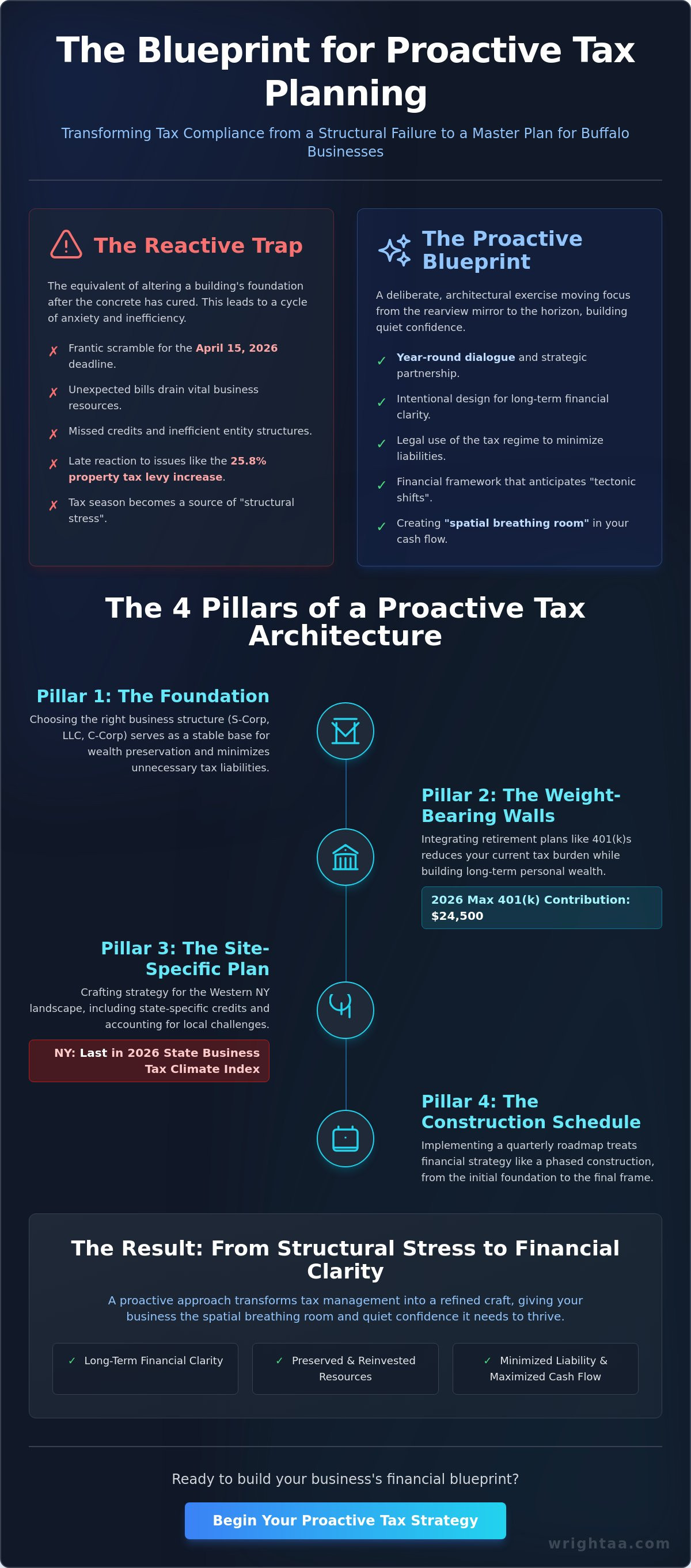
Architecture is the art of permanence. It requires a deep understanding of the site, the materials, and the intended human experience before the first shovel hits the ground. Tax management should follow a similar philosophy. Most business owners in Western New York view taxes through the lens of reactive compliance, a frantic effort to gather documents as the April 15, 2026, deadline approaches. This is the equivalent of trying to alter a building's foundation after the concrete has cured. It's stressful, inefficient, and ultimately limits the potential of the structure.
True proactive tax planning Buffalo NY is a deliberate, architectural exercise. It moves the focus from the rearview mirror to the horizon. By treating tax strategy as a design element rather than a clerical burden, you gain a sense of quiet confidence. You aren't just reacting to the 25.8% property tax levy increase proposed in the city's latest budget; you're building a financial framework that accounts for these tectonic shifts in the local landscape.
The Reactive Trap vs. The Strategic Vision
Waiting until January to discuss your tax position is a missed opportunity for Buffalo entrepreneurs. By then, the window for meaningful intervention has closed. Compliance-only accounting often results in missed credits and inefficient entity structures that don't reflect your current growth. This reactive habit creates a cycle of anxiety and unexpected bills that drain your business's vital resources. Proactive tax planning is a year-round dialogue between CPA and client.
This dialogue centers on the legal use of the tax regime to minimize your liabilities before they become permanent. It's a disciplined process of evaluating every business decision through a tax-efficient lens. When you plan ahead, you're not just filing forms; you're crafting a site-specific strategy that respects the unique challenges of the New York tax climate, which recently ranked last in the 2026 State Business Tax Climate Index.
The Materiality of Tax Savings
In our practice at Wright CPAs, LLC, we view tax savings as the "materiality" of your financial health. Just as the choice of stone or timber dictates the feel of a room, your tax strategy dictates your cash flow. Intentionality is the core of this process. It involves choosing precisely when to realize income or expenses to maximize your spatial breathing room. We don't see taxes as an isolated technical exercise. Instead, we see them as a vital component of your business's tectonic structure. This approach ensures that your financial resources are preserved and reinvested into the craft of your business, elevating your overall experience as a founder.
The Architecture of Strategy: Core Pillars of a Proactive Tax Plan
A building’s integrity relies on its tectonic structure. In the context of proactive tax planning Buffalo NY, this structure begins with entity selection. Whether you choose an S-Corp, LLC, or C-Corp, the decision defines how your business interacts with the legal environment. It’s the foundational line on your financial blueprint. Without the right frame, even the most successful business can feel cluttered by unnecessary tax liabilities and administrative weight.
Entity Selection as a Structural Foundation
The S-Corp vs. LLC tax implications aren't merely technical choices; they represent the vernacular of your business growth. New York State requires revised withholding tables as of January 1, 2026, making the precision of your payroll strategy more critical than ever. A well-designed entity structure ensures you don't overpay self-employment taxes while maintaining the flexibility needed for a scaling Buffalo enterprise. As your business matures, re-evaluating this foundation becomes essential to preserve financial integrity and spatial breathing room.
Beyond the legal frame, retirement integration acts as a weight-bearing wall for your personal wealth. By maximizing 401(k) contributions, which rose to $24,500 for the 2026 tax year, you reduce your current tax burden while building long-term stability. This isn't a separate task. It’s a fundamental integration into your payroll strategy that elevates the human experience of business ownership. It turns a mandatory expense into a thoughtful investment in your future site.
Maximizing Deductions through Craft and Precision
Precision in documentation is the craft of the modern entrepreneur. For Buffalo law firms and consultants, identifying industry-specific deductions requires a deep understanding of New York State business taxes. It’s about recognizing the materiality of every expense. Whether it’s the site-specific costs of a historic office renovation or the nuances of professional development, every deduction must be documented with architectural rigor to withstand the scrutiny of an audit.
Effective small business accounting in Buffalo, NY serves as the primary blueprint for these deductions. Choosing between cash and accrual accounting methods provides the clarity necessary for predictable cash flow. For many, the unhurried pace of a thoughtful financial consultation reveals opportunities that a rushed tax season would overlook. You deserve a financial structure that feels as permanent and intentional as the city’s most iconic landmarks.
Navigating the New York Landscape: Local Tax Nuances for Buffalo Businesses
Every building is inextricably linked to its site. For a business, that site is the regulatory and economic environment of New York State. Understanding the specific materiality of local tax laws is essential for any structure intended to last. In Buffalo, this means looking beyond federal obligations to the unique requirements set by the NYS Department of Taxation and Finance. Without a site-specific plan, you risk building on shifting sand.
New York State Specific Credits and Incentives
True craft in tax strategy involves identifying incentives that others overlook. The Excelsior Jobs Program provides a framework for growth, offering credits for job creation and investment that are highly site-specific to Western New York. For partnerships and S-Corps, the Pass-Through Entity Tax (PTET) serves as a vital tectonic shift in how we approach state liabilities. It allows for a workaround of the federal SALT deduction cap, effectively reducing the net tax burden on the human owners of the firm. This election must be made with intentionality, as it changes the very flow of your quarterly obligations.
For legal professionals, the integration of IOLTA compliance with broader tax efficiency is a delicate exercise. It requires a CPA who understands the professional vernacular of law practices. By aligning trust accounting with proactive tax planning Buffalo NY, firms ensure that their financial reporting is as precise as their legal arguments. This discipline prevents the "leakage" of capital and ensures that every dollar is accounted for within the practice’s broader blueprint.
The Buffalo "Place" Factor
Buffalo’s fiscal climate presents dualities that require careful navigation. While New York State implemented income tax rate reductions on January 1, 2026, the City of Buffalo proposed a 25.8% property tax levy increase to address structural deficits. This shift impacts the cost of doing business within city limits compared to neighboring Amherst or Williamsville. A thoughtful maker looks at the whole landscape, considering how these local property and school tax obligations intersect with your broader strategy. It's about finding the spatial breathing room within a high-tax environment.
Managing nexus is another layer of the architectural design. If your Buffalo firm serves clients in Pennsylvania or Ontario, you create a dialogue across state lines that the tax authorities watch closely. This is no longer just a local matter; it is an integration of multiple tax vernaculars. Proactive tax planning Buffalo NY ensures that these exterior relationships don't compromise the interior strength of your financial position. It’s about building a business that respects its origins in the Queen City while maintaining the structural integrity to reach beyond its borders.
The Construction Phase: Implementing a Proactive Roadmap in 2026
A blueprint only gains value when the construction begins. In the context of proactive tax planning Buffalo NY, this requires a rhythmic, quarterly commitment to the financial structure of your business. We view the fiscal year as a construction project, moving from the stability of the foundation to the precision of the finishing touches. This steady, unhurried pace ensures that no detail is overlooked and that the human experience of business ownership remains serene rather than frantic.
In Q1, we lay the foundation. This period involves a retrospective look at the 2025 performance while adjusting the current year’s blueprint. With the federal filing deadline of Wednesday, April 15, 2026, acting as a primary anchor, we ensure that the prior year’s materiality is correctly captured. Moving into Q2, the frame of your strategy takes shape. This is the time for mid-year check-ins and estimated payment adjustments, particularly as New York State’s revised withholding tables and the 11.70% supplemental wage withholding rate impact your cash flow requirements.
The integration occurs in Q3. We analyze financial KPIs to determine if the business is performing according to its design. If the data suggests a surplus, we begin the dialogue regarding year-end spend to maximize tax efficiency. Finally, Q4 represents the finishing touches. Before the December 31 deadline, we finalize retirement contributions and deductions, ensuring every tectonic shift in the tax code is accounted for before the books close.
Quarterly Checkpoints for Financial Clarity
Design remains site-specific only through constant observation. Fixed-fee monthly advisory ensures that your tax strategy isn't a static document but a living dialogue. This is where outsourced CFO services from Wright CPAs, LLC provide real-time monitoring of your financial health. By adjusting estimated payments throughout the year, you avoid the structural stress of New York State underpayment penalties. This disciplined approach creates the spatial breathing room necessary for thoughtful leadership.
Year-End Strategy: The Final Walkthrough
The final weeks of the year serve as a walkthrough of your financial site. We look for opportunities to enhance the structure, such as strategic equipment purchases utilizing Section 179 or bonus depreciation rules. Charitable giving also plays a role, allowing you to support the Buffalo community while refining your tax position. If you're ready to move from reactive filing to an intentional roadmap, you can schedule a strategic blueprint session to begin your 2026 planning. Every decision made before December 31 strengthens the permanence of your business's success.
Elevating the Human Experience through Strategic Partnership
Tax planning is not merely a technical exercise. It is a poetic one. At Wright CPAs, LLC, we view the financial landscape of a business as a "thoughtful maker" views a site before the first line is drawn. Every business has a unique vernacular, a specific way it moves through the world and interacts with its environment. By choosing proactive tax planning Buffalo NY, you move beyond the materiality of simple filing. You begin to design a financial structure that serves the human experience of ownership, providing the calm and purpose necessary to lead with clarity.
The dialogue between a CPA and a business owner should be steady and unhurried. We prioritize listening deeply to your goals before suggesting a single structural change. This intentionality ensures that every tectonic shift in your strategy is grounded in your specific needs. Whether you are navigating the complexities of the New York State business climate or planning for long-term wealth preservation, the partnership acts as a weight-bearing wall for your ambitions. It is an integration of professional expertise and your personal vision.
The Wright CPAs, LLC Difference
Our commitment to craft and precision is rooted in the Buffalo business community. We understand that a firm in the Queen City faces different dualities than one in Rochester or Syracuse. This site-specific knowledge allows us to provide a more curated experience. For those just beginning their journey, our guide on starting a business in Buffalo serves as an initial blueprint. It integrates early-stage decisions with the long-term goal of financial intentionality, ensuring your foundation is poured correctly from day one.
We favor the use of fixed-fee retainers to create spatial breathing room in your budget. This model eliminates the friction of hourly billing and encourages a continuous, open dialogue. When your financial oversight is predictable, your mind is free to focus on the substance of your work. It moves your finances from a source of anxiety to a source of meaning. You gain the freedom to reinvest in your craft, knowing that your tax strategy is being managed with architectural rigor.
Your Next Intentional Step
Starting your journey toward financial clarity begins with a single walkthrough of your current position. During a proactive tax consultation with Wright CPAs, LLC, we examine the existing structure of your business to find where the light can be let in. We look for inefficiencies in your entity selection and missed opportunities in your local tax credits. This process is patient and methodical, designed to build trust and provide a clear roadmap for the 2026 tax year and beyond.
There is a profound peace of mind that comes from a well-designed financial structure. It allows you to move through the fiscal year with a sense of quiet authority. If you are ready to elevate your business through a more sophisticated approach to your finances, we invite you to design your proactive tax strategy with Wright CPAs, LLC today. Let's build a permanent structure of tax efficiency that honors the craft of your business and the place you call home.
Designing a Permanent Financial Legacy
Tax strategy is the foundation upon which business longevity is built. By moving from reactive filing to a rhythmic dialogue, you create a structure that resists the pressures of shifting local regulations. We've explored how entity selection serves as a tectonic base and how quarterly roadmaps provide spatial breathing room. Proactive tax planning Buffalo NY is more than a technical necessity; it's an act of financial craft that respects the unique vernacular of Western New York.
Since our founding in 2012, Wright CPAs has focused on elevating the human experience for law firms and closely held businesses. We serve the communities of Buffalo, Rochester, and Syracuse with a commitment to precision. Design has the power to elevate. Your financial future deserves the same level of excellence as a master-planned building. It's time to move beyond the materiality of simple compliance toward a future of quiet confidence.
Elevate your business strategy with proactive tax planning from Wright CPAs.
Frequently Asked Questions
What is the difference between tax preparation and proactive tax planning?
Tax preparation is a retrospective exercise that records past financial events, while proactive tax planning is the intentional design of future outcomes. Preparation focus on compliance after the year has ended. Planning involves a continuous dialogue throughout the year to shape your business's tectonic structure and minimize liabilities before they become permanent. It's the difference between documenting a finished building and drafting a blueprint for its construction.
How often should I meet with my Buffalo CPA for tax planning?
You should meet with your CPA at least quarterly to ensure your financial strategy remains aligned with your operational reality. These rhythmic check-ins allow for real-time adjustments to estimated payments and deduction strategies. This steady cadence prevents the structural stress of unexpected bills in April. It ensures that your tax roadmap remains site-specific to your current business needs and goals.
Can proactive tax planning help reduce my New York State tax bill specifically?
Yes, proactive tax planning Buffalo NY identifies state-specific opportunities such as the Pass-Through Entity Tax election and WNY-specific investment credits. These strategies are designed to navigate the dualities of the New York tax landscape. By focusing on local incentives and credits, we help you retain more capital within your business. This intentionality creates spatial breathing room in a high-tax environment.
Is proactive tax planning only for large corporations in Buffalo?
Proactive planning is essential for businesses of all scales, particularly closely held firms and professional practices. Small businesses often have more flexibility to implement creative entity structures and payroll strategies. Every business deserves a foundation built with precision and craft. Whether you're a solo consultant or a growing firm, intentional design protects your resources from reactive habits.
What are the most common tax planning strategies for Buffalo law firms?
Common strategies for law firms include optimizing entity selection to manage self-employment taxes and maximizing retirement contributions like the $24,500 limit for 2026. Firms also benefit from aligning their IOLTA compliance with broader tax efficiency goals. These interventions ensure that the practice’s financial frame is as disciplined as its legal work. It elevates the human experience for partners and their families.
How does New York’s PTET (Pass-Through Entity Tax) work for small businesses?
The PTET allows partnerships and S-Corps to elect to pay state income tax at the entity level. This strategy effectively bypasses the $10,000 federal cap on state and local tax deductions. It results in a lower federal taxable income for the business owners. This election must be made with precision to ensure it integrates correctly with the firm’s broader financial blueprint.
What is the cost of proactive tax planning services in Buffalo, NY?
We favor a fixed-fee retainer model that provides predictable, intentional financial oversight without the friction of hourly billing. This model encourages a continuous dialogue between the maker and the expert. While the specific investment depends on the complexity of your business site, the focus is always on the value of long-term clarity. It turns an administrative cost into a strategic investment in your business’s permanence.
Can I start tax planning mid-year, or do I have to wait for January?
You can begin the planning process at any time since strategic design isn't constrained by the calendar. Starting mid-year allows for significant adjustments to your estimated payments and equipment purchases before the final quarter. It's better to begin the walkthrough of your finances today than to wait for the next filing season to uncover structural flaws. Early integration leads to more refined results.


