

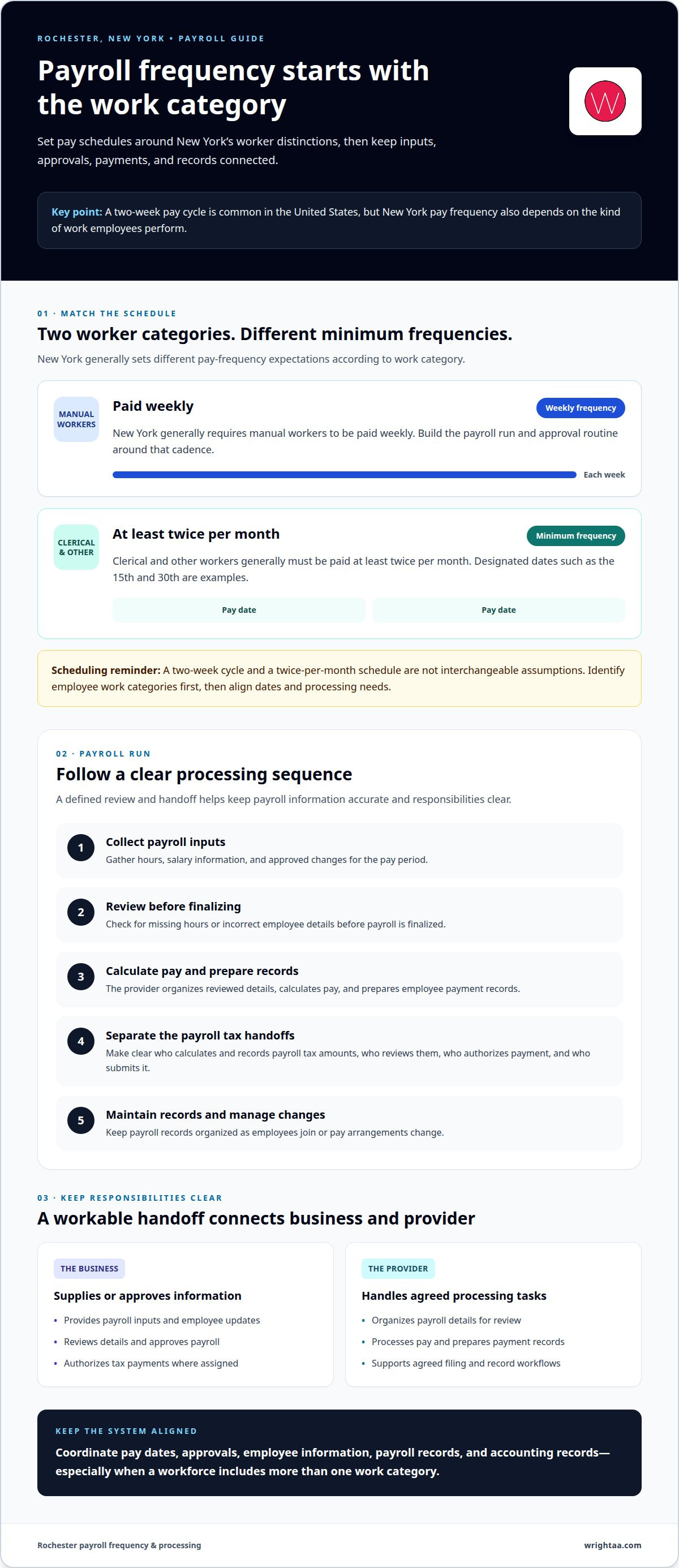
In Rochester, payroll frequency depends on employees’ work categories, not a one-size-fits-all calendar. New York generally requires manual workers to be paid weekly, while clerical and other workers must be paid at least twice per month. Payroll management services in Rochester need to account for these distinctions when setting schedules.
A two-week pay cycle is common in the United States, but it is not the only consideration for a small business in New York. Your schedule needs to follow the rules and keep payroll, accounting records, and employee information aligned.
This article explains how often different workers must be paid, what payroll processing involves, and how accounting and HR support can work alongside it. You’ll also see what to consider when choosing professional support for a small business, so the process fits the way your business operates.
Key Takeaways
- Compare payroll providers by how well their support, processing approach, and fit align with your small business.
- Understand the steps involved in payroll processing and the factors that shape a suitable pay schedule.
- See how professional support can help manage New York payroll filings and keep payroll records connected to business accounting.
- Learn when combining payroll services with bookkeeping, cash flow management, and tax planning can create a clearer financial picture.
What is the best payroll company in Rochester, NY for a small business?
The right fit depends on your workforce, pay schedule, and support needs. A provider can help Rochester businesses organize payroll by understanding their current steps, employee information, and reporting needs.
Local and National Provider Comparison
There are 43 payroll services results listed for Rochester, New York, so begin with the work each provider will handle. Compare local knowledge, processing support, reporting options, and how questions reach a person. A national provider may offer a standardized platform, while a local provider may offer more direct regional context. For either choice, ask how the service supports accurate records and compliance tasks.
Service Selection and Setup
Start setup with a clear picture of your current process. Review employee classifications, pay schedules, payroll records, and approval steps, then organize the service around those needs. For example, a small Rochester business with hourly and salaried staff may need different time and pay inputs. A clear transition plan also spells out who provides information, who reviews payroll, and when each step happens.
A local sales team can make the first discussion more specific to Rochester businesses. It should be able to explain the service’s workflow, identify which information is needed for setup, and describe how support continues after enrollment. For example, a representative can map how an owner submits hours and approves a payroll run. That conversation helps reveal whether support is dedicated or routed through a general service channel.
Local economic impact can also inform the decision. Choosing a Rochester-based provider may keep more business relationships within the regional economy, while a national provider may serve companies across multiple locations. Consider which relationship suits your operations, not just the provider’s address. A business with local hiring and one operating location may value regional familiarity; a company with distributed staff may prioritize consistent processes across locations.
Use a simple selection sequence: define the payroll tasks, compare support models, then review the setup process. Payroll management services in Rochester should make responsibilities clear and keep records organized. Efficient service depends on a workable handoff between your business and the provider, not just a platform.
Payroll processing and pay-cycle frequency
Pay frequency shapes employee expectations and the timing of each payroll run. In New York, the schedule depends in part on the type of work employees perform.
Pay-Cycle Frequency
A two-week cycle is typical in the United States, while the 15th and 30th are examples of designated monthly payment dates. New York generally requires manual workers to be paid weekly. Clerical and other workers generally must be paid at least twice per month. The right schedule starts with identifying employee work categories, then aligning each group’s pay dates with processing needs.
A business with manual and clerical employees, for example, may need to coordinate different pay schedules. Payroll support can help organize those schedules so pay dates, approvals, and employee records stay aligned.
Payroll Administration
Processing starts with collecting payroll inputs for each pay period, such as hours, salary information, and approved changes. The provider organizes those details for review, calculates pay, and prepares employee payment records. A clear approval step helps catch missing hours or incorrect employee details before payroll is finalized.
Administration also involves maintaining records and managing changes, such as a new employee or a revised pay arrangement. A clear process assigns responsibility at each handoff: the business supplies or approves information, and the provider handles agreed processing tasks. This supports accurate records and clear responsibilities.
Payroll Tax Payments
Payroll processing also involves calculating and recording payroll tax amounts related to employee pay. The service arrangement should make clear how those amounts are reviewed, who authorizes payment, and who submits it. Calculation, approval, and payment are separate steps in the payroll workflow.
During setup, providers can document the tax-payment workflow alongside payroll dates. For example, the process can identify the person who reviews payroll totals and the person responsible for authorizing payment. A platform can keep payroll calculations and payment records together, giving the business a clear trail for routine reviews. Payroll processing support can help establish this handoff.
Payroll services for Rochester small and midsized businesses
Rochester businesses can organize payroll processing, filing deadlines, and employee records with professional support. To avoid unclear responsibilities and fees, define the services and charges before setup.
Payroll Outsourcing for Business Sizes
Outsourcing assigns agreed payroll tasks to a provider, while the business supplies or approves the information needed to process pay. A small employer may need help with regular payroll runs and employee changes. A midsized business may need clearer workflows for multiple teams or locations. The right arrangement depends on staff structure, payroll complexity, and the level of support needed.
Consider how support will adapt as your workforce changes. A specialist who understands the business can help track New York filing deadlines and annual rate or compliance changes. Clarify the provider’s role, the business’s approvals, and the handoff for employee updates.
Available Payroll Features and Services
Rochester businesses can look for support with payroll processing, employee record tracking, and recurring filing tasks. New York payroll obligations include state disability benefits (DBL), Paid Family Leave (PFL), and new hire reporting. The workflow should show how these items fit within the agreed scope and who handles each step.
Business size shapes the coordination required. A small team may need a simple process for submitting hours and approving payroll. A growing business may need defined access and approval roles across departments. Payroll support can also connect with accounting tasks, keeping payroll information organized alongside business records.
Outsourcing Risks and Hidden Fees
Payroll providers may charge a base fee plus a per-employee charge. The total can depend on the selected services and workforce details. Ask for a clear breakdown of processing, support, and additional tasks. This helps distinguish the core arrangement from optional services without assuming every provider uses the same fee structure.
Operational risks include incomplete employee information, unclear approval duties, and missed handoffs between the business and provider. Set out who submits changes, reviews payroll, and tracks New York reporting tasks. Business insurance is separate from payroll administration: assess coverage for your own operations rather than treating payroll outsourcing as insurance protection.
Payroll services combined with accounting and HR consulting
Payroll works best as part of a connected operating process. Linking payroll, accounting, and employee information can reduce duplicate data entry and give owners a clearer view of labor costs.
Start by defining how information moves between functions. Payroll records show wages and related costs; accounting uses those figures to maintain financial records and prepare reports. Employee records may include details and changes that affect payroll. When teams enter the same information separately, errors and delays can follow. Shared workflows help make each handoff clear.
Technology can support that connection, but a platform alone does not assign responsibilities. Define who submits employee changes, who reviews payroll totals, and who records payroll expenses. For example, a new hire’s details can follow an agreed approval path before being entered in payroll and accounting records. This keeps the process traceable without requiring several people to re-enter the same data.
Connected records also help owners understand labor costs in context. A CFO-level review can examine payroll alongside cash flow and other operating expenses. That perspective can inform staffing plans, budget decisions, and the timing of business spending. The value is not simply a faster filing process, but a clearer picture of payroll’s effect on the business.
Choose a partner whose process fits your company’s size and structure. A small team may need a direct approval path, while a business with several managers may need defined access and review roles. Good support clarifies the handoffs between payroll processing, accounting entries, and employee information. It should also spell out which tasks the provider handles and which decisions remain with the business.
For Rochester businesses, payroll management services can be more useful when they connect payroll activity with financial planning. Explore integrated payroll and accounting support to bring those responsibilities into a clearer operating structure.
Wright CPAs, LLC: Payroll Services
Wright CPAs, LLC provides Payroll Services for businesses seeking support with payroll processing and administration. This can be a natural next step when payroll is taking time away from business operations or payroll records need closer coordination with bookkeeping.
Payroll connects directly to financial visibility. Pairing payroll support with Bookkeeping can help keep payroll activity reflected in business records. Cash Flow Management can help owners understand how payroll timing fits broader cash needs, while Tax Planning and Preparation supports a wider view of tax-related decisions.
Consider this support when you want payroll handled alongside related accounting work, rather than as a separate process. Wright CPAs, LLC can help organize these connected responsibilities around your business’s needs.
Contact Wright CPAs, LLC to discuss payroll support for your business.
Give Your Payroll Process a Clear Next Step
Payroll is part of how a business operates, not an isolated task. A useful next step is to decide how payroll responsibilities should connect with financial records and future planning. That gives the process a purpose beyond completing each pay run.
For Rochester businesses, choosing payroll management services should start with the structure you need: clear responsibilities, dependable records, and support that fits your operations. Wright CPAs, LLC offers Payroll Services alongside Bookkeeping and Tax Planning and Preparation, helping business owners consider these connected needs together. Start by identifying where payroll creates friction and what support would make the work more orderly.
If you’re ready to discuss how payroll support could fit your business, contact Wright CPAs, LLC about payroll services. A clear conversation can help you identify a practical next step and move forward with greater confidence.
Frequently Asked Questions
How often must Rochester employers pay employees?
New York generally requires manual workers to be paid weekly, while clerical and other workers must be paid at least twice per month. A common two-week payroll cycle does not override these distinctions. Identify each employee’s work category before setting pay dates. For instance, a business with both manual and clerical staff may need separate schedules to meet the applicable frequency rules.
What payroll management services are available in Rochester, NY?
Rochester businesses can use payroll processing support, employee record administration, payroll tax payment support, and filing assistance. The exact workflow depends on the provider and the tasks included in the arrangement. Wright CPAs, LLC offers Payroll Services, including payroll solutions that can include preparation and filing of Form 1099s. Some businesses also coordinate payroll with bookkeeping so payroll activity is reflected in financial records.
Which payroll providers serve Rochester-area small businesses?
Rochester small businesses can consider local providers and national payroll companies. Wright CPAs, LLC offers Payroll Services to businesses in Rochester, Buffalo, and Syracuse. Providers may differ in how they deliver support, process payroll, and coordinate related tasks. To narrow the options, identify the workflow your business needs, then compare service scope and support structure against it.
How do payroll services compare for price, features, and customer support?
Compare each provider’s included services, support model, and fee structure rather than relying on a headline price. Payroll providers may charge a base fee plus a per-employee charge, so the total depends on the arrangement and workforce. Review whether processing, filings, employee updates, and direct support are included or separate. A written scope makes service packages easier to compare.
Can Rochester payroll providers handle payroll taxes and tax filings?
Providers can support payroll tax processing and related filing tasks, depending on the service arrangement. Clarify who prepares calculations, submits payments, files required documents, and maintains records. These are distinct responsibilities, even when one provider supports several steps. For example, a business may use a provider to prepare payroll information while retaining approval responsibility for payments. Wright CPAs, LLC offers Payroll Services and Tax Planning and Preparation.
What New York State and local payroll requirements apply to Rochester employers?
Rochester is in New York State’s remainder-of-state wage region. The general minimum wage there is $16.00 per hour as of January 1, 2026; tipped employees and certain industries may have different rates or rules. New York payroll obligations include state disability benefits (DBL), Paid Family Leave (PFL), and new hire reporting. The amended New York State Pay Transparency Law impacts businesses with 4 or more employees.


