

A business doesn’t have to be large or highly complex to benefit from CFO-level perspective. Part-time CFO services in Syracuse may help when bookkeeping alone no longer answers the financial questions you face. Consider whether clearer cash flow visibility, forecasting, or financial analysis would help you make decisions with greater confidence.
It’s reasonable to wonder whether your business is ready for this support. The answer depends less on company size than on the questions you need to resolve: how much cash will be available, what growth may require, or which costs are affecting your margins.
This article explains what part-time CFO support can involve, how it differs from routine bookkeeping, and what to consider when deciding whether it fits your business. It also covers how forecasting and cash flow management can bring structure to financial decisions, and how Wright CPAs’ CFO services may fit into your next steps.
Key Takeaways
- Assess the financial decisions ahead, not just your company’s size, to determine whether CFO-level support could help.
- Trace when cash enters and leaves the business to spot working capital pressures and improve visibility.
- Use forecasting to explore how changing assumptions may affect plans, resource needs, and financial decisions.
- Look for CFO experience that aligns with your business needs, then consider how financial guidance can work alongside bookkeeping and tax planning.
CFO support for startups and expanding businesses
In Syracuse, a growing business can use CFO guidance to connect everyday accounting with decisions about hiring, investment, and expansion. A practical test is whether better financial insight could change what you do next.
Fractional CFO Support for Syracuse Businesses
A fractional CFO provides senior financial guidance without requiring a full-time executive role. For a Syracuse business, start by identifying decisions that need stronger analysis, such as setting a hiring plan or assessing a new market opportunity. Then consider whether regular discussions, financial reporting, and clear follow-up responsibilities will provide useful insight. Local context matters, but the work should be grounded in your company’s actual numbers.
Financial Operations During Growth
Growth adds moving parts: more transactions, payroll coordination, and decisions about where cash should go. CFO guidance can help owners establish a monthly review of revenue, expenses, cash needs, and the assumptions behind plans. Payroll processes are another operational detail to consider. The Internal Revenue Service identifies Form 941 as a federal payroll tax filing; a payroll service may handle it as part of payroll administration. Clear ownership of each task helps keep financial operations orderly as responsibilities expand.
Business Fit and Benefits
Startups and established small businesses can benefit when owners need financial guidance beyond routine accounting. This support may be useful when weighing a new location, hiring, or a change in sales strategy. The key question is whether recurring financial challenges call for analysis and a decision-making process, rather than transaction recording alone. Urgent daily processing may still require separate bookkeeping or payroll workflows.
Small-business assistance programs in Syracuse or New York may offer advising or financing, but eligible uses depend on each program’s rules. Distinguish general business support from funding specifically available for CFO services.
Services in Part-Time CFO Packages
Define the work around business decisions and deliverables. Common areas include reviewing financial statements, preparing forecasts, monitoring cash flow, evaluating performance, and planning strategic choices. Some engagements also coordinate with accounting, bookkeeping, or payroll processes. Ask what information informs each analysis, how often results are reviewed, and who is responsible for follow-up. A clear scope makes it easier to match the support to your business’s needs.
Cash flow and working capital visibility
Cash flow visibility connects incoming payments, operating costs, and upcoming commitments. For Syracuse businesses, this helps owners make decisions based on timing as well as profitability.
Cash Flow and Profitability Guidance
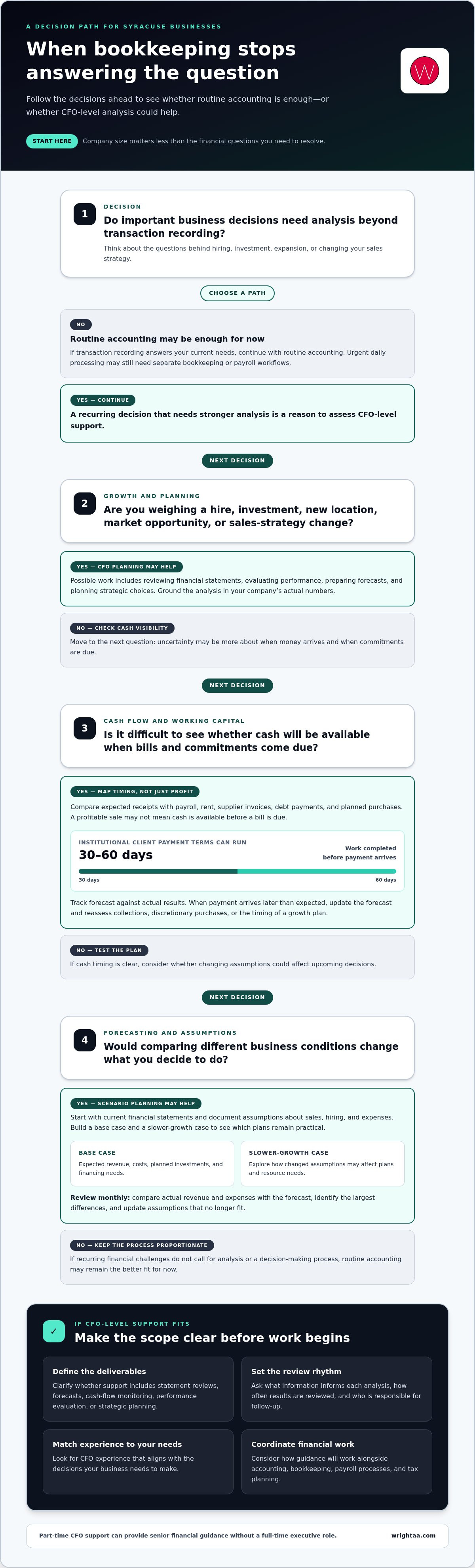
Profit on an income statement doesn’t always mean cash is available when bills fall due. Compare reported revenue with collection timing, payroll, supplier payments, and other planned costs. Institutional client payment terms for Syracuse businesses can run 30 to 60 days, leaving a gap between completing work and receiving payment. Mapping that timing against expenses helps show where working capital is under pressure. An executive can then weigh whether to adjust spending, follow up on receivables, or revise a growth plan.
For useful analysis, review the assumptions behind each forecast. A delayed customer payment or unexpected expense can change available cash without changing the sale’s underlying profitability. Keep those distinctions visible in your numbers, rather than treating profit and liquidity as interchangeable.
Commitment and Liquidity Management
Liquidity planning starts with a clear view of available cash and upcoming commitments. List expected receipts alongside payroll, rent, supplier invoices, debt payments, and planned purchases. Then identify the dates when cash may be under the greatest pressure. This helps you judge whether a planned commitment fits your cash position or whether its timing needs reconsideration.
Cash flow analysis should also track the relationship between forecast and actual results. When a customer pays later than expected, record the variance and update the forecast. Owners can use that insight to prioritize collections, sequence discretionary purchases, or preserve cash for essential obligations. A consistent review turns financial guidance into a practical decision tool, not simply a report. For support shaping this process, explore cash flow management as part of your financial planning.
Financial forecasting
A useful forecast connects expected revenue with operating costs, planned investments, and financing needs. Start with current financial statements, then document assumptions about sales, hiring, and expenses. Build a base case and a slower-growth case to see which decisions remain practical under different conditions. This gives leadership a shared view of risks and opportunities before commitments are made.
Banking and credit oversight also belong in the plan. Review available cash, existing borrowing, repayment obligations, and the purpose of any proposed credit facility. Financing equipment, for example, differs from borrowing to cover a temporary gap between invoicing and receiving customer payments. CFO-level guidance can help owners compare financing needs with forecast cash generation and prepare focused questions for their bank.
A monthly review turns forecasts into practical management tools. Compare actual revenue and expenses with the forecast, identify the largest differences, and update assumptions that no longer fit. If sales arrive later than planned, leadership can consider the effects on hiring or purchases before acting. This brings financial analysis into regular decisions instead of leaving reports as a record of past results.
For a potential merger or acquisition, financial due diligence starts with a clear view of the business under consideration. Review its statements, revenue sources, costs, cash requirements, and material commitments. Then assess how those figures align with the buyer’s strategic goals and forecast. Continued monitoring keeps the analysis useful after a decision, as new results can show where plans need adjustment.
Senior financial guidance is most useful when these activities work together. Set a review schedule, assign responsibility for updating assumptions, and record which decisions each forecast informs. A well-structured process can support business success without treating projections as promises. It helps owners understand the financial effects of their choices, keep leadership aligned, and refine strategy as actual performance changes.
CFO team experience and credentials
Credentials matter, but relevant judgment matters more. Match a finance leader’s experience to the complexity of your decisions. A company preparing to hire may need labor-cost analysis; a firm considering expansion needs insight into investment and margins. Ask how the finance professional has handled comparable decisions, what information informed their recommendations, and how results were evaluated.
Look for financial leadership that turns statements into practical choices. A strong process explains what changed, why it matters, and what action could follow. For example, if rising expenses are narrowing margins, an advisor can help separate one-time costs from recurring ones. That distinction gives owners a clearer basis for adjusting budgets, pricing, or hiring plans.
Consider how the CFO will work with your existing finance team. Clarify who prepares records, who reviews them, and who presents conclusions to leadership. If an outsourced advisor recommends a new reporting practice, determine who will maintain it. Clear roles prevent duplicated work and help internal staff build skills alongside senior guidance.
Experience should fit your company’s stage. A startup establishing its first financial routines needs different support from an established business managing several revenue streams. Discuss a relevant situation, such as evaluating a new service line or preparing for a lender conversation. Notice whether the advisor asks about assumptions, risks, and decision timing before recommending a course of action.
Use the discussion to assess communication as well as technical knowledge. Ask for an example of how the advisor presents complex financial information to non-finance leaders. Strong financial leadership makes the reasoning understandable, identifies tradeoffs, and records agreed next steps. If your business needs help developing that decision process, explore business consulting support.
Wright CPAs: Tax Planning and Preparation
Wright CPAs connects CFO-level guidance with tax planning and preparation when financial decisions and tax considerations intersect. For a business facing uneven cash flow, new hiring plans, or changing revenue, this perspective can help owners weigh financial choices alongside tax obligations. Bookkeeping and payroll services can also support the financial records used in those discussions.
Consider this next step if you need clearer financial reporting, tax planning, or ongoing CFO support for business decisions. A useful first conversation starts with the questions you need answered and the financial processes you want to strengthen.
Contact Wright CPAs to discuss your business’s financial needs.
Give Your Next Financial Decision a Clearer Foundation
Choose one financial decision that would benefit from a steadier view. It might involve a hiring plan, a growth investment, or how your financial priorities fit together. Defining the question gives a CFO conversation a practical starting point and keeps the discussion focused on what matters to your business.
For businesses considering part-time CFO services in Syracuse, Wright CPAs can bring financial guidance into the decision-making process. Related services include Tax Planning and Preparation, Bookkeeping, and Payroll Services, supporting connected financial needs while keeping the larger picture in view.
Share the decision you’re working through and the financial clarity you need. Contact Wright CPAs about CFO support to begin the conversation. A deliberate next step can help you move forward with greater confidence and a clearer sense of direction.
Frequently Asked Questions
How is a Part-Time CFO engagement structured without minimum hour requirements?
An engagement without minimum-hour requirements can be organized around agreed responsibilities and deliverables. Define priorities, decision owners, meeting cadence, reporting needs, and communication channels in the scope. For example, a startup may focus on financing plans and leadership reviews, while an established firm may prioritize performance analysis. Clear deliverables keep accountability visible, even when the time needed changes from one period to another.
How much does it cost to hire a part-time CFO?
The cost depends on the scope and is provided after a quote request. Reporting needs, meeting cadence, financial complexity, and the level of analysis all affect the engagement. A business seeking focused support for a specific decision has different needs from one requiring ongoing financial oversight. Compare the work included and its intended outcomes rather than considering a fee without its service scope.
Which Syracuse firms offer fractional or outsourced CFO services?
Wright CPAs, LLC offers CFO Services to businesses in Syracuse, with local relevance across Buffalo and Rochester. If you’re exploring part-time CFO services in Syracuse, consider whether financial guidance can connect reporting with upcoming decisions. Wright CPAs also offers bookkeeping and cash flow management to align current financial records with forward-looking business choices and give owners a clearer foundation for planning.
How are fractional CFO hourly, monthly, and project fees compared?
Hourly billing reflects time worked, monthly arrangements support ongoing responsibilities, and project fees define specific work. Compare the scope, deliverables, access to guidance, and expected review schedule for each structure. Wright CPAs offers monthly retainers for ongoing bookkeeping, reporting, and tax strategy, alongside project-based consulting for defined work. These formats show how billing can align with the nature of an engagement.
How do I choose and vet a fractional CFO in Syracuse?
Start with the decisions you need help making, then ask how the advisor would approach a real example. A Syracuse business considering a new hire, for instance, can discuss how labor costs would be assessed against its financial plans. Review the deliverables, communication schedule, and division of responsibilities. The advisor’s explanation should make the reasoning and next steps clear to business owners seeking part-time CFO services in Syracuse.
What qualifications and experience should a part-time CFO have?
Look for financial leadership experience relevant to your company’s stage and decisions, including forecasting, cash flow analysis, and interpreting financial statements. Ask for examples of similar challenges and how the advisor explained options to owners. Wright CPAs identifies founder Tom Wright as a CPA and MST. Credentials provide context, while relevant experience shows how financial knowledge may apply to your business.


