

Financial leadership is not a milestone of size. It's an intentional choice to prioritize structural integrity over simple survival. Many leaders find themselves at a crossroads, weighing the merits of a fractional cfo vs full time cfo as their operations grow more complex. If your revenue is rising but your cash flow feels like shifting sand, the architecture of your business is likely being tested by forces your current systems weren't designed to handle.
It's common to feel that your financial data exists in a vacuum, disconnected from the strategic decisions that shape your future. You deserve a clearer view of your capital allocation and a more grounded approach to tax liabilities. This guide provides the precise indicators that your business has outgrown traditional accounting. We'll examine the ROI of high-level oversight and offer a framework for choosing the financial architecture that supports your long-term vision. By the end, you'll have the clarity needed to transition from reactive reporting to a disciplined, visionary strategy.
Key Takeaways
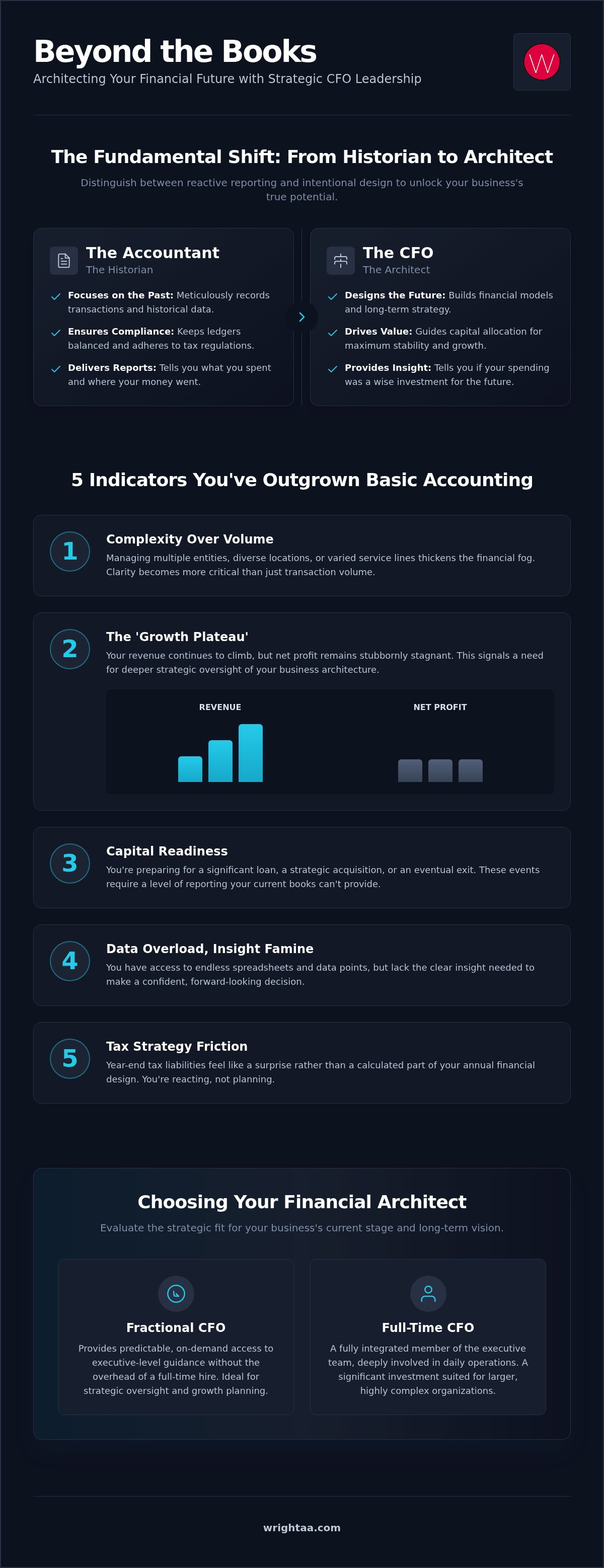
- Distinguish between the accountant as a historian and the CFO as an architect to move your business from reactive reporting to intentional design.
- Navigate the transition between a fractional cfo vs full time cfo by auditing your current financial gaps and emotional pain points.
- Recognize the subtle signs of a growth plateau where revenue increases but profit remains fixed, signaling a need for deeper strategic oversight.
- Evaluate how the specific tax and regulatory landscape of Western New York impacts your choice of financial leadership and capital allocation.
- Explore the value of a fixed-fee model that provides predictable access to executive-level guidance without the overhead of a traditional full-time hire.
CFO vs. Accountant: Understanding the Architecture of Financial Leadership
In the lifecycle of a business, financial roles are often misunderstood. We view the accountant as the historian. They are the keepers of the archives, meticulously recording every transaction to ensure the ledgers remain balanced and compliant. Their work is vital; it is the foundation upon which every other floor is built. However, a historian cannot tell you where the next wing of your business should be constructed. That requires a Chief Financial Officer.
The CFO acts as the architect. While the accountant documents the past—a role handled with precision by chartered experts like Stewart Accounting Services—the CFO designs the future financial structure of the firm. They look at the raw materials of your business-your cash, your talent, and your market position-and determine how to assemble them for maximum stability. This transition from compliance to intentionality is where true wealth is created. Whether you are currently weighing the merits of a fractional cfo vs full time cfo, the objective remains the same: to move from simply observing your numbers to actively directing them.
The Limitations of Traditional Bookkeeping
Accurate ledgers are the essential soil of a business, but they aren't the blueprint. There is a quiet danger in making 2026 decisions based solely on 2025 data. If your current reporting feels static, it lacks the forward-looking resonance needed to navigate market shifts. You might see that you're profitable on paper, but you won't see the structural cracks forming in your cash flow before they widen. Bookkeeping tells you what you spent; it doesn't tell you if that spend was an investment or an expense. To explore how professional advisory transforms these records into a strategic roadmap, you can learn more about Business Wise.
Strategic Financial Oversight Defined
Strategic oversight is rooted in the discipline of capital allocation. It is the process of deciding where your next dollar will yield the highest return for the structure as a whole. This goes far beyond simple tax compliance or insurance. For those operating across borders, you might explore Tax Accounting Services from Samios Partners to manage variables like foreign exchange rates. A CFO analyzes risk through a wider lens, ensuring the enterprise value of your business grows with every passing quarter. They bridge the gap between daily payroll and the long-term vision you hold for your legacy. By introducing this level of oversight, you ensure that every dollar spent is a deliberate brick in a much larger, more permanent design.
To see how these principles are applied in practice, you can explore Business Advisory with Cairns Quality Accounting, where the focus is on moving small businesses from reactive bookkeeping to strategic clarity.
Five Indicators That Your Business Has Outgrown Basic Accounting
Growth is an evolution of form. It requires more than just additional space; it requires a more sophisticated way of occupying that space. Many leaders begin to weigh the merits of a fractional cfo vs full time cfo when they realize their current financial framework no longer matches their operational reality. This transition isn't always marked by a specific revenue milestone. Instead, it's often signaled by a loss of clarity or a sense that the business is moving faster than its systems can record.
Five specific indicators suggest your foundation needs reinforcement:
- Complexity over volume: When you manage multiple entities, diverse locations, or varied service lines, the financial fog thickens.
- The 'Growth Plateau': Revenue continues to climb, yet your net profit remains stubbornly stagnant.
- Capital readiness: You're preparing for a significant loan, a strategic acquisition, or an eventual exit, requiring a level of reporting that your current books can't provide.
- Data overload: You have access to endless spreadsheets, but you lack the insight to make a confident decision.
- Tax strategy friction: Year-end tax liabilities feel like a surprise rather than a calculated part of your annual design.
Complexity and the Need for Clarity
As a business matures, managing cash flow across diverse service lines or complex inventory types becomes a technical challenge. It marks the transition from owner-managed finances to system-managed finances. In Western New York, businesses often face unique geographic and regulatory layers that demand a more nuanced perspective. Achieving Small Business Accounting in Buffalo, NY: Designing Financial Clarity is about creating a transparent environment where every asset is visible and purposeful. Exploring CFO services can provide the perspective needed to resolve these frictions before they compromise your stability.
The Shift from Survival to Strategy
Hitting a specific headcount, often between 20 and 50 employees, frequently triggers the need for higher-level oversight. The emotional toll of financial uncertainty on a founder is significant; it's the weight of knowing the structure is growing but fearing the foundation is brittle. The 'Growth Plateau' represents a structural failure where the business's footprint expands, but its foundation lacks the integrity to translate that scale into sustained profit. Utilizing a framework for hiring allows you to identify these gaps before they become permanent. By addressing these indicators early, you ensure your business remains a place of purpose rather than just a site of constant maintenance.
Fractional CFO vs. Full-Time CFO: Evaluating the Strategic Fit
Architecture is defined as much by what is omitted as by what is included. In the design of a business, financial leadership follows a similar principle of essentialism. Deciding between a fractional cfo vs full time cfo is an exercise in resource optimization. A full-time executive represents a permanent, heavy structure; they require a significant commitment of capital, benefits, and physical space. For many enterprises in Western New York, this level of overhead is often premature. The fractional model offers a more refined alternative, allowing a business to access 100% of an expert’s strategic vision for a fraction of the traditional cost.
This approach utilizes a fixed-fee model to provide clarity and predictability. In a landscape where costs often fluctuate, having a set monthly investment for high-level guidance allows for more disciplined planning. A fractional CFO does not operate in isolation. They integrate with your existing Buffalo-based team, bringing a modern technology stack and a disciplined perspective to your current bookkeeping and payroll processes. They serve as a temporary yet intentional intervention, strengthening the foundation until the business requires a more permanent executive presence.
Cost vs. Investment: The ROI of Financial Guidance
True financial leadership pays for itself by identifying structural inefficiencies. A CFO often uncovers 'leaks' within the business, such as misaligned pricing models, dormant vendor contracts, or inefficient capital allocation. These adjustments do more than save money; they improve the daily life of the business owner by removing friction. Proactive tax strategy is another cornerstone of this role. By integrating tax planning with ongoing financial oversight, the savings generated often exceed the cost of the engagement. For those looking to deepen their understanding of this dynamic, exploring Outsourced CFO Services in Buffalo, NY: Elevating Your Business Strategy can provide a clearer view of how these services function as a long-term investment.
The Local Advantage in Rochester and Buffalo
New York State presents a specific, often complex, business tax landscape. Navigating these requirements requires more than technical skill; it requires a partner who understands the rhythmic shifts of the Western New York economic climate. Whether you are operating in Buffalo, Rochester, or Syracuse, your business is part of a unique geographic and cultural context. A local CFO understands the traditional building methods of the regional economy and how to marry them with modern financial sensibilities. This shared context fosters a deeper sense of trust, ensuring that your financial architecture is built to withstand the specific challenges of our region.
Designing Your Future: A Framework for Hiring the Right CFO
Selecting financial leadership is a process that mirrors the selection of a lead architect for a complex restoration. It requires a disciplined sequence of evaluation that moves beyond technical credentials into the realm of strategic alignment. As you weigh the decision of a fractional cfo vs full time cfo, your focus should remain on the structural integrity of the partnership. A CFO must do more than inhabit a role; they must actively shape the environment in which your business operates.
To find the right fit for your Western New York enterprise, consider this five step framework:
- Step 1: Audit your current financial gaps. Look beyond the balance sheet to identify where financial anxiety resides. Is it in unpredictable cash flow or a lack of clarity regarding capital allocation?
- Step 2: Seek 'Industry Resonance' by finding experience with similar business models. A CFO who understands the specific rhythms of your industry will offer more intuitive guidance.
- Step 3: Evaluate the technology stack and reporting cadence. A modern financial architect utilizes real-time tools to provide clarity. Ensure their reporting matches the speed of your decision making.
- Step 4: Prioritize proactive strategy over reactive reporting. A historian reports the rain; an architect anticipates the storm. Choose a leader who focuses on future growth.
- Step 5: Test for communication style and visionary alignment. Your CFO should be able to translate complex financial narratives into a clear, purposeful path forward for your team.
Questions to Uncover Strategic Intent
The quality of your financial leadership is often determined by the quality of the questions you ask during the selection process. Move beyond inquiries like "Can you do my taxes?" and focus instead on "How will you grow my margins?" A sophisticated candidate will demonstrate a capacity for deep listening before offering a solution. They should be able to simplify complex financial narratives, making the data feel accessible rather than overwhelming. This ability to communicate with clarity is what transforms a technical expert into a true strategic partner.
Defining the Scope of the Engagement
It's essential to distinguish between a project based fix and ongoing advisory. While a specific capital raise might require a temporary intervention, long term health often demands a consistent partnership. Establishing clear milestones for the first 90 days ensures that the engagement begins with a sense of purpose. This may include identifying Financial KPIs for Small Business: A Guide to Clarity in Western New York that serve as the foundation for your future growth. If you're ready to design a more resilient financial structure, you can schedule a consultation with Wright CPAs, LLC to explore how our intentional guidance fits your vision.
Wright CPAs, LLC: Elevating Buffalo Businesses Through Intentional Guidance
At Wright CPAs, LLC, we view financial health through the lens of structural integrity. A business is more than a series of transactions; it is a living environment that requires a foundation both rigid enough to support growth and flexible enough to adapt to change. When evaluating the merits of a fractional cfo vs full time cfo, many leaders in Buffalo, Rochester, and Syracuse find that the traditional executive model is too cumbersome for their current site. We offer a more curated intervention. Our fixed-fee model provides the sophisticated guidance of a financial architect without the permanent overhead of a six-figure salary. This creates a relationship built on partnership rather than just transaction.
Our work is deeply rooted in the specific geographic and cultural context of Western New York. We understand that a business in Syracuse faces different atmospheric pressures than one in Buffalo. By utilizing a modern technology stack, Wright CPAs, LLC provides real-time clarity that allows for a steady, unhurried decision-making process. This predictable framework ensures that you have access to executive-level expertise whenever the design of your business requires it. We don't just record the history of your firm. We help you draft its future.
A Partnership Rooted in Clarity
We believe that financial peace of mind is a sensory experience. It is the calm that comes from knowing your capital is allocated with purpose and your tax strategy is built into the very walls of your daily operations. By integrating proactive tax planning with high-level CFO services, Wright CPAs, LLC ensures that every dollar serves the broader design. Wright CPAs, LLC defines financial intentionality as the disciplined alignment of fiscal resources with the visionary goals of the founder. This approach allows you to move away from the fog of reactive reporting and into a space of quiet, confident authority where your data finally speaks a language of strategy.
Your Next Step Toward Financial Success
Transitioning to a modern, technology-forward CPA firm should feel as natural as walking through a well-designed building. We invite a dialogue about the unique structure of your enterprise and the specific challenges you face in the regional market. Our process begins with deep listening to understand your context before we ever suggest a change to your financial architecture. By exploring The Architecture of Finance: Strategic Business Tax Planning in Buffalo, NY, you can begin to see how a more intentional approach to your finances creates a permanent, thoughtful intervention in your business's future. Wright CPAs, LLC is here to help you build something that lasts, ensuring your financial structure is as resilient as the communities we serve.
Constructing a Legacy of Financial Clarity
A business is a living structure that requires a foundation of both strength and foresight. The choice between a fractional cfo vs full time cfo represents a pivotal moment in your firm's design. It's the transition from merely documenting the past to actively architecting your future. By recognizing the indicators of growth and aligning with a partner who understands your specific context, you ensure that your capital serves your vision rather than just your obligations.
Wright CPAs, LLC brings a disciplined, intentional approach to financial oversight. We provide specialized guidance for law firms and closely held businesses through fixed-fee monthly advisory retainers, offering predictable costs and proactive strategy. While we are rooted in Buffalo, our modern technology stack allows us to provide this high-level architecture to businesses across the United States. Design your business's financial future with Wright CPAs, LLC's CFO services. Your vision deserves a framework as resilient as the legacy you are building.
Frequently Asked Questions
What is the difference between a CPA and a CFO for a small business?
A CPA or accountant typically functions as a historian, focusing on historical accuracy and tax compliance. They ensure your records are balanced and your filings are timely. A CFO acts as a financial architect who uses those records to design future growth. While the CPA documents what's already been built, the CFO determines how to expand the structure safely and profitably through strategic capital allocation.
How much does it typically cost to hire a fractional CFO?
Industry data for 2026 suggests that fractional CFO retainers often range between $3,000 and $15,000 per month depending on the complexity of the firm. Choosing a fractional cfo vs full time cfo allows a business to access executive-level expertise without the $250,000 or higher salary of a full-time hire. This model provides a sophisticated level of guidance that's often more accessible for growing enterprises in the Western New York region.
Does my small business really need a CFO if my revenue is under $1 million?
Revenue volume is only one indicator of need. Complexity, such as managing multiple service lines or navigating high-growth phases, often demands strategic oversight much earlier. If your financial foundation feels brittle despite being under $1 million in revenue, a CFO can help reinforce your architecture before you scale. It's about ensuring the structural integrity of your business before the weight of growth increases.
Can a CFO help with my business tax planning in New York?
Yes, especially within the specific and often complex regulatory landscape of New York. A CFO integrates tax strategy with your broader financial oversight to ensure every dollar is allocated with purpose. They help navigate regional complexities in Buffalo and Rochester to protect your capital and support long-term stability. This proactive approach ensures that tax liabilities are a planned part of your business design rather than a year-end surprise.
What are the first signs that I need to outsource my CFO functions?
The first signs often include a growth plateau where revenue rises but profit remains stagnant. You might also feel a sense of fog regarding your cash flow or anxiety over unpredictable tax liabilities despite rising sales. These are indicators that your business has outgrown its current systems. It requires a more intentional design to move from reactive reporting to strategic clarity.
How does a fractional CFO work with my existing bookkeeper?
The CFO serves as a strategic lead who refines and elevates the work of your bookkeeper. They don't replace the bookkeeping function; they ensure the data being recorded is translated into actionable narratives. By overseeing the technology stack and reporting cadence, the CFO turns simple ledger entries into a blueprint for your future. This partnership allows your existing team to focus on accuracy while the CFO focuses on strategy.
What kind of financial reports should a CFO provide to a small business owner?
A CFO provides forward-looking reports such as cash flow forecasts, margin analysis, and strategic KPI dashboards. These documents go beyond historical balance sheets to show you the path ahead. They allow you to make decisions based on where your business is going, not just where it's been. This reporting cadence creates a steady rhythm of clarity that supports confident, visionary leadership.
How do I measure the ROI of hiring a CFO service?
ROI is measured through margin expansion, improved capital efficiency, and proactive tax savings that often exceed the cost of the service. Beyond the numbers, you should notice a reduction in the emotional toll of financial uncertainty. When your financial architecture is sound, the resulting peace of mind becomes a tangible asset. It allows you to focus on the creative and strategic aspects of your business with a sense of purpose.


