

A law firm's financial integrity is not merely a matter of bookkeeping; it's a deliberate act of design. For many practitioners in New York, the weight of fiduciary duty often brings a persistent sense of unease. You likely feel the pressure of maintaining absolute separation between your operating capital and client funds, knowing that a single oversight in trust accounting for law firms NY can compromise a career's work. It's a delicate balance between the daily demands of practice and the rigorous, rhythmic requirements of New York Rule 1.15.
We understand that the manual burden of three-way reconciliation and the ambiguity of unearned fees can feel like structural flaws in an otherwise successful firm. This guide offers a sophisticated framework for navigating New York IOLA requirements with confidence. You'll gain a clear blueprint for building a foundation of financial security that supports your firm's growth. We'll walk through the technical precision required for compliance, the tools that streamline your billing workflows, and the peace of mind that comes from a perfectly balanced ledger.
Key Takeaways
- Establish a firm understanding of New York Rule 1.15 and the IOLA program to protect your practice's professional integrity.
- Construct a resilient chart of accounts that ensures absolute transparency in trust accounting for law firms NY.
- Utilize the three-way reconciliation as a rhythmic, structural safeguard to maintain the perpetual integrity of your client trust accounts.
- Recognize and mitigate the risks of inadvertent commingling, particularly when handling credit card processing fees and unearned retainers.
- Leverage specialized CFO-level guidance to integrate modern technology and achieve a state of calm, compliant financial oversight.
The Foundation of Fiduciary Duty: Understanding NY IOLTA Requirements
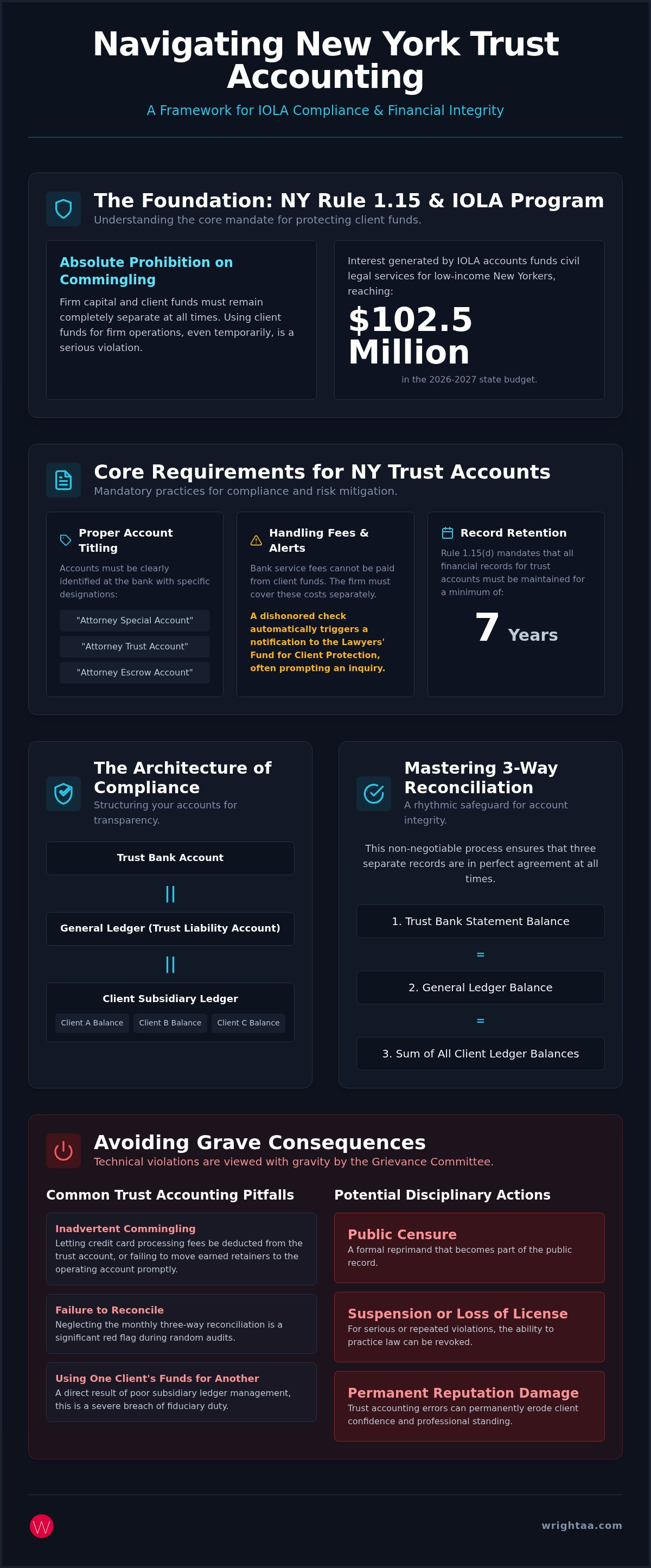
A law firm's financial architecture rests on the absolute separation of client resources from firm capital. In New York, this boundary is defined by the Interest on Lawyer Account (IOLA) program. While the broader legal community often refers to this as Interest on Lawyers' Trust Accounts (IOLTA), New York's specific framework carries its own set of rigorous expectations. Trust accounting for law firms NY is more than a regulatory box to check; it's a commitment to the structural integrity of the legal profession. These pooled interest-bearing accounts serve a poetic purpose, as the interest generated funds civil legal services for low-income New Yorkers. In the 2026-2027 state budget, this funding reached $102.5 million, illustrating the profound scale of this collective fiduciary effort.
The core of this system is Rule 1.15 of the New York Rules of Professional Conduct. It establishes an absolute prohibition against commingling. You cannot allow even a small amount of firm money to rest in a trust account, nor can client funds be used to bridge a temporary gap in firm operations. This isn't a suggestion of best practices. It's a foundational mandate. Every dollar must be accounted for with surgical precision, held in a space that's entirely separate from the firm's daily life.
Key Rules for New York Trust Accounts
Compliance begins with the way an account is titled. New York requires that trust accounts be clearly identified at the banking institution. You must use specific designations such as "Attorney Special Account," "Attorney Trust Account," or "Attorney Escrow Account." This clarity ensures that the bank, the state, and your own staff recognize the protected status of these funds.
Managing the costs of these accounts requires equal care. While banks charge service fees, these costs cannot be deducted from client funds. The firm must deposit its own money into the trust account specifically to cover these charges, or arrange for the bank to debit the firm's operating account instead. Additionally, New York banks are required to notify the Lawyers' Fund for Client Protection whenever a trust account check is dishonored. This notification acts as an automatic alarm, often triggering an immediate inquiry into the firm's records.
The Consequences of Structural Failure
The Grievance Committee views trust accounting errors with gravity. They conduct random audits to ensure firms maintain the required seven years of records mandated by Rule 1.15(d). In these reviews, "good intentions" provide no shelter. A technical violation, such as a failure to reconcile or an improperly titled account, can lead to public censure or the loss of a license. The damage to a professional reputation is often permanent. Designing a resilient system for trust accounting for law firms NY is the only way to ensure your practice remains standing on firm ground.
The Architecture of a Compliant Legal Accounting System
A standard chart of accounts is insufficient for the legal profession. It requires a tailored structure that recognizes the duality of firm assets and client liabilities. To achieve true financial intentionality, your system must mirror the unhurried precision of a master builder. This begins with a chart of accounts designed specifically for legal practice, ensuring every transaction has a designated place within the firm's structural framework. When properly executed, trust accounting for law firms NY becomes a rhythmic process rather than a source of stress.
The system must also integrate time-tracking with trust withdrawals to ensure earned fee accuracy. This connection prevents the premature movement of funds, ensuring that every transfer from trust to operating accounts is supported by documented work. It's a methodical approach that prioritizes quality over speed, creating a transparent narrative for every dollar the firm handles.
Designing the Subsidiary Ledger
The general ledger provides the broad view, but the subsidiary ledger holds the essential details. Every client matter functions as a discrete financial unit. You must track deposits, disbursements, and transfers at the matter level to prevent the accidental use of one client's funds for another's expenses. This relationship between the general ledger and client balances creates a redundant layer of protection. It ensures that the total of all individual client balances always matches the balance of the trust bank account, a core requirement for trust accounting for law firms NY.
Modern Tools for Intentional Accounting
Selecting the right technology is an exercise in deep listening to your firm's specific needs. QuickBooks Online, when configured with professional expertise, offers a refined platform for managing these complexities. It provides cloud-based transparency that allows partners to view trust balances in real-time, fostering a culture of accountability. The NY IOLA Fund provides the regulatory baseline, but your firm's internal architecture must exceed those standards to ensure absolute safety.
A dedicated CPA for Law Firms Buffalo NY understands that your books are a reflection of your professional values. This partnership ensures your firm's foundation is both compliant and visionary. Our law firm accounting services are designed to provide this quiet, confident authority over your finances, allowing you to focus on the practice of law with a clear mind.
Mastering 3-Way Reconciliation for NY Law Firms
Trust accounting for law firms NY requires a level of verification that goes beyond standard business practices. A traditional reconciliation merely compares the bank statement to the general ledger. For a law firm, this is incomplete. You must introduce a third element: the sum of all individual client ledgers. This three-way reconciliation acts as the structural keystone, ensuring that the money the bank says you have matches exactly what your records say you owe to every specific client. Without this third check, errors in individual client balances can remain hidden for years, even if the total bank account appears to balance perfectly.
The mathematical relationship is precise. The adjusted bank balance must equal the trust account balance in your general ledger, which in turn must equal the total of all balances in your client subsidiary ledgers. If these three figures don't align, the structure is compromised. Establishing a monthly rhythm for this process prevents small variances from growing into systemic failures. It's a practice of deep listening to your firm's financial heartbeat, catching discrepancies before they become disciplinary issues.
The Step-by-Step Reconciliation Process
The process begins by reconciling the trust bank statement to your general ledger, accounting for outstanding checks and deposits in transit. Next, you must sum the balances of every individual client matter from your subsidiary ledger. Finally, you compare these three totals. Any variance, however small, must be investigated and resolved immediately. According to the New York IOLA regulations, this level of oversight isn't just a best practice; it's a requirement of your fiduciary duty. It ensures that you aren't inadvertently using one client's funds to cover another's expenses.
Documenting the Process for Audit Readiness
Documentation is the physical proof of your firm's integrity. Each month, you should produce a formal three-way reconciliation report. This record must be clear, legible, and permanent. In New York, Rule 1.15(d) requires you to maintain these records for seven years, providing a durable audit trail for the Grievance Committee. Partner review is a critical final step. A partner's signature on the reconciliation report signifies that the firm's leadership has exercised its duty of supervision. It transforms a clerical task into a deliberate act of professional responsibility, ensuring the firm's foundation remains secure against external scrutiny.
Avoiding the Most Common Trust Accounting Pitfalls in New York
Technical excellence in trust accounting for law firms NY requires more than just understanding the rules; it demands a vigilant awareness of the subtle ways a system can erode. Even a well-designed financial structure can develop stress points if the daily flow of capital isn't managed with intentionality. One of the most common structural failures occurs when a firm disburses funds before they're fully cleared by the banking institution. Even if a deposit appears on a digital ledger, the physical availability of those funds is the only safe threshold for payment. Premature disbursement essentially uses other clients' money to cover a transaction, a violation that the Grievance Committee views with significant gravity.
Uncleared checks and dormant client balances represent another form of neglect. These "ghost" figures clutter the subsidiary ledger and create a fog of uncertainty over your true liabilities. When a client fails to cash a check or a small balance remains after a matter is closed, the firm has a duty to resolve these items promptly. Allowing them to linger indefinitely is a failure of oversight that can complicate your monthly reconciliations and lead to long-term compliance risks.
Merchant Processing and Trust Accounts
This vigilance is especially important for firms managing high-value personal injury cases, where a Car accident lawyer Connecticut must ensure that settlement funds are fully cleared and meticulously recorded before any disbursements are made to clients or third-party providers.
Similarly, for those interested in how firms in other states like Pennsylvania uphold these high standards in personal injury and real estate, you can learn more about D'Intino Law Firm, LLC.
Credit card processing introduces a unique friction into the trust environment. When a merchant processor deducts fees from a gross deposit, the trust account is left with less than the client actually paid. This creates an immediate deficit. To prevent this, your firm must ensure that the processor is configured to pull all fees from an operating account rather than the trust account itself. New York allows a nominal buffer of firm funds to remain in the trust account specifically to cover bank service charges, but this buffer must be strictly limited and carefully documented. If you're unsure how to configure these digital flows, it's time to partner with a specialist in law firm accounting who can design a compliant workflow for your practice.
The Timing of Fee Transfers
The movement of earned fees is a delicate transition. Leaving earned income in a trust account is just as problematic as placing firm money there; both are considered commingling. Once a fee is earned according to your engagement agreement and New York rules, it must be moved to the operating account in a rhythmic, timely fashion. Holding onto these funds for convenience blurs the line between the firm's assets and its fiduciary obligations. Establishing a weekly or bi-weekly protocol for these transfers ensures that your capital remains where it belongs, maintaining the clarity and purpose of every account in your firm's ecosystem.
Strategic Trust Oversight: Why WNY Firms Partner with Wright CPAs
Wright CPAs approaches trust accounting for law firms NY with the same intentionality an architect brings to a landmark structure. We serve the legal communities of Buffalo, Rochester, and Syracuse, providing a serene and methodical design for your firm's books. Our process moves beyond the mere technical exercise of bookkeeping. It's a professional intervention designed to foster a sense of calm and purpose within your practice. By grounding your financial foundation in precision, we allow you to focus on the human elements of your legal work.
We recognize that legal partners value quality over quantity and substance over spectacle. Our firm prioritizes deep listening to understand your specific geographic and cultural context. This commitment to design excellence ensures that your accounting system isn't just a separate tool, but a permanent, thoughtful part of your firm's daily life.
The Value of a Fixed-Fee Partnership
Predictability is essential for a stable practice. We utilize fixed-fee monthly retainers to provide ongoing financial oversight without the friction of the billable hour. This model ensures that our partnership is built on value rather than time, allowing for open communication and unhurried collaboration. You won't hesitate to reach out for CFO-level guidance when you know the cost is already accounted for in your firm's budget.
- Eliminate the anxiety of unexpected accounting bills and administrative surprises.
- Ensure year-round proactive strategy instead of reactive year-end tax preparation.
- Gain absolute certainty through professional three-way reconciliations performed with unhurried accuracy.
This steady rhythm of oversight transforms your accounting from a manual burden into a structural asset. It provides the visual breathing room needed to make informed decisions about your firm's future. When your books are handled with artistic discipline, you gain the freedom to lead your firm with confidence.
Elevating Your Practice Through Financial Intentionality
Compliance is the baseline, but the ultimate goal is the improvement of your daily life as a practitioner. Clear, accurate trust records are the first step toward cash flow management that feels effortless. When your trust accounts are perfectly balanced, you gain a transparent view of your firm's actual liquidity and long-term potential. This data-driven clarity is the catalyst for improving law firm profitability and planning for eventual succession.
We invite you to experience a more thoughtful approach to your firm's finances. By leveraging modern technology like QuickBooks Online with a disciplined accounting process, we help you build a firm that is both legally compliant and financially visionary. To begin this transformation, book a consultation with Wright CPAs today. Let's design a foundation that supports your highest professional aspirations.
Building a Legacy of Financial Integrity
A firm's financial architecture is never finished; it's a living system that requires constant, quiet attention. By embracing the rhythmic discipline of three-way reconciliation and maintaining a clear boundary between earned and unearned fees, you protect the very essence of your practice. This level of precision transforms a technical requirement into a statement of professional values. Mastering trust accounting for law firms NY ensures that your foundation remains secure, allowing you to focus on the human impact of your legal work.
At Wright CPAs, we provide the proactive CFO-level guidance and specialized expertise needed to navigate New York's complex IOLTA landscape. Our fixed-fee monthly retainers offer predictable oversight, removing the friction from your financial management and replacing it with a sense of calm purpose. We invite you to Request a Consultation for Law Firm Accounting in Buffalo, NY to begin designing a more resilient future for your practice. With the right structure in place, your firm can grow with absolute clarity and enduring strength.
Frequently Asked Questions
What is the most common trust accounting mistake NY lawyers make?
Inadvertent commingling is the most frequent error, often occurring when firms fail to separate bank service charges or credit card fees from client funds. Many practitioners in Buffalo and Rochester struggle with the timing of earned fee transfers, mistakenly leaving income in the trust account long after it's been earned. This creates a structural flaw in your trust accounting for law firms NY, as the rules view firm money in a trust account as a serious violation.
How often must a New York law firm perform 3-way reconciliation?
You should perform a three-way reconciliation every month to ensure the structural integrity of your books. While the New York Rules of Professional Conduct require maintaining specific records for seven years, a proposed amendment to Rule 1.15(d)(1) as of August 2026 aims to explicitly mandate these regular reconciliations. Monthly oversight allows you to catch minor variances before they become systemic failures, providing a serene rhythm of compliance for your Syracuse or Buffalo practice.
Can I use one trust account for all my clients in New York?
Yes, New York attorneys generally use a single pooled IOLA account for nominal or short-term client funds. The interest from this account supports civil legal services across the state, such as the $102.5 million funding allocated in the 2026-2027 budget. However, you must maintain a precise subsidiary ledger for every individual client matter. This ledger ensures that you never use one client's funds to cover the obligations of another, maintaining the poetic balance of your fiduciary duty.
What bank records must I keep for my NY IOLTA account?
New York Rule 1.15(d) requires you to maintain a comprehensive set of records for seven years. This includes all bank statements, records of deposits, checkbooks, and cancelled checks. You must also keep a record of all disbursements and a ledger showing the source and destination of every dollar. Keeping these records in a curated, organized system is essential for surviving a random audit by the Grievance Committee in Western New York.
How do I handle credit card processing fees with my trust account?
You must ensure that your merchant processor withdraws all fees from your operating account rather than the trust account. If fees are deducted from a client's gross deposit before it hits the trust account, you've effectively underfunded that client's ledger. This creates an immediate deficit. Configuring your technology to pull fees from operating capital maintains the absolute separation required for trust accounting for law firms NY and protects your professional standing from unnecessary risk.
Does New York require a specific software for trust accounting?
New York doesn't mandate a specific software platform, provided your chosen system generates the required reports and ledgers. Many firms find that generic accounting tools lack the specific architecture needed for legal trust management. We often integrate QuickBooks Online with specialized legal tools to create a sophisticated, cloud-based environment. This approach provides partners in Rochester and Syracuse with real-time transparency and ensures every transaction is mapped to its specific legal context.
What happens if I discover a shortage in my law firm trust account?
Discovering a shortage requires immediate, methodical action to identify the source of the error and restore the funds. Under New York's dishonored check reporting rule, banks must notify the Lawyers' Fund for Client Protection if a trust account check is returned. This often leads to a disciplinary inquiry. Addressing discrepancies during your monthly three-way reconciliation allows you to resolve issues quietly and intentionally before they trigger external notifications or jeopardize your licensure.
How can an outside CPA help with my IOLTA compliance?
An outside CPA provides the CFO-level guidance necessary to move beyond simple compliance into strategic growth. At Wright CPAs, we offer fixed-fee monthly advisory retainers to firms in Buffalo, Rochester, and Syracuse. This partnership ensures that your three-way reconciliations are performed with unhurried precision. We act as a thoughtful creator of your firm's financial foundation, allowing you to focus on your clients while we maintain the structural integrity of your books.


