

What if your balance sheet functioned less like a static ledger and more like a set of architectural plans? You understand the weight of Buffalo’s seasonal cycles, where a vibrant summer gives way to the quiet, deliberate pace of winter. It’s common to feel a sense of hesitation before making a significant commitment when the future feels unpredictable. Mastering financial forecasting for small business Buffalo allows you to transform this uncertainty into a structured vision for your company's future.
You’ll discover how to convert raw data into a precise roadmap that guides your growth through the next 12 to 24 months. This approach replaces anxiety with a grounded, quiet confidence. It helps you articulate your business health to lenders in a market where the prime rate is 6.75%. We’ll explore how to align your daily operations with a thoughtful tax strategy, ensuring your business is built on a foundation of clarity and purpose. This isn't just about accounting; it's about designing a resilient path forward.
Key Takeaways
- View your finances through the lens of a visionary creator. Shift from reactive management to a structured, intentional blueprint for growth.
- Learn how to anchor your future projections in the bedrock of historical data and sensory market awareness.
- Navigate the unique economic landscape of Western New York by mastering financial forecasting for small business Buffalo, specifically managing seasonal cash flow shifts.
- Elevate your perspective from simply reading reports to executing high-level strategy through CFO-level insights and meaningful KPIs.
- Discover how integrating proactive tax planning into your monthly forecast creates a more resilient and harmonious business structure.
The Intentionality of Financial Forecasting for Small Business
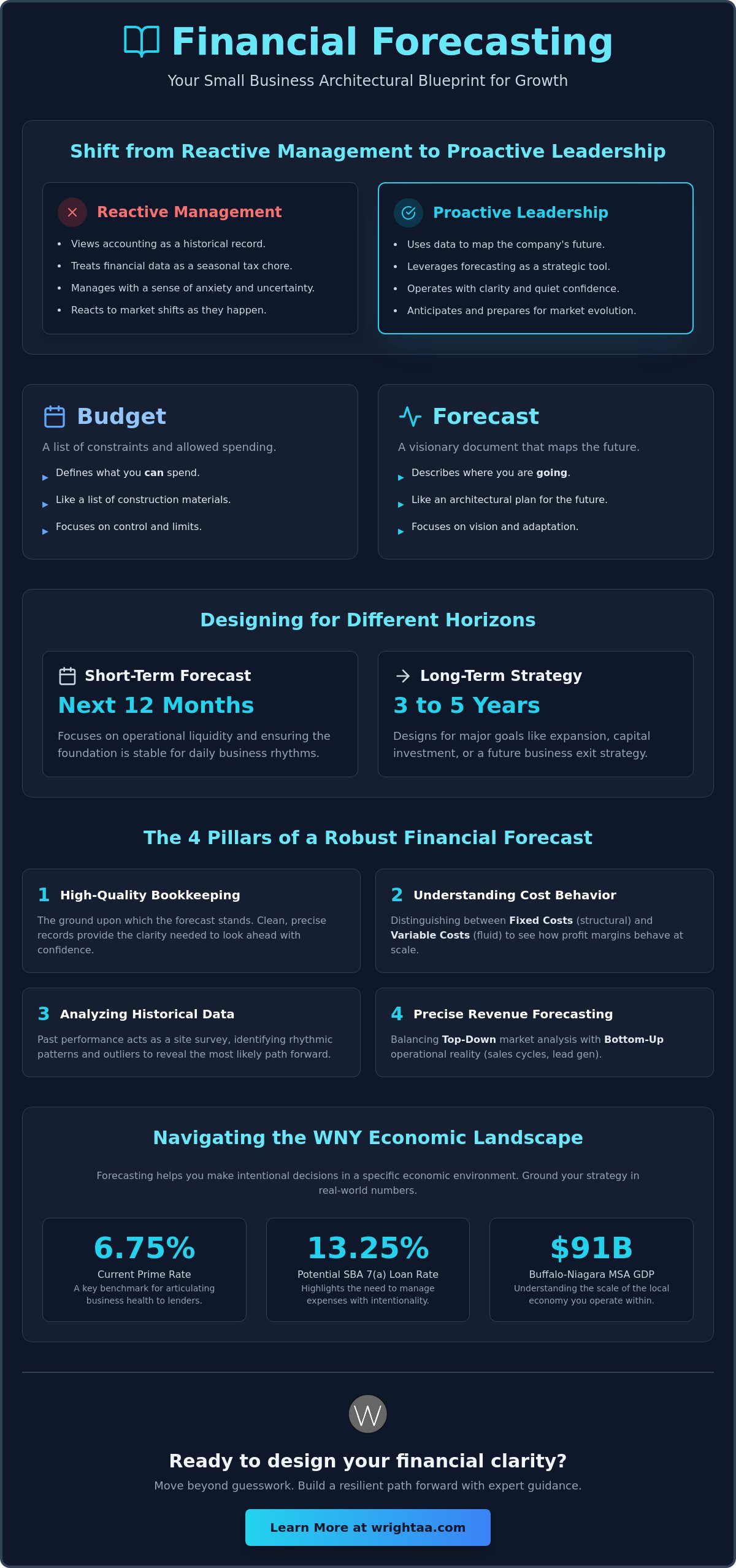
A building begins long before the first stone is laid. It starts with an intentional design, a set of plans that account for the weight of the structure and the nature of the ground beneath it. In the same way, financial forecasting for small business Buffalo serves as your company's architectural blueprint. It's the process of looking at the horizon and deciding where the walls will stand and how much light the rooms will catch. While many view accounting as a historical record, a visionary leader understands that the true value of data lies in its ability to map the future.
There is a fundamental distinction between a budget and a financial forecast. A budget is a list of constraints; it defines what you are allowed to spend, much like a list of construction materials. A forecast is a visionary document. It describes where you are going and how the environment will shift around you. For a Buffalo-based business, this distinction is vital. Our local economy is transitioning from its manufacturing roots toward service, education, and tech hubs. Surviving this shift requires more than just "keeping the books." It requires an active engagement with the numbers to ensure your business remains resilient as the landscape evolves.
Short-Term vs. Long-Term: Designing for Different Horizons
Effective forecasting requires a dual perspective. Short-term forecasting, typically covering the next 12 months, focuses on operational liquidity. It ensures the foundation is stable and the daily rhythm of the business remains uninterrupted. Long-term strategic forecasting looks three to five years into the distance. This is where you design for expansion, capital investment, or an eventual exit. These two horizons must interact. The daily decisions you make should always support the long-term integrity of the structure. When these timelines align, they create a cohesive narrative of growth and stability.
The Mindset of a Visionary Business Owner
The shift from reactive management to proactive leadership begins with a change in mindset. Many owners fall into the "books are for taxes" trap, viewing financial data as a seasonal chore rather than a strategic tool. Embracing financial forecasting for small business Buffalo allows you to quiet the noise of market uncertainty. By using data to ground your decisions, you replace anxiety with clarity. This process involves deep listening. You must listen to what your cash flow cycles are telling you and observe how your costs behave. This disciplined approach ensures that every intervention you make in your business is both thoughtful and permanent.
The Pillars of a Robust Financial Forecast
A forecast is only as strong as the ground it stands upon. In the context of financial forecasting for small business Buffalo, that ground is composed of your historical data and the precision of your current records. Without a clean set of books, a forecast is merely a guess. It lacks the structural integrity required to support real-world decisions. High-quality bookkeeping ensures that every entry is a true reflection of your business's movement, providing the clarity needed to look ahead with confidence.
Understanding the behavior of your costs is like understanding how materials react to the Western New York climate. Fixed costs are your structural beams; they remain constant regardless of your output. Variable costs are more fluid, rising and falling with your activity. Distinguishing between these dualities allows you to see how your profit margins will behave as you scale. In an environment where borrowing rates for variable SBA 7(a) loans can reach 13.25%, managing these expenses with intentionality is a necessity for long-term survival.
Analyzing Historical Financial Statements
Past performance acts as a site survey for your future growth. By examining your Balance Sheets and Income Statements from previous years, you identify the rhythmic patterns of your business. You might see the specific ebb and flow of the Buffalo-Niagara Falls MSA economy, which holds a GDP of approximately $91 billion. It's vital to identify "outlier" events, such as a one-time equipment failure or an unusual grant, so they don't skew your future vision. Historical trends serve as the shadow cast by future probability, revealing the most likely path forward.
Forecasting Revenue with Precision
Predicting growth requires a balance of top-down market analysis and bottom-up operational reality. Top-down methods look at the broader environment, such as the growth in Buffalo's tech and renewable energy sectors. Bottom-up methods focus on your specific lead generation metrics and sales cycles. When creating financial projections for a business plan, you must integrate these trends without falling into the trap of hyperbole. Precision is found in the intersection of market data and your demonstrated capacity to deliver. This disciplined approach ensures your roadmap remains visionary yet grounded in the reality of the local corridor.
Navigating the Buffalo and Western New York Economic Landscape
A structure must be designed for its specific site. In Western New York, the economic climate is as distinct as our physical seasons. For a local owner, financial forecasting for small business Buffalo requires an intimate understanding of these regional shifts. You cannot apply a generic model to a city that experiences such profound seasonal duality. Your forecast should act as a living document, one that breathes with the city’s rhythm and accounts for the specific constraints of the New York State regulatory environment.
The labor market within the Buffalo-Rochester-Syracuse corridor presents its own set of challenges. As of April 2026, the unemployment rate in the Buffalo-Niagara Falls MSA stood at 4.1%. This suggests a tight labor market where competition for talent is rigorous. Your financial roadmap must account for rising payroll costs and the necessity of retaining skilled professionals. Additionally, the New York tax landscape remains complex. With a combined sales tax rate of 8.75% in Erie County and a corporate tax rate of 6.5% for most businesses, your bottom line depends on precise, intentional planning.
Managing Seasonal Cash Flow in Buffalo
The "Winter Factor" is a reality for many industries, from construction and retail to specialized law firms. During the peak months, it's easy to mistake high activity for permanent growth. An intentional forecast identifies these peaks and directs the surplus into strategic reserves. These reserves act as insulation, sustaining your operations when the pace naturally slows. A well-designed stability plan ensures that your daily operations remain undisturbed by the changing weather, allowing for a steady, unhurried progression toward your long-term goals.
Local Market Trends and Growth Opportunities
Buffalo's economy is undergoing a quiet but significant restructuring. We're moving toward a service-oriented model with strong clusters in healthcare, education, and professional services. There's a burgeoning tech hub focused on renewable energy and eco-friendly construction. By analyzing Buffalo metro area economic indicators, you can validate your growth assumptions with concrete data. Your 2026 projections should reflect these emerging sectors. When you align your business with these broader trends, you aren't just surviving; you're participating in the city's visionary evolution.
From Data to Strategy: The Role of CFO-Level Insights
Numbers are the medium, but strategy is the structure. To move beyond the static observation of balance sheets, an owner must adopt a CFO-level perspective. This involves translating raw figures into actionable interventions. When you engage in financial forecasting for small business Buffalo, you aren't just predicting the future; you're preparing to influence it. This proactive stance is what separates a business that merely survives from one that grows with intention. It's the difference between looking at a finished building and understanding the structural forces that keep it standing.
Executing strategy requires a shift in how you perceive your monthly reports. Instead of seeing them as a summary of what has passed, view them as a diagnostic tool for what is to come. This high-level oversight allows you to identify which parts of your business are performing efficiently and which require a thoughtful redesign. True leadership is found in this transition from reactive recording to visionary execution.
Tracking the KPIs that Matter
Identifying the right metrics is essential. Not every number deserves your attention. By focusing on specific Financial KPIs for Small Business, you gain a high-resolution view of your company's health. We recommend focusing on a few core indicators:
- Gross Margin: This reveals the fundamental profitability of your products or services before overhead.
- Burn Rate: Understanding how quickly you consume cash is vital for maintaining operational liquidity.
- Customer Acquisition Cost (CAC): This metric ensures that your growth is sustainable rather than forced.
Establishing "triggers"—specific thresholds that alert you when reality diverges from your forecast—provides the early warning system needed to adjust your course before the foundation is compromised. These triggers allow for a steady, unhurried response to market changes.
Scenario Planning: Preparing for the Unforeseen
Scenario planning is the architectural practice of building in safety margins. It requires designing models for various outcomes: the Best Case, the Worst Case, and the Most Likely Case. This discipline prevents emotional decision-making during periods of volatility. If the Buffalo market shifts or borrowing rates fluctuate, you already have a plan in place. With variable SBA 7(a) rates currently ranging from 9.75% to 13.25%, having a clear "What-If" model is a vital defensive measure. It also serves as a powerful tool when speaking with lenders. A business owner who presents a rigorous forecast, backed by scenario analysis, demonstrates a level of sophistication that often leads to better terms. Lenders value the clarity of a visionary who has accounted for the shadows as well as the light.
True clarity comes from having an expert partner to help interpret these complex dualities. Our CFO Services provide the deep listening and technical rigor required to turn your data into a visionary roadmap.
Designing Financial Clarity with Wright CPAs
At Wright CPAs, we view the financial landscape as a space to be curated and shaped. Our approach to financial forecasting for small business Buffalo transcends simple data entry. It is a disciplined process where accounting meets intentional design. We don't merely record transactions; we help you design a structure that supports your specific vision for growth in Western New York. For closely held businesses, this level of clarity is the difference between constant reaction and steady, purposeful movement.
Clarity is achieved through a rigorous commitment to quality and substance. We provide the technical expertise required to turn raw data into a visionary roadmap, ensuring that your business remains grounded even as it expands. Our personality is artistic yet disciplined. We prioritize deep listening to understand the unique context of your business before we begin the creative process of financial modeling.
The Monthly Advisory Model: Consistent Oversight
The traditional model of year-end "cleanups" is like trying to fix a building's foundation after the walls have begun to crack. It's reactive and often leads to structural instability. Our monthly advisory model provides consistent oversight, ensuring your books remain a reliable reflection of reality. This allows us to maintain a "living" forecast that evolves as your business grows. This unhurried, methodical approach to Small Business Accounting in Buffalo ensures you're never operating in the dark. We utilize a fixed-fee structure to provide predictability, removing the friction of hourly billing and allowing for ongoing, meaningful collaboration.
Integrating Proactive Tax Strategy
Integrating tax strategy into your financial forecasting for small business Buffalo is an elemental part of our process. When you understand your trajectory, you can make decisions that optimize your tax position in real-time. This prevents the "tax surprises" that often disrupt a business owner's peace of mind in April. By linking your forecast to Strategic Business Tax Planning, we ensure your business is designed for maximum efficiency. This isn't just about compliance; it's about designing your business for long-term wealth and stability. Our CFO services provide the high-level perspective needed to navigate the complexities of the New York State tax environment, helping you build a business that is both resilient and well-proportioned.
Cultivating a Vision for Resilient Growth
A business is a permanent intervention in the life of its owner and its community. By embracing financial forecasting for small business Buffalo, you move beyond the static observation of your books and begin to shape your company's future with intent. You've seen how historical data provides the bedrock for revenue projections and how scenario planning acts as structural insulation against market shifts. This disciplined approach ensures that your daily operations are in harmony with your long-term vision. It transforms the uncertainty of the local economic climate into a series of calculated, visionary steps.
Our Buffalo-based team brings deep local market knowledge and specialized expertise in Law Firm and Closely Held Business accounting. We integrate a proactive Tax Strategy into every advisory retainer, ensuring that your growth is both tax-efficient and sustainable. This is the intersection where technical rigor meets visionary design. We prioritize deep listening to understand your specific context before building the financial models that will guide your path forward.
Design your financial future with Wright CPAs—Book a Consult. Your business deserves a roadmap that is as thoughtful and enduring as the city it calls home. Build with confidence.
Frequently Asked Questions
What is the difference between a budget and a financial forecast?
A budget is a static spending plan that defines your constraints, while a financial forecast is a dynamic trajectory based on real-world data. Consider the budget as a list of materials and the forecast as the evolving site conditions. This distinction allows you to adjust your path as market variables shift, ensuring your business remains resilient and grounded.
How often should a small business in Buffalo update its financial forecast?
We recommend updating your model monthly to ensure it remains a living document. Buffalo’s seasonal rhythm requires a steady hand and frequent recalibration. By reviewing your numbers every thirty days, you can identify subtle shifts in cash flow before they impact your structural stability. This unhurried pace allows for more intentional decision-making throughout the year.
Do I need a CFO to create a financial forecast for my business?
You don't strictly need a full-time CFO, but the insights provided by CFO Services are invaluable for complex organizations. These professionals bring a level of technical rigor that transcends basic bookkeeping. They help you interpret the dualities of your data, turning raw numbers into a visionary roadmap that supports your long-term expansion and stability.
Can financial forecasting help me get a small business loan in Buffalo?
Presenting a rigorous model for financial forecasting for small business Buffalo significantly improves your standing with commercial lenders. Banks value the transparency of a well-designed blueprint. It demonstrates that you've accounted for market risks and have a disciplined plan to manage debt in a shifting interest rate environment, which is vital for securing favorable terms.
How much does it cost to implement professional financial forecasting?
The cost of implementing professional forecasting is an investment in the structural integrity of your company. While fees depend on the complexity of your business and the frequency of advisory, the clarity gained provides a significant return. It's a thoughtful intervention that protects your foundation and prevents the high costs associated with reactive, emotional decision-making.
What software is best for small business financial forecasting in 2026?
In 2026, the most effective tools are cloud-based platforms that integrate directly with your accounting software for real-time data flow. We prioritize systems that offer clean, minimalist interfaces and robust scenario-modeling capabilities. These technologies allow for a more precise approach to business planning, ensuring your data is always a current reflection of your company's movement.
How does New York State tax planning affect my financial forecast?
New York State’s complex tax environment is an essential variable in any robust forecast. By projecting your income and expenses, you can anticipate your tax liabilities and integrate proactive planning into your monthly rhythm. This alignment ensures that your cash flow is never compromised by unforeseen state requirements or regulatory shifts, allowing for a more serene financial experience.
Can forecasting help my law firm manage IOLTA compliance or profitability?
Forecasting allows a law firm to project future fee revenue and manage the specific rhythms of contingency or retainer-based billing. It provides the structural clarity needed to maintain profitability while ensuring that operational funds are never entangled with trust accounts. This disciplined oversight supports both ethical compliance and the long-term health of your practice.


