

A plan can be financially sound on paper and still lead you away from what matters most. Creating a strategic financial plan means translating your priorities into measurable goals, then shaping your spending, saving, and risk decisions around them. Long-term goals are generally 10 or more years away, so the plan should account for both near-term needs and the future you want to build.
You may already know what you want your money to support: more flexibility, a stable business, time with family, or a comfortable retirement. The challenge is turning those priorities into practical decisions without treating the plan as fixed. Creating a strategic financial plan means giving each goal a place in your budget and adjusting as circumstances change.
This article explains how to set goals, assess your financial starting point, and balance spending, savings, and debt. It also covers regular reviews, risk management, and forecasts that help you evaluate how different choices may affect your path. The result is a clearer framework for making purposeful financial decisions.
Key Takeaways
- Translate personal and business priorities into clear goals, then map each one to a practical financial decision.
- Use regular reviews to adjust your plan when income, obligations, or market conditions shift.
- Give spending, saving, and debt repayment defined roles so your budget supports both current needs and future aims.
- Build forecasts around possible disruptions and cash-flow changes to make decisions with greater clarity.
1. Aligning financial goals with clients' life goals and values
Begin with a clear picture of what you want your money to make possible. List priorities such as stable housing, family support, a business transition, or retirement. Then assign each goal a target, an owner, and a review date. This turns values into decisions rather than leaving them as wishes.
Set timelines before choosing savings targets. Short-term goals generally fall within one to two years; medium-term goals span three to 10 years. Long-term goals are generally 10 or more years away. For example, a business owner might fund equipment soon, education in several years, and retirement later. Rank these term goals by urgency, impact, and flexibility. A high-interest balance can compete with a near-term goal, so include repayment in the plan.
Retirement planning should describe a desired daily life, not just a final balance. Estimate housing, healthcare, travel, and family costs, then identify income sources and savings needed. In the United States, Social Security retirement benefits can be collected starting at age 62, according to the Social Security Administration. Treat that age as one planning point, then weigh timing against income needs and other resources.
Common financial planning tools include spreadsheets, budgeting apps, accounting platforms, and planning software. Costs vary by provider, features, and number of users; compare current subscription terms with the task each tool needs to support.
For a business, connect each goal to an operating result, such as steadier cash flow or a planned hire. Rank goals by importance, timing, and available cash, then assign responsibility and review dates.
A business plan draws on the income statement, balance sheet, cash-flow statement, tax records, budgets, and forecasts. Together, these show profitability, obligations, liquidity, and whether planned commitments fit expected cash flow. A financial advisor can help connect the figures to the owner’s priorities.
2. Reviewing plans and adapting to life and market changes
Update the plan when income, family responsibilities, expenses, or business conditions change. Review it regularly and revisit it sooner after a major shift, such as a job change or a new dependent. For retirement income, review withdrawals against current needs and market conditions. Record each change, its effect on cash flow, and the decision it calls for.
Portfolio rebalancing brings investments closer to the allocation set for your goals and comfort with risk. If market movement changes that mix, compare current holdings with the target before making adjustments. Consider upcoming expenses, such as tuition or home repairs, so needed funds remain accessible. An allocation is a guide, not a guarantee of returns.
Withdrawal plans also need attention as income sources and tax circumstances change. In the United States, required minimum distributions from tax-advantaged accounts become mandatory at age 73, according to the Internal Revenue Service. Map withdrawals across accounts and consider their tax effects. For retirees, the order of withdrawals can influence the plan’s tax impact and how long savings support future expenses.
For college saving, a 529 plan gives education costs a defined place in the household plan. Estimate the amount needed, the time until enrollment, and the contributions that fit alongside retirement saving. Revisit the target when a child’s education plans or household cash flow changes. Keep tuition saving distinct from emergency reserves, which serve a different purpose.
Business owners should update forecasts when sales, payroll, or supplier costs shift. Compare actual cash flow with the forecast, then revise hiring, spending, and reserve decisions. A new payroll commitment, for example, changes both expected expenses and the business’s liability to employees. CFO Services can help business owners connect financial reporting with forecasts and operating decisions as circumstances evolve.
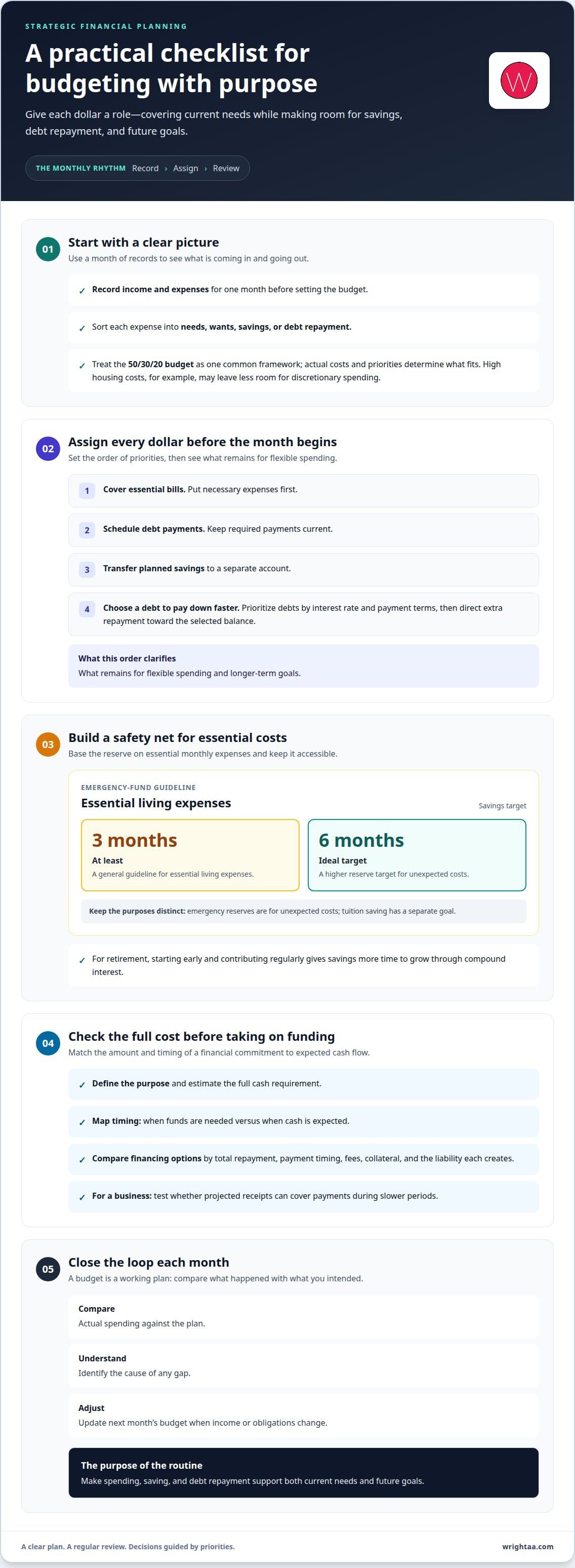
Budgeting needs, wants, savings, and debt repayment
Begin with a month of income and expense records, then sort each expense into needs, wants, savings, or debt repayment. The 50/30/20 budget is one common framework: it assigns shares to those categories, but your actual costs and priorities determine what fits. For example, high housing costs may require smaller discretionary spending. Adjust the plan when income or obligations change.
Give each dollar a role before the month begins. Cover essential bills, schedule debt payments, and transfer planned savings to a separate account. Prioritize debts by interest rate and payment terms while keeping required payments current. Then direct extra repayment toward a chosen balance. This sequence shows what remains for flexible spending and long-term goals.
Build a safety net by totaling essential monthly expenses and identifying how much you can save. A general emergency-fund guideline is at least three months of essential living expenses, with six months as an ideal target. Keep the reserve accessible for unexpected costs. For retirement, starting early and contributing regularly gives savings more time to grow through compound interest.
To assess funding needs, define the purpose, estimate the full cash requirement, and map when funds are needed against expected cash flow. Compare financing options by total repayment, payment timing, fees, collateral, and the liability each creates. A business should also test whether projected receipts can cover payments during slower periods.
Connect your budget to goals such as reducing debt or preparing an estate. A financial advisor can help organize priorities and assess trade-offs. For a business, compare forecast cash with operating commitments before taking on new borrowing. Each month, compare actual spending with the plan, identify the cause of any gap, and adjust the next month’s allocations instead of relying on a single annual estimate.
4. Including risk management and financial forecasting
A forecast turns assumptions into a working view of future revenue, expenses, and cash flow. Start with recent financial records, then list expected sales by source and timing. Map recurring costs, payroll, taxes, and planned purchases to their expected payment dates. Compare projected inflows with outflows to spot periods when cash may tighten.
Build three scenarios using the same operating model. A base case reflects the assumptions management currently considers most reasonable. A best case accounts for stronger sales or faster collections, while a worst case tests lower revenue, delayed payments, or higher costs. For each scenario, identify decisions that would protect essential operations, such as postponing discretionary spending.
Review the assumptions behind each forecast, not just its final balance. A change in customer demand can affect revenue; slower collections can create a cash gap even when sales remain steady. Track actual results against projections, identify the source of each variance, and update the next forecast. Knowing which assumptions have the greatest effect helps focus attention on key risks.
Risk planning also considers people who depend on the household or business. Review insurance coverage, existing obligations, and the cash needed if income is interrupted. For small-business owners, a general guideline is to hold three to six months of operating expenses in cash reserves. The right reserve supports continuity while distinguishing available cash from funds already committed.
Match risk-management decisions to your goals, time horizon, and comfort with uncertainty. A forecast is a decision tool, not a guarantee. Write down the action each scenario would trigger, such as reducing spending or changing a hiring timeline. Clear assumptions make the plan easier to discuss with a financial advisor or business leader.
For a clearer view of business inflows and obligations, work on cash flow management as part of your forecasting process.
Wright CPAs: Tax Planning and Preparation
Wright CPAs, LLC helps connect tax decisions and business records with the financial plan you’re building. Turn to the firm when tax obligations, bookkeeping, or payroll make it difficult to see how decisions affect cash flow and goals.
Tax Planning and Preparation helps organize tax-related decisions, while Bookkeeping and Payroll Services support clear financial records and payroll processes. For business owners who need a broader view of performance, CFO Services provide financial guidance for forecasts and operating choices. These services can help when you’re preparing for a major business decision, adjusting plans after an income change, or bringing financial records into a clearer picture.
For help connecting your financial records and tax planning with your next steps, contact Wright CPAs, LLC.
Give your next decision a clear direction
A financial plan proves useful through the decisions it helps you make. Choose an upcoming decision, such as changing your business structure, adjusting household commitments, or preparing for a transition. Identify what information would make the decision clearer, and set a time to revisit it as circumstances evolve.
Creating a strategic financial plan is an ongoing practice of aligning financial decisions more closely with what matters to you. The next step needn’t be large. A focused conversation about tax planning, records, or financial priorities can help turn an open question into a considered direction.
Wright CPAs, LLC works with individuals and businesses on financial matters that shape their plans. Begin a conversation with Wright CPAs, LLC about the decisions you’re considering, and take the next step with greater clarity.
Frequently Asked Questions
What are the key steps to create a strategic financial plan?
Start by choosing the decision your plan needs to support, then gather records that explain your current position. Set a measurable outcome, identify the assumptions behind it, and note who will act on each decision. For example, a business preparing to hire can document the role, its cash-flow impact, and the conditions that would pause the hire. This makes the plan useful for real decisions.
What financial risks should a strategic plan address, and how can they be mitigated?
Consider risks that could interrupt income or increase obligations, including dependence on a small number of customers, loss of a key employee, or unexpected repairs. Identify which risk would most affect essential operations, then define a response, such as alternate suppliers or a spending-reduction plan. Review insurance coverage and contractual obligations together, so protections and responsibilities are considered as part of the same assessment.
How often should a strategic financial plan be reviewed and updated?
Review the plan regularly, using an annual review as a useful baseline for household and business decisions. Revisit it sooner when a major change affects income, ownership, family responsibilities, or planned borrowing. At each review, compare actual results with assumptions, record what changed, and decide whether any action needs to shift. Documenting the review date keeps the plan connected to current decisions.
What financial planning tools and software are commonly used, and how much do they cost?
Common tools include spreadsheets, budgeting apps, accounting platforms, and planning software. Costs vary by provider, features, and number of users, so compare subscription terms with the task each tool needs to support.


