

Is the internal structure of your business quietly eroding the capital you worked so hard to build? For many New York entrepreneurs, the transition from a standard LLC to S Corp taxation isn't just a filing requirement; it's a deliberate act of financial architecture. You likely feel the weight of the 15.3% self-employment tax on every dollar of profit. This burden feels particularly heavy as the Social Security wage base reaches $184,500 in 2026. Navigating the converting LLC to S corp tax implications NY requires a careful balance between federal savings and the unique regulatory landscape of the Empire State.
We recognize that the complexity of New York’s tax code can feel like an obstacle to your growth. This guide provides a clear path to reducing your tax liability while maintaining perfect alignment with both the IRS and the New York State Department of Taxation and Finance. We'll examine the essential CT-6 election requirements, the strategic use of the Pass-Through Entity Tax, and the discipline required for a defensible payroll strategy. You'll gain a refined perspective on your business’s fiscal foundation.
Key Takeaways
- Distinguish between your legal entity and its tax classification to ensure your business structure supports your long-term financial vision.
- Identify the specific threshold where shifting profit to distributions can significantly reduce your exposure to the 15.3% self-employment tax.
- Navigate the dual-filing requirements of both the IRS and New York State to fully realize the converting LLC to S corp tax implications NY without administrative error.
- Define a 'reasonable' salary for owner-employees that balances IRS compliance with the goal of maximizing tax-efficient profit distributions.
- Discover how integrating payroll and tax strategy creates a cohesive architectural plan for your business's fiscal health in 2026.
The Architecture of Taxation: LLC vs. S Corp in New York
A business is a structure built over time. Its legal form, the Limited Liability Company, serves as the foundation. It provides the essential perimeter of protection between personal assets and professional risks. However, the tax election is the lens through which the IRS views your internal operations. For many New York entrepreneurs, the default disregarded entity status becomes a source of friction as profits grow. In this state, every dollar of profit in a single-member LLC is subject to the full weight of self-employment taxes. It feels like an inefficient use of space.
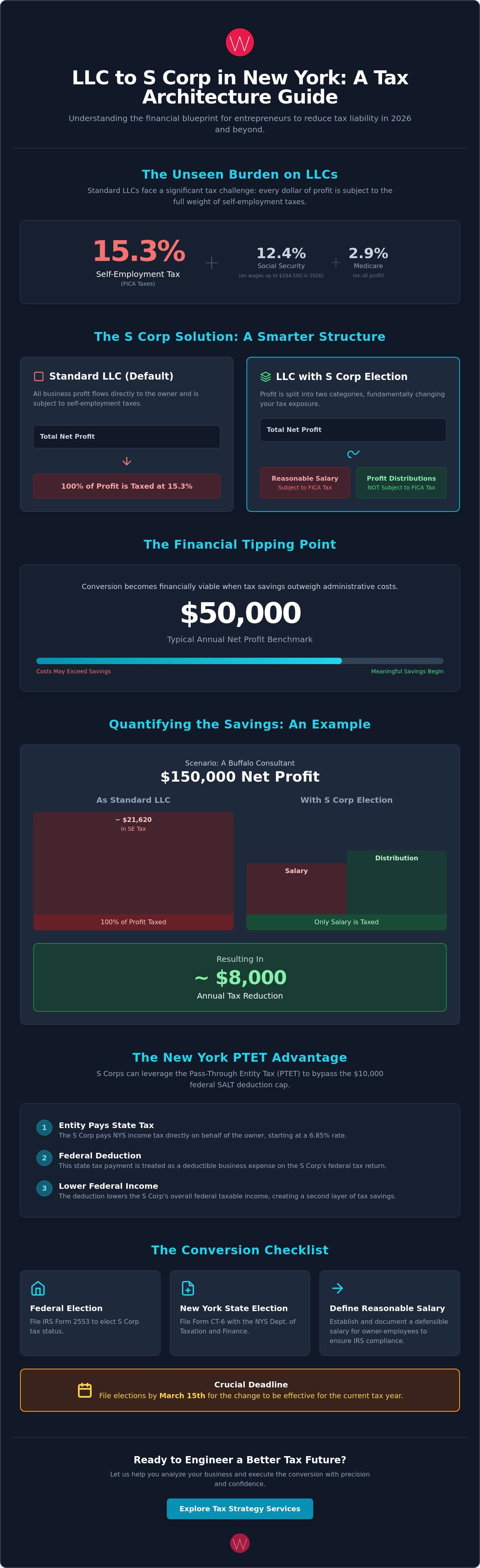
In 2026, the Social Security wage base has reached $184,500. This means a larger portion of your income is subject to the 12.4% Social Security tax before you even consider the 2.9% Medicare tax. By electing S corporation status, you introduce a new internal layout. You become an employee of your own firm. This allows you to draw a reasonable salary and take the remaining profit as distributions. These distributions escape the 15.3% self-employment tax net. Converting LLC to S corp tax implications NY involves more than just a federal filing. It requires a dual commitment to federal and state compliance. The transition is subtle yet profound.
The Legal Shell vs. The Tax Election
The New York Department of State oversees your entity's birth and legal existence. When you change your tax status, you don't re-form the company. You don't need new Articles of Organization. Your liability protection remains constant. The change occurs solely in how you report income to the authorities. It is an administrative shift, not a physical one. You retain your history while evolving your fiscal strategy. This distinction is crucial for maintaining continuity with clients and vendors while optimizing your internal financial architecture.
When Does the Conversion Become Financially Viable?
The decision to convert often rests on a specific tipping point. For most Western New York businesses, an annual net profit of $50,000 is the traditional benchmark. Below this level, the costs of maintaining payroll and filing additional tax returns may consume your savings. Above it, the reduction in FICA taxes begins to offer meaningful relief. Precision is vital here. Utilizing small business accounting Buffalo NY ensures your data is accurate before you commit to this new framework. You must weigh the administrative weight against the poetic efficiency of tax savings. The goal is a structure that is both compliant and liberating.
Quantifying the Savings: Self-Employment Tax and the NY PTET
The fiscal weight of a growing business is often felt most acutely through the 15.3% self-employment tax. This FICA burden, comprised of 12.4% for Social Security and 2.9% for Medicare, applies to every dollar of profit in a standard single-member LLC. In 2026, with the Social Security wage base rising to $184,500, the exposure for high-earning professionals has never been greater. By shifting to an S Corp structure, you draw a boundary. You separate the reward for your labor from the return on your investment.
Consider a consultant in Buffalo with a net profit of $150,000. As a disregarded entity, the entire sum is subject to self-employment tax. By adopting a strategy that includes a reasonable salary and profit distributions, this same professional could realize a reduction in tax liability of roughly $8,000 annually. This is the practical reality of converting LLC to S corp tax implications NY. It's about reclaiming capital that can be reinvested into the business’s future. For those seeking this level of precision, our tax strategy services help define the most efficient path forward.
The New York Pass-Through Entity Tax (PTET) Advantage
New York provides a sophisticated workaround for the federal $10,000 SALT deduction cap through the Pass-Through Entity Tax. While an LLC owner typically pays state income tax personally, an S Corp allows the entity to pay the tax directly. For 2026, the NYS PTET rate begins at 6.85% for income up to $2,000,000. This payment becomes a deductible business expense for federal purposes, effectively lowering your federal taxable income. It's a dual-layered benefit that many standard LLCs cannot access without first meeting federal S Corp election requirements. This election must be made by March 15th to be valid for the current year.
Qualified Business Income (QBI) Deduction Nuances
The Section 199A deduction remains a vital component of your tax architecture. However, the S Corp election introduces a trade-off. While distributions are eligible for the 20% QBI deduction, the salary you pay yourself is not. In high-tax environments like Syracuse or Rochester, we must meticulously calculate the balance between self-employment tax savings and the potential reduction in your QBI benefit. The goal is to find the equilibrium where the total tax burden is at its lowest, ensuring your business remains both compliant and lean.
The New York Mandate: Navigating Federal and State Elections
The transition to an S Corp is a synchronized movement across two distinct regulatory landscapes. Many entrepreneurs assume that filing IRS Form 2553 is the final step in their structural evolution. In New York, this assumption is a significant oversight. The state does not automatically recognize federal tax elections. Failing to understand the converting LLC to S corp tax implications NY can lead to a "mismatched" entity status. This occurs when the IRS views you as a pass-through entity while New York continues to tax you as a C Corp. The result is double taxation at the state level; a structural flaw that erodes the very savings you sought to create.
To avoid this trap, New York requires the submission of Form CT-6. This is the official New York State S Corporation Election. It must be filed with the same precision and timing as your federal election. Without a valid CT-6 on file, your business remains subject to the New York corporate franchise tax rather than the pass-through treatment. This administrative boundary requires deliberate attention during the transition process. It ensures that your federal and state tax architectures remain in perfect alignment.
The Critical Timeline for 2026
Precision in timing is a requirement for fiscal health. For calendar-year businesses in 2026, the deadline for both federal and state elections is March 15th. This 75-day window is narrow. While the IRS provides a path for late election relief under Rev. Proc. 2013-30, New York State is historically less lenient. Leniency for a missed CT-6 filing is rare and often requires demonstrating reasonable cause. A flawless dual-election process involves three essential steps:
- Secure unanimous, written consent from all LLC members or shareholders.
- File IRS Form 2553 and obtain a confirmation of receipt.
- File NYS Form CT-6 immediately following the federal submission.
New York State Specific Requirements
Shareholder consent in New York is an absolute mandate. Every member must sign the election form to validate the shift. For businesses operating within New York City, an additional layer of complexity exists. The city does not recognize the S Corp election for its General Corporation Tax. This means your business may be a pass-through for federal and state purposes but remains a corporation for city filings. If you are starting a business in Buffalo NY, your initial roadmap must account for these specific milestones. Planning for these filings today prevents a reactive and costly administrative correction tomorrow.
Reasonable Compensation: Defining Your Salary in Western NY
Structure requires balance. In the eyes of the IRS, the most critical component of an S Corp is the owner's salary. Because distributions escape the 15.3% self-employment tax, there is a natural temptation to minimize wages. The IRS is aware of this incentive. Underpaying the owner-employee is the primary audit trigger for S corporations. If your salary is deemed artificially low, the authorities may reclassify your distributions as wages, leading to back taxes, penalties, and interest. A $0 salary while taking significant distributions is a clear signal for scrutiny.
Defining "reasonable" is an exercise in market-based objectivity. You must determine what you would pay a third party to perform your specific duties. It isn't just about the hours you spend; it's about the value of your role within your specific industry and geography. Understanding the converting LLC to S corp tax implications NY requires this level of precision. If your salary doesn't reflect the market reality of your position, the tax architecture you've built may collapse under professional review. We help our clients find the equilibrium where tax efficiency meets regulatory compliance.
Benchmarking Salaries in Buffalo, Rochester, and Syracuse
Labor markets in Buffalo, Rochester, and Syracuse offer distinct benchmarks that differ significantly from downstate New York. A retail owner in Syracuse faces different wage expectations than a specialized consultant in Buffalo. For professional practices, the stakes are higher. Utilizing a CPA for law firms Buffalo NY provides the data necessary to justify a partner's salary against local market averages. We recommend maintaining a "defensive file" that includes salary surveys and specific job descriptions to support your compensation choices during any future inquiry.
Administrative Realities: Payroll and Withholding
The shift to an S Corp replaces simple owner draws with a formal W-2 payroll system. This transition introduces new administrative requirements. You must manage quarterly payroll tax filings and adhere to New York State unemployment insurance mandates. These are the pillars of a compliant business structure. While modern software can assist with the mechanics, professional oversight ensures that your withholdings are accurate and your deadlines are met. This discipline protects your distributions and ensures your savings are realized. If you're ready to establish a defensible and efficient system, our payroll services provide the professional oversight your business deserves.
Executing the Conversion with Wright CPAs, LLC
Execution is the final layer of design. A strategy remains merely a concept until it is built with precision. At Wright CPAs, LLC, we view your business as a living environment that requires constant refinement. Moving beyond reactive filing toward proactive tax architecture ensures your business evolves alongside your professional goals. Our fixed-fee advisory model provides the steady cadence needed for a successful S Corp transition, offering a CFO-level perspective that extends far beyond a simple tax return. We prioritize substance over spectacle, ensuring your business's structural change is both meaningful and enduring.
Deeply understanding the converting LLC to S corp tax implications NY is the beginning of a larger dialogue about your firm's fiscal health. We look for the dualities in your financial data, balancing immediate tax efficiency with the long-term stability of your operation. This disciplined approach transforms compliance from a seasonal burden into a tool for growth. It allows you to build with a sense of calm and purpose, knowing the internal framework of your business is handled with professional care. By integrating payroll and tax planning, we create a cohesive plan that reflects the specific needs of your Western New York practice.
Our Intentional Approach to Tax Strategy
The S Corp election is one element of a broader business tax planning Buffalo NY framework. We integrate these benefits into your overall vision, monitoring financial kpis for small business to ensure the structure remains viable as your revenue fluctuates. This vigilance at Wright CPAs, LLC reduces the administrative weight of navigating New York’s specific mandates. You're free to focus on your craft while we maintain the integrity of your state and federal alignment. Our process is unhurried and methodical, mirroring the patience required for sound architectural design.
Begin Your Financial Walkthrough
The process begins with a detailed walkthrough of your current financial landscape. During our initial entity consultation, we review your recent filings and 2026 revenue projections to determine if an S Corp provides the most efficient path forward. If you've already passed the March 16, 2026 federal deadline or the March 15 PTET cutoff, we can assess the feasibility of retroactive late elections. While New York’s requirements are rigorous, certain paths exist for those who act with professional guidance. Secure your strategic tax consultation with Wright CPAs, LLC to ensure your business rests on a foundation of clarity.
Refining Your Financial Foundation
A business structure is more than a legal formality; it's a deliberate choice in how you interact with your economic environment. We've examined the shift from a disregarded entity to a more sophisticated tax lens. By mastering the converting LLC to S corp tax implications NY, you move from reactive filing to an intentional tax architecture. This evolution requires a balance of federal savings, strict adherence to New York’s CT-6 mandates, and the market-based discipline of reasonable compensation.
At Wright CPAs, LLC, we specialize in navigating these dual-layered requirements with a quiet, confident authority. Our proactive CFO-level planning ensures that your business remains both compliant and lean, while our fixed-fee monthly advisory model provides the predictability you need to grow. We prioritize substance over spectacle, guiding you through the complexities of the Empire State's tax code with a patient, methodical rhythm. Design your 2026 tax strategy with a Buffalo-based CPA. Allow your business to rest on a foundation designed for longevity and purpose.
Frequently Asked Questions
What is the deadline for converting my LLC to an S Corp for the 2026 tax year in NY?
The deadline for calendar-year businesses to elect S Corp status for the 2026 tax year is March 16, 2026, for federal purposes and March 15, 2026, for New York State. This narrow window requires the coordinated filing of IRS Form 2553 and NYS Form CT-6. Precision in timing ensures your structural shift is recognized by both authorities from the start of the fiscal year.
Can a single-member LLC in New York become an S Corp?
Yes, a single-member LLC is eligible to elect S Corp taxation by filing the necessary federal and state forms. While the legal entity remains an LLC, the tax lens shifts from a "disregarded entity" to a corporation. This change is often the catalyst for accessing the New York Pass-Through Entity Tax (PTET) benefits, which are otherwise unavailable to standard single-member structures.
What happens if I file IRS Form 2553 but forget New York Form CT-6?
Forgetting Form CT-6 creates a "mismatched" status where you are an S Corp federally but a C Corp in New York. This oversight often leads to double taxation. The state will tax your business income at the corporate level rather than allowing it to pass through to your personal return. Rectifying this usually requires a formal request for late election relief, which the state grants only under specific, documented circumstances.
How much can I save in self-employment taxes by switching to an S Corp?
Savings typically equal 15.3% of the income you reclassify from salary to distributions, up to the Social Security wage base of $184,500 in 2026. For earnings above this threshold, the savings continue at the 2.9% Medicare tax rate. When analyzing the converting LLC to S corp tax implications NY, many business owners find that the reduction in FICA exposure far outweighs the additional administrative costs once net profits exceed $50,000.
Is an S Corp always better than an LLC for New York business owners?
An S Corp is not a universal solution; it's a specific tool for specific needs. If your business profit is below $50,000 or if you reside in New York City, the added complexity of the General Corporation Tax and payroll administration may erode your savings. The decision requires a disciplined look at your cash flow and long-term growth projections within the state’s unique tax climate.
What does 'reasonable compensation' mean for a business owner in Buffalo, NY?
Reasonable compensation is the market-rate salary you would pay an unrelated person to perform your exact duties. In Buffalo, this is determined by local labor market data rather than national averages. It's a foundational requirement that protects your distributions from being reclassified as wages during an IRS audit. We recommend maintaining a detailed job description and local wage benchmarks to support your compensation choice.
Does New York State recognize federal S Corp status automatically?
No, New York State is one of the few jurisdictions that requires a separate, standalone election. While the IRS may accept your Form 2553, the New York State Department of Taxation and Finance remains indifferent until you file Form CT-6. This duality is a common point of friction for entrepreneurs who assume federal compliance guarantees state-level recognition. Both filings must be handled with equal importance.
How does the NY Pass-Through Entity Tax (PTET) work for S Corp shareholders?
The PTET allows your S Corp to pay New York State income tax at the entity level, creating a federal deduction that bypasses the $10,000 SALT cap. Shareholders then receive a corresponding credit on their personal NYS tax returns for their share of the tax paid. For 2026, the election must be made by March 15, providing a sophisticated way to reduce your overall federal tax burden through your business structure.


