

The obvious choice may not be the right one: the best entity depends on how your business is taxed, who owns it, and how it may grow. A C corporation pays tax on its profits, and owners may pay tax again on dividends; partnerships, LLCs, and sole proprietorships generally pass taxable income through to their owners. For business entity selection advice in Rochester, tax treatment is a useful starting point, but not the only consideration.
It’s understandable to focus on taxes when choosing a structure. But liability exposure, plans for investment or expansion, and the time you can devote to administration also matter. A structure that fits at launch may need another look as ownership or business goals change.
This comparison explains how corporations, partnerships, LLCs, and sole proprietorships are taxed, along with key differences in liability and administration. It also offers a practical way to weigh these factors and recognize when to review your business structure.
Key Takeaways
- Weigh personal liability alongside tax treatment; a simple structure can carry different risks than a separate legal entity.
- Compare how each structure handles business income, owner taxes, and the possibility of a second level of tax.
- Revisit your structure when ownership, operations, growth plans, or financial goals change.
- Use tax and financial guidance to connect your choice of entity with your business’s current needs and next steps.
What’s the Right Entity Type Selection for Your Business?
Choose an entity by weighing liability, tax treatment, ownership, growth plans, and administrative capacity together. For businesses in Rochester, the right structure depends on how these factors fit the business.
Sole Proprietorships
A sole proprietorship gives one owner direct control and typically uncomplicated tax reporting. The business has little legal separation from its owner, so personal assets may be exposed to business debts or liabilities. Unlike a corporation, it has no shareholders or stock to issue. Its simpler administration may suit an owner who prioritizes control, but comes with personal liability and fewer options for shared ownership or investment.
Limited Liability Partnerships
A limited liability partnership (LLP) is a partnership structure that can protect partners from certain partnership obligations and other partners’ actions. The scope of protection depends on state law, so an LLP’s liability profile differs from that of a sole proprietorship or general partnership. In a general partnership, each partner is personally liable for the business’s debts and other partners’ actions. Partnership agreements should define roles, financial interests, responsibilities, and decision-making authority.
Local Operating Requirements
Business licenses and permits in Rochester depend on the activity and premises. A business may need zoning, building, health, professional, or signage approvals; requirements depend on what it does and where it operates. Local taxes, fees, and registration needs also vary with business activity, employees, property, and tax classification. There is no single package for every Monroe County business, so account for these operating obligations in your plans.
For annual obligations, distinguish entity maintenance from corporate governance. LLCs have some annual filing requirements, while C corporations are expected to hold annual shareholder and board meetings and record minutes. These are distinct responsibilities, not interchangeable forms of reporting.
An LLC generally separates business obligations from owners’ personal assets, although that protection isn’t unlimited. It offers management flexibility and usually pass-through taxation, while its default federal tax classification depends on the number of members. Corporations create a distinct entity and may support investment through stock, but C corporations can face double taxation. Partnerships commonly pass income and losses through to partners.
| Entity type | Liability | Tax and ownership considerations |
|---|---|---|
| Sole proprietorship | Owner may face personal liability | Direct control; generally simple reporting |
| Partnership or LLP | Varies by partnership form and state law | Shared ownership; agreement sets authority |
| LLC | Generally limits personal liability | Flexible management; tax classification varies |
| Corporation | Separate legal entity | Stock may support investment; C corporations may face double taxation |
Match liability exposure, owner roles, funding plans, tax objectives, and administrative capacity to the entity’s trade-offs.
Tax treatment of corporations, partnerships, LLCs, and sole proprietorships
Entity type shapes how business income, losses, and distributions reach owners’ tax returns. For business entity selection advice in Rochester, compare tax classification with ownership and funding plans.
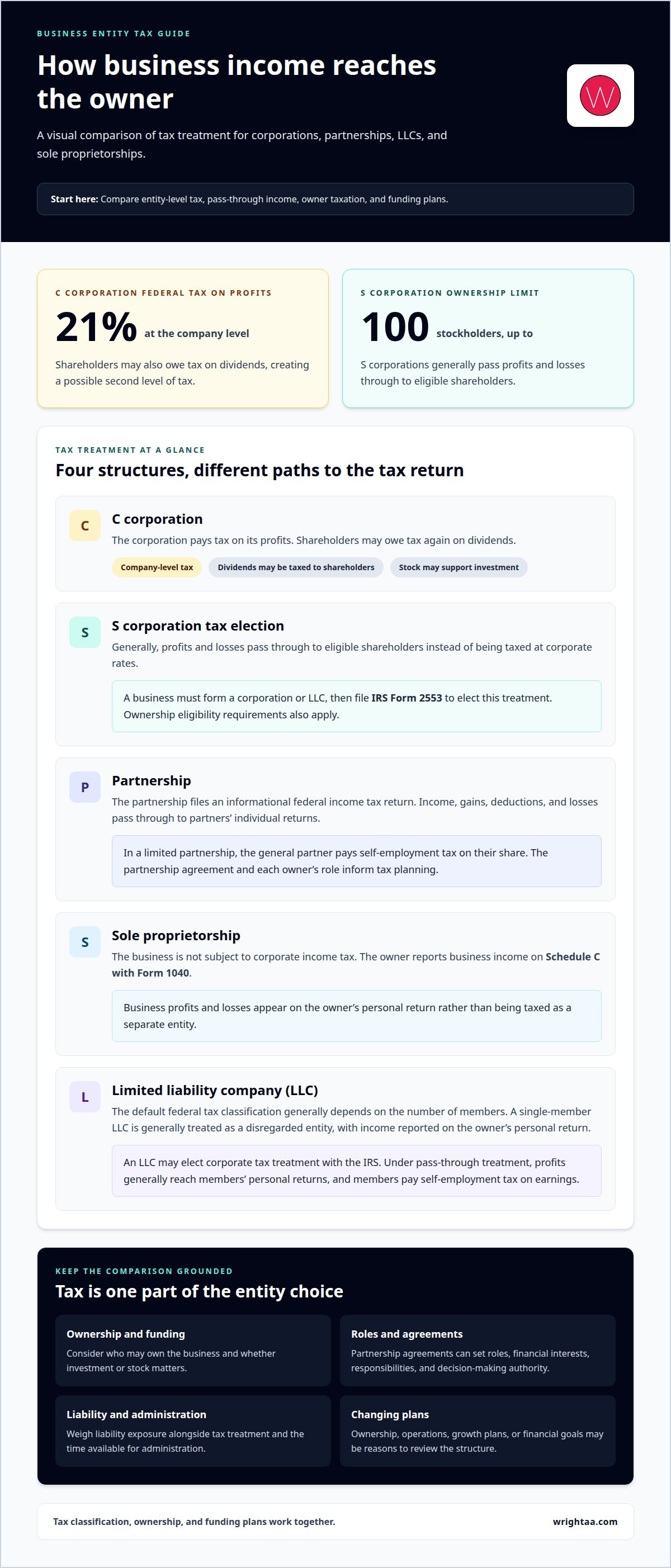
A C corporation pays federal income tax on its profits at 21%. Shareholders may also owe tax on dividends, creating double taxation. C corporations can raise capital by selling stock, and stock options are widely understood. This structure may suit businesses seeking investment or broad ownership, but owners should account for company-level tax and shareholder taxes when planning distributions.
S Corporation Pass-Through Taxation
An S corporation generally passes profits and losses through to eligible shareholders rather than taxing profits at corporate rates. A business must form a corporation or LLC, then file IRS Form 2553 to elect this treatment. According to the Internal Revenue Service, an S corporation can have up to 100 stockholders. Eligibility requirements also shape who may own shares, so ownership plans matter.
Partnership Tax Treatment
A partnership files an informational federal income tax return, while income, gains, deductions, and losses pass through to partners’ individual returns. This differs from a C corporation, where profits are taxed at the entity level and dividends may be taxed again. In a limited partnership, the general partner pays self-employment tax on their share. The partnership agreement and each owner’s role inform tax planning.
Sole Proprietorship Tax Treatment
A sole proprietorship isn’t subject to corporate income tax. The owner reports business income on Schedule C with Form 1040. Unlike a corporation, the sole proprietorship doesn’t pay income tax as a separate entity; business profits and losses appear on the owner’s personal return. This generally uncomplicated reporting suits direct ownership, while tax obligations remain connected to the owner’s business earnings.
LLC Tax Treatment
An LLC’s default federal tax classification generally depends on its number of members. A single-member LLC is generally treated as a disregarded entity, with income reported on the owner’s personal return. An LLC may elect corporate tax treatment with the IRS. Under pass-through treatment, profits generally reach members’ personal returns, and members pay self-employment tax on earnings.
Sound business entity selection advice in Rochester weighs how the tax classification fits the company’s ownership and financial plans. Business consulting can help align those choices with funding goals.
Choosing and periodically reviewing a business structure
A business structure should fit its current owners, tax purposes, funding needs, and growth plans. Review the choice as operations, ownership, or goals change.
Tax Impacts
Tax treatment affects how business income and losses reach owners, and whether profits are taxed at both the entity and owner levels. Compare the current structure’s tax classification with how owners use or distribute earnings. A partnership, LLC, or S corporation may avoid a second tax on distributed earnings. A C corporation may better fit plans for outside investment, but changing from a corporate structure can be difficult without adverse tax consequences.
Ownership and Capital Structure
Ownership plans shape how a business can transfer equity and raise capital. LLCs and partnerships generally offer flexibility in transferring equity, while a corporation can issue stock. A sole proprietor can’t sell stock, and an LLC can’t issue it. Consider who may join, leave, or invest, and how decisions will be made. Partnership agreements should set out each partner’s roles, financial interests, and authority.
What are the risks and tax consequences of changing a business entity later? A business may change its structure as operations, ownership, or goals evolve, but converting from a corporate structure is usually more difficult without adverse tax consequences. A sole proprietorship may become an LLC, and an LLC may convert to a corporation.
Review the choice when a new owner joins, the business changes direction, or funding needs shift. Compare the proposed structure against the same criteria used at formation: liability exposure, tax objectives, growth plans, and administrative capacity. For example, a business planning to distribute earnings to owners may weigh pass-through treatment differently from one seeking outside investment. An ownership change can also make a partnership agreement’s decision-making terms more consequential.
Keep the decision tied to the business’s purposes, not just its original setup. Reviewing projected income, ownership changes, and capital plans can reveal whether the existing structure still fits. New business formation planning can help organize these factors before you choose a structure.
Business entity selection advice from lawyers and tax attorneys
A lawyer and a tax attorney examine different aspects of entity selection. Legal analysis centers on ownership rights, liability protection, and formation documents. Tax analysis compares how an election affects income, distributions, and reporting. For a Rochester business, a sound recommendation connects both perspectives to the owners’ plans.
A lawyer can assess whether an LLC, partnership, or corporation fits the way the owners will operate. An LLP’s liability protection depends on state law, while an LLC’s protection for personal assets isn’t unlimited. A lawyer can also shape agreements that define authority, financial interests, and how an owner’s stake may transfer. Those terms matter when partners disagree or ownership changes.
A tax attorney can compare pass-through taxation with C corporation treatment, then consider how the business expects to use earnings. For example, a business distributing profits to current owners may weigh avoiding a second tax differently from a company seeking outside investment. An S corporation election also requires eligibility and an IRS filing. The ownership plan and intended distributions therefore belong in the tax analysis.
Make the advice specific by focusing on practical factors: who will own the business, whether employees may become owners, how it may raise capital, and how much administration it can manage. A C corporation may suit a business expecting broad ownership, including employee ownership. LLCs and partnerships generally allow more flexibility when transferring equity. An LLC may be easier to convert if it no longer fits.
One professional’s recommendation may not resolve both legal and tax questions. A lawyer can address entity documents and liability structure; tax analysis can model the effects of classification and distributions. The business’s assets, ownership, and growth plans guide the choice, not a label alone.
For a practical review of formation choices and their financial implications, discuss your business structure.
Wright CPAs
Wright CPAs helps business owners connect entity decisions with the financial work that follows. When choosing a structure or reviewing one after a change in ownership, operations, or growth plans, tax planning can clarify how that choice affects business finances. Tax Planning and Preparation, bookkeeping, and payroll solutions support the records and routines that keep financial reporting aligned with the business. CFO Services can help owners consider the structure alongside cash flow and broader financial priorities.
Seek support before forming a business, considering a tax election, or responding to a meaningful change. Bring your questions about ownership, income, and growth plans into the discussion. Contact Wright CPAs to talk through your business structure and financial needs.
Set a Clear Direction for Your Business
Turn the entity decision into a working plan. Consider how ownership, financial reporting, and daily operations will fit together, then record the assumptions behind your choice. A clear rationale can make future conversations with co-owners and advisers more focused. It also gives you a reference point as the business develops.
For business entity selection advice in Rochester, connect the structure decision to the financial picture you want to build. Wright CPAs helps business owners consider entity questions alongside their broader financial needs, with the way the business operates in view. A focused discussion can identify which questions deserve attention now and which belong in a later review.
Contact Wright CPAs to discuss your business structure. Take the next step with a clearer view of how your business is organized and where it is headed.
Frequently Asked Questions
What business entity types are available in New York State?
Common structures to compare include sole proprietorships, partnerships, LLCs, and corporations. Partnerships may be general partnerships, limited partnerships, or limited liability partnerships; corporations may use C or S tax treatment when eligible. For business owners in Rochester, Buffalo, and Syracuse, a useful first step is distinguishing the legal entity from its tax classification. An LLC, for example, can elect corporate tax treatment.
How do sole proprietorships, LLCs, partnerships, and corporations compare for liability and taxes?
These structures differ in owner exposure and how income reaches tax returns. A sole proprietor reports business income personally and may be personally exposed to business liabilities. LLCs generally separate business obligations from owners’ assets, while partnership liability depends on the partnership form. A corporation is a distinct entity; a C corporation may face taxation at both company and shareholder levels. Compare these trade-offs with your ownership and funding plans.
What are the New York State filing fees and publication requirements for forming an LLC?
Plan for state filing charges and publication-related steps as separate parts of LLC formation. The total expense depends on filing details and location, so one statewide estimate may not fit every Rochester business. Before setting a budget, identify the LLC’s filing location and account for the publication process that applies there. Keep formation expenses separate from ongoing tax, bookkeeping, and compliance costs.
What are the costs and steps to form a corporation in New York State?
Corporation formation costs depend on the state filing and the work needed to establish ownership and governance. Start by defining shareholders, stock arrangements, and who will direct the business; then prepare and submit the formation documents. A corporation’s structure also calls for attention to board and shareholder records. Separately decide whether C corporation treatment fits or whether the corporation will seek eligible S corporation tax treatment.
What New York State and federal taxes apply to LLCs, S corporations, and C corporations?
Federal tax treatment depends on the entity’s classification. An LLC may use pass-through or corporate tax treatment, while an eligible S corporation generally passes income through to shareholders. A C corporation pays federal income tax on profits, and shareholders may owe tax on dividends. State treatment can differ from federal classification, so businesses in Rochester, Buffalo, and Syracuse should include state and federal tax planning in their structure review.


