

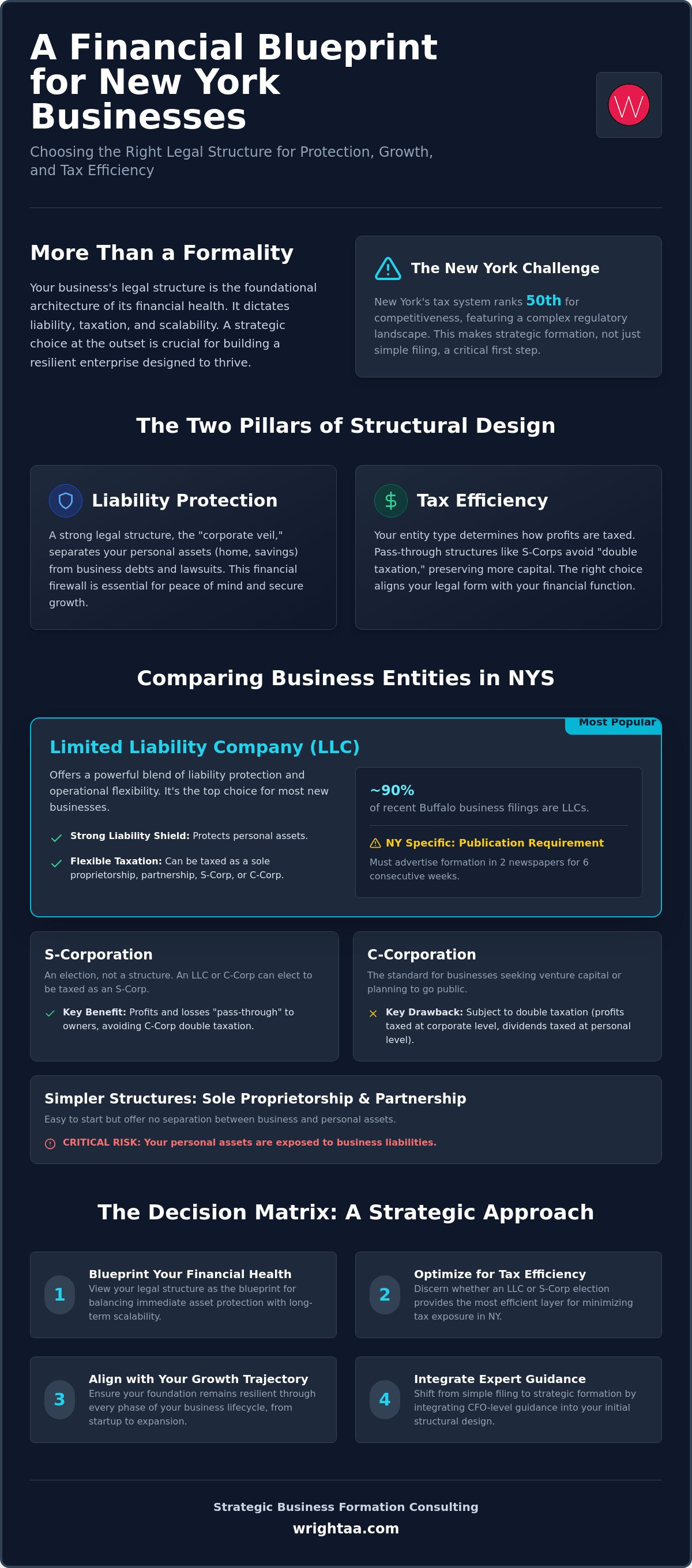
The structure you choose for your enterprise is far more than a legal formality; it's the foundational architecture upon which your entire financial future rests. In a state where the tax system ranks 50th for competitiveness, a single decision at the outset determines whether your business thrives with structural integrity or buckles under the weight of unforeseen liability. When seeking business formation consulting, New York entrepreneurs often find that the path to clarity is obscured by the complexity of local regulations and the unique demands of the state tax code.
You likely understand that the right entity should shield your personal life from professional risks, yet the distinction between an LLC and an S-Corp can feel needlessly opaque. This guide offers a curated look at the legal frameworks available to you, promising a clear path toward a tax-efficient structure that preserves your capital. We'll explore the nuances of New York's specific requirements, such as the publication mandate for LLCs and the strategic benefits of pass-through taxation, to help you build a business with confidence and purpose.
Key Takeaways
- View your legal structure as the architectural blueprint for your financial health, balancing immediate asset protection with long-term scalability.
- Professional business formation consulting New York helps you discern whether an LLC or an S-Corp election provides the most efficient layer for minimizing tax exposure.
- Navigate the specific nuances of the New York tax landscape, including the geographic impact of the Metropolitan Commuter Transportation Mobility Tax on your bottom line.
- Align your entity selection with a defined growth trajectory to ensure your financial foundation remains resilient through every phase of your business lifecycle.
- Shift from simple filing to strategic formation by integrating CFO-level guidance into your initial structural design.
Foundational Intent: Why Business Entity Selection in New York Matters
Designing a business in New York requires the same level of intentionality as drafting the blueprints for a permanent structure. The legal entity you choose serves as your financial foundation. It dictates how your assets are shielded, how your profits are taxed, and how easily your enterprise can scale. In a state that consistently ranks at the bottom of tax competitiveness indices, this decision isn't merely administrative. It's a strategic intervention. Seeking professional business formation consulting New York ensures that your structure is built to withstand both economic shifts and regulatory scrutiny.
New York's regulatory landscape is uniquely demanding. Unlike states with simpler filing processes, New York imposes specific burdens like the LLC publication requirement and a graduated corporate tax system. Choosing the wrong entity type early on creates friction that persists for years. Re-incorporation is often a costly and disruptive process involving new filing fees, potential tax penalties, and the complex unwinding of existing contracts. It's far more efficient to build correctly from the start than to retrofit a failing structure later.
The Architecture of Liability Protection
For Buffalo entrepreneurs, the corporate veil is the primary barrier between personal security and professional risk. A well-chosen legal structure isolates your home, savings, and personal property from the obligations of the business. Whether you select a corporation or a Limited Liability Company (LLC), the goal is to create a distinct legal personhood for the enterprise. This separation provides a profound sense of psychological peace. It allows you to focus on growth and innovation without the constant weight of personal exposure. It's the difference between building on solid ground and building on a fault line.
Tax Efficiency as a Structural Element
Financial health is inextricably linked to how capital flows through your organization. Different structures offer different paths for this flow. Pass-through entities like S-Corps allow profits to reach owners directly, avoiding the double taxation inherent in C-Corporations. However, the optimal choice depends entirely on your specific goals and projected income. Your selection serves as the framework for all future business tax planning Buffalo NY. A CPA acts as the architect in this process, ensuring that the legal form of your business perfectly aligns with its financial function. We look at the site and the structure together, creating a unified strategy that preserves your hard-earned capital.
A Comparative Study: LLCs, S-Corps, and Corporations in NYS
The selection of a legal entity is the first material choice in the construction of your business. Each structure offers a different weight, texture, and capacity for growth. While many entrepreneurs gravitate toward the simplicity of a sole proprietorship, this choice often lacks the necessary barrier between the individual and the enterprise. Partnerships offer collaborative strength but introduce shared liabilities that can destabilize the foundation. For those seeking high-growth trajectories or venture capital, the C-Corporation remains the standard for scalability, despite the presence of double taxation on dividends. Professional business formation consulting New York helps clarify which of these paths aligns with your long-term intent. This process is about more than just paperwork; it's the curation of your professional identity.
The New York LLC: Popularity and Publication
The Limited Liability Company (LLC) is the most frequent choice for Buffalo startups, accounting for nearly 90% of recent business filings. Its popularity stems from its inherent flexibility. It allows for "check-the-box" taxation, letting owners choose how the entity is treated for tax purposes. The $200 filing fee is a one-time investment in your legal shield. However, New York introduces a unique procedural step. According to the New York Department of State, new LLCs must fulfill a publication requirement, advertising their formation in two newspapers for six consecutive weeks. This process is a necessary component of maintaining your entity's standing. Beyond the filing, the Operating Agreement serves as the internal skeleton of the LLC. It defines the relationships and responsibilities of the members, ensuring the structure remains rigid under pressure.
S-Corp vs. LLC: The Tax Strategy Debate
The dialogue often shifts toward the S-Corporation when a business reaches a specific level of profitability. It's vital to remember that an S-Corp is not a separate legal entity but a tax election made by an LLC or a corporation. The primary appeal lies in the potential to minimize self-employment taxes. By paying yourself a reasonable salary and taking the remaining profit as a distribution, you can reduce the tax burden on your net income. This layer of strategy is a core component of business formation consulting New York, ensuring your financial architecture is as efficient as possible.
When evaluating S-Corp vs. LLC New York tax implications, the decision usually rests on a financial threshold. If your projected net income significantly exceeds a reasonable salary, the savings on self-employment tax may outweigh the added administrative costs of payroll. This transition requires a disciplined approach to bookkeeping and compliance. If you're ready to design a more efficient financial framework, you might consider how strategic advisory services can support your transition. We focus on the intersection of legal form and financial function to ensure your business remains both compliant and lean.
Navigating the New York Tax Landscape: Nuances and Requirements
The fiscal environment of New York is a complex topography. It requires precise navigation to maintain the integrity of your financial structure. While the legal entity provides the shield, the state's tax code determines the climate in which your business must survive. For those researching How To Set Up An LLC In New York, the initial filing is only the first layer of a much larger architectural challenge. Professional business formation consulting New York serves as a map through these regulations, ensuring you aren't surprised by the hidden costs of compliance.
Franchise Taxes and Filing Fees
Every entity type carries its own set of recurring maintenance costs. For LLCs, New York mandates an annual filing fee based on your gross income from the previous year. This fee, submitted with Form IT-204-LL, ranges from $25 to as much as $4,500 for high-earning entities. Corporations face a different path. Most taxpayers with business income exceeding $5 million are subject to a 7.25% corporate income tax rate, while others pay 6.5%. There's also a capital base tax of 0.1875% to consider. Budgeting for these elements is a standard part of business formation consulting New York, as these costs are often omitted from basic filing services.
Regional Considerations for WNY Businesses
Operating in Western New York offers a distinct set of advantages and requirements. When starting a business in Buffalo NY, you must account for a combined state and local sales tax rate that averages 8.54%. Registering for sales tax is a critical step for retailers and many service providers in the region. Beyond the numbers, local expert guidance helps you avoid pitfalls specific to upstate municipalities. Whether you're building in the heart of Rochester or the outskirts of Syracuse, your structure must be responsive to the local economic environment. We focus on these granular details to ensure your financial foundation is both compliant and optimized for your specific geographic context.
The Decision Matrix: Selecting Your Business Structure with Intentionality
Selecting your business structure requires a deliberate movement from abstract vision to material detail. It is a decision matrix that balances your future aspirations with current financial realities. Effective business formation consulting New York provides the necessary framework for this evaluation. It ensures that the structure you build today doesn't become a constraint tomorrow. This process is not a simple choice between forms; it's an exercise in aligning your legal environment with your professional purpose.
To reach a decision with structural integrity, you must move through a series of intentional steps:
- Define your 5-year growth trajectory and exit strategy. A structure designed for a lifestyle business differs fundamentally from one built for acquisition or public offering.
- Calculate your projected net income and self-employment tax exposure. The numerical data often points toward a specific tax election to preserve capital.
- Evaluate your need for outside investment or complex ownership tiers. Corporations offer the rigid, recognizable hierarchy required by institutional investors.
- Assess the administrative burden you're willing to manage. Sophisticated structures require CFO-level oversight to maintain compliance and operational clarity.
- Consult with a CPA to finalize the architectural plan. Professional guidance ensures the foundation is level before the first brick is laid.
Criteria for Professional Service Firms
Professional service firms face a distinct set of requirements that demand a more nuanced approach. For those seeking a CPA for law firms Buffalo NY, the choice often narrows to the Professional Service Corporation (PC) or the Professional LLC (PLLC). These entities are curated to accommodate the ethical and legal standards of licensed professionals. Selecting the correct form ensures that the firm's profitability is protected while maintaining the necessary structural clarity for partners and associates. It is about creating a space where the practice of law can flourish within a secure financial frame.
Evaluating Administrative Complexity
Administrative complexity is a recurring cost of certain structures that must be weighed against their benefits. A corporation requires a disciplined approach to governance, including formal bylaws, regular meetings, and meticulous minutes. Conversely, small business accounting Buffalo NY is often more streamlined within an LLC framework. The goal is to design a system that supports your craft rather than distracting from it. By minimizing unnecessary paperwork, you preserve your energy for the work that truly matters. If you're ready to move from concept to construction, our team can help you design your financial foundation with precision and care.
Designing Your Future: Strategic Formation with Wright CPAs, LLC
The final phase of business formation isn't the receipt of a filing certificate; it's the integration of that structure into your daily operations. At Wright CPAs, LLC, we view our role as more than just a service provider. We act as the financial architects who oversee the long-term stability of your build. Choosing business formation consulting New York through our firm means gaining access to CFO-level guidance that extends far beyond the initial paperwork. We ensure that your legal framework is perfectly aligned with your operational reality.
Structural integrity requires constant vigilance. Our fixed-fee monthly advisory retainers are designed to provide this ongoing support. Instead of reactive check-ins, we offer a steady, unhurried rhythm of oversight that prevents small misalignments from becoming foundational cracks. This proactive approach allows you to maintain compliance with New York's rigorous standards while focusing your energy on growth. It creates a sense of trust, knowing that the design process is patient and methodical.
A key component of this oversight is the implementation of a robust tracking system. We integrate your entity choice into a broader strategy for monitoring financial kpis for small business. By connecting your structure to your data, we transform your legal entity from a static document into a dynamic tool for decision-making. This alignment between the site and the structure is what ensures long-term viability in the Western New York market.
Proactive Strategy vs. Reactive Preparation
We begin every engagement with a Buffalo startup by looking toward the horizon. Starting with the end in mind allows us to design a structure that accommodates your ultimate goals. There is a delicate synergy between your bookkeeping, payroll systems, and entity structure. When these elements work in harmony, they create a sense of purpose and clarity. Wright CPAs, LLC doesn't just file forms; we build a cohesive financial environment where every material choice supports your daily life and professional success. Our personality is artistic yet disciplined, prioritizing deep listening before the creative process of formation begins.
Next Steps for Western New York Entrepreneurs
Preparing for your initial consultation is a step toward professional maturity. To ensure a seamless New York filing, gather your foundational documents, including identification for all members and a clear outline of your ownership percentages. Consider your projected income and your plans for hiring employees in the coming year. This preparation allows us to move logically from broad philosophical concepts to the specific material details of your formation. It's the first step in a permanent, thoughtful intervention in your financial future.
Your business deserves a foundation built with intention and precision. It's time to move beyond the generic and toward the curated. Design your financial foundation with Wright CPAs, LLC and begin your journey with a structure that is as resilient as it is visionary.
Constructing a Foundation for Lasting Success
The selection of a legal entity is the first permanent intervention in your professional life. We've examined how the right structure balances liability protection with long-term tax efficiency, ensuring your capital remains protected within the complex New York regulatory environment. Whether you're navigating the unique requirements of a law firm or scaling a closely held business, the architecture you choose today dictates the height you can reach tomorrow. Professional business formation consulting New York provides the clarity needed to move from a conceptual vision to a resilient reality.
At Wright CPAs, LLC, we combine our deep Buffalo roots with a modern, technology-forward approach to financial oversight. Our specialized experience in law firm accounting and fixed-fee monthly advisory retainers offers the predictable guidance your venture requires to thrive. We invite you to schedule your strategic entity selection consultation with Wright CPAs, LLC to begin drafting your blueprint. Your business is a structure worth designing with precision and care.
Frequently Asked Questions
What is the most common business entity for startups in New York?
The Limited Liability Company (LLC) remains the most frequent choice, representing nearly 90% of new business filings in recent years. Its popularity is rooted in the flexibility it offers for both management and taxation. It provides a robust legal shield while allowing profits to pass through to owners' personal returns, avoiding the double taxation often associated with traditional corporations.
How much does it cost to form an LLC in New York State in 2026?
The initial filing fee for Articles of Organization is $200, paid to the New York Department of State. However, the total investment includes the unique publication requirement, which can range from $200 in upstate counties to over $2,500 in Manhattan. You must also account for a $50 filing fee for the Certificate of Publication and a $9 biennial statement fee every two years.
What is the New York LLC publication requirement?
New York mandates that every new LLC publish a notice of formation in two newspapers for six consecutive weeks within 120 days of its creation. One newspaper must be a daily publication and the other a weekly, both located in the county where the office is established. Failure to meet this requirement can lead to the suspension of your authority to do business within the state.
Can I change my business entity later if my company grows?
Yes, you can transition to a different structure, though the process requires a careful unwinding of your current framework. Changing entities often involves new filing fees, the creation of new operating agreements, and potential tax consequences. Professional business formation consulting New York helps you design a structure that anticipates growth, minimizing the need for disruptive retrofitting later in your business lifecycle.
Is an S-Corp a separate legal entity in New York?
An S-Corp is a tax election rather than a distinct legal entity. It's a status that an LLC or a corporation chooses to adopt with the IRS and the state. This election allows the business to be treated as a pass-through entity for tax purposes, which can be a strategic layer for profitable businesses looking to reduce self-employment tax exposure for the owners.
Do I need a lawyer or a CPA to select my business entity?
While both professionals offer valuable perspectives, a CPA ensures your structure is built for long-term financial health and tax efficiency. A lawyer focuses on the legal boundaries of the corporate veil, while a CPA designs the internal financial flow and tax strategy. Selecting an entity is a multidisciplinary exercise that benefits from the technical precision of a financial architect; to explore how international firms like Tax Partners approach these challenges, read more about their professional advisory services.
How does being in Buffalo vs. NYC affect my business taxes?
Geographic context fundamentally alters your tax burden, particularly regarding the Metropolitan Commuter Transportation Mobility Tax (MCTMT). Businesses in Buffalo and Western New York are exempt from this specific tax, which applies only to the NYC metropolitan area. Additionally, NYC businesses must navigate an extra layer of local regulations and taxes, such as the Unincorporated Business Tax, which don't apply to upstate enterprises.
What are the ongoing filing requirements for a NY Corporation?
Corporations must file a Biennial Statement every two years with a $9 fee to remain in good standing. They are also subject to annual corporate franchise tax filings, with rates currently set at 6.5% for most businesses or 7.25% for those with income exceeding $5 million. Beyond state filings, corporations must maintain internal discipline through annual meetings, formal minutes, and updated bylaws to preserve their structural integrity.


