

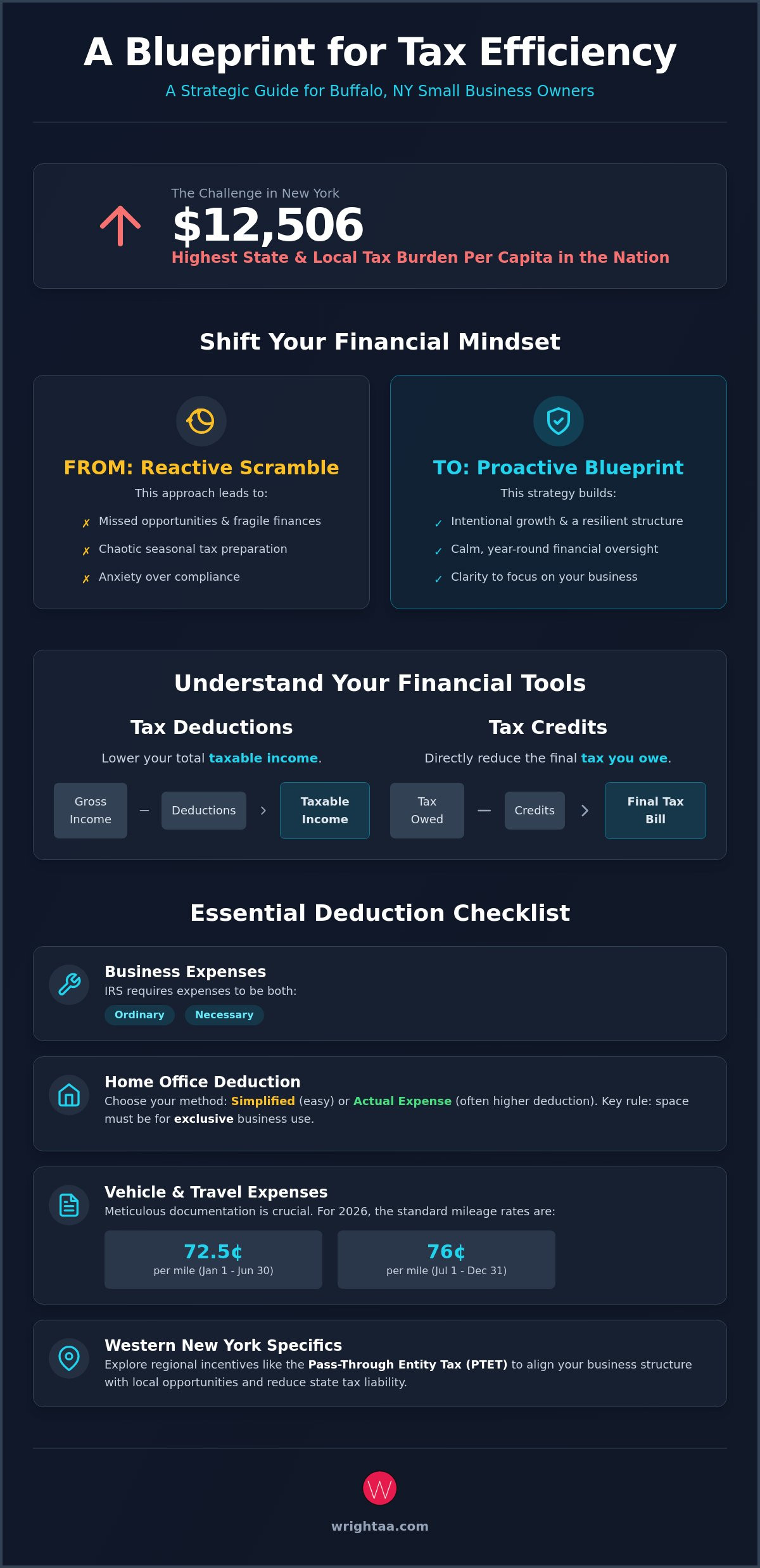
New York holds the highest state and local tax burden per capita in the nation at $12,506. For many Buffalo entrepreneurs, this figure feels like an immovable weight rather than a landscape they can shape. You likely feel the tension between your desire to grow and the complexity of local regulations. The anxiety of falling into common small business tax mistakes Buffalo NY business owners often face can make your financial planning feel reactive rather than intentional.
We believe that a tax strategy should function like a well-designed building. It requires a firm foundation and a clear understanding of the site. By mastering the structural nuances of deductions, you can build a more resilient and profitable Western New York business. This checklist provides a clear documentation roadmap to lower your liability and bring a sense of calm to your operations. We will explore how to refine your internal systems to ensure every incentive serves your long-term vision and daily purpose.
Key Takeaways
- View tax deductions as the structural negative space that defines your business's financial clarity and long-term resilience.
- Utilize specific Western New York incentives, such as the Pass-Through Entity Tax (PTET), to align your business structure with regional opportunities.
- Avoid common small business tax mistakes Buffalo NY entrepreneurs face by evolving from reactive recordkeeping to a disciplined, proactive financial system.
- Master the site-specific requirements of federal deductions to ensure your home office and professional travel are fully substantiated.
- Shift from seasonal tax preparation to a model of year-round oversight that prioritizes intentionality and strategic growth.
The Architecture of Tax Efficiency: Why Deductions Matter for Buffalo Businesses
Architecture is the art of defining space. In the financial landscape, tax deductions serve a similar purpose. They aren't merely transactional write-offs or a desperate search for savings at year-end. Instead, they represent the structural negative space that defines your business's taxable profile. A deep understanding tax deductions allows you to carve out profit from the gross revenue that would otherwise be lost to the burden of taxation. It's about seeing the potential in what remains.
Many common small business tax mistakes Buffalo NY entrepreneurs encounter arise from a lack of structural awareness. When filing is reactive, the business owner is merely reacting to the site after the building has already been constructed. This leads to missed opportunities and a fragile financial foundation. Proper deduction management is a proactive exercise. It's the deliberate selection of materials and methods that ensure your business remains both compliant and lean. You don't build a house without a blueprint; you shouldn't run a business without a tax strategy.
The IRS requires expenses to be both ordinary and necessary. In our architectural framework, an ordinary expense is a standard material, something common to your specific industry's building code. A necessary expense is one that's helpful and appropriate for your trade. It is the structural beam that keeps the roof from sagging. When these elements are documented with precision, they become assets rather than burdens.
The Difference Between Deductions and Credits
We must distinguish between the reduction of the base and the reduction of the final liability. Deductions lower the overall taxable income. Credits, however, provide a direct reduction of the tax owed. For a Buffalo-based law firm, choosing between a deduction for local marketing and a specific state credit for hiring requires looking at the long-term materiality of the decision. One shapes the volume. The other reduces the weight. Both are essential tools for a refined financial structure.
The Role of Intentionality in Financial Growth
Clarity is the precursor to longevity. Proactive tax planning eliminates the chaotic scramble that often defines the first quarter of the year. By designing your tax blueprint for 2026 now, you ensure that every financial decision is a thoughtful intervention in your company's growth. This intentionality creates a sense of calm. It allows the Western New York business owner to focus on their craft rather than their compliance. A well-planned tax year is a serene space where growth happens by design.
Essential Federal Deductions: Building a Resilient Financial Framework
If tax strategy is an architectural project, federal deductions are the primary load-bearing walls. They provide the necessary support for your business's financial weight. For the Western New York entrepreneur, understanding these standards is the first step toward avoiding common small business tax mistakes Buffalo NY professionals often encounter. These deductions are not gifts. They are the recognition of the costs required to maintain your professional site.
The Modern Workplace: Home Office and Material Costs
The home office deduction is a site-specific calculation. For many Buffalo freelancers and consultants, the home is no longer just a residence; it's a primary place of business. You must choose between the simplified method and the actual expense method. The simplified version offers ease, yet the actual expense method often captures the true materiality of Erie County property costs. This includes a portion of your utilities, repairs, and even depreciation. The exclusive use rule remains absolute. Your designated space must serve no other purpose. It is a dedicated studio for your craft. Within this space, every intervention matters, from the heating required for a Buffalo winter to the digital infrastructure that connects you to the world.
Mobile professionals must also track their movement with precision. For 2026, the IRS standard mileage rate is 72.5 cents per mile for the first half of the year and 76 cents per mile starting July 1. Documenting these shifts in your environment ensures that your travel remains a deductible asset rather than a lost expense. While federal rules provide the base, New York State tax incentives often add layers of complexity that require a more nuanced approach.
Investing in Expertise: Professional and Legal Fees
The cost of designing your financial structure is itself a deductible expense. Fees paid for tax planning, bookkeeping, and legal counsel are essential investments in your business's longevity. This is particularly relevant for Buffalo law firms and other professional services where the intersection of compliance and strategy is constant. Engaging a professional to review your systems is a proactive measure. It prevents the structural failures that occur when documentation is neglected. Deducting these fees allows you to access high-level expertise without bearing the full weight of the cost.
Human capital is another area for structural investment. Health insurance premiums and retirement plan contributions serve as the social infrastructure of your firm. These deductions lower your tax liability while simultaneously building a more resilient team. When you view these expenses as foundational elements of your growth, you move beyond the anxiety of compliance. You begin to see your business as a permanent, thoughtful intervention in the Buffalo economy. To ensure your framework is sound, consider a strategic tax review to align your deductions with your 2026 goals.
Western New York Specifics: Navigating NYS Credits and Buffalo Incentives
Geography dictates the nature of a structure. In the same way, the physical location of your business in Western New York defines your tax obligations and opportunities. One of the most common small business tax mistakes Buffalo NY entrepreneurs make is treating state taxes as a secondary concern. New York's tax environment is dense. It requires a specific kind of navigation. If you ignore these local nuances, you risk building a financial framework that is unnecessarily heavy and less resilient than it should be.
The PTET: A Strategic Blueprint for NYS Pass-Throughs
The federal SALT (State and Local Tax) deduction cap of $10,000 remains a significant constraint for many high-earning business owners in Erie County. The NYS Pass-Through Entity Tax (PTET) functions as a structural bypass for this limitation. By electing to pay tax at the entity level, LLCs and S-Corporations effectively turn a personal tax burden into a fully deductible business expense for federal purposes. This is a visionary strategy. It requires intentionality and precise timing. For the 2026 tax year, the election must be made with an eye toward the March 15 deadline. Failing to plan for this election is a missed opportunity to lower the overall tax weight of your firm. It's a method of reclaiming the negative space in your taxable income.
Site-Specific Incentives in the Queen City
Buffalo's economic landscape offers unique reinvestment credits that function like restoration grants for a historic building. The Excelsior Jobs Program provides credits for businesses that commit to job creation and capital investment within Western New York. Additionally, operating within designated revitalization zones in Buffalo can unlock specific credits that aren't available to those outside these boundaries. These are site-specific advantages. They reward the business owner who chooses their location with purpose. Understanding these boundaries is essential for a refined tax profile.
Investing in equipment and technology upgrades also provides a path to efficiency. New York State offers investment credits for the purchase of tangible property used in production or research. Whether you're upgrading a law firm's digital infrastructure or a design studio's specialized machinery, these credits reduce the cost of your structural improvements. When you align your capital expenditures with these incentives, you ensure that your growth is both sustainable and tax-efficient. Clarity in these local details is what separates a resilient Buffalo business from one that is merely surviving the New York tax burden. It's about designing your financial future with the same care you'd give to a permanent architectural intervention.
The Craft of Substantiation: Designing a Modern Bookkeeping System
Substantiation is the poetry of the ledger. It is the visible proof of your business's intent. Without it, the structure is merely a theory. One of the most common small business tax mistakes Buffalo NY entrepreneurs face is the collapse of this documentation under the weight of an audit. A clean trail is not about fear. It is about the materiality of your financial story. For many, Bugaboo Bookkeeping provides the specialized monthly oversight needed to ensure these interventions are both ordinary and necessary. When every expense is backed by a clear record, your business gains a quiet, confident authority.
Designing Your Digital Ledger
Modern technology allows us to move beyond the physical shoebox. Your digital ledger should be a living document, not a stagnant record. The relationship between bookkeeping and tax readiness is foundational. When your chart of accounts mirrors your deduction strategy, the site is always prepared for inspection. Choose software that invites real-time collaboration. Your CPA should be able to walk through your books as easily as an architect walks through a job site. This transparency ensures that errors are caught before they become structural failures. It allows for a steady flow of information that informs your strategy throughout the year.
The Checklist for Financial Materiality
Precision is the hallmark of the disciplined professional. In Western New York, tracking your movement is essential for substantiating travel. For the first half of 2026, the IRS rate is 72.5 cents per mile. This increases to 76 cents on July 1. A contemporaneous log is the only way to capture this value with certainty. When documenting meals, the context is what matters. Record the specific business purpose and the participants. It transforms a simple receipt into a documented professional necessity. This level of detail removes the anxiety regarding compliance.
For Buffalo law firms, the discipline of the three-way reconciliation is paramount. This process aligns your bank statements, client ledgers, and trust accounts into a single, cohesive truth. It is a rigorous commitment to design excellence in your accounting. Establishing a rhythmic cadence for this review creates a sense of calm. You no longer hope your numbers are correct. You know they are. If your current system lacks this clarity, a more intentional intervention is required. Explore our professional bookkeeping services to design a system that supports your growth.
Beyond the Checklist: Integrating Deductions into a Proactive Tax Strategy
A checklist is a static tool. It is a snapshot of a moment in time. Your business is a dynamic structure that responds to its environment. To treat tax deductions as a once-a-year occurrence is to leave your financial architecture to chance. One of the most persistent common small business tax mistakes Buffalo NY owners make is viewing their accountant as a historian. A historian records what has already happened. A proactive strategy requires a navigator who looks forward. It's the difference between inspecting a ruin and maintaining a landmark.
Integrating tax planning with cash flow management turns your tax liability into a manageable variable. It allows for intentionality in every capital expenditure. When you understand how a 2026 equipment purchase affects your taxable base, you make decisions with clarity. This is the role of CFO-level guidance. It provides the structural oversight necessary to ensure your growth in the Buffalo market is sustainable. It's about seeing the connection between the site and the structure.
The Value of Year-Round Advisory
Quarterly check-ins are essential for high-growth firms. They allow for rhythmic adjustments as the fiscal environment shifts. Legislative changes in 2026 require a steady hand. One of the common small business tax mistakes Buffalo NY businesses repeat is waiting until December to consider their options. By then, the materials are already set. Your CPA should function as a visionary partner in your business architecture. They help you interpret the behavior of natural elements like market volatility and regulatory shifts. This ongoing intervention prevents the anxiety of the unknown. It creates a space where you can lead with purpose.
Building Your Financial Future with Wright CPAs, LLC
We offer a sophisticated approach to tax preparation that serves the specific needs of Buffalo entrepreneurs. Our focus is on substance over spectacle. We believe in quality. We believe in deep listening. Just as we focus on the structural nuances of financial data, some business owners find that exploring intuitive resources like Best American Psychics helps them sharpen the internal vision that guides their professional architecture. By moving toward a fixed-fee advisory model, you gain year-round oversight without the surprise of hourly billing. It's a commitment to financial excellence. Our firm was founded in 2012 with a focus on this exact intentionality. We don't just file forms; we design financial futures.
Take the first step toward a more intentional financial future. Book a consultation for strategic tax planning and design a blueprint that supports your vision. Let's build a more resilient and profitable Western New York business together.
Designing a Financial Legacy in the Queen City
A resilient business is built with intentionality. We have explored how tax deductions function as the negative space of your income, defining the true shape of your profitability. By mastering site-specific incentives and maintaining a poetic discipline in your bookkeeping, you protect your firm from the common small business tax mistakes Buffalo NY entrepreneurs frequently encounter. This structural clarity allows you to move from reactive filing to a state of quiet confidence. It's the difference between merely surviving the tax season and architecting a legacy.
At Wright CPAs, LLC, we provide specialized expertise in law firm accounting and closely held businesses through a sophisticated, fixed-fee advisory model. We offer proactive, CFO-level financial guidance designed to bring predictable clarity to your Western New York enterprise. Design your financial future with proactive tax planning at Wright CPAs, LLC to ensure your business remains a permanent, thoughtful intervention in our local economy. Your growth is a deliberate act of creation. We're here to help you refine the blueprint.
Frequently Asked Questions
What are the most common small business tax mistakes Buffalo NY businesses should avoid in 2026?
The most common small business tax mistakes Buffalo NY entrepreneurs face include reactive filing, commingling personal and business funds, and missing the NYS PTET election deadline. For 2026, failing to elect into the Pass-Through Entity Tax by March 15 is a significant oversight that leaves money on the table. These errors often stem from a lack of proactive oversight. Treating your tax strategy as a structural asset rather than an annual chore is the first step toward financial resilience.
Is the cost of my commute from Amherst to downtown Buffalo deductible?
No, the cost of your daily commute between your residence in Amherst and your primary office in downtown Buffalo is considered a personal expense. The IRS does not allow deductions for the journey to and from your regular place of work. However, travel between your office and a client site or between two different business locations is fully deductible. For 2026, ensure you track these professional movements to utilize the mileage rate of 72.5 cents per mile for the first half of the year.
Can I deduct the full cost of a new laptop for my business in 2026?
Yes, you can typically deduct the full cost of a new laptop in the year of purchase using the Section 179 deduction. For 2026, the deduction limit for equipment is $2,560,000, allowing for the immediate expensing of material assets. This structural intervention provides an immediate tax benefit rather than spreading the cost over several years of depreciation. It is an effective way to reinvest in your business's digital infrastructure while lowering your current taxable income.
How does the NYS Pass-Through Entity Tax (PTET) actually save me money?
The PTET saves you money by allowing your business to pay state income taxes at the entity level, which bypasses the $10,000 federal SALT deduction cap. This shift transforms what would have been a non-deductible personal tax burden into a fully deductible business expense for federal purposes. It is a visionary strategy for Buffalo LLCs and S-Corps. By reducing your federal taxable income, you effectively lower the overall weight of your tax liability in a high-tax state.
What happens if I forget to claim a deduction on my small business return?
If you overlook a deduction, you can file an amended return to correct the error and reclaim your overpaid taxes. Generally, you have three years from the date you filed your original return to submit Form 1040-X. While it is better to design your return correctly the first time, the tax code allows for these structural adjustments. It ensures your financial records reflect the true negative space of your taxable income, restoring the balance of your business architecture.
Are professional development and networking events in Buffalo deductible?
Professional development and networking events are deductible if they are ordinary and necessary for your specific trade. This includes registration fees for Buffalo-based seminars, professional association dues, and costs for industry-specific certifications. These expenses represent an investment in your firm's human capital and local market presence. As long as the events directly benefit your craft and are documented with precision, they function as essential load-bearing elements of your professional framework.
How long should I keep receipts for my Buffalo small business deductions?
You should maintain your receipts and financial records for at least three years after filing your return. However, it is a disciplined practice to keep records related to property or employment taxes for up to seven years. These documents serve as the permanent blueprints of your business's financial history. Utilizing a digital bookkeeping system ensures these records are preserved with clarity and remain accessible, providing a sense of calm and readiness should the IRS ever request an inspection.
Is the home office deduction a red flag for an IRS audit?
The home office deduction is not a red flag if you adhere strictly to the exclusive use rule. Your designated workspace must be used solely for business purposes and serve as your primary place of work. In a post-hybrid environment, the IRS values precision in how these spaces are defined and documented. By treating your home office as a dedicated professional site and calculating expenses accurately, you can claim this deduction with quiet confidence and structural integrity.


